The yuan’s 13-session winning streak, its longest since 1996, ended abruptly on 3 November 2026. The People’s Bank of China (PBoC) lifted the foreign-exchange reserve requirement ratio for financial institutions from 4% to 6% without warning, and the currency gave up ground within hours.
The higher ratio takes effect on 15 November 2026. China’s State Council Information Office described it as the first increase in nearly five years.
Analysts read the move as a brake on how fast the yuan is rising, not an attempt to send it lower. The distinction matters if you hold yuan exposure, trade China-linked assets or run a business that invoices in renminbi.
Here is what the move reveals about how much yuan strength Beijing will tolerate, how the policy tool works, how it compares with the last tightening cycle, and which signals will show whether the central bank is prepared to push harder.
What did the market do when the PBoC moved?
The announcement came on Tuesday. Financial institutions will have to hold 2 percentage points more of their foreign-currency deposits in reserve, which the PBoC said would strengthen the management of foreign exchange liquidity at those institutions.
The reaction was immediate. The onshore yuan weakened by as much as about 0.4%, and both onshore and offshore dollar-yuan pairs jumped to around 6.67.
| Measure | Level | Date | Source |
|---|---|---|---|
| Onshore USD/CNY (intraday) | About 6.6728 | 3 Nov 2026 | Reuters-republished coverage |
| Onshore USD/CNY (official-session close) | Around 6.6765 | Reported 4 Nov 2026 | Xinhua/CFETS |
| Offshore USD/CNH | About 6.67 | 3-4 Nov 2026 | Morningstar/Dow Jones |
| PBoC midpoint fixing | 6.7150 | 3 Nov 2026 | Straits Times |
| PBoC midpoint fixing | 6.7180 | 4 Nov 2026 | Business Recorder |
A streak broken According to Bloomberg, the yuan’s 13-session run of gains was its longest winning streak since 1996.
The fixing is where the real story sits. The midpoint fixing is the daily reference rate the PBoC sets, and onshore trading can only move within a band around it.
The daily fixing mechanism includes a countercyclical adjustment factor, which lets the central bank publish a rate stronger or weaker than model inputs alone would produce, and the model gap is the closest real-time readout of policy priorities.
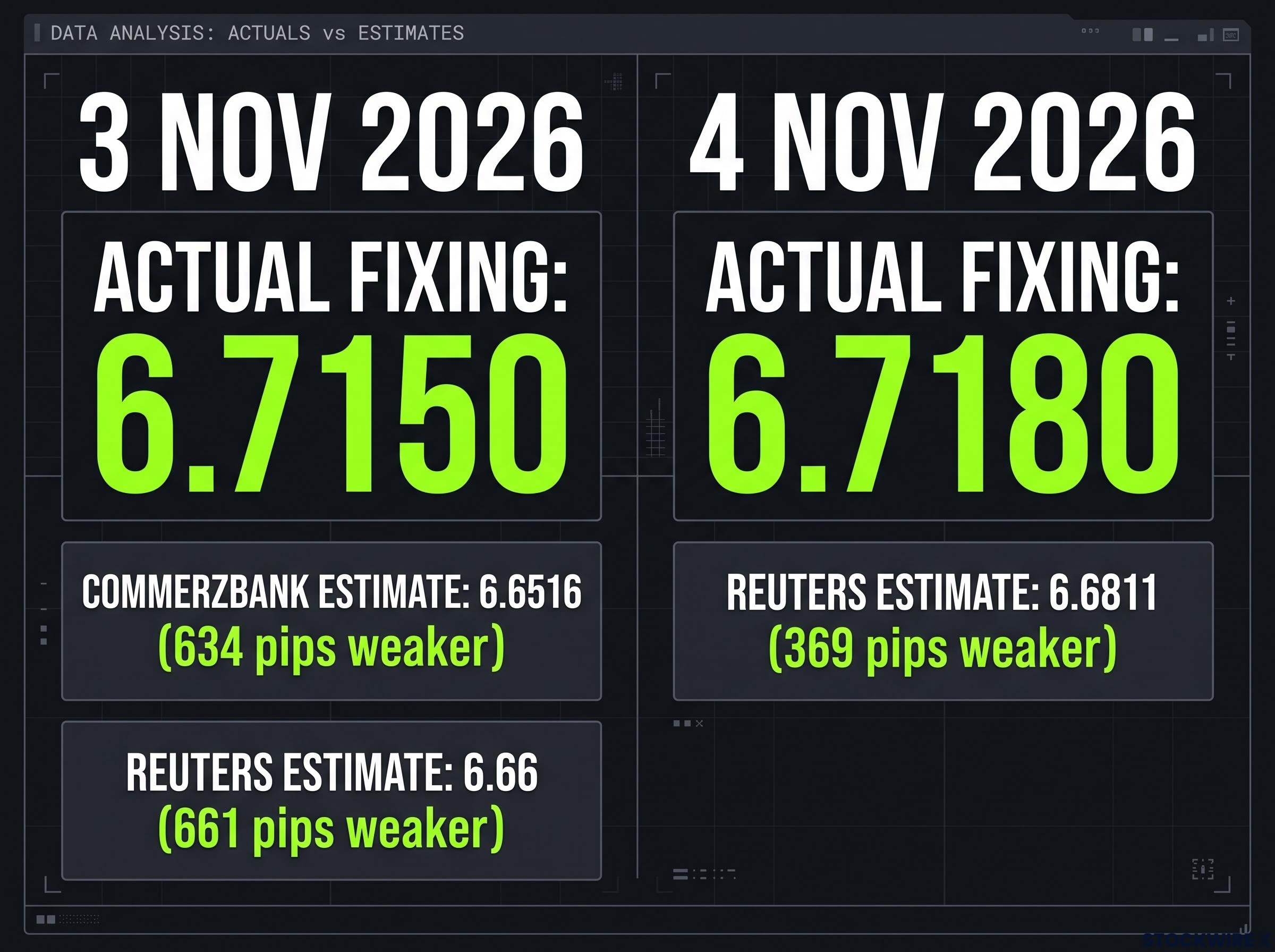
Commerzbank had estimated the fixing at 6.6516. The actual 6.7150 print was 634 pips weaker, the widest gap since 10 September. A pip is the smallest standard price increment in a currency pair.
Against a Reuters model estimate of about 6.66, the gap was 661 pips. The two figures differ only because each source uses its own model. On 4 November, the 6.7180 fixing came in 369 pips weaker than a Reuters estimate of 6.6811.
A weak fixing on the same day as the reserve hike tells you the central bank was pulling more than one lever. If you look at the reserve ratio alone, you will underestimate how seriously Beijing is treating the speed of this rally.
When big ASX news breaks, our subscribers know first
How does the FX reserve requirement drain dollar liquidity?
The ratio sets how much of the foreign-currency deposits that banks hold must be lodged with the PBoC rather than lent or traded. Raising it from 4% to 6% locks away a larger slice of those dollars.
The transmission runs in five steps:
- Banks have fewer foreign-currency funds they can freely deploy.
- The onshore supply of dollars for lending, settlement and market-making falls.
- Dollar liquidity tightens.
- Dollar selling and yuan buying lose force.
- Appreciation pressure moderates, and USD/CNY and USD/CNH may rebound.
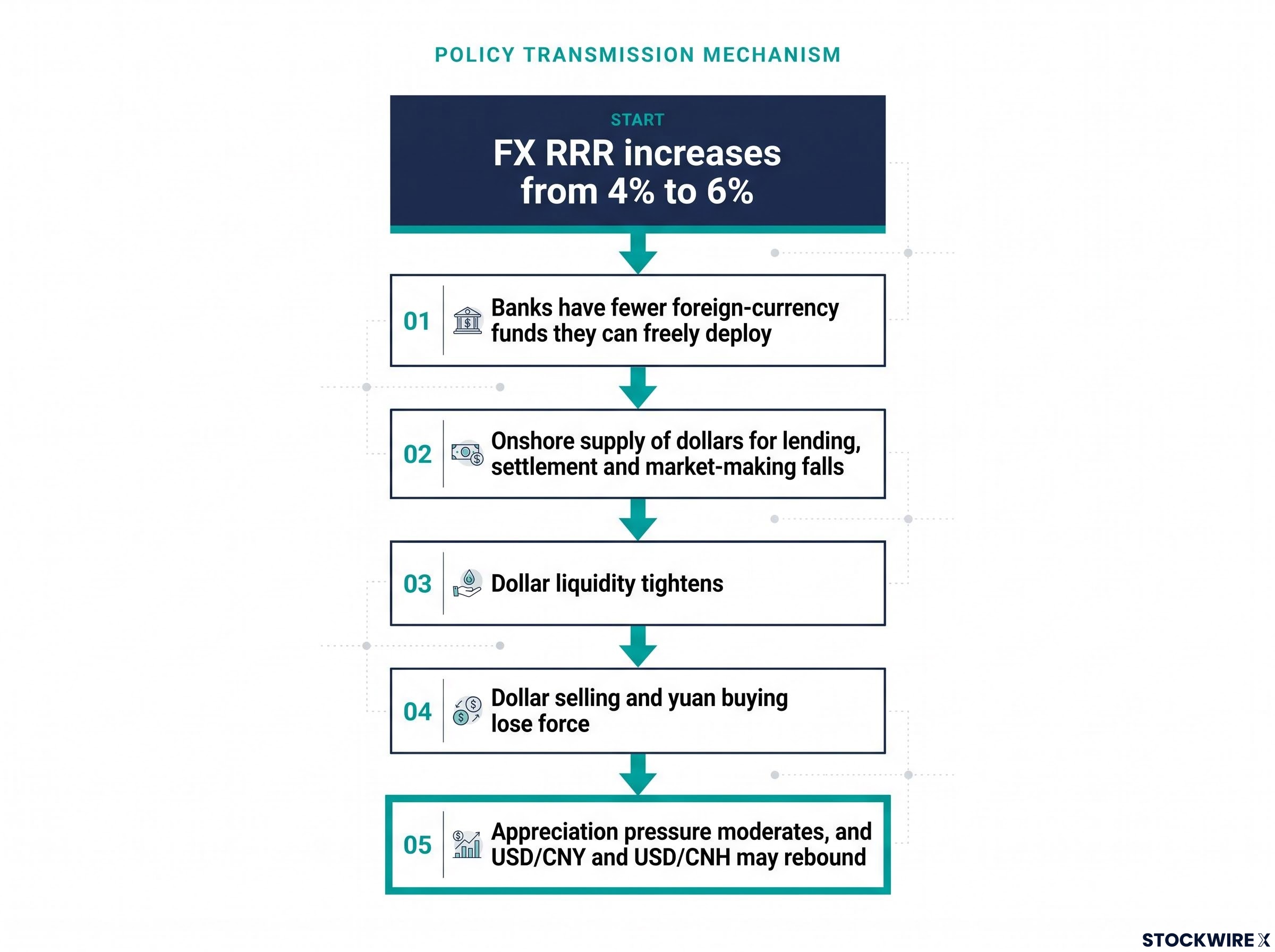
Not a single yuan has to be sold for this to work. The tool controls speed. It is not a direct intervention, a new capital control or a new exchange-rate band.
Wen Bin, chief economist at China Minsheng Bank, said the move should improve the balance of FX supply and demand and curb self-reinforcing appreciation expectations. Societe Generale noted the PBoC also injected about RMB100 billion through a one-year swap, and described the hike as an attempt to curb one-way appreciation.
Why a liquidity rule slows expectations as well as flows
The policy is counter-cyclical, meaning it leans against the prevailing trend. With global investors joining exporters in buying yuan, Beijing wants to keep the currency able to move both ways.
History offers a caution. In 2021 the daily fixing, official guidance and state-bank activity all worked alongside the ratio, and no clean estimate exists of what the reserve requirement achieved on its own.
Because the tool shifts liquidity rather than setting a price, you should expect it to dampen momentum and expectations. On its own, it is unlikely to decide where the yuan settles over the coming months.
How does this compare with the 2021 playbook?
The dates tell a story of a central bank that uses this lever in both directions.
| Date | Change | Result |
|---|---|---|
| 15 June 2021 | Increase of 2 pp | 5% to 7% |
| 15 December 2021 | Increase of 2 pp | 7% to 9% |
| 2022 (dates not confirmed) | Cuts | Reduced during the yuan’s weakening cycle |
| 15 September 2023 | Cut of 2 pp | 6% to 4% |
| 15 November 2026 | Increase of 2 pp | 4% to 6% |
The ratio was cut three times across 2022 and 2023 to reach 4%, but only the September 2023 cut is confirmed in both date and size.
In 2021, the PBoC hiked twice to reach 9%. Today’s single step ends at 6%, well short of that peak.
The structural pressure has not gone away. The South China Morning Post reported a goods trade surplus of about US$938.1 billion for January to September 2026, up from US$726.2 billion a year earlier. Goldman Sachs maintains a 12-month USD/CNY forecast of 6.40, which implies further yuan gains, and cites the surplus and strong exporter conversion.
The September export surge, driven by AI-linked semiconductor shipments and autos, helps explain why exporter dollar conversion remains a durable source of yuan demand.
The smaller scale and single step mean you should treat this as a warning shot with room to escalate. It is not evidence that Beijing wants the yuan to fall.
What should traders watch after 15 November?
The institutional read is close to unanimous. Commerzbank’s Charlie Lay and Dr Henry Hao said the aim is to slow appreciation, not reverse it, with the trade surplus keeping the underlying trend supported. UOB’s Ho Woei Chen and Peter Chia expect modest yuan weakening. Goldman still expects appreciation over the next year.
The central bank’s no-devaluation pledge of 8 October fits the same reading, since a fix set weaker than spot suggests Beijing is moderating strength rather than defending against weakness.
The shared message Slow the rally, do not reverse it.
Zhennan Li of Asia Macro Pulse said further measures could follow if the yuan appreciates too quickly. Commentators have flagged other macro-prudential and signalling steps as options. These indicators show which way things are moving:
- Daily fixing deviations: continued weak prints against models signal ongoing resistance.
- State-bank dollar purchases: direct absorption of dollar supply would point to escalation.
- FX RRR beyond 6%: a second hike would suggest the first step fell short.
- Countercyclical factor and fixing parameters: adjustments would mark a firmer stance on the daily rate.
- Swap and forward measures: more operations like the RMB100 billion swap would add pressure.
- Exporter settlement data: rising conversion would show yuan demand is persisting.
- USD/CNY versus USD/CNH divergence: a wide gap would show offshore traders reacting more aggressively.
- Official language on one-way moves: sharper wording usually precedes action.
Timing matters too. The SCMP noted exporters tend to convert more dollar receipts into yuan toward year-end and ahead of Lunar New Year.
If the fixing keeps printing weak and offshore diverges from onshore, you are likely watching a central bank still resisting. If the fixing normalises while exporter conversion picks up, the rally could resume.
What the hike changes, and what the surplus still decides
The PBoC has made its tolerance clear. It will accept a stronger yuan, but not a fast, one-sided climb.
What it has not changed is the surplus and the seasonal conversion that keep demand for the currency strong. Those forces still set the medium-term direction.
The first tests arrive quickly: the 15 November effective date and the fixings either side of it. If you trade CNY or carry yuan exposure on a balance sheet, the question now is whether to plan for a slower climb or a pause. The fixing gap is the clearest early answer.
Analyst forecasts cited here are speculative and subject to change based on market developments and policy decisions.
This article is for informational purposes only and should not be considered financial advice. Investors should conduct their own research and consult with financial professionals before making investment decisions.