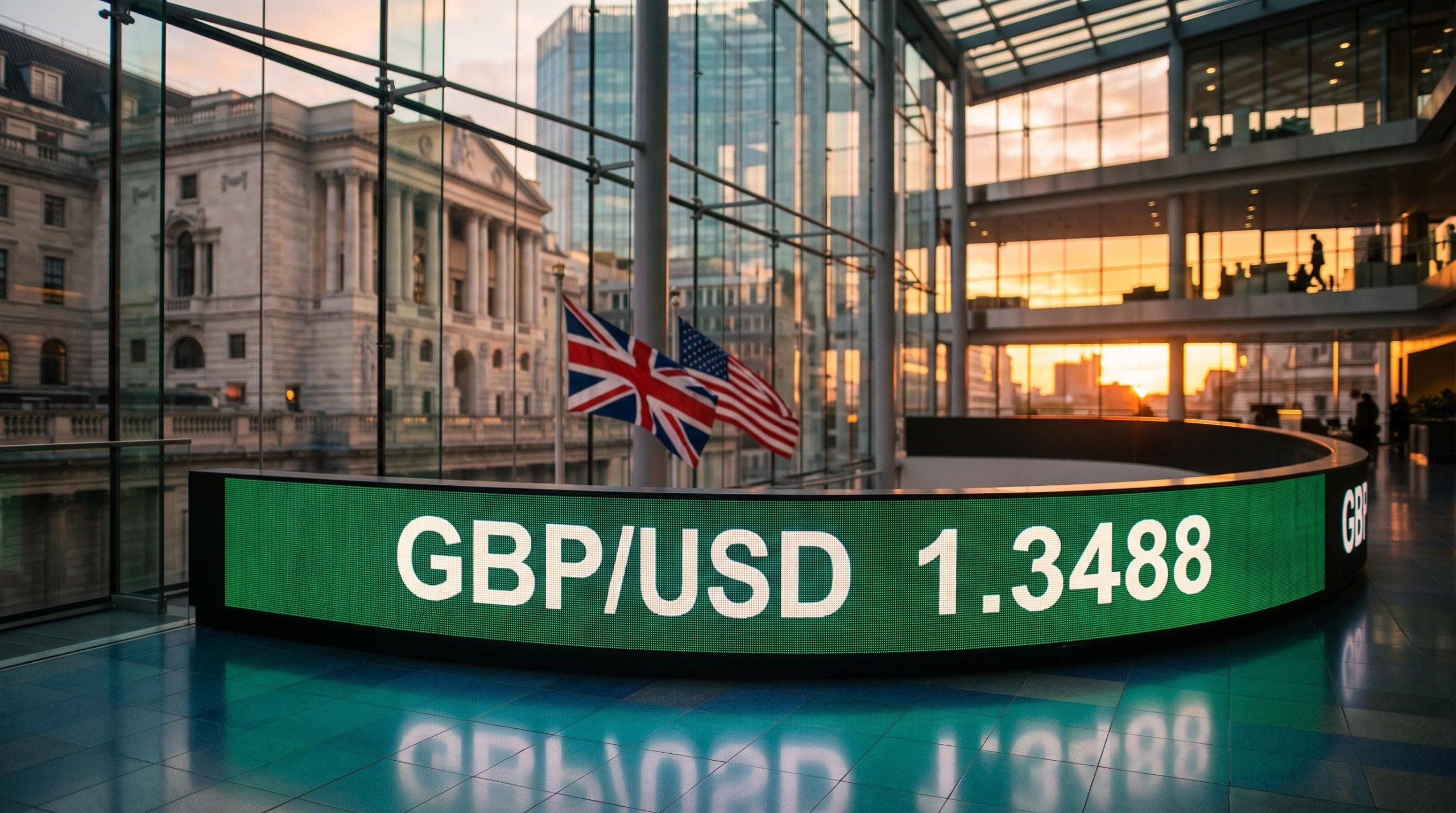
Scotiabank’s FX strategists see GBP/USD climbing to the upper 1.36 area in the coming weeks, according to a note relayed by the FXStreet Insights Team on 4 November 2026. Their forecast arrives with the pair near 1.3488, its strongest level since August. The Bank of England decision on 5 November will test whether a fully priced hike pushes sterling higher or sets up a sell-the-fact reversal.
A 25bp rise in Bank Rate from 3.75% to 4.00% is almost fully priced, so attention has moved to the vote split and the guidance. Meanwhile, a softer US dollar after the US midterm elections is lifting the pound on its own.
Here are the levels, the rate-pricing logic and the decision-day signals that separate a continuation from a reversal.
Why Scotiabank sees a pound rebound reaching the upper 1.36 area
Scotiabank’s target comes with conditions. GBP/USD needs to hold above its 200-day moving average at 1.3425, the average closing price over the past 200 trading days. Preferably, it also needs to close above 1.3470, the 61.8% retracement of the August-October decline.
The pair was up about 0.4% intraday. Scotiabank calls the recovery from the mid-October low a major weekly reversal, and that chart signal is the first leg of its case.
The second leg comes from Washington. After Democrats won both congressional chambers, the dollar index (DXY), which measures the dollar against a basket of major currencies, fell about 0.6% to 101.27. Reports linked the drop to reduced scope for tax cuts and government spending, alongside concerns about growth and regulation. Markets trimmed pricing for 2027 Fed hikes, although a December hike remains roughly 75-80% priced. Scotiabank also sees downside risk for the dollar and judges it overvalued against its fair-value estimate.
The pound is only keeping pace with the euro, which traded near 1.1235. That tells you much of this move reflects dollar weakness rather than pound strength. A rebound in US data could matter as much to your read on GBP/USD as anything the BoE says.
| Level | Value | Why it matters |
|---|---|---|
| Scotiabank target | Upper 1.36 area | Upside objective if conditions hold |
| 61.8% retracement | 1.3470 | A close above strengthens the case |
| 200-day moving average | 1.3425 | Must hold for the call to stand |
| Initial support | 1.3400-1.3419 | First floor below the average |
| Lower support | 1.3336 | Exposed if initial support breaks |
How weekly reversals and Fibonacci levels inform a currency forecast
A weekly reversal is a failed decline followed by a strong weekly recovery. It can signal that sellers have lost control.
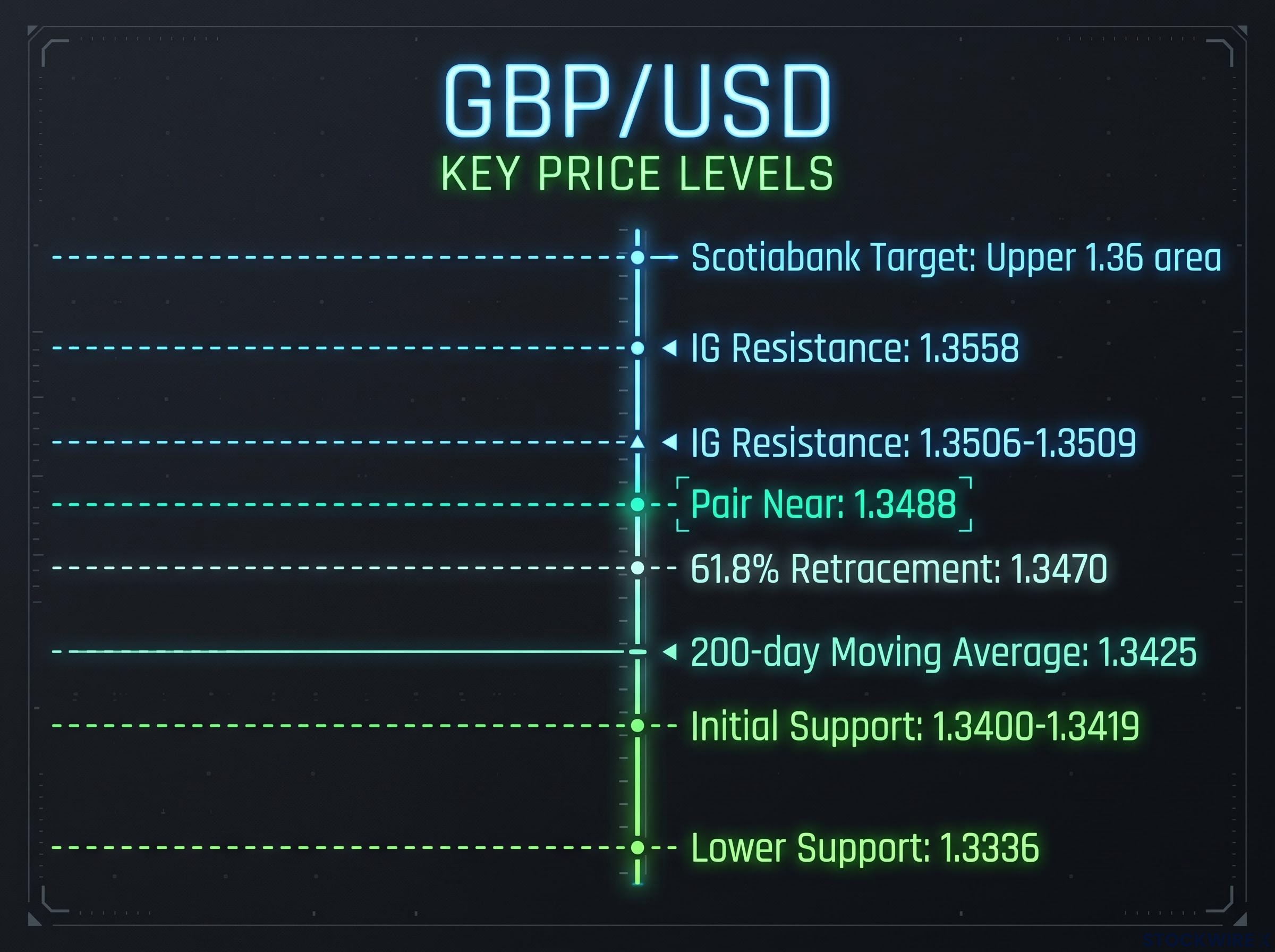
The 61.8% retracement matters because many traders watch it, so orders tend to cluster there. It predicts nothing by itself. Closes above both levels improve the case without guaranteeing 1.36, and IG flags resistance near 1.3506-1.3509 and 1.3558 along the way.
Moving average configuration matters because the 200-day sits inside a wider cluster of averages, and a reading of that cluster, alongside RSI and layered resistance, tends to be more reliable than any single level.
What does a priced-in hike mean for sterling on decision day?
A hike everyone expects can leave the pound flat or lower.
Swaps and overnight index swaps (OIS) convert expected policy into market-implied interest rates. Sterling responds to the UK rate path relative to the US path, not to one decision. Economists unanimously expect 25bp, and a Reuters poll on 2 November pointed to a 7-2 vote. Another poll summary showed nearly 60% expecting 7-2 and 24% expecting 6-3.
MPC vote splits carry information beyond the headline decision, since each dissenter signals how close the committee is to changing course and how markets may reprice the next meeting.
The surprise relative to pricing is what matters.
Estimates of the further tightening priced in vary by source:
- Scotiabank: about 75bp over roughly a year
- Reuters-related reports: three further hikes in 2027
- Other coverage: roughly 100bp over 12 months
These gaps likely reflect different measurement windows and timing. Recent history shows how they can bite. The September 2026 hold on a 6-3 vote knocked sterling down about half a cent. In July 2026, year-end tightening pricing fell from 38bp to 29bp and the pound slipped to about 1.337. On 30 October, sterling rose to 1.3429 as the hike became priced.
The backdrop supports a hike: September CPI was 3.5%, unemployment 4.7% and the October composite PMI 52.9.
| Outcome | Likely read | Typical GBP reaction |
|---|---|---|
| 7-2 vote, hawkish-leaning | Rate path broadly validated | Supportive |
| 6-3 vote | Less committed board | Sell-the-fact risk |
| Guidance against further hikes | Priced path challenged | Downside pressure |
These are scenarios, not predictions. Treat the vote split and guidance as your signal, because they show whether the 75-100bp path is being validated.
What would confirm or derail the call after the BoE decision?
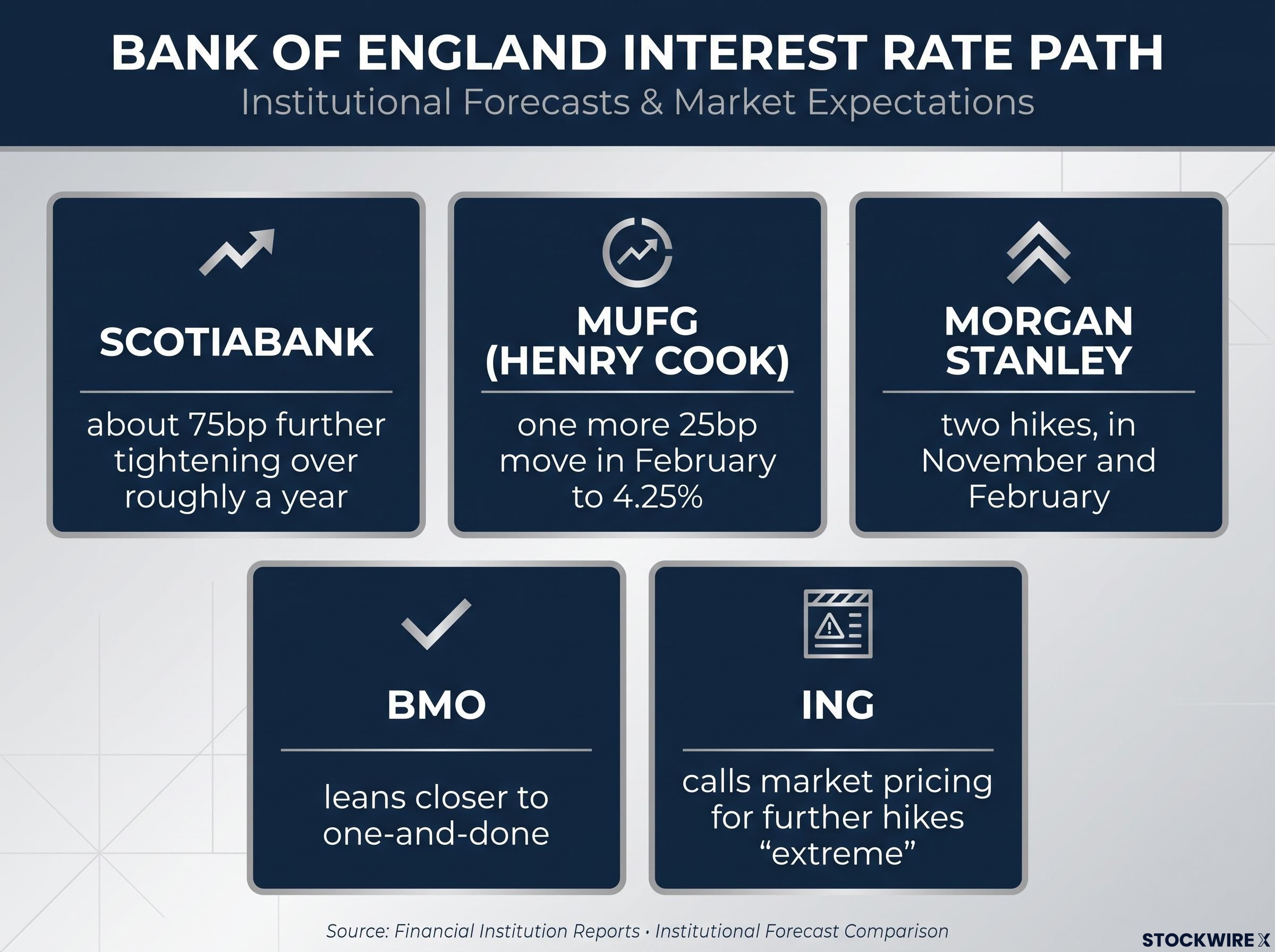
The debate is less about tomorrow’s hike than about whether it starts a sustained cycle. MUFG’s Henry Cook expects one more 25bp move in February to 4.25%. ING calls market pricing for further hikes “extreme”, and BMO leans closer to one-and-done. Morgan Stanley sees two hikes, in November and February.
BBVA’s Roberto Cobo expects the hike could offer near-term support through the rate differential. AIB is more conservative, citing a 1.33-1.34 range with the pair around 1.3384.
On the chart, a sustained fall below 1.3425 weakens the setup, and a break of 1.3400-1.3419 exposes 1.3336. A dollar rebound on payrolls, inflation or yields, crowded sterling positioning and UK growth concerns are further risks. The Services PMI was revised to 52.8 from a flash 53.1 with limited market effect, and it remained below its long-run average.
A bank forecast is only as useful as its invalidation level, the price at which the call is abandoned, and Scotiabank’s 1.3425 average works as that test for its upper 1.36 view.
Every figure here is an expectation, because the outcome is still pending. The upper 1.36 target needs both a supportive BoE and a soft dollar, so a miss on either weakens the case.
- Vote split: 7-2 versus 6-3.
- Guidance: signals on further hikes.
- Daily close: where the pair settles relative to 1.3425 and 1.3470.
- US dollar: any Fed repricing.
What the decision-day signals settle, and what stays open for GBP/USD
The hike is the expected part. The vote, the guidance and the dollar will decide whether the upper 1.36 area is realistic.
Your chart test is whether the pair holds 1.3425 and closes above 1.3470. Your fundamental test is whether the BoE leaves the swaps-implied path of roughly 75-100bp intact. Once the 5 November decision lands, check the vote count and the guidance first, then the daily close and the dollar index.
This article is for informational purposes only and should not be considered financial advice. Investors should conduct their own research and consult with financial professionals before making investment decisions.