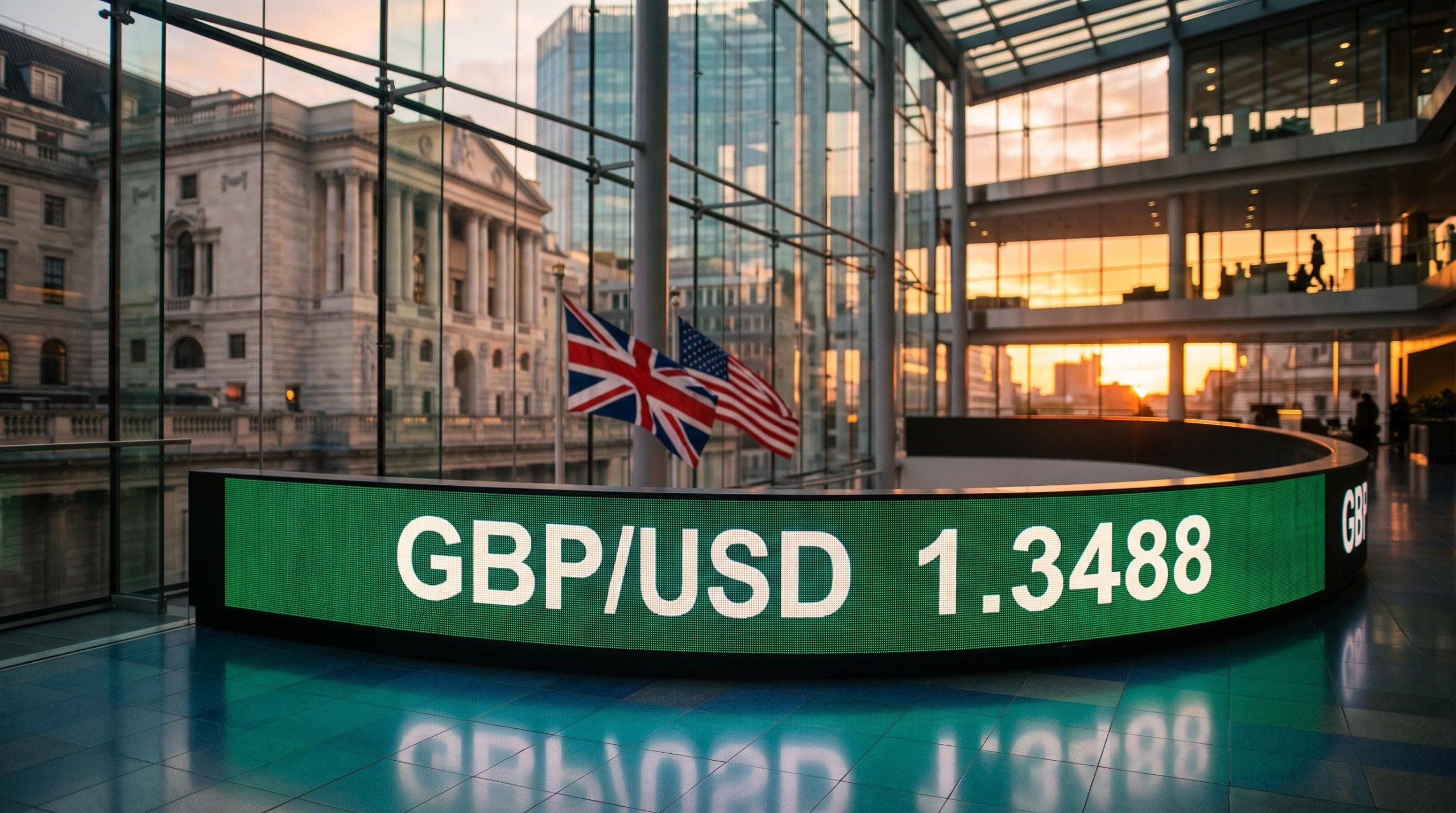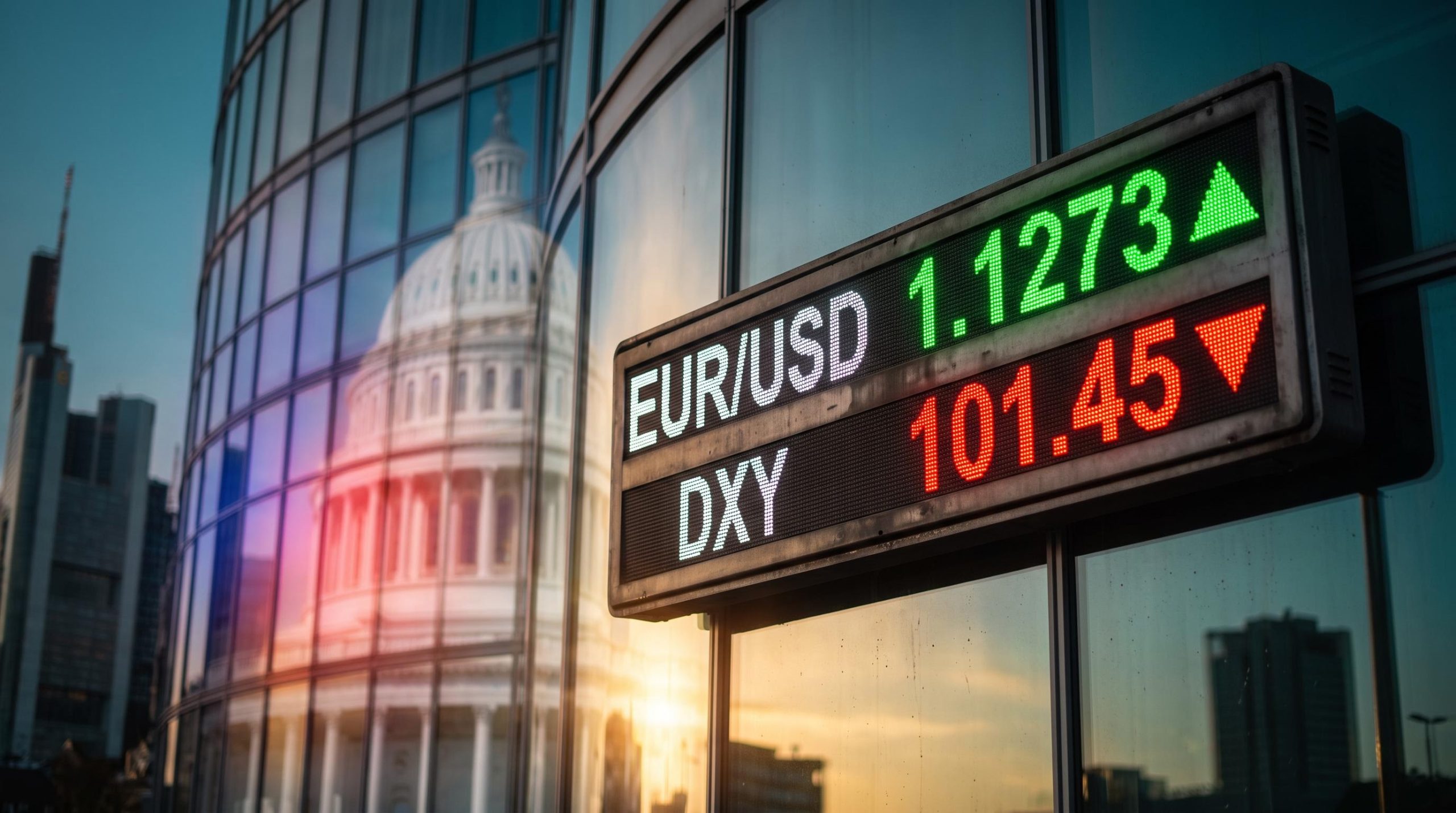
The euro pushed to an intraday high of 1.1273 against the dollar on 4 November 2026, and the US Dollar Index (DXY) sank to a one-month low near 101.45. The trigger was the Democrats’ win of both the House and the Senate in the 3 November midterms, a result that immediately reshaped the short-term EUR/USD forecast.
Three forces hit at once. Traders priced in legislative gridlock and less fiscal stimulus, crude oil swung sharply on speculation about Iran war funding, and the Federal Reserve and European Central Bank (ECB) remain on diverging paths. Reported oil figures conflict across sources, which matters for how much weight that channel deserves.
The same drivers decide whether the euro holds its gains or gives them back. Here is how to separate the political noise from the forces that tend to set the pair’s direction over weeks rather than hours.
Why a Democratic Congress is hitting the dollar, and why analysts expect it to fade
The selling came fast. EUR/USD traded near 1.1235, up about 0.35%, after its intraday peak, while the DXY touched 101.21 before settling around 101.45, down roughly 0.40%. Reuters put the index at 101.51, down 0.2%, its weakest level since 30 September.
The damage was uneven across currencies:
| Dollar versus | Daily change |
|---|---|
| Australian dollar | -0.70% |
| Swiss franc | -0.50% |
| British pound | -0.45% |
| Euro | -0.40% |
| Canadian dollar | -0.33% |
| New Zealand dollar | -0.31% |
| Japanese yen | -0.25% |
Two separate fears drove the move. Less fiscal stimulus lowers expected US growth and yields, which MUFG and Schroders both flagged as dollar-negative. Fiscal risk is different: shutdown and debt-ceiling fights raise the extra return investors demand for holding US assets, which can weaken the dollar even when yields rise.
Yet as the strategist views stacked up, the read shifted from breakdown to brief repricing. An FXStreet review found most analysts expected a modest, short-lived reaction, partly because divided government was already priced in.
ING’s view: The election effect is briefly negative, with the Fed outlook the more important medium-term driver for the dollar.
What history does and does not tell us
Pepperstone notes the 14 divided-government midterms since 1950 were followed by average 12-month stock returns of 15.1%. That is an equity record, not a currency one, and no reliable estimate exists for the average dollar move after past midterms. For you, the election headline looks more like a short-term trigger than a trend-setter, so weigh it below Fed and ECB expectations.
Beyond the election headline, the euro’s value over longer horizons rests on ECB policy, inflation and trade flows, which is why strategists weigh them above short-lived political shocks when judging whether a rally has staying power.
When big ASX news breaks, our subscribers know first
Does a 9% oil drop help or hurt the euro?
The intuitive answer is simple: Europe imports most of its energy, so cheaper oil should help the euro. Prices slid as traders bet that Democratic control of Congress could limit money for the American war effort in Iran, adding momentum toward ending the fighting.
The mechanism is messier than it looks:
- Import bill: Higher oil drains income from Europe and weakens household purchasing power; lower oil reverses that.
- Growth: Expensive energy squeezes real incomes and lifts production costs.
- Inflation: Oil pushes headline inflation up, which can spill into wages and services.
- ECB reaction: If inflation fears dominate, markets price more ECB hikes and the euro gains; if growth fears dominate, rate expectations fall and the euro weakens.
- Net short-term effect: The pair moves with whichever channel wins.
The ECB has said the euro was weakened by an adverse terms-of-trade shock from the Middle East war. Terms of trade measure the price of what a country exports relative to what it imports. The bank’s adverse scenario assumed oil peaking around $119 per barrel.
The ECB monetary policy statement from the 29 October meeting warned that rising energy prices pose upside risks to inflation and downside risks to growth, the same trade-off that leaves the euro’s reaction to oil moves so hard to call.
At Commerzbank, the debate is live. Volkmar Baur argues an end to the conflict and a reopened Strait of Hormuz could support the euro through real interest rate dynamics. His colleague Michael Pfister sees a two-stage effect.
Lower oil may first restrain the euro by trimming expectations of ECB hikes, then support it later through stronger PMIs and real activity, according to Pfister.
Where the sources disagree on the oil price
TMGM and FXStreet reported West Texas Intermediate (WTI) crude near $87, down about 9%. Reuters’ French market roundup showed WTI at $96.60 and Brent at $104.21, both slightly higher. The accounts have not been reconciled. Oil is not a one-way signal for the euro, so check whether markets are trading growth relief or lower ECB hike odds before reading a move as bullish.
Can the ECB out-hawk the Fed on a 4.0% inflation print?
The US side came armed with data. ADP private payrolls rose 86,000 in October against a 69,000 consensus. In the ISM Services survey, where anything over 50 points to expansion, the reading fell to 54.5 from 54.9, narrowly missing the 54.8 forecast yet remaining well within growth territory.
That resilience keeps December hike odds high: 82% per FXStreet, 79% per Trading Economics and about 80% on the CME FedWatch Tool.
Europe answered with inflation. Eurostat’s October flash put headline inflation at 4.0%, up from 3.8%, with core steady at 2.5%. The ECB held rates on 29 October after two hikes earlier in 2026, and markets reportedly expect another in December.
Economists polled before the 29 October meeting largely held that a December ECB hike was the likelier path, with oil staying elevated as the condition that could confirm or derail it.
| Measure | Federal Reserve | ECB |
|---|---|---|
| Policy rate or pricing | 79%-82% December hike odds | Deposit 2.50%, refinancing 2.65%, lending 2.90% |
| Latest inflation or data | ADP +86,000; ISM Services 54.5 | Headline 4.0%; core 2.5% |
| Tone | Hawkish on resilient data | Hawkish, per Knot |
| Next decision | December | December |
Dutch central bank chief Klaas Knot told Bloomberg the ECB likely needs to stay hawkish as core inflation and second-round effects strengthen.
The ECB should approach 2% “more often from above than from below,” Knot said.
The two banks pull the pair in opposite directions, so direction depends on whose expectations move first. For you, the euro’s rally has genuine support in ECB hawkishness, but US data strength matches it. Neither side holds a clear lead yet.
What would make this EUR/USD move last? The catalysts on the calendar
The explanation phase ends this week. The tests arrive in order:
- Thursday: Weekly US jobless claims.
- Friday: October nonfarm payrolls. Reuters’ consensus is +65,000 and CNBC’s +59,000, after +29,000 in September, with unemployment expected at 4.2%.
- December: Fed and ECB rate decisions.
- Ongoing: Iran and oil, plus US shutdown or debt-ceiling risk.
A strong payrolls print would reinforce the case for a restrictive Fed, lifting yields and the dollar. A miss could unwind hawkish Fed pricing and extend the euro’s gains. Friday is the first real test of whether the post-election move survives.
The risks to a durable euro rally are specific:
- Resilient US payrolls and services data
- A Fed hike delivered or priced more aggressively
- An oil rebound that hurts Eurozone growth more than it lifts ECB expectations
- An ECB tightening into an energy-driven growth shock
The analysts’ conclusion is that the initial euro gains look more likely to fade than to start a straight-line trend. Current evidence does not establish a durable uptrend. These views are speculative and subject to change as data and events develop.
Reading the euro’s next move without chasing the headline
The election gave the dollar a brief push lower. The trend from here belongs to Fed and ECB expectations, oil and the incoming US data, and the strategists cited above broadly expect the political effect to fade.
Use a simple order of checks. Start with Friday’s payrolls, then watch whether oil’s swings read as growth relief or lower ECB hike odds, then listen for ECB commentary ahead of December. If US data soften while European inflation keeps the ECB hawkish, the euro’s case strengthens; if not, this week’s gains may prove temporary.
For readers wanting the wider framework, our full explainer on euro valuation fundamentals covers the ECB’s symmetric 2% mandate and how BTP-Bund spreads signal fragmentation risk.
This article is for informational purposes only and should not be considered financial advice. Investors should conduct their own research and consult with financial professionals before making investment decisions.