
Why 39% of Americans Are Betting on High-Risk Assets

Key Takeaways
- Nearly 39% of Americans are now investing in or planning to invest in speculative assets, according to Northwestern Mutual's 2025 Planning and Progress Study, reflecting a broad shift in retail investor behavior.
- Financial nihilism, the belief that traditional wealth-building is inaccessible, is a primary psychological driver, with three-quarters of those who feel financially behind viewing speculation as their path to catching up.
- Options trading now accounts for 40-50% of total market volume (up from 35% pre-pandemic), and call options represent more than 60% of total option volume, signaling aggressive speculative positioning across markets.
- Goldman Sachs historical analysis warns that while near-term speculative returns can be substantial, the S&P 500 has historically underperformed over two-to-three year horizons after similar conditions, suggesting current gains may be provisional.
- Investors are advised to size speculative positions as capital they can afford to lose entirely, establish clear exit criteria in advance, and treat recent gains as provisional rather than permanent to protect long-term financial security.
Nearly 4 in 10 Americans are now investing in or planning to invest in high-risk speculative assets, according to Northwestern Mutual’s 2025 Planning & Progress Study. This isn’t irrational exuberance. It reflects a calculated bet by people who feel traditional paths to wealth have failed them. Three-quarters of those who feel financially behind view speculation as their path forward.
This analysis examines what’s driving the speculative surge, the platforms enabling it, the market conditions rewarding risk-taking, and what historical data suggests about sustainability.
What Counts as Speculative Investing—And Who’s Doing It
Speculative investments refer to high-risk, high-potential-reward assets that don’t fit traditional investment frameworks. These differ fundamentally from conventional stock and bond portfolios. The category spans a spectrum from cryptocurrency to prediction markets to meme stocks.
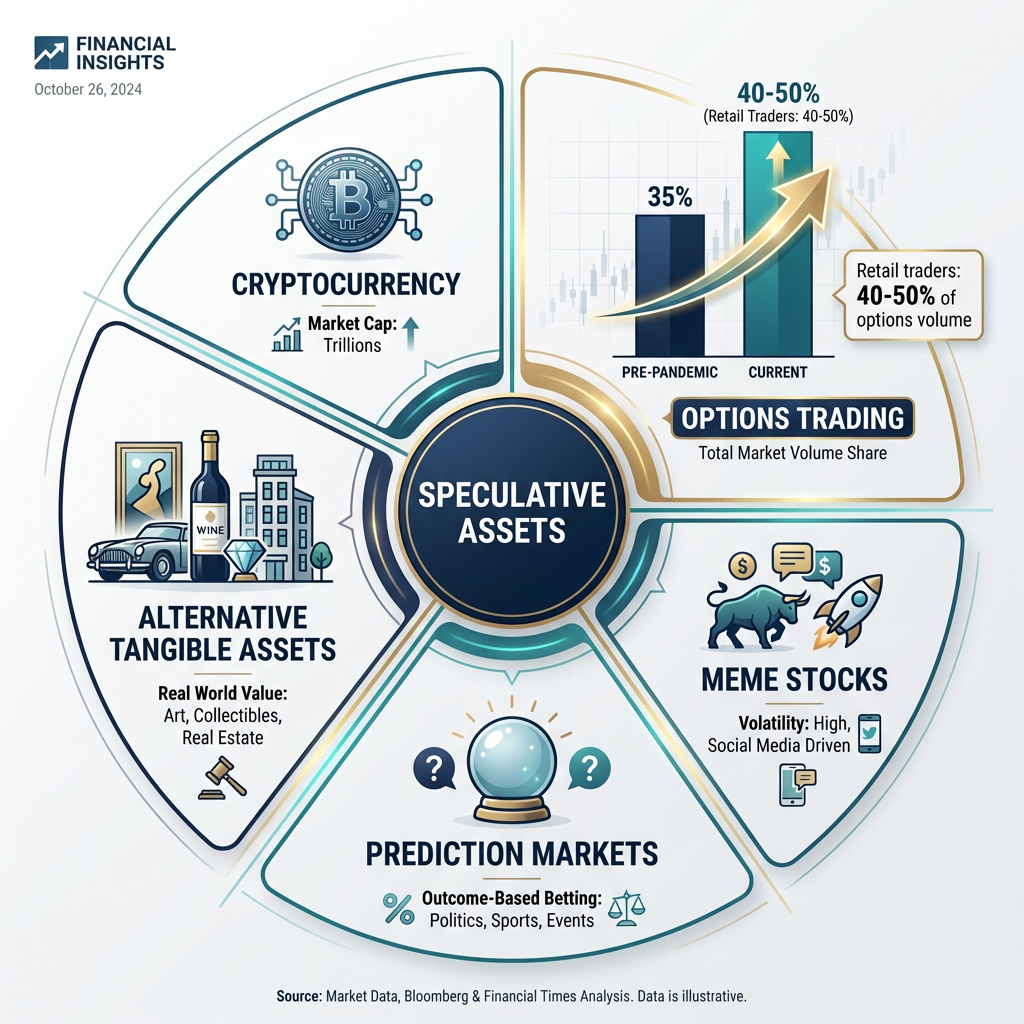
Americans are pursuing several main categories of speculative assets:
- Cryptocurrency: Digital assets like Bitcoin and altcoins
- Options trading: Derivatives contracts that amplify gains and losses, now representing 40-50% of total market volume (up from 35% pre-pandemic)
- Meme stocks: Retail-driven equities with volatile price movements disconnected from fundamentals
- Prediction markets: Platforms allowing speculation on event outcomes, showing particular appeal among younger investors
- Alternative tangible assets: Gold, luxury watches, and collectible cards as speculative vehicles
Demographic patterns show clear generational divides. Retail traders now account for 40-50% of options trading volume, a substantial increase from pre-pandemic levels.
When big ASX news breaks, our subscribers know first
Financial Nihilism: The Psychology Behind the Risk-Taking
Financial nihilism, as identified by Northwestern Mutual research, represents a specific economic psychology. The core premise is straightforward: when traditional investment approaches feel insufficient for achieving financial goals, high-risk strategies become appealing despite their dangers. This isn’t recklessness. It’s a rational-seeming response to perceived systemic barriers.
Nearly three-quarters of Americans who feel financially behind see speculation as their pathway to catching up financially.
Housing inaccessibility functions as a concrete driver of this behavior. Bloomberg data shows renters with net worth under $300,000 hold cryptocurrency at higher rates than homeowners with equivalent wealth. Speculation may be functioning as a substitute for homeownership wealth-building when traditional property ownership feels blocked.
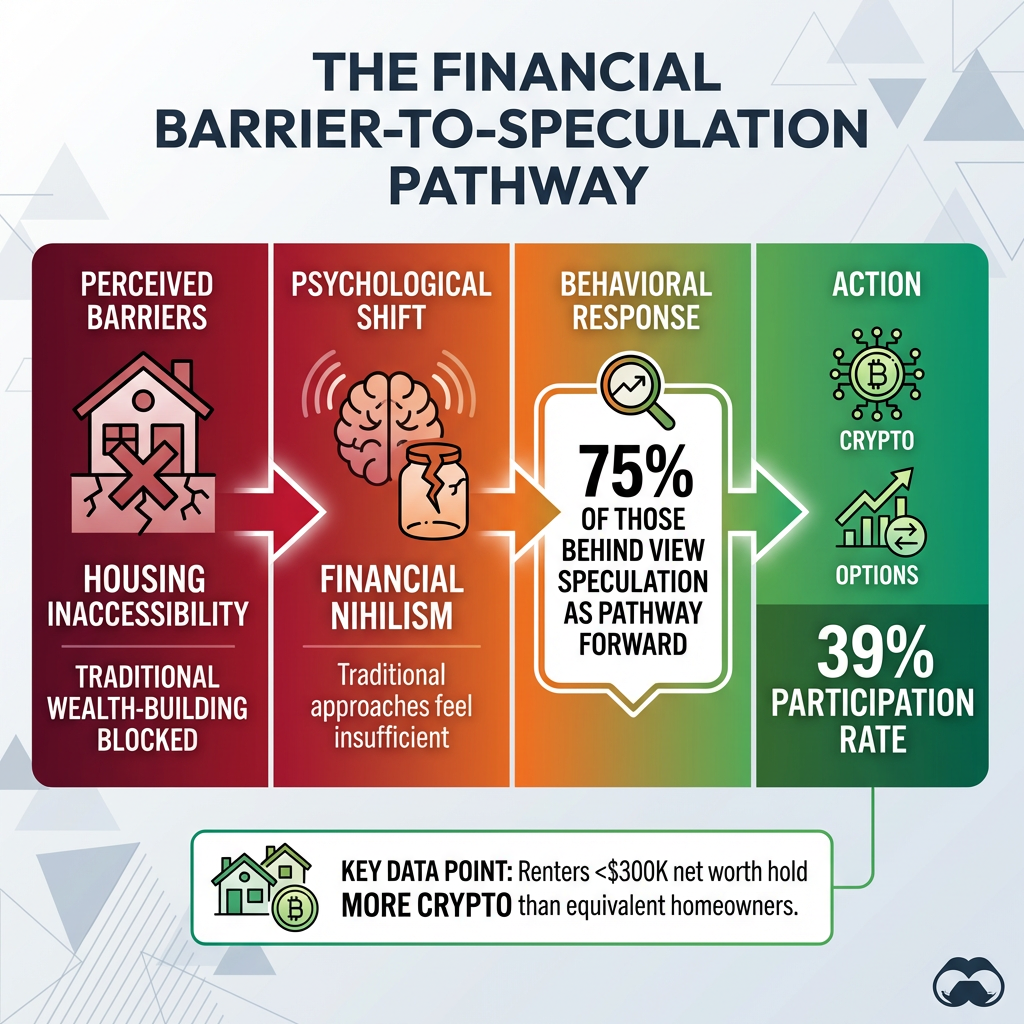
This behavioral pattern carries specific economic logic from the participant’s perspective. When the expected value of traditional approaches feels low, higher-variance strategies become subjectively attractive. The statistical risk remains, but the subjective calculation shifts. Financial nihilism explains why 39% participation makes sense to those involved, even when historical data counsels caution.
How Platforms and Technology Enabled the Speculative Surge
Trading platforms like Robinhood, Coinbase, and Kalshi removed friction from speculative investing. Commission-free trading, intuitive interfaces, and fractional shares made participation accessible to everyday investors. Barriers that once kept retail investors out of high-risk markets disappeared.
Social platforms created information networks and coordination mechanisms for retail investors. Reddit and X (formerly Twitter) enabled collective action at unprecedented scale. The meme stock phenomenon of 2021 demonstrated how platform-enabled coordination could move markets, with retail investors driving explosive price movements in heavily-shorted equities.
This represents the convergence point where psychological drivers met technological enablers. Financial nihilism provided the motivation. Platform democratisation provided the access. The confluence of macroeconomic, technological, and behavioral factors created conditions for mass participation in speculative markets.
Market Conditions in 2025-2026: Volatility Creates Opportunity (and Risk)
The April 2025 correction set the scene for subsequent speculative activity. The S&P 500 dropped 15% in three trading days, creating both fear and opportunity. This volatility event demonstrated the fragility of market conditions while simultaneously creating entry points for risk-seeking investors.
The April 2025 correction that triggered this speculative surge also created conditions where traditional strategies for investing during market volatility, including defensive sector rotation and systematic rebalancing, diverged sharply from the high-risk approaches now attracting 39% of Americans.
Summer 2025 meme stock performance produced substantial gains for participants:
| Stock | Gain | Timeframe |
|---|---|---|
| OPEN | +377% | 1-25 July 2025 |
| GPRO | +99% | 1-25 July 2025 |
| DNUT | +52% | 1-25 July 2025 |
These returns attracted additional speculative capital and reinforced the financial nihilism narrative among participants.
For readers wanting to understand the specific mechanics behind one of the 120% single-day meme stock surges referenced in this analysis, our full explainer on the Forum Markets strategic review and buyback announcement walks through the corporate actions that triggered retail coordination, the trading volume patterns that sustained the price movement, and what the event reveals about current speculative market structure.
Options market data reveals the intensity of speculative positioning. Call options now account for more than 60% of total option volume, according to Goldman Sachs. The Goldman Sachs Speculative Trading Indicator has jumped to multi-year highs. This indicates aggressive bullish sentiment and leveraged positioning across retail and institutional participants.
The earnings environment provided fundamental support for risk-taking. Forecasts for S&P 500 earnings per share improved, with upwards of 14% EPS growth projected for 2026. Positive earnings expectations create air cover for speculative activity by suggesting underlying market health justifies elevated valuations and risk appetite.
For investors exploring whether current market valuations can sustain speculative positioning, our detailed coverage of AI investment risks and valuation sustainability examines the $6 trillion capital deployment into artificial intelligence infrastructure and whether earnings growth projections justify the sector’s premium multiples amid institutional skepticism.
The next major ASX story will hit our subscribers first
What History and Experts Say About Speculative Cycles
Goldman Sachs historical analysis presents a cautionary pattern. While fear-of-missing-out driven near-term returns can be substantial, the S&P 500 has underperformed after similar conditions when measured over two to three year horizons. Short-term gains don’t historically translate to sustained returns. This creates a timing challenge for current participants.
The tension between speculative momentum plays and traditional value investing appears most starkly in momentum versus value positioning in tech sectors, where software stocks trading at premium multiples compete with semiconductor equities offering lower valuations but cyclical risk exposure.
Morgan Stanley guidance for the K-shaped economy recommends taking profits in volatile speculative investments, particularly in unprofitable companies and small-cap and micro-cap stocks.
Current conditions offer some nuance to the warning signals. Speculative indicator levels remain below the February 2021 peak, suggesting the market may not be at cycle extremes. This doesn’t invalidate the historical pattern, but it indicates potential room for continuation before inevitable reversal.
The expert perspective synthesises to a clear tension: near-term opportunity exists alongside longer-term risk. Speculation can work until it doesn’t. Timing the transition between profitable momentum and destructive reversal is notoriously difficult. Historical precedent suggests caution even when recent performance suggests continuation.
The Bottom Line for Investors Considering Speculative Assets
The drivers behind speculative investing reflect real economic anxieties. Financial nihilism stems from genuine barriers to traditional wealth-building. Short-term gains in cryptocurrency, meme stocks, and options trading have been real for many participants. Dismissing this as pure irrationality misses the behavioral logic involved.
Investors thinking about speculative positions should consider several practical factors:
- Understand your motivation: Are you catching up financially, seeking entertainment, or making a calculated risk? Your ‘why’ determines appropriate position sizing.
- Size positions appropriately: Speculative assets should represent capital you can afford to lose entirely without compromising long-term financial security.
- Establish exit criteria: Define in advance what price movements or time horizons trigger profit-taking or loss-cutting.
- Recognize historical patterns: 39% participation doesn’t validate the approach. Markets have repeatedly punished speculative excesses after extended runs.
The 39% of Americans participating aren’t wrong to seek opportunity in a challenging economic environment. However, historical patterns and expert guidance suggest treating gains as provisional rather than permanent. Discipline matters most at moments of apparent success, when the temptation to increase exposure conflicts with the wisdom of reducing risk.
This article is for informational purposes only and should not be considered financial advice. Investors should conduct their own research and consult with financial professionals before making investment decisions.
Frequently Asked Questions
What are speculative investments and how do they differ from traditional investing?
Speculative investments are high-risk, high-potential-reward assets such as cryptocurrency, meme stocks, options contracts, and prediction markets that fall outside conventional stock and bond portfolios. Unlike traditional investments, their valuations are often disconnected from underlying fundamentals and can experience extreme price swings in short periods.
What is financial nihilism and why are so many Americans embracing risky investing in 2025?
Financial nihilism is the belief that traditional wealth-building paths are insufficient, making high-risk speculation feel like a rational alternative for catching up financially. According to Northwestern Mutual's 2025 Planning and Progress Study, nearly three-quarters of Americans who feel financially behind view speculative investing as their primary pathway forward.
How much of the US population is currently investing in speculative assets?
Nearly 39% of Americans are currently investing in or planning to invest in speculative assets, according to Northwestern Mutual's 2025 Planning and Progress Study. This broad participation is partly fueled by commission-free trading platforms like Robinhood and Coinbase that removed traditional barriers to entry.
What do historical patterns say about the long-term performance of speculative investments?
Goldman Sachs historical analysis shows that while fear-of-missing-out driven near-term returns can be substantial, the S&P 500 has tended to underperform over two-to-three year horizons after similar speculative conditions. Morgan Stanley guidance also recommends taking profits in volatile speculative positions, particularly in unprofitable and small-cap stocks.
How should investors size their positions in speculative assets to manage risk?
Investors should limit speculative positions to capital they can afford to lose entirely without compromising their long-term financial security. Experts also recommend defining exit criteria in advance, such as specific price targets or time horizons, to trigger profit-taking or loss-cutting before emotions drive decision-making.


