Why Most Golden Parachute Headlines Get the Numbers Wrong
58 mins ago


Most investors assume the CEO is the most powerful person in a public company. That assumption is wrong, and it leads to costly misreadings of the events that actually move share prices.
When you misidentify where authority sits, you misinterpret the signals that matter most. A CEO departure looks like operational chaos instead of a deliberate board decision. An activist campaign looks like corporate drama instead of shareholders exercising their structural rights. A board reshuffle looks like bureaucratic shuffling instead of the governance layer above management reasserting control.
Here is what this piece gives you: a clear map of where authority actually lives inside a public company, from ownership through the board to the CEO, and the practical skill to read governance events as the signals they are. Once you understand the hierarchy, leadership changes stop being surprises and start being data.
If you hold even one share of a public company, you are a partial owner of that business. That is not a figurative description. It is a legal reality that carries real governance rights.
Your ownership, however fractional, grants you three specific rights:
The legal rights attached to share ownership sit inside a broader doctrine: shareholder primacy, the idea that a company’s primary obligation runs to its owners rather than to any other stakeholder group, which is the underlying logic that makes the governance hierarchy above management possible in the first place.
Owning an S&P 500 index fund extends that principle across hundreds of companies at once, giving you indirect fractional stakes in all of them simultaneously. At the far end of the scale, major institutional players such as Vanguard and BlackRock, along with other asset managers and pension funds, hold concentrated influence because the sheer scale of their holdings translates into substantial voting power across those same companies.
But their power flows through the exact same mechanism as yours. When a large institution votes its shares against management at an annual meeting, it is exercising the same legal authority you exercise when you vote your own shares. The difference is scale, not kind. That is why shareholder voting is not a formality. It is the structural foundation on which the entire governance hierarchy rests.
You cannot coordinate governance decisions among millions of individual shareholders on a rolling basis. Someone has to represent owners in the room where strategy and leadership accountability are decided. That practical problem is why boards exist.
Shareholders delegate their governance authority to a smaller elected body, the board of directors, because the alternative (millions of people voting on every strategic question) does not work. The board’s function is categorically distinct from the CEO’s. Rather than directing products, managing sales teams, or overseeing daily operations, the board operates at an altogether higher level of accountability:
The board sets CEO pay, evaluates CEO performance, and holds the authority to hire or fire the chief executive. That last point is the one most investors underestimate. The board’s time horizon is your time horizon: if you are holding a stock for years rather than quarters, the board’s assessment of whether the CEO can deliver the company’s future matters more to your outcome than last quarter’s earnings miss.
Board composition determines whether the people evaluating the CEO actually have incentives aligned with long-term shareholders: directors who hold meaningful personal equity stakes in the business tend to evaluate executive performance differently from those whose income is largely insulated from share price movement.
Directors are elected by shareholders, typically at annual general meetings through a proxy voting process. You receive a ballot, vote for or against the nominated directors, and the results determine the board’s composition for the coming year.
In contested situations, activist shareholders may nominate rival director candidates, putting their own slate forward against management’s preferred nominees. That is what makes an activist campaign a governance event, not simply a financial one. The activists are not just making noise; they are attempting to change who sits at the table where strategy and leadership accountability are decided.
The CEO is the most visible, most scrutinised, highest-stakes operating role in any public company. That visibility is earned. The chief executive is responsible for executing strategy, leading the organisation, making the calls that determine daily performance, and acting as the company’s public face to investors, media, and regulators. No other single person carries as much operational accountability.
But operational authority is not the same as structural authority. The CEO reports to the board, not the other way around. The board retains the power to hire, compensate, evaluate, and remove the CEO regardless of how prominent or successful that person becomes. Think of it this way: the CEO decides how to navigate day-to-day, but the board and shareholders decide where the ship is allowed to go and who gets to be captain.
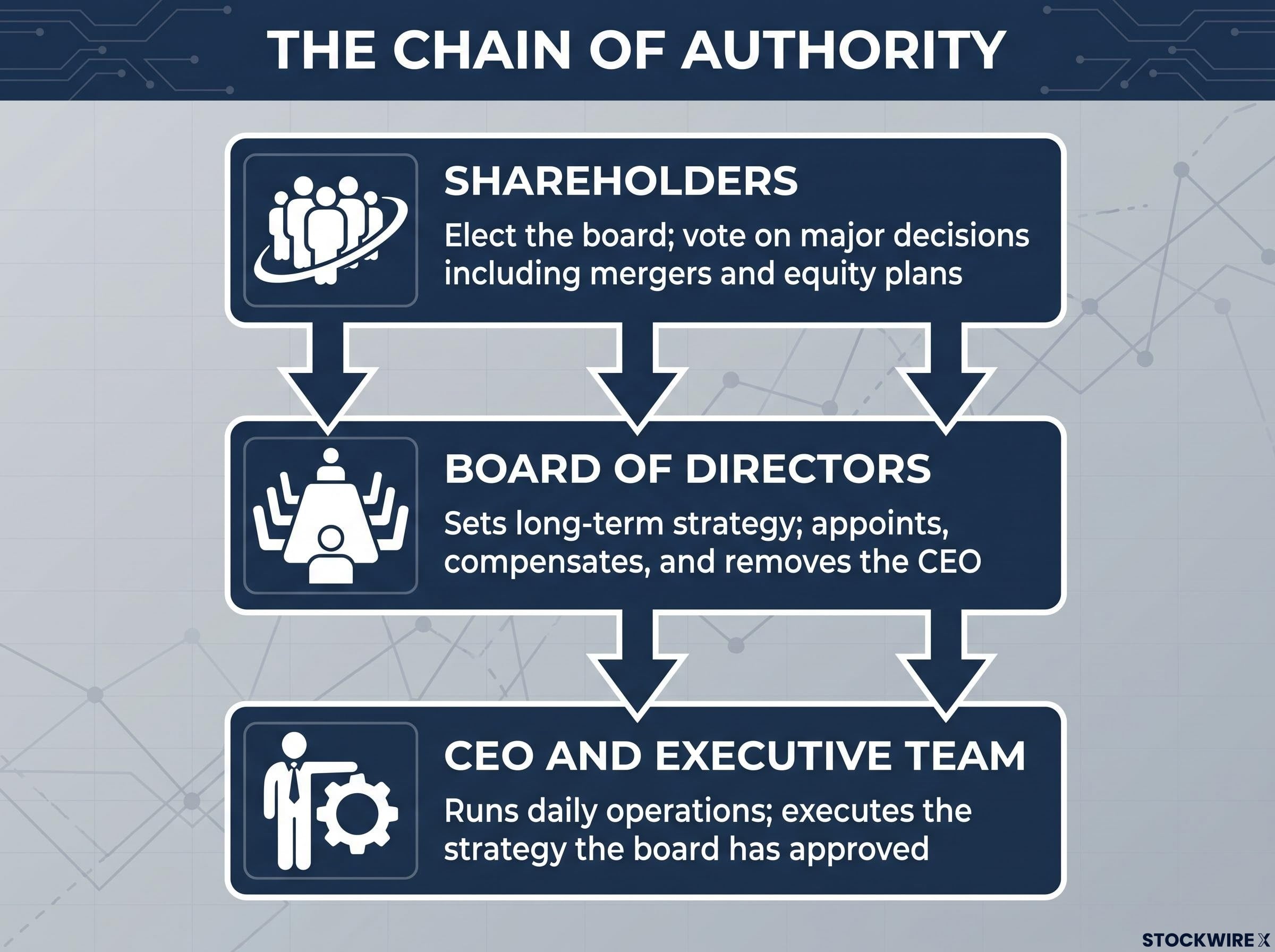
The complete hierarchy runs in one direction:
| Level | Authority and responsibility |
|---|---|
| Shareholders | Elect the board; vote on major decisions including mergers and equity plans |
| Board of directors | Sets long-term strategy; appoints, compensates, and removes the CEO |
| CEO and executive team | Runs daily operations; executes the strategy the board has approved |
When you see a CEO described as “the most powerful person at Company X,” that description is operational, not structural. The board can replace that person at any time, and sometimes does. That is why governance matters as much as individual leadership quality when you are evaluating a long-term holding.
Here is how this plays out in a concrete sequence. Walk through it step by step:
That fourth step is where most investors get caught off guard. Suppose a company’s board determines the CEO is no longer the right person to lead a strategic pivot. The board can exercise its authority to make that change independently of short-term stock performance. A CEO’s visibility on earnings calls, in media interviews, and at investor conferences does not confer governance authority. Visibility is operational. Authority is structural.
What looks like a sudden CEO departure from the outside is almost always the visible conclusion of a private deliberation that has been running internally for some time, with a successor typically identified well before any public announcement is made. Investors who recognise this avoid a common misreading: treating the announcement as the opening chapter when it is, in fact, the final one.
The same governance principles apply whether the company has 5,000 shareholders or 5 million. The chain of authority runs in the same direction every time.
When boards reassess their chief executive, it is rarely because of a single dramatic failure. The more common pattern is a slow-building shift in confidence, with directors moving from asking whether the CEO delivered last year to asking whether this is the right person to make the next hundred consequential decisions for the business.
Boards hold informational advantages that you do not have. While external observers rely on public filings and earnings calls, directors engage with detailed internal forecasts, have regular direct access to the CEO and senior leadership, and witness how decisions are made when the pressure is not yet public. By the time media speculation about a CEO’s future becomes audible, the internal conversation at board level has usually been running for considerably longer.
Harvard Law School research on CEO turnover finds that forced departures carry reputational consequences for the directors involved, reinforcing why boards typically move through a prolonged private deliberation before any public announcement rather than acting on a single quarter’s underperformance.
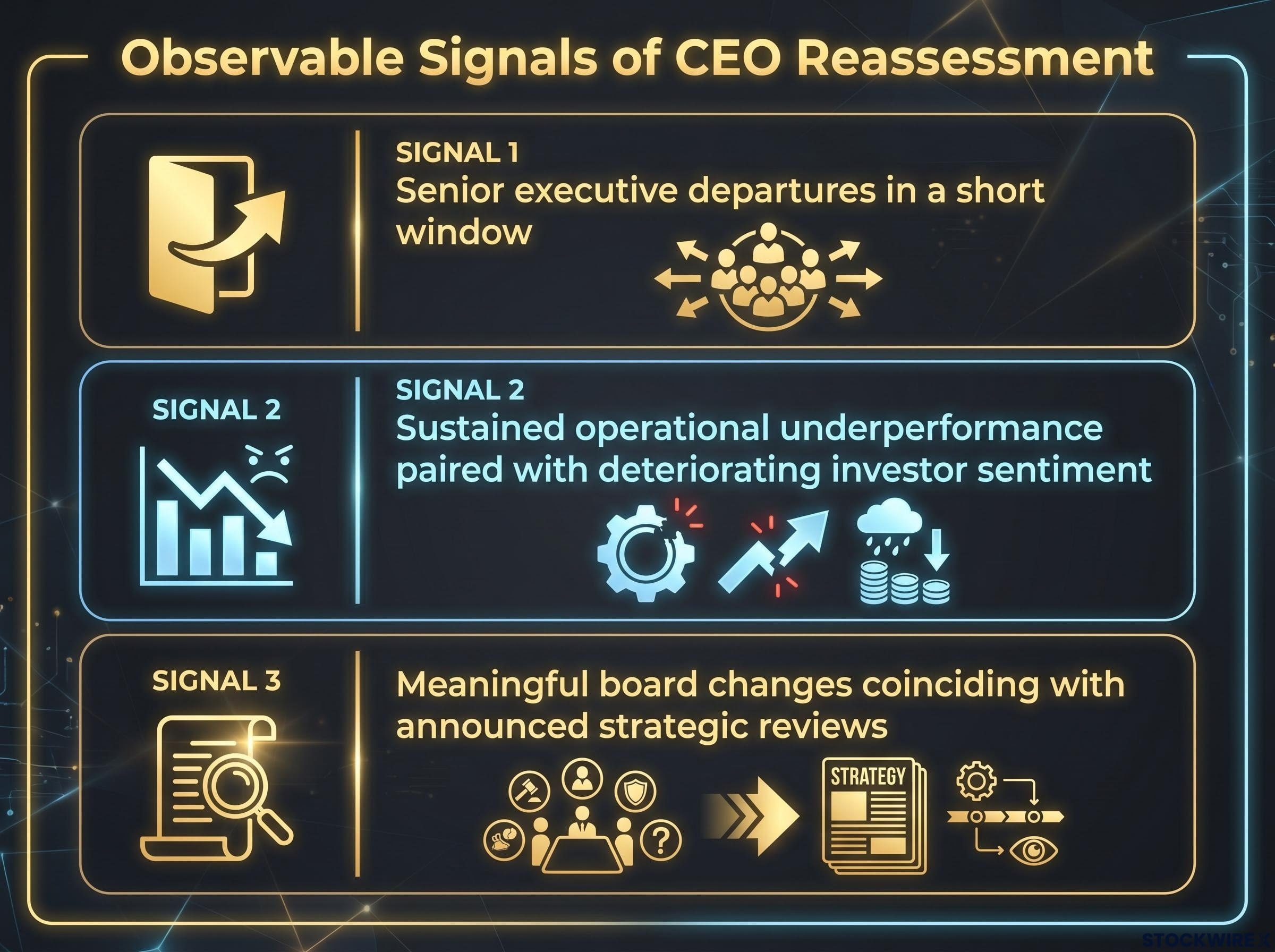
You cannot see inside the boardroom. But you can track three external signals that often indicate a reassessment is underway:
None of these signals is definitive on its own. But when two or three appear simultaneously, you are likely observing a governance process that is already well advanced, not a problem that is just beginning.
Businesses can absorb difficult quarters, competitive setbacks, and failed product launches, given time and capable leadership. What is far harder to recover from is a board that has concluded the person at the helm no longer has a credible path forward, because that conclusion almost always produces the kind of leadership and strategic upheaval that no single good quarter can undo.
That distinction matters for your portfolio decisions. When multiple warning signs cluster together, they can collectively point to a problem rooted in leadership rather than in trading conditions or market cycles. Developing the habit of distinguishing between the two gives you a meaningful advantage in interpreting what governance events actually mean for your holding.
Understanding the hierarchy is useful in the abstract. Using it to decode specific events is where the real value sits. Three governance event types appear regularly in financial news, and each carries more signal than its surface description suggests.
CEO removals are the board exercising authority over the top operating executive. The departure itself is the least interesting part. What matters is what it tells you about the board’s view of the company’s future and what kind of leader the board believes the company now needs. Three questions are worth asking every time: Did performance justify this? What does this tell you about how the board sees the company’s trajectory? What kind of leadership does the board believe the next phase requires?
Activist campaigns are shareholders attempting to reshape the board’s composition, which is the structurally correct way to change a company’s direction. Activists target the board because the board sits above management. Change the board, and you change the people making leadership and strategic decisions.
Board reshuffles combined with strategic reviews signal that governance is moving above operations. The company’s problems are being treated as structural, not executional. When a strategic review coincides with new director appointments, the board is signalling that the existing framework, not just the existing execution, needs rethinking.
| Governance event | What it looks like on the surface | What it actually signals |
|---|---|---|
| CEO removal | A leadership change or executive departure | The board has formed a view on what kind of leadership the company’s future requires |
| Activist campaign | An outside investor agitating for change | Shareholders are attempting to reshape the board, and through it, the company’s strategic direction |
| Board reshuffle with strategic review | New directors appointed, strategy under review | Governance is asserting itself above operations; the company’s issues are being treated as structural |
CEO turnover is a governance event, not just a personnel change. The real information in each of these events is about where the board’s conviction currently sits and what it has concluded about the company’s future direction.
The hierarchy does not change. Shareholders elect the board. The board runs the company through the CEO. That structure applies to every public company you will ever evaluate, regardless of sector, market capitalisation, or geography.
The practical shift this gives you is in where you look. Beyond the CEO’s statements on earnings calls. Beyond the analyst consensus. To the board’s composition, its members’ tenure, who appointed them, and what they have signalled through their recent decisions. That layer is visible in public filings, director biographies, and annual meeting records for every listed company, and most retail investors skip it entirely.
Leadership risk in a public company is always a governance question first. Every CEO transition, activist campaign, and board change you encounter from this point forward will be more interpretable because you now understand where authority sits, how it moves, and what the signals look like when it shifts.
For investors wanting to see how these governance principles translate into measurable valuation outcomes, our full explainer on governance and post-IPO valuation examines how board quality and management communication together determine whether a listed company’s valuation holds or compresses across its first eight to twelve quarters of public life.
This article is for informational purposes only and should not be considered financial advice. Investors should conduct their own research and consult with financial professionals before making investment decisions.
The board of directors holds structural authority above the CEO in any public company. The CEO runs daily operations and executes strategy, but the board appoints, compensates, evaluates, and can remove the CEO at any time, making the board the higher authority in the governance hierarchy.
Shareholders have three core governance rights: voting for board members at annual general meetings, voting on major proposals such as mergers and equity compensation plans, and submitting shareholder proposals to engage directly with the board on governance matters.
A CEO departure is almost always the visible conclusion of a private board deliberation that has been running internally for some time, with a successor typically identified before any public announcement. Treating it as a sudden shock misreads the signal; it reflects the board's settled view on the leadership the company's next phase requires.
An activist campaign is shareholders attempting to reshape a company's board composition by nominating rival director candidates against management's preferred nominees. Activists target the board specifically because the board sits above management: change the board, and you change who makes leadership and strategic decisions.
Three external signals often appear before a formal CEO change: senior executive departures in a short window, sustained operational underperformance paired with deteriorating investor sentiment, and meaningful board changes coinciding with announced strategic reviews. When two or three cluster together, a governance process is likely already well advanced.