
Asian Currencies Fall as Hormuz Incident Drives Oil Up 6%

Key Takeaways
- The South Korean won fell 0.6% on Monday, leading Asian currency losses after U.S. forces seized an Iranian vessel and Iran declared the Strait of Hormuz closed.
- WTI crude surged to $87.48 per barrel, a gain of approximately 5.92%, creating secondary inflation pressure across energy-dependent Asian economies.
- A clear north-south divergence has emerged, with yuan stability and lower energy import dependency insulating north Asian currencies while south Asian currencies face compounding pressure from dollar strength and oil prices.
- The Japanese yen extended weakness to 158.94 against the dollar, defying traditional safe-haven expectations as yield differentials and carry trade logic continue to dominate price action.
- Tuesday's ceasefire expiration between the U.S. and Iran is the immediate market focal point, with both diplomatic resolution and further escalation remaining plausible scenarios.
A single naval incident in the Strait of Hormuz sent shockwaves through Asian currency markets on Monday, with the South Korean won tumbling 0.6% and oil prices surging nearly 6% as traders scrambled to reprice geopolitical risk. The seizure of an Iranian vessel by American forces over the weekend has reignited tensions just 24 hours before a fragile U.S.-Iran ceasefire is set to expire, leaving currency traders navigating conflicting signals about whether diplomatic talks will proceed or military escalation will follow. This analysis breaks down how the renewed Middle East uncertainty is reshaping Asian FX positioning, which currencies face the greatest pressure, and what the divergence between north and south Asian markets signals for the days ahead.
Weekend escalation triggers safe-haven dollar rally
American forces seized an Iranian vessel over the weekend. Iran responded by declaring the Strait of Hormuz closed and alleging ceasefire violations. Markets opened Monday with the dollar claiming a safe-haven bid that reversed a two-week losing streak.
Three developments broke the weekend calm:
- U.S. naval forces seized Iranian vessel in regional waters
- Iran announced Strait of Hormuz closure in response
- Both sides accused the other of violating ceasefire terms
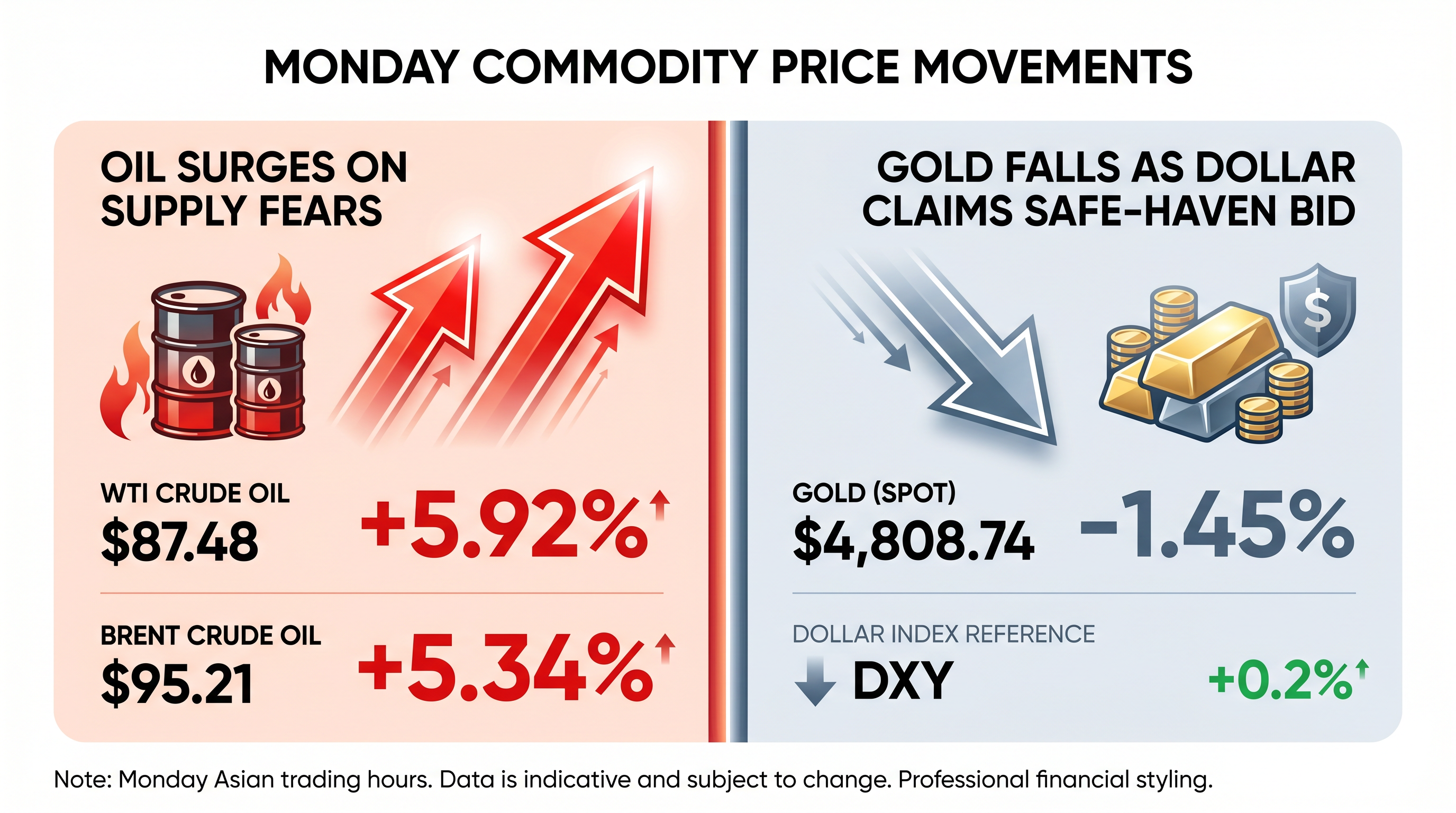
The dollar index and futures both advanced roughly 0.2% during Asian hours. WTI crude surged to $87.48, up approximately 5.92%, while Brent climbed to $95.21, gaining 5.34%. Gold futures fell 1.45% to $4,808.74 as safe-haven flows shifted to the dollar.
The dollar’s safe-haven bid on Monday reversed two weeks of weakness that began with capital reallocation patterns following the April 7 ceasefire, when $28 billion flowed into US equity funds and weakened the dollar through carry trade positioning.
Monday’s 6% surge represents a dramatic reversal from just days earlier, when oil prices crashed 9.41% to $82.59 per barrel as markets recalibrated geopolitical risk premiums around the Strait of Hormuz.
Ceasefire expires Tuesday, April 21, with conflicting signals on whether talks will proceed
The dollar’s renewed strength on geopolitical uncertainty directly pressures Asian currencies across the board. The oil surge creates a secondary inflation channel that will filter through regional economies in coming weeks, with energy-dependent nations facing the sharpest import cost increases.
When big ASX news breaks, our subscribers know first
Regional currency losses reveal north-south divergence
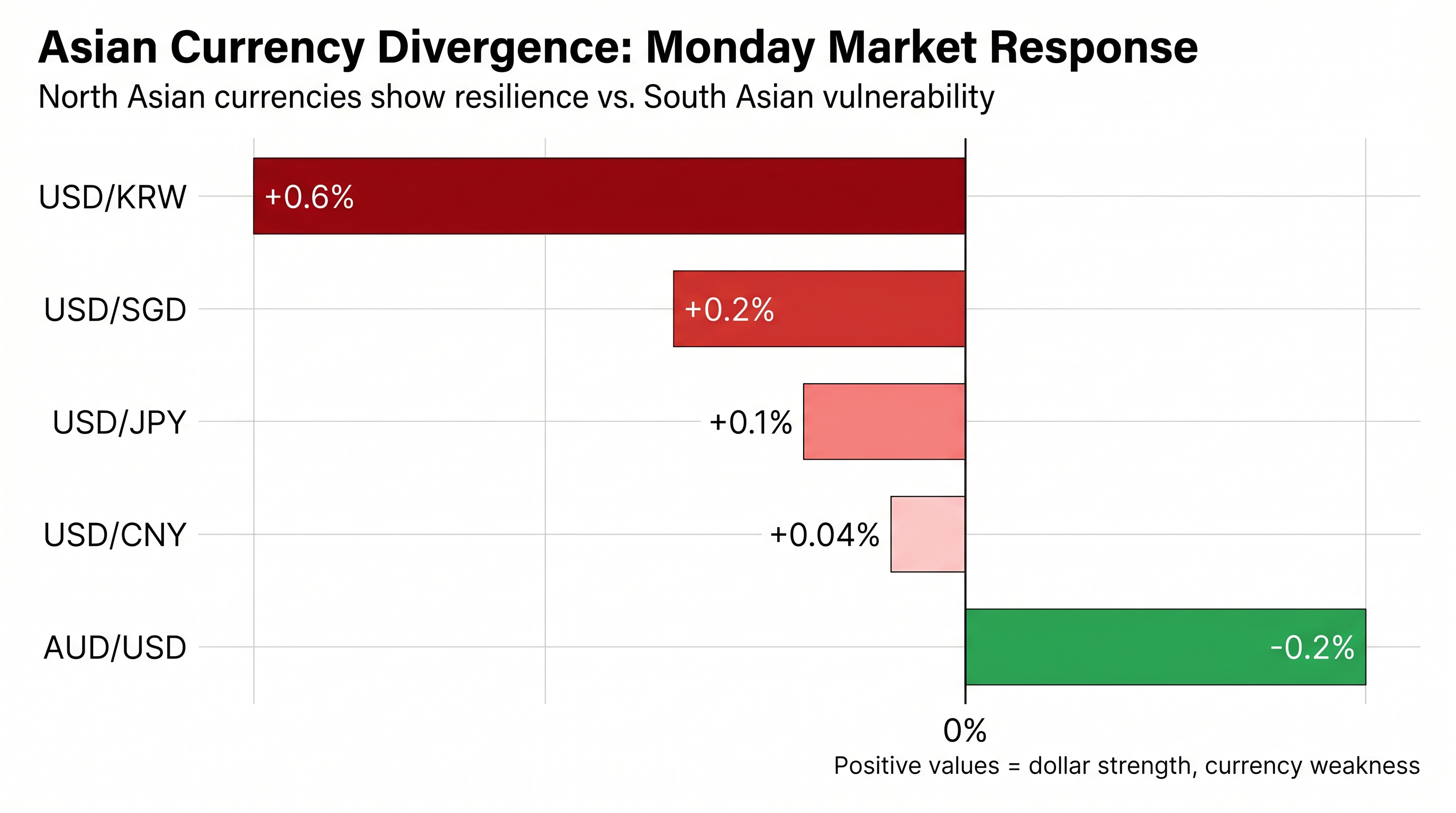
Asian currency pairs sold off Monday, though the magnitude of losses varied sharply by geography. The South Korean won led regional weakness, falling 0.6% against the dollar. The Japanese yen slipped 0.1%, with USD/JPY trading at 158.94. Singapore’s dollar weakened 0.2%, while the Indian rupee edged up 0.1% but remained below April record highs.
The Australian dollar declined 0.2%, retreating from its near two-year peak. The Chinese yuan showed minimal movement, with USD/CNY advancing approximately 0.04%.
| Currency Pair | Monday Movement | Key Driver |
|---|---|---|
| USD/KRW | +0.6% | Energy import vulnerability, risk aversion |
| USD/JPY | +0.1% (158.94) | Carry trade logic, retreating BOJ hike expectations |
| USD/CNY | +0.04% | PBOC daily fixings, energy resilience |
| USD/INR | +0.1% | Oil import costs, south Asian vulnerability |
| AUD/USD | -0.2% | Risk sentiment shift from two-year highs |
The divergence between north and south Asian currency performance reflects structural differences in energy import dependency and central bank capacity. This pattern is likely to intensify if oil prices remain elevated through the week.
Yuan stability anchors regional sentiment
The People’s Bank of China left its loan prime rate unchanged at record lows. USD/CNY trades near three-year lows, supported by stronger daily fixings that signal the central bank’s comfort with current levels. The yuan’s resilience provides north Asian currencies a relative anchor, limiting the extent of regional selloffs even as geopolitical uncertainty persists. China’s lower reliance on Middle Eastern energy imports compared to south Asian economies insulates the currency from oil price transmission effects.
Why Asian currencies react differently to oil shocks
The same geopolitical event produces different currency outcomes across Asia because energy import dependency varies sharply by economy. India, Japan, and South Korea are major oil and gas importers most affected by Brent’s 5.34% surge. These nations face three compounding pressures:
The IMF working paper on oil price shocks and exchange rate transmission in emerging Asia quantifies how energy import dependency creates asymmetric currency responses, with countries importing over 80% of energy needs experiencing exchange rate depreciation 2.5 times larger than diversified economies following equivalent oil price surges.
- Higher inflation from elevated energy input costs
- Trade balance deterioration as import bills widen
- Limited policy response capacity given existing inflation concerns
China’s relative energy resilience stems from diversified supply sources and lower per-capita consumption intensity. The oil price surge creates immediate import cost pressure for south Asian economies, where energy represents a larger share of total imports and passes through more directly to consumer inflation.
ING recommends positioning for north Asian resilience and caution on south Asian vulnerability
Understanding the structural differences in energy exposure helps readers anticipate which currencies will face sustained pressure if Hormuz disruptions persist, versus those likely to stabilise once immediate volatility fades. North Asian currencies benefit from both the yuan anchor effect and lower energy import intensity, while south Asian currencies face a double pressure from dollar strength and oil price transmission.
Investors navigating the divergence between north and south Asian currency performance will find our full explainer on positioning strategies for geopolitical volatility regimes, which covers asset allocation approaches, hedging instruments, and risk management frameworks for sustained uncertainty periods.
Central bank responses remain measured as uncertainty persists
No major Asian central bank issued emergency interventions or statements Monday, signalling policymakers view current volatility as manageable. The three largest central banks adopted distinct stances:
- PBOC: Maintained steady loan prime rates and daily yuan fixings with no reported interventions tied to Monday’s volatility
- MAS: Pre-emptively raised the S$NEER band slope for tighter monetary stance earlier this month (prior to April 20)
- BOJ: Holding the 0.75% short-term rate with market expectations for immediate hikes retreating
The Monetary Authority of Singapore’s pre-emptive tightening via the nominal effective exchange rate band slope adjustment positions the city-state ahead of potential inflation pressures. The Bank of Japan faces policy tension between its rate trajectory and energy subsidy pressures, though no immediate shift appears likely.
The energy price surge driving Asian FX volatility is the same mechanism behind the reversal of Fed rate cut expectations from two cuts to near-zero probability, illustrating how Strait of Hormuz disruptions constrain monetary policy flexibility globally.
The measured central bank response suggests policymakers view current volatility as manageable. However, the BOJ April meeting and ongoing Hormuz situation could force more active intervention if conditions deteriorate or oil prices push significantly higher from current levels.
The next major ASX story will hit our subscribers first
Yen weakness defies safe-haven expectations
USD/JPY advanced to 158.94 on Monday, extending the yen’s decline even as geopolitical tensions escalated. The yen hit a decade-low against the Singapore dollar, defying the traditional safe-haven pattern where Middle East instability strengthens Japanese currency demand.
Yield differentials are overriding traditional geopolitical safe-haven demand for the yen. The carry trade logic that dominated 2025 continues to suppress yen strength despite the Hormuz incident. Market expectations for Bank of Japan rate hikes have retreated, removing the catalyst that might reverse the yen’s structural weakness against higher-yielding currencies.
The BIS research on carry trade dynamics and currency volatility transmission demonstrates that yield differentials can override traditional safe-haven flows during periods of elevated geopolitical risk, particularly when rate expectations diverge sharply across major central banks.
Yield differentials are overriding traditional geopolitical safe-haven demand for the yen
Traders expecting yen strength from Middle East escalation risk being caught offside. The rate differential regime currently dominating yen price action may persist unless the BOJ signals a more hawkish shift at its April meeting or geopolitical conditions force a reassessment of global risk positioning.
Conclusion
Monday’s Asian currency selloff reflects the market’s rapid repricing of geopolitical risk, with structural differences in energy exposure creating clear winners and losers across the region. Tuesday’s ceasefire expiration represents the immediate focal point, with conflicting signals from Washington and Tehran leaving both diplomatic and escalation scenarios plausible.
Key data releases this week (Japanese trade figures, Tokyo core CPI, U.S. retail sales) will compete with geopolitical headlines for market attention. North Asian currencies remain better positioned to weather continued uncertainty, anchored by yuan stability and lower energy import dependency. South Asian currencies face compounding pressure from oil prices and dollar strength, with limited central bank capacity to offset external shocks.
Traders should monitor Tuesday’s ceasefire deadline and any signals from planned U.S.-Iran talks in Pakistan, while watching oil prices as the primary transmission mechanism for continued FX volatility. The divergence between north and south Asian currency performance is likely to widen if Hormuz disruptions persist beyond the immediate news cycle.
Frequently Asked Questions
Why did Asian currencies fall after the Strait of Hormuz incident?
The seizure of an Iranian vessel by U.S. forces triggered a safe-haven rally in the dollar, pushing Asian currencies lower as traders repriced geopolitical risk. Energy-dependent economies like South Korea, Japan, and India faced additional pressure from a nearly 6% surge in oil prices.
Which Asian currencies are most vulnerable to oil price shocks?
South Asian currencies, particularly the Indian rupee and South Korean won, are most vulnerable because these economies import over 80% of their energy needs, meaning rising oil prices directly widen trade deficits and push currencies lower.
Why is the Japanese yen weakening despite rising geopolitical tensions?
The yen is defying its traditional safe-haven role because yield differentials are overriding geopolitical demand; carry trade logic and retreating Bank of Japan rate hike expectations are suppressing yen strength even as Middle East tensions escalate.
What is the north-south divergence in Asian currency markets?
North Asian currencies like the Chinese yuan and Japanese yen are holding up better than south Asian currencies because they benefit from yuan stability, stronger PBOC daily fixings, and lower energy import dependency relative to economies like India and South Korea.
What should currency traders watch ahead of the U.S.-Iran ceasefire expiration?
Traders should monitor Tuesday's ceasefire deadline, any signals from planned U.S.-Iran talks in Pakistan, and oil price movements, as sustained Hormuz disruptions would likely widen the performance gap between north and south Asian currencies further.


