Record Highs Are Not the Risk Most Investors Think They Are
5 hrs ago


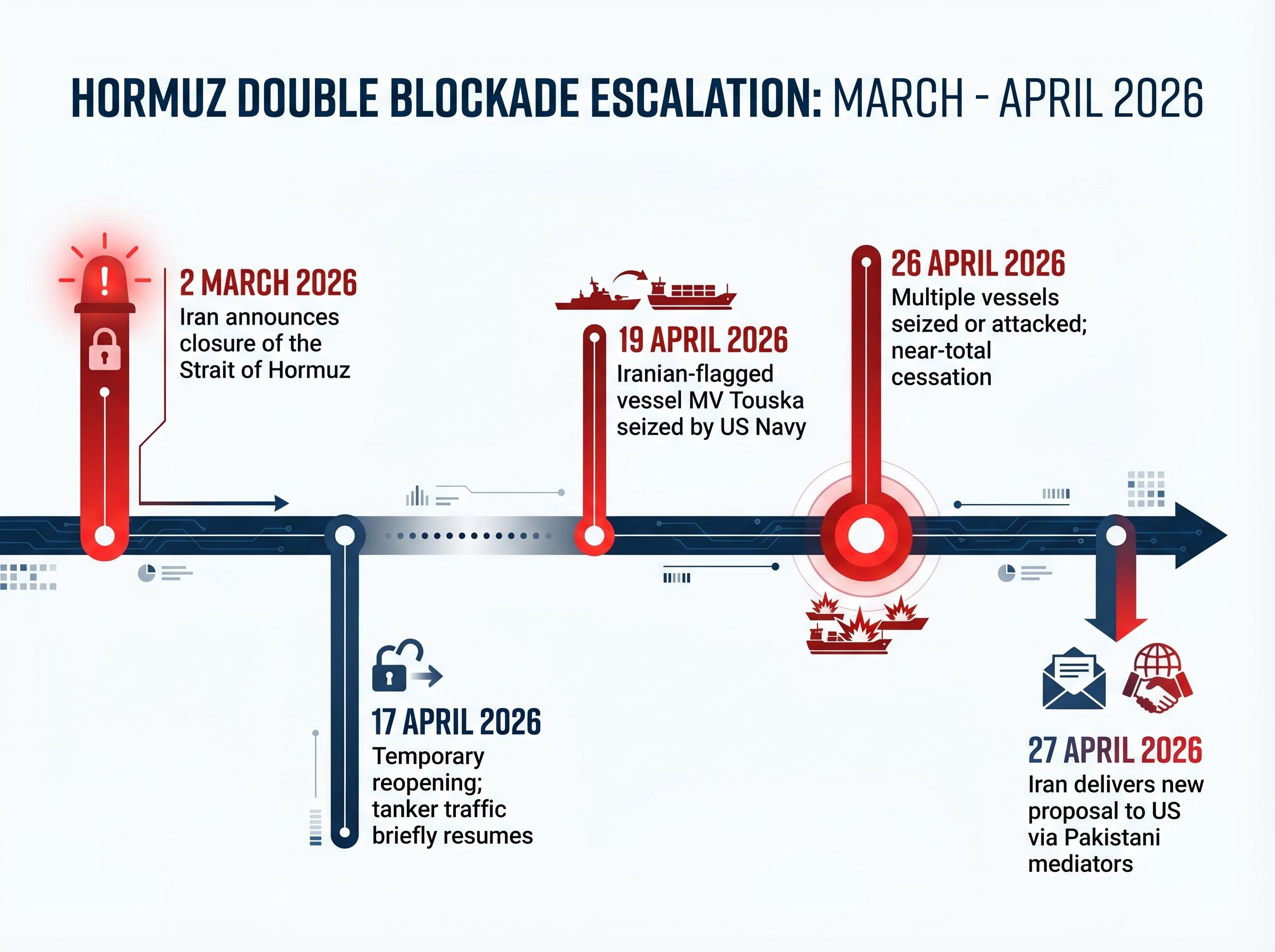
“`json { “fact_checked_full_article”: “The Strait of Hormuz, the narrow waterway that carries roughly one-fifth of the world’s oil supply, is effectively closed. As of 27 April 2026, multiple vessel seizures and attacks over the preceding 24 hours have rendered passage too dangerous for commercial shipping, collapsing a fragile temporary reopening that lasted barely a week. The blockade, which began on 2 March 2026 when Iran announced closure of the waterway, has since evolved into what analysts describe as a \”double blockade\”: Iran restricting outbound tanker traffic while the United States enforces a counter-blockade on Iranian ports and vessels. Brent crude sits above $100 a barrel. No coordinated international response has materialised. And as of this morning, a new Iranian proposal delivered through Pakistani mediators has landed on the desk of the White House Situation Room, offering a path to reopening that neither side has yet accepted.\n\n## How the U.S.-Iran diplomatic standoff escalated into a double blockade\n\nThe crisis began with a single announcement. On 2 March 2026, Iran declared the Strait of Hormuz closed to outbound tanker traffic, choking the only sea route connecting Persian Gulf oil exporters to global markets. Washington responded not with negotiations but with force projection, deploying US Navy assets to interdict Iranian vessels and enforce a counter-blockade on Iranian ports.\n\nA temporary reopening around 17 April 2026 offered brief relief. A convoy of tankers was observed leaving the Gulf on 18 April before shots were fired. Within days, the window had shut again.\n\nThe escalation timeline captures how each move boxed both sides further in:\n\n1. 2 March 2026: Iran announces closure of the Strait of Hormuz.\n2. 17 April 2026: Temporary reopening; tanker traffic briefly resumes.\n3. 19 April 2026: Iranian-flagged vessel MV Touska seized by US Navy.\n4. 26 April 2026: Multiple vessels seized or attacked in a single day; passage returns to near-total cessation.\n5. 27 April 2026: Iran delivers new proposal to the US via Pakistani mediators.\n\n### What \”double blockade\” means in practice\n\nThe term describes a mutual stranglehold. Iran controls the Strait itself, restricting outbound tanker movement from the Gulf. The US Navy, meanwhile, interdicts Iranian-flagged vessels and enforces restrictions on Iranian port access, cutting Tehran off from its own export revenue.\n\nThis dual-layer enforcement is why a simple ceasefire is insufficient. Neither side can stand down without the other moving first, a sequencing problem that led President Trump to cancel the dispatch of US negotiators to Pakistan. Washington’s stated position: Tehran should initiate contact, given what the administration described as the strength of the US negotiating hand.\n\n## Why the Strait of Hormuz matters so much to global energy supply\n\nThe statistic is familiar: the Strait of Hormuz handles approximately 20% of the world’s oil supply. What makes that figure weigh so heavily is the list of producers behind it.\n\nSaudi Arabia, the UAE, Iraq, and Kuwait all depend on passage through the Strait to reach their primary destination markets in Asia, Europe, and beyond. The Strait is not one of several available routes; it is the only sea passage from the Persian Gulf to the open ocean for the region’s largest exporters. When it closes, their crude has no alternative path to market.\n\n
| Country | Estimated daily export dependency | Primary destination markets |
|---|---|---|
| Saudi Arabia | ~6-7 million barrels/day | Asia (China, Japan, South Korea), Europe |
| UAE | ~2.5-3 million barrels/day | Asia (India, Japan), Europe |
| Iraq | ~3-3.5 million barrels/day (partial Strait dependency) | Asia (China, India), Europe |
| Kuwait | ~1.5-2 million barrels/day | Asia (South Korea, Japan), Europe |
\n
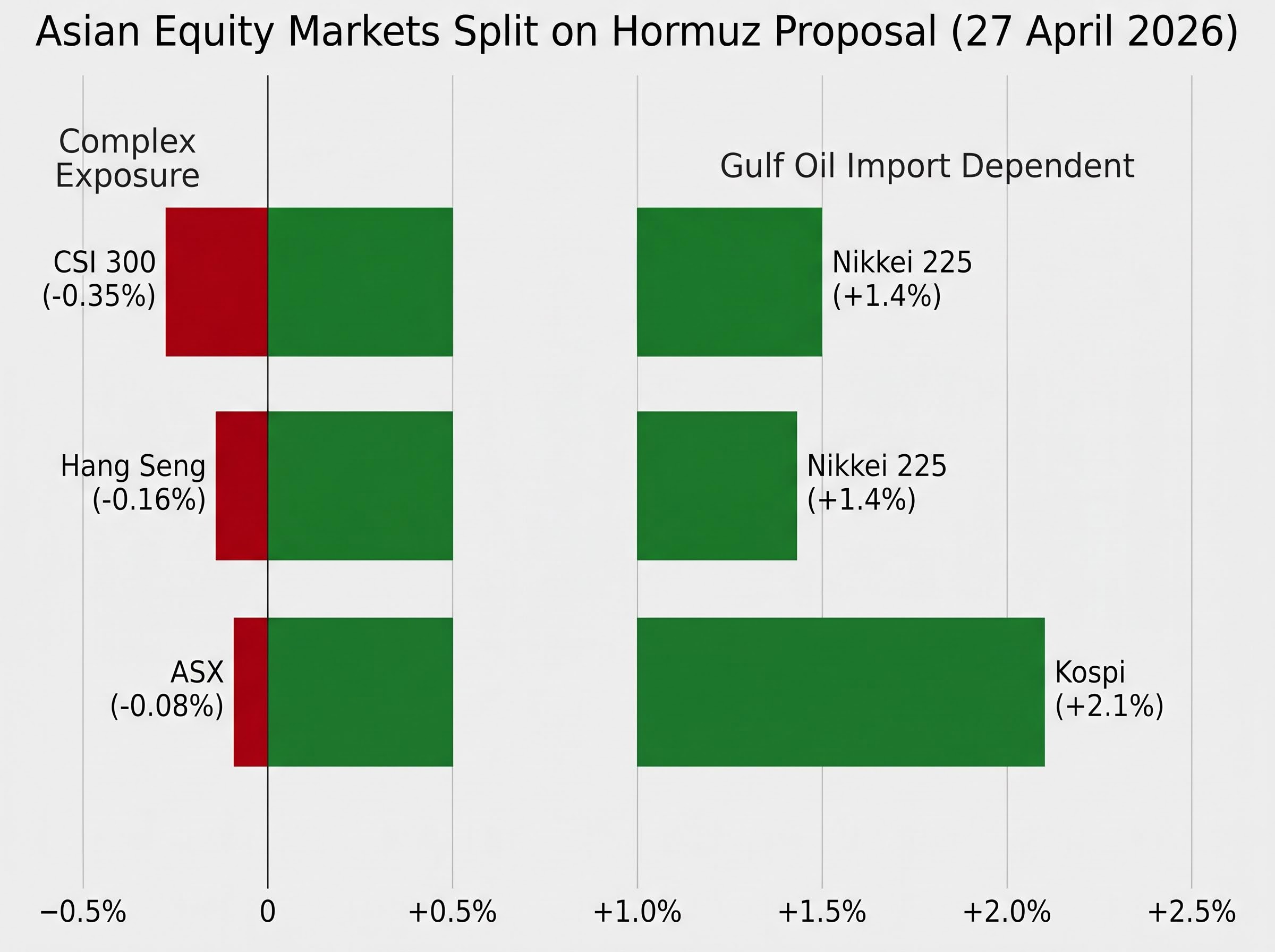
\n\nFigures are approximate and reflect pre-blockade export volumes routed through the Strait.\n\nThe disruption has now persisted for nearly eight weeks, compounding the supply deficit with each passing day. Analysts estimate Iran itself can sustain the current standoff for up to approximately three months before its own export capacity becomes critically constrained.\n\n> No safety valve has been activated. As of 27 April 2026, no emergency OPEC+ meeting has been called, no International Energy Agency (IEA) Strategic Petroleum Reserve release has been announced, and no coordinated G7 response has been confirmed. Markets are pricing this disruption without any institutional cushion.\n\n### No institutional safety valve yet\n\nThe absence of a coordinated response is itself a signal. In previous oil supply crises, the IEA’s strategic reserves and OPEC+ emergency sessions served as pressure-release mechanisms. Neither has materialised. No G7 joint statement has been issued. For investors tracking energy markets, this means the current price levels reflect raw supply-demand dislocation rather than a managed policy response.\n\n## Brent above $100 and what the price surge reflects\n\nBrent crude closed at approximately ~$107 on 27 April 2026, up roughly 2.52% on the day. On 24 April, Brent reached $106.28. The global benchmark has held above $100 as the blockade’s duration extends.\n\n> Brent crude above $101 on 27 April 2026 marks the sustained breach of the $100 threshold that energy markets had not seen since the early stages of the crisis escalated in late March.\n\nWTI crude, the US benchmark, tells a different story. At approximately $95.35-$96.63 on the same day, up roughly 2.36%, WTI has not breached $100. The divergence is structural: Brent reflects global seaborne supply risk directly, while WTI is partly insulated by North American production dynamics and pipeline-delivered domestic supply.\n\nKey commodity and rate data as of 27 April 2026:\n\n- Brent crude: ~$101.63 (up ~2.52%)\n- WTI crude: ~$95.35-$96.63 (up ~2.36%)\n- Gold futures: $4,731.10 (down 0.21%), suggesting some rotation out of safe-haven assets following the Iran proposal news\n- US 10-year Treasury yield: 4.319%\n\nA secondary layer of pressure arrived on 24 April 2026, when the US sanctioned Hengli Petrochemical, a private Chinese refiner, for purchasing Iranian oil. The action restricts one of Iran’s remaining export channels through third-party refiners, compounding the supply constraint and indirectly pressuring China’s access to discounted Iranian crude.\n\n## How global equity markets are reading the crisis\n\nAsian markets split cleanly on 27 April 2026, and the dividing line was instructive. Energy-importing economies most exposed to Gulf crude rallied on the Iran proposal; markets with more complex exposure to the crisis declined.\n\nThe Nikkei 225 surged approximately 1.4% to record highs. South Korea’s Kospi climbed roughly 2.1%, also reaching new highs. Both economies are heavily dependent on Gulf oil imports, and both responded to the prospect of a reopened Strait with immediate optimism.\n\nChina and Hong Kong moved in the opposite direction. The Hang Seng dipped approximately 0.16%, and the CSI 300 fell roughly 0.35%. The decline reflects a more complicated position: China is both an importer of Gulf crude and a buyer of sanctioned Iranian oil, meaning the Hengli Petrochemical sanctions add a secondary pressure that a Hormuz reopening alone would not relieve. Australia’s ASX edged down approximately 0.08%.\n\n### European equities: caution with pockets of movement\n\nEuropean indices opened with minimal conviction. The Stoxx 600 was flat. The FTSE 100 showed no net change. The DAX added 0.3% and the CAC 40 rose 0.2%, movements consistent with sustained geopolitical uncertainty rather than any specific negative catalyst.\n\nIndividual names cut through the macro caution. Nordex shares jumped more than 9% after a Q1 earnings beat. Forvia gained over 3% following confirmation of its interiors division sale to Apollo Global Management for 1.82 billion euros.\n\n
| Market | Index | Move (27 April) | Direction |
|---|---|---|---|
| Japan | Nikkei 225 | +1.4% | Up (record highs) |
| South Korea | Kospi | +2.1% | Up (new highs) |
| Hong Kong | Hang Seng | -0.16% | Down |
| China | CSI 300 | -0.35% | Down |
| Australia | ASX | -0.08% | Down |
| Europe | Stoxx 600 | Flat | Neutral |
| UK | FTSE 100 | Flat | Neutral |
| Germany | DAX | +0.3% | Up |
| France | CAC 40 | +0.2% | Up |
| Europe (single stock) | Nordex | +9%+ | Up (Q1 earnings beat) |
| Europe (single stock) | Forvia | +3%+ | Up (asset sale to Apollo) |
\n
\n\n## Iran’s new proposal and what a resolution could mean for energy markets\n\nThe proposal, reported by Axios on 27 April 2026, arrived via Pakistani mediators and contains four components:\n\n- Reopen the Strait of Hormuz immediately\n- Defer nuclear negotiations to a later stage\n- Require the US to end its blockade of Iranian ports as a precondition for broader talks\n- Pakistan to serve as formal intermediary throughout\n\nThe offer is structured around a sequencing logic: resolve the Hormuz crisis first, address nuclear issues second. Iran’s position is that the \”double blockade\” must be dismantled before any broader diplomatic framework can function.\n\nWashington has not formally responded. The White House stated on 27 April that it is awaiting a peace proposal from Iran without a set deadline. President Trump convened a Situation Room meeting on the same day, the clearest signal yet that the proposal is receiving attention at the highest level.\n\n> Analysts recommend resolving the double blockade within days or weeks by focusing solely on Hormuz first, as introducing broader issues such as the nuclear programme into the immediate negotiations could prolong the standoff.\n\nOil prices pared some gains on 27 April following news of the proposal, suggesting markets are pricing in a non-trivial probability of resolution. Iran’s estimated export capacity runway of up to approximately three months provides a window, but a narrow one. A confirmed Hormuz reopening could trigger a sharp reversal in oil prices. A breakdown in talks could push Brent materially higher.\n\nThe Strait of Hormuz blockade has reached a point where the crisis is no longer about whether it will cause damage, but how much. Brent sits above $100, global shipping through the waterway has near-ceased, and no institutional safety net, whether from the IEA, OPEC+, or the G7, has been activated. Against that backdrop, Iran’s proposal represents the first concrete diplomatic opening since the temporary reopening collapsed. The two paths forward are now visible: a negotiated Hormuz reopening that could ease energy prices sharply, or a continued standoff that analysts project would drive further price increases and sustained market volatility. The specific catalyst to watch is what comes out of the 27 April White House Situation Room meeting and whether Washington responds to Tehran’s offer through Pakistani mediators in the days ahead.\n\nThis article is for informational purposes only and should not be considered financial advice. Investors should conduct their own research and consult with financial professionals before making investment decisions. Past performance does not guarantee future results. Financial projections are subject to market conditions and various risk factors.\n\n—” } “`
Investors wanting to translate the diplomatic and commodity dynamics into specific portfolio implications will find our deep-dive into what the Hormuz standoff means for US investors, which covers Goldman Sachs’s analysis of the structural flaw in Iran’s reopening offer, the convergence of the Fed decision on 29 April with major tech earnings, and the historical context for five-ship transit days as a quantitative measure of near-total chokepoint shutdown.
The equity market paradox created by the sustained blockade, where the S&P 500 hit record highs during the same week that US inflation surged to 3.3%, reflects a Shiller CAPE ratio of 40.57, the second-highest reading in over 155 years of data, a valuation level that historically precedes significant corrections when economic fundamentals deteriorate.
The brief window that closed on 19 April traced directly to the MV Touska seizure that collapsed the first reopening, a 24-hour sequence in which commercial traffic went from more than 20 vessels transiting on 18 April to zero transits the following day after the US Navy boarded and seized the Iranian cargo ship.
The US Treasury OFAC sanctions targeting Iran’s oil trade and shadow fleet, announced on 24 April 2026, named Hengli Petrochemical alongside a broader network of entities facilitating Iranian petroleum purchases, expanding enforcement well beyond a single refiner and signalling that Washington intends to close the third-party buyer channels Iran has used to sustain export revenue during the blockade.
The EIA analysis of the Strait of Hormuz as a critical oil chokepoint confirms that the waterway handles approximately 20 million barrels per day, representing roughly one-fifth of global petroleum liquids consumption, a volume that cannot be rerouted through any existing alternative pipeline or sea passage on a comparable timescale.
The Strait of Hormuz blockade refers to Iran's closure of the narrow waterway that carries approximately 20% of the world's oil supply, cutting off the only sea passage from the Persian Gulf to global markets for major exporters including Saudi Arabia, the UAE, Iraq, and Kuwait. Because no alternative route can handle comparable volumes, the blockade has directly driven Brent crude above $100 a barrel and disrupted global energy markets.
A double blockade describes the mutual stranglehold currently in place: Iran restricts outbound tanker traffic through the Strait of Hormuz while the US Navy interdicts Iranian-flagged vessels and enforces restrictions on Iranian port access, cutting Tehran off from its own export revenue. Neither side can stand down without the other moving first, creating a sequencing problem that has prevented resolution since the crisis began on 2 March 2026.
Brent crude reached approximately $107 on 27 April 2026, up roughly 2.52% on the day, and has held above $100 throughout the extended blockade. WTI crude, the US benchmark, has remained below $100 at approximately $95.35-$96.63, reflecting North American production insulation from the seaborne supply disruption.
Iran's proposal, delivered via Pakistani mediators on 27 April 2026, calls for an immediate Strait reopening, deferral of nuclear negotiations to a later stage, and a US end to its blockade of Iranian ports as a precondition for broader talks. Washington has not formally responded, though President Trump convened a Situation Room meeting on the same day, signalling the proposal is receiving high-level attention.
Energy-importing Asian economies dependent on Gulf crude saw the strongest moves on 27 April 2026, with Japan's Nikkei 225 surging approximately 1.4% and South Korea's Kospi climbing roughly 2.1% to new highs following the Iran proposal news. China and Hong Kong declined, as both face the additional pressure of US sanctions on Hengli Petrochemical targeting Iranian oil purchases, meaning a Hormuz reopening alone would not fully relieve their exposure.