Record Highs Are Not the Risk Most Investors Think They Are
6 hrs ago


Two rival naval forces are simultaneously choking the world’s most important oil chokepoint, and the diplomatic off-ramp that might end it landed on Donald Trump’s desk just hours ago.
As of 27 April 2026, both the United States and Iran are enforcing separate blockades through the Strait of Hormuz, trapping more than 20 million barrels of daily oil supply and driving Brent crude above $100 per barrel for the first time in years. A war that began in late February produced a tenuous truce; the U.S. naval blockade launched on 13 April has now unravelled whatever stability that truce provided. This morning, Iran submitted a new reopening proposal through Pakistani intermediaries, triggering a White House Situation Room meeting.
This article explains what is physically happening at the strait, why diplomacy collapsed, what the live Iranian proposal contains, how energy markets and global supply chains are responding, and what the recovery timeline looks like even if a deal is struck today.
The U.S. blockade began on 13 April 2026, with enforcement commencing the following day. Over 100 aircraft and a dozen warships from Central Command now hold a cordon at the strait’s mouth in the Gulf of Oman, intercepting Iranian vessels and cargo ships. Thirteen ships have been turned around since enforcement started.
The speed was striking. Admiral Brad Cooper, Commander of U.S. Central Command, reported on 14 April that the operation had effectively strangled Iran’s maritime commerce almost overnight.
Admiral Brad Cooper, CENTCOM Commander (14 April 2026): 90% of Iran’s sea trade was halted in under 36 hours of enforcement.
On 23 April, U.S. forces seized the oil tanker Majestic X for alleged Iranian oil smuggling, a direct escalation of enforcement operations.
Iran’s response escalated from partial restriction to full chokepoint closure. On 22 April, the Islamic Revolutionary Guard Corps attacked and captured two container ships and targeted a third, the most aggressive Iranian naval action of the crisis.
Iran’s Parliament Speaker Mohammad Bagher Ghalibaf declared on 23 April that reopening the strait was “impossible” under the current U.S. blockade, framing America’s naval cordon as a direct violation of the ceasefire reached after the late-February conflict. More than 80 regional energy attacks have occurred during the broader crisis period, underscoring the scale of the confrontation.
The UNCLOS provisions on transit passage through international straits establish the right of continuous and expeditious passage for all vessels through waterways used for international navigation, the foundational legal framework that both sides in the Hormuz standoff are implicitly invoking to justify their competing naval postures.
The diplomatic channel appeared dead over the weekend. Trump cancelled a Pakistan-mediated negotiating round before 27 April, publicly asserting that Washington holds the dominant negotiating position and that Tehran should initiate direct contact with the United States.
President Trump stated that the U.S. holds a dominant position and called on Tehran to contact Washington directly.
That framing left little room for Iranian engagement. Then, this morning, Tehran moved.
Iran submitted a new reopening proposal through Pakistani intermediaries, reported via Axios and Tasnim on 27 April 2026. The proposal contains three elements:
The proposal triggered a White House Situation Room meeting on 27 April. The fact that Iran routed the offer through Pakistani intermediaries, rather than abandoning that channel entirely, signals that the mediation pathway remains alive despite the cancelled round.
The current Iranian offer did not arrive in a vacuum; it follows four successive diplomatic attempts that failed before the 27 April proposal, including a China-brokered ceasefire in early April and the 26 April Pakistani intermediary round that received no formal U.S. response, each failure narrowing the space within which a settlement can be credibly framed.
The core diplomatic gap is now visible. Iran wants the blockade lifted before nuclear discussions begin. Washington has framed its naval presence as leverage for exactly those discussions. Gulf state positions from Saudi Arabia, the UAE, Kuwait, and Qatar remain unconfirmed as of publication, as do European mediator stances.
The Strait of Hormuz is the only sea passage connecting the Persian Gulf to the open ocean. Its narrowest navigable shipping lanes compress some of the world’s largest tanker traffic into a corridor that, when blocked, has no short-term substitute.
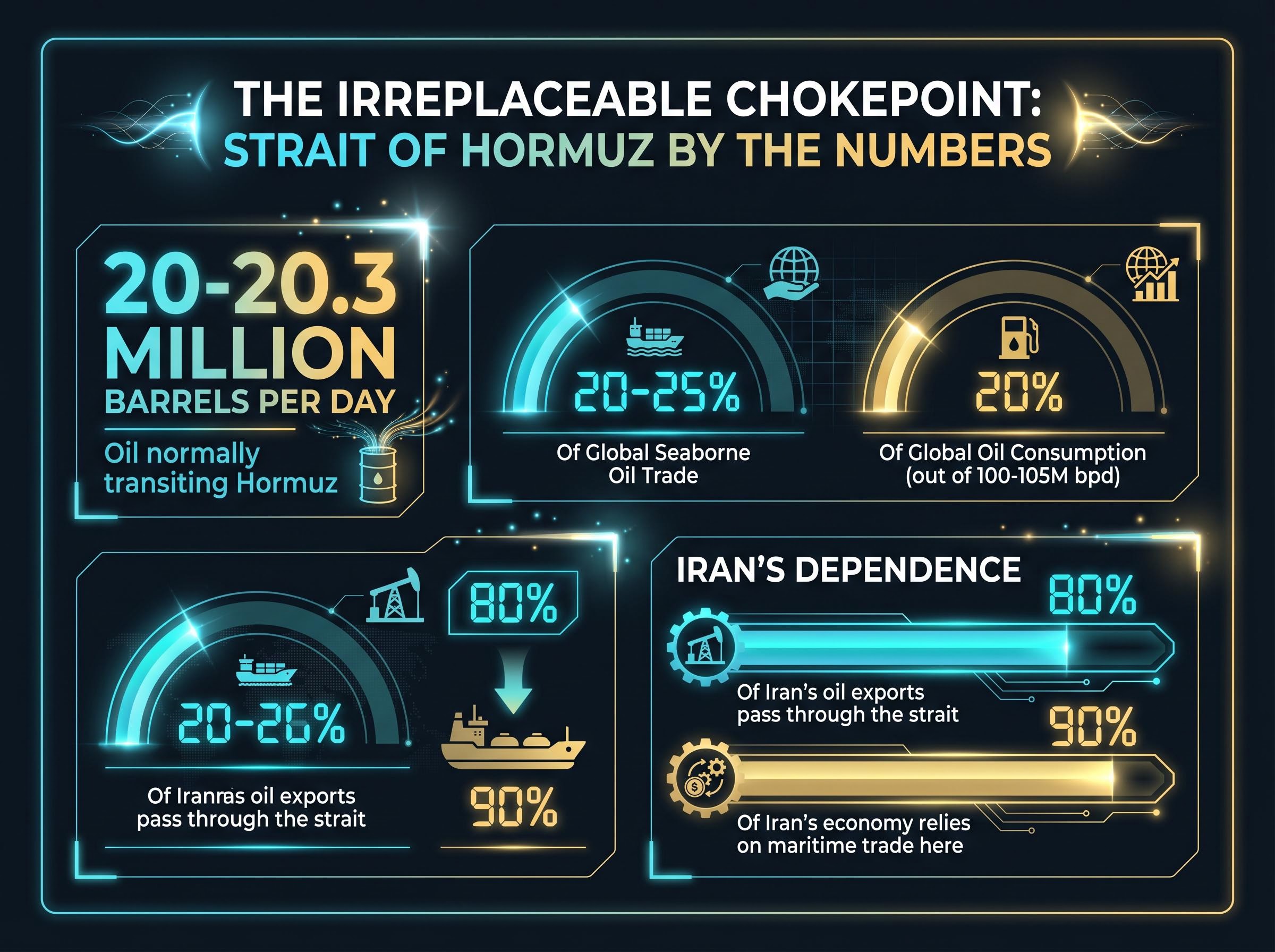
Approximately 20-20.3 million barrels per day of oil normally transit Hormuz. That represents roughly 20-25% of global seaborne oil trade and approximately 20% of total global oil consumption, measured against worldwide consumption of roughly 100-105 million barrels per day. Some 80% of Iran’s own oil exports pass through the strait, and CENTCOM estimates that 90% of Iran’s overall economy relies on maritime trade through this single corridor.
The EIA analysis of the Strait of Hormuz as a critical oil chokepoint confirms that approximately 20 million barrels per day transit the strait, representing roughly one-fifth of global petroleum liquids consumption and making it the single most consequential maritime passage in the global energy system.
| Commodity / Sector | Normal Daily Hormuz Transit or Dependency | Key Affected Regions |
|---|---|---|
| Crude oil | ~20 million barrels per day | Asia-Pacific, Europe, North America |
| LNG (liquefied natural gas) | Major share of Qatar’s global LNG exports | Japan, South Korea, Europe |
| Fertilisers & industrial goods | Aluminium, polymers, plastics, diesel | Agriculture-dependent and manufacturing-heavy economies globally |
Alternative routes, whether pipeline capacity through Saudi Arabia or rerouting tankers around the Cape of Good Hope, cannot absorb this volume in any realistic short-term scenario. The disruption is structural, not marginal.
Ellen Wald, Atlantic Council Senior Fellow (16 April 2026): This is the “biggest energy crisis in history,” with disruptions spanning fertilisers, aluminium, LNG, polymers, plastics, and diesel.
The price data reflects the supply logic directly. Brent crude reached $100.62 per barrel on 27 April 2026, while WTI traded at approximately $99.67 per barrel.
Brent crude at $100.62/barrel represents an approximately 40% surge from pre-war levels of roughly $70-75/barrel in late February 2026.
That 40% move is the market’s answer to more than 20 million barrels per day being physically trapped. Hundreds of tankers have sat stranded in the Gulf since late February.
With more than 700 vessels stranded in the Gulf and daily transits through the strait falling to just 2-3 from a normal baseline of dozens, OPEC+’s announced production increase of 206,000 barrels per day is structurally incapable of offsetting the disruption because Gulf producers cannot export through the sealed chokepoint regardless of how much additional output they authorise.
On 27 April, oil pared some gains following Iran’s reopening proposal. European equities showed modest positive movement in early trading: the DAX gained 0.3%, the CAC 40 rose 0.2%, while the Stoxx 600 and FTSE 100 traded flat. The market is taking the diplomatic signal seriously, even before any deal exists. Asian and U.S. equity index reactions to the proposal remain unconfirmed at publication time.
The Strait of Hormuz closure’s transmission into U.S. inflation has been swift and measurable, with gasoline prices up 37% to $4.11 per gallon in seven weeks, the Consumer Price Index jumping 90 basis points in a single month, and Federal Reserve rate cut expectations effectively eliminated as a result.
The disruption extends well beyond crude oil prices. With the strait closed, second-order effects are spreading through:
These commodity disruptions create compounding economic pressure. Agriculture-dependent nations face rising input costs at planting season. Manufacturing-heavy economies face production bottlenecks that worsen with each week the strait remains closed.
Iran’s proposal is the most substantive diplomatic signal of the crisis. It is not, however, a reopening.
The physical and commercial obstacles to resuming normal shipping through Hormuz would persist even if Washington and Tehran reached an agreement today. The recovery involves a sequence, and each stage depends on the one before it:
Pentagon assessment (23 April 2026): Mines could delay full commercial recovery by weeks to six months, even after a diplomatic agreement is reached.
Analyst commentary on Daybreak Europe (27 April) suggested that reopening could occur in days to weeks if the U.S. lifts its blockade, but the physical and insurer recovery lag would be significant. Hundreds of tankers remain stranded. Iran has reversed prior reopening commitments quickly in this crisis, meaning even a credible announcement this week would require sustained follow-through before shipping insurers and tanker operators resume normal operations.
The diplomatic headline may arrive soon. The oil will take longer.
The Strait of Hormuz blockade is operating on three simultaneous tracks: a physical blockade that neither side has fully lifted, a diplomatic negotiation that collapsed and then partially revived within the same 24-hour window, and a market repricing that has driven Brent above $100 for the first time in years. Iran’s 27 April proposal via Pakistani intermediaries is the most substantive diplomatic signal yet, but its conditions, specifically requiring the U.S. to lift its port blockade before nuclear talks proceed, leave a significant gap to close.
Even if Washington and Tehran reach an agreement in the coming days, the Pentagon’s mine-clearance timeline and the expected caution from shipping insurers mean that physical oil flow resumption is a weeks-to-months story, not an overnight one. Markets are repricing on diplomatic signals today; the fundamental supply picture will only ease when tankers are actually moving.
Readers tracking energy market exposure should monitor the White House’s formal response to Iran’s 27 April proposal and watch whether Pakistan’s mediation channel produces a structured negotiating timeline, as these are the near-term catalysts most likely to move crude prices from current levels.
Investors wanting to track the specific terms of Tehran’s offer and the divergent asset-price signals it has produced will find our full explainer on Iran’s four-point Hormuz proposal and Asian market reaction, which covers the proposal’s exact conditions, why Japan and South Korea equity indices moved higher while China and Hong Kong fell, and the analyst estimate that Iran can sustain the standoff for up to three months before its own export capacity becomes critically constrained.
This article is for informational purposes only and should not be considered financial advice. Investors should conduct their own research and consult with financial professionals before making investment decisions. Forward-looking statements regarding diplomatic outcomes, oil price movements, and recovery timelines are speculative and subject to change based on developments in the crisis.
The Strait of Hormuz blockade refers to simultaneous U.S. and Iranian naval enforcement actions closing the strait to normal shipping, trapping approximately 20 million barrels of daily oil supply and driving Brent crude above $100 per barrel, representing roughly a 40% surge from pre-war levels.
Approximately 20 to 20.3 million barrels of oil transit the Strait of Hormuz each day, representing roughly 20-25% of global seaborne oil trade and around 20% of total global oil consumption based on worldwide consumption of 100-105 million barrels per day.
Iran's proposal, submitted through Pakistani intermediaries, calls for a joint reopening of the Strait of Hormuz by both the U.S. and Iran, defers nuclear talks until the physical blockade is resolved, and is conditioned on the U.S. lifting its port blockade first.
Even with an immediate diplomatic agreement, the Pentagon estimates mine clearance alone could delay full commercial recovery by weeks to six months, with additional lags from shipping insurer re-entry and tanker repositioning before flows approach pre-crisis volumes.
The White House's formal response to Iran's 27 April proposal and whether Pakistan's mediation channel produces a structured negotiating timeline are the most immediate catalysts likely to move crude prices from current levels above $100 per barrel.