Intel shares closed at $133.99 on 18 June 2026, surging 10.64% on volume of approximately 233.91 million shares, after President Donald Trump announced that Apple had agreed to collaborate with Intel on designing and manufacturing chips inside the United States. The move established a new 52-week high of $135.48 and marked an all-time closing record for Intel stock.
The announcement represents the most significant external customer validation Intel Foundry has received since the company staked its future on competing with TSMC as a contract chipmaker. It arrives against a backdrop of intensifying U.S. industrial policy aimed at reducing dependence on Taiwan-based semiconductor production.
What follows is a breakdown of what the Apple-Intel agreement actually involves, why the market reaction was so sharp, what the deal means for the U.S. semiconductor supply chain, and what investors weighing a position at record highs should understand before acting.
What Trump announced and why Intel surged to an all-time high
The scale of the move came first, and the explanation followed. Intel gained more than 10% in a single session, a magnitude of daily return rarely seen in a company of its market capitalisation, on volume that dwarfed its trailing average.
The catalyst was President Trump’s 18 June 2026 public statement confirming that Apple had agreed to work with Intel on domestic chip production. The Wall Street Journal had first reported the existence of negotiations in May 2026, meaning the market had been aware of the possibility for weeks. What changed on 18 June was presidential endorsement, converting a reported negotiation into a policy-backed commitment with the White House’s explicit imprimatur.
When news of the preliminary Apple-Intel talks first broke on 5 May 2026, Intel’s stock actually fell approximately 3.85% on the session, a reminder that markets initially priced the announcement as a capital-intensive risk event rather than a confirmed revenue catalyst.
Bloomberg’s May 2026 reporting on Apple-Intel negotiations first surfaced the discussions publicly, establishing that Apple was simultaneously exploring both Intel and Samsung as potential U.S.-based manufacturing partners before the White House announcement narrowed the commercial focus to Intel.
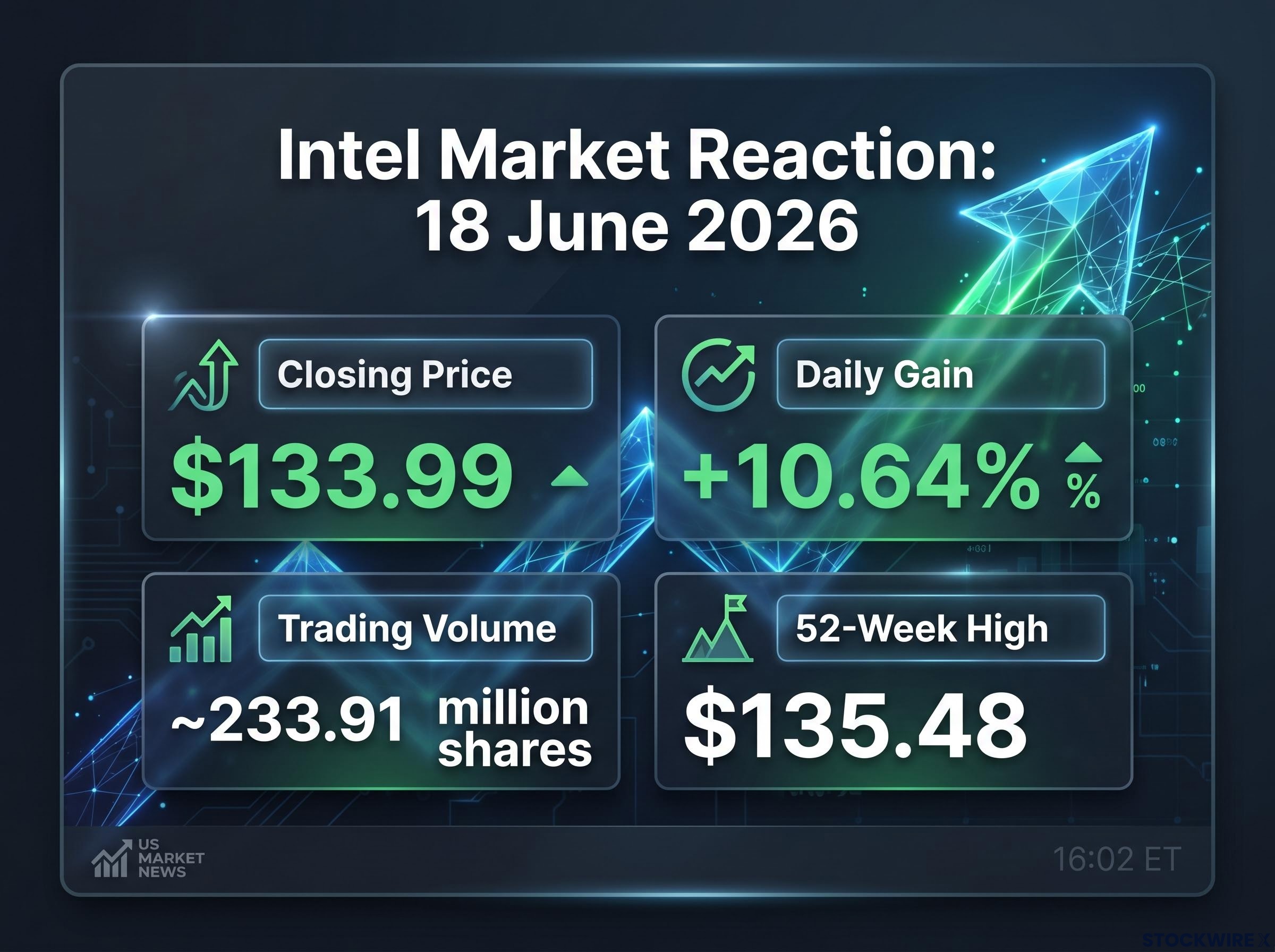
Intel closing price: $133.99 (18 June 2026), up 10.64% on the session.
Key confirmed market data:
- Closing price: $133.99
- Single-day gain: 10.64%
- Trading volume: approximately 233.91 million shares
- 52-week high: $135.48 (intraday, 18 June 2026)
The distinction matters. The stock did not move on the deal alone; it moved on the combination of commercial agreement and political validation, a signal that the Trump administration would actively support Intel’s foundry ambitions.
When big ASX news breaks, our subscribers know first
The Apple-Intel chip deal: what is actually agreed and what is not
Behind the headline sits a deal that is real but deliberately narrow in its initial scope. The agreement centres on Apple-designed chips manufactured on Intel’s advanced 18A process node, with production targeting entry-level or non-flagship silicon rather than the high-performance A-series or M-series chips that power iPhones and MacBooks.
TSMC retains production of Apple’s flagship silicon under the existing arrangement. The Intel partnership is supply-chain diversification, not displacement.
| Deal Parameter | What Is Confirmed | What Remains Open |
|---|---|---|
| Process node | Intel 18A | Whether future nodes will be included |
| Chip types | Entry-level, non-flagship Apple silicon | Expansion to flagship A-series or M-series |
| Production timeline | Volume production targeted for 2027 and beyond | Exact ramp schedule and initial volumes |
| TSMC’s role | Retains flagship Apple silicon production | Whether TSMC’s share contracts over time |
Timeline and what comes next
Volume production is targeted for 2027 and beyond, with full commercial impact expected to unfold over subsequent years. Scope expansion beyond entry-level chips depends on Intel demonstrating yield and performance parity with TSMC on customised Apple designs, a threshold that neither company has publicly confirmed Intel has met.
The talks between the two companies lasted more than a year before the May 2026 Wall Street Journal report surfaced the negotiations publicly.
Why Intel needs this deal more than Apple does (for now)
The asymmetry of this partnership explains the asymmetry of the stock reaction. Intel gained more than 10%. Apple’s move was comparatively modest. The gap reflects which company’s strategic thesis the deal validates.
Intel Foundry has spent years repositioning the company to compete with TSMC and Samsung as an external contract chipmaker. Landing Apple, the world’s highest-profile chip designer, as a customer is the marquee endorsement that entire strategy has been seeking. The 18A process node is the centrepiece of Intel’s pitch to prospective foundry clients, and an Apple commitment gives it credibility no press release could match.
Apple’s motivations are different in kind:
- Geopolitical hedging: U.S. national-security pressure to reduce concentration of advanced chip manufacturing in Taiwan
- Supply-chain diversification: Reducing single-source risk from exclusive TSMC reliance
- Political positioning: Aligning with the Trump administration’s “made in America” manufacturing agenda
Intel’s motivations reflect a company seeking validation:
- Foundry credibility: Proving 18A can attract the most demanding chip designer in the world
- Utilisation economics: Filling advanced-node capacity in newly built U.S. fabs
- Competitive positioning: Demonstrating parity with TSMC to attract additional fabless customers
Apple’s caution is visible in the deal’s limited initial scope. Entry-level chips first; flagship silicon only if Intel proves it can deliver.
The CHIPS Act foundation underneath this announcement
The Apple-Intel partnership did not emerge in a vacuum. It sits on top of a multi-billion-dollar federal programme that has been reshaping U.S. semiconductor manufacturing since its passage into law.
The CHIPS and Science Act is federal legislation that channels billions in grants and loans into domestic chip production, with Intel as a primary beneficiary. The law was designed to address a strategic vulnerability identified by U.S. defence and intelligence communities: the concentration of the world’s most advanced chip manufacturing in Taiwan, a region subject to geopolitical tension.
U.S.-China semiconductor trade tensions reached a near-term inflection point at the Trump-Xi summit in May 2026, where scenario analysis placed a 70% probability on partial de-escalation but flagged an asymmetric downside of 10-20% for the SOXX index under a hardening outcome, a risk profile that illustrates why policy-backed domestic production partnerships carry strategic value beyond their immediate commercial terms.
Intel’s active and planned fab expansions supported by CHIPS Act funding include:
- Ohio: New fabrication complex, the largest single private-sector investment in the state’s history
- Arizona: Expansion of existing advanced manufacturing facilities
- Oregon: Continued investment in process technology development
The Trump administration, inaugurated for its second term on 20 January 2025, has maintained a consistent industrial policy posture throughout 2025-2026, actively encouraging U.S.-based production partnerships between domestic manufacturers and global technology companies.
What the CHIPS Act means for Intel’s foundry economics
Federal subsidies reduce Intel’s capital risk on the 18A capacity buildout, improving the economics of taking on Apple as a customer even at initially limited volumes. CHIPS Act funding is specifically conditioned on domestic production, aligning Intel’s incentive structure directly with the Apple deal’s U.S. manufacturing framework.
The policy scaffolding means Intel is not bearing the full cost of the infrastructure Apple would rely on. That distinction matters for investors assessing whether Intel’s foundry business can reach profitability on the timeline the stock’s valuation now implies.
What investors should weigh before chasing Intel stock at record highs
The strategic significance of the Apple agreement is real. Whether it justifies buying Intel stock at $133.99, an all-time closing high, is a separate question that requires honest accounting of execution risks.
- 18A yield and performance against TSMC benchmarks: Intel must demonstrate that its 18A process can match TSMC’s leading nodes (N3 and N2) on yield, power efficiency, and transistor performance for customised Apple designs. This has not been publicly confirmed.
- Initial scope limited to entry-level chips: The deal covers non-flagship silicon. Revenue and margin contribution at this tier will be materially smaller than a full Apple silicon mandate.
- TSMC retention of flagship Apple silicon: TSMC remains Apple’s primary foundry partner for the chips that generate the highest volumes and margins. Intel is the secondary supplier, not the primary one.
- 2027 production timeline subject to ramp delays: Volume production is targeted for 2027 and beyond. Process technology ramps in the semiconductor industry frequently encounter delays, and Intel’s recent track record on node transitions has included setbacks.
The 18A-P node performance gains confirmed in Intel’s June 2026 risk production milestone, exceeding 9% higher performance and 18% lower power consumption relative to baseline 18A, represent the most direct technical evidence investors have ahead of the 2027 volume ramp, though risk production and volume production are distinct phases with different yield thresholds.
The near-term positive news from the Apple agreement was substantially priced into Intel’s record close on 18 June 2026. Longer-term stock performance will be determined by execution milestones through 2027 and whether the Apple relationship expands beyond entry-level chips.
This article is for informational purposes only and should not be considered financial advice. Investors should conduct their own research and consult with financial professionals before making investment decisions. Past performance does not guarantee future results.
A record high built on a promise: what comes next for Intel and the U.S. chip industry
The 18 June record high is not an endpoint. It is the opening of an execution contest that will play out over years rather than quarters.
TSMC and Samsung, Intel’s two primary foundry competitors, now face a scenario in which Intel has secured Apple’s implicit endorsement of 18A as a credible alternative to the processes they offer. TSMC may respond with pricing adjustments, capacity commitments, or accelerated geographic diversification of its own manufacturing footprint. Samsung Foundry will reassess its competitive positioning if Intel proves capable of executing Apple designs at scale.
TSMC’s wafer capacity advantage remains the most concrete measure of the distance Intel must close: Bank of America analysis placed TSMC’s 3nm output at approximately 180,000 wafers per month by end-2026, against an estimated 20,000-25,000 at Intel 18A, a roughly eight-times gap that defines what credible foundry competition would require Intel to narrow.
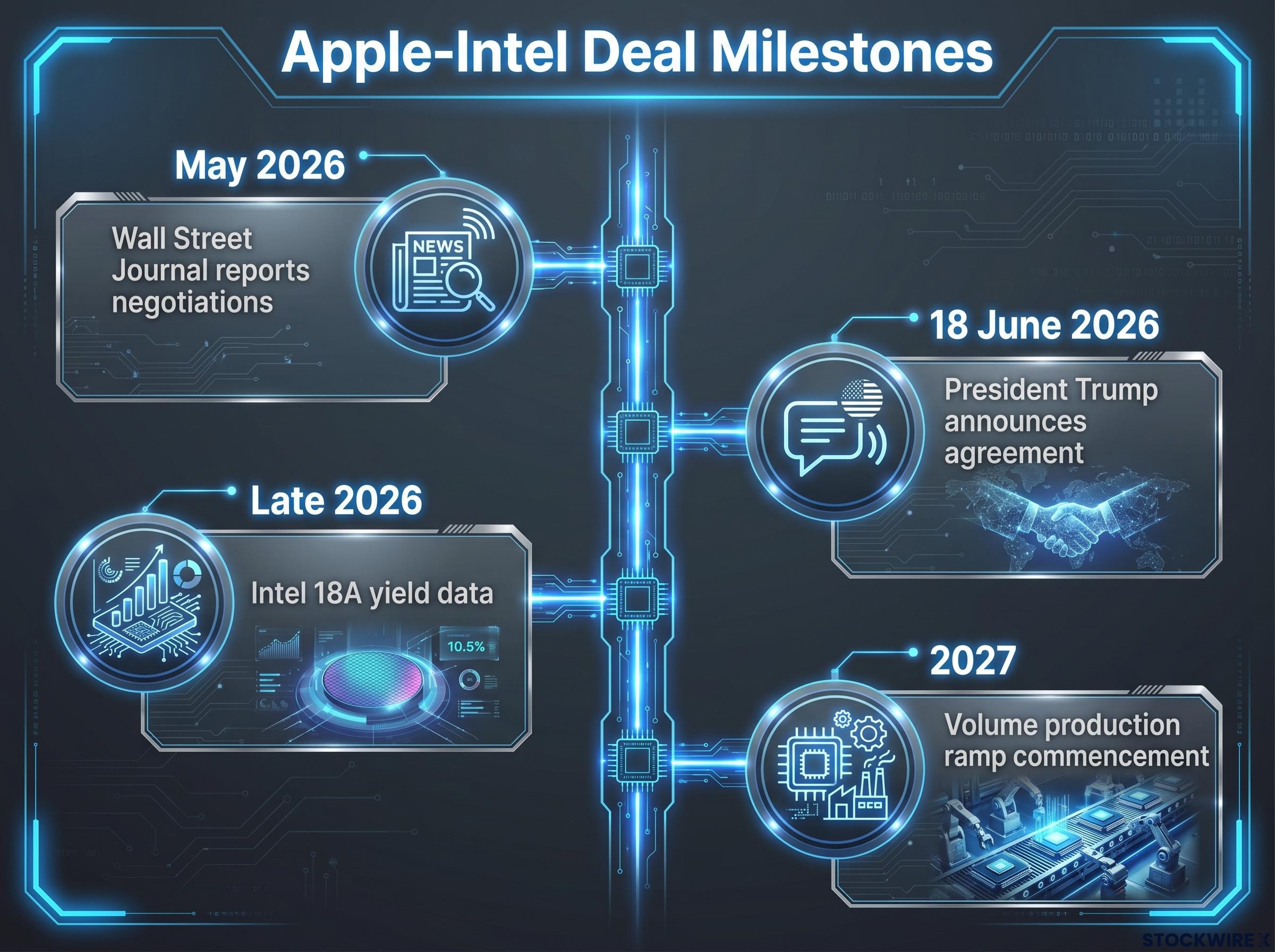
The milestones that will determine whether this deal expands from a limited entry-level arrangement to a broader Apple silicon mandate are specific and trackable:
- Late 2026: Intel 18A yield data, the first public indication of whether the process meets the performance thresholds Apple requires
- 2027: Volume production ramp commencement, the first proof point for commercial execution
- Post-2027: Any announcement of scope expansion to flagship Apple silicon, the signal that Intel has earned Apple’s full confidence
If the partnership executes successfully, it would represent the most significant shift in advanced chip manufacturing geography since Apple first moved its chip production to TSMC. That is the scale of the promise Intel’s record high is pricing in. Whether Intel delivers on it remains the open question.