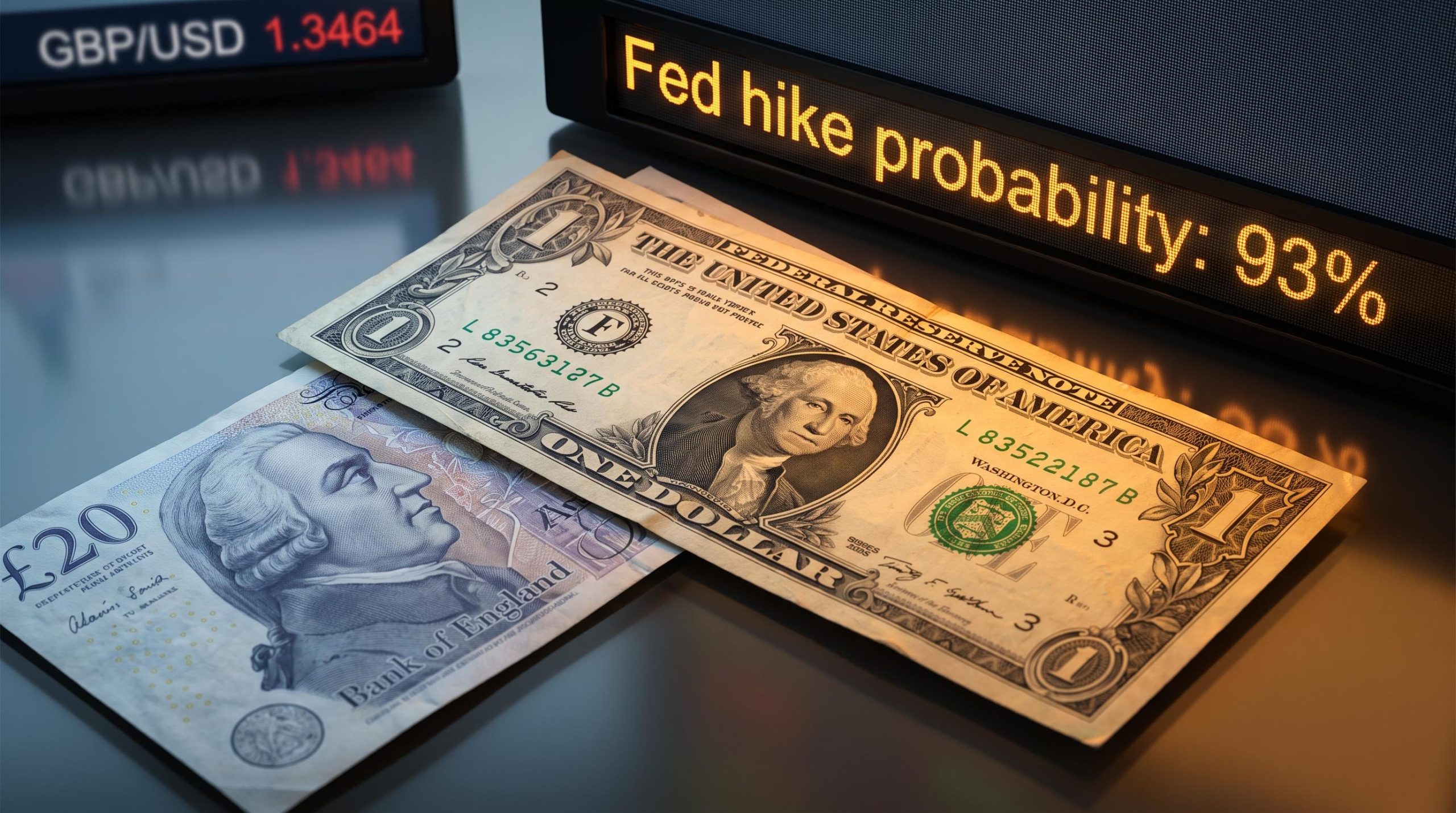
A 93% probability of a Fed hike priced in the week before the decision. A Bank of England widely expected to sit on its hands. And GBP/USD already grinding out a two-month low.
The market has made its call, and it has made it loudly.
Policy divergence between the Federal Reserve and the Bank of England is nothing new, but the current configuration is unusually clean. The Fed is leaning toward further tightening while the BoE holds amid firmer UK growth data, and that gap is producing one of the sharpest yield-spread setups of 2026. For anyone holding sterling assets, dollar-denominated positions, or cross-border exposure, the mechanics behind this move matter far more than the price ticking across the screen.
This piece gives you a working framework for the GBP/USD monetary policy divergence now driving the pair lower. Not just why sterling is falling today, but which specific variables to watch in the coming days to judge whether the pressure holds or snaps back the other way.
What the rate markets are actually pricing right now
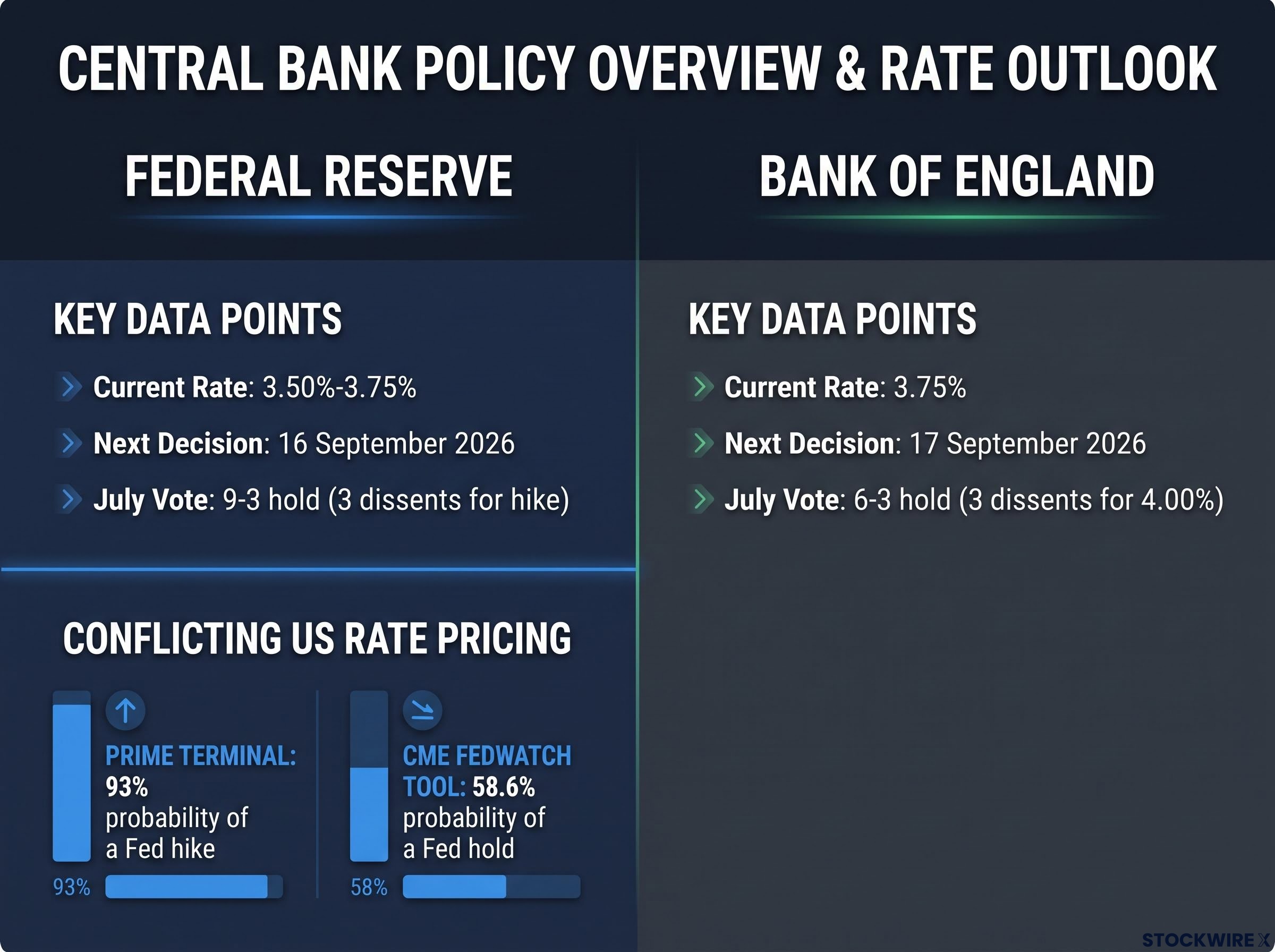
Two respected sources are telling two very different stories about the same central bank meeting. The original market data, drawn from the Prime Terminal, put the odds of a Fed hike from the 3.50%-3.75% range to 3.75%-4.00% at 93% for the 16 September 2026 decision. The CME FedWatch Tool, as of 25 August 2026, had it almost inverted: a 58.6% probability that the Fed simply holds.
A 93% probability of a Fed hike, according to the original market pricing. A competing source, the CME FedWatch Tool, puts the odds of a hold at 58.6%.
That contradiction looks like confusion. It is not.
Look at the structural evidence instead. At the July FOMC meeting on 28-29 July 2026, the committee held rates by a 9-3 vote, but three members, Beth M. Hammack, Neel Kashkari, and Lorie K. Logan, dissented in favour of an immediate 0.25 percentage point increase. Three governors publicly wanting to tighten is not market noise. It is tightening pressure baked into the committee itself.
The Bank of England is split too, just less aggressively. Its Monetary Policy Committee (MPC) voted 6-3 to hold Bank Rate at 3.75% at the meeting ending 29 July 2026, with the three dissenters pushing for 4.00%. Both committees have hawkish minorities. The difference is that external market pricing still tilts harder toward the Fed acting first.
The growing MPC hawkish bloc is more significant than a three-vote dissent count suggests: that minority has expanded from one dissenter in April 2026 to three by July, and five-year swap rates have already crossed 4.52%, meaning mortgage markets are pricing a hike ahead of any official decision.
| Central bank | Current rate | Latest vote and dissent | Next decision |
|---|---|---|---|
| Federal Reserve | 3.50%-3.75% | 9-3 hold; 3 dissents for a hike | 16 September 2026 |
| Bank of England | 3.75% | 6-3 hold; 3 dissents for 4.00% | 17 September 2026 |
Here is what the split readings actually tell you. The debate over whether the Fed hikes this week is the wrong thing to obsess over. What matters is the direction of travel, because even a hold delivered with hawkish language widens the forward rate differential and keeps sterling on the back foot. GBP/USD hit an intraday low of 1.3464, a roughly two-month trough, before settling near 1.3492, down 0.23% on the session. Read the tone of the statement, not just the yes or no on rates.
When big ASX news breaks, our subscribers know first
The yield-spread mechanism: why rate expectations move currencies
You can see the effect in the price. The harder question is why a rate decision that has not happened yet is already pulling GBP/USD down. The answer sits in how currency markets actually work.
Forex markets do not price today’s spot rates. They price forward expectations and how each central bank is expected to react to incoming data. That distinction is the whole game. Even if both the Fed and the BoE hold this week, a hawkish Fed statement set against a softer BoE outlook widens the forward interest rate differential in the dollar’s favour, and the currency moves on that gap.
The bond-to-currency transmission running through US Treasuries is not merely directional; a 100-basis-point positive surprise in US rates is historically associated with a 2.5%-5% appreciation in the dollar against major currencies, which contextualises why the 10-year yield crossing 5% carries more GBP/USD weight than any single FOMC vote.
The transmission chain runs like this:
- The Fed hikes or signals further tightening, so US Treasury yields rise relative to UK gilts.
- The US-UK yield spread widens, making dollar assets more attractive on a risk-adjusted basis.
- Global capital flows toward those higher-yielding dollar assets, lifting demand for USD.
- That demand pushes GBP/USD lower.
The current session data shows the mechanism live. The US Dollar Index, which tracks the dollar against a basket of six currencies, rose about 0.39% to around 99.47. More striking, the 10-year US Treasury yield pushed above 5% for the first time since 2023, driven by elevated US inflation data and worries over Middle East oil supply disruptions.
That 5% level is not just a headline number. It tells you the market is now demanding meaningfully more compensation to hold long-duration dollar assets, which feeds straight back into dollar demand and keeps the yield-spread dynamic working against sterling until the Fed explicitly signals a change of course.
When both banks hold but the signals diverge
A simultaneous hold does not cancel the divergence trade. If the two banks’ forward guidance pulls in opposite directions, the gap keeps widening regardless of what the headline decision says.
Markets read the Fed’s trio of hawkish dissenters as a floor under US rate expectations. Sterling, meanwhile, has cover for a longer hold rather than a pivot. UK GDP expanded 0.3% in July, above most economists’ estimates, and BoE Chief Economist Huw Pill described rates in a 3 September 2026 speech as “at about the right level for the time being.” Better UK data buys the BoE patience; it does not signal easing. That asymmetry is what keeps the pressure on GBP/USD even in a double-hold scenario.
Historical precedents that stress-test the divergence logic
The mechanism is clean in theory. History shows it is powerful in practice, but not unconditional. Three episodes run it in different directions, and the pattern that emerges is more useful than any single one.
Start with the cleanest analogue. Between 2015 and 2018, the Fed began hiking in December 2015 while the BoE held at 0.5% until late 2017. The resulting yield differential peaked around 175 basis points and coincided with sustained dollar strength and a weaker pound. That is what a prolonged, uninterrupted divergence looks like when nothing else gets in the way.
Now the counter-case. From 2013 to 2016, robust UK growth produced a positive UK-US yield spread that supported sterling, right up until Brexit risk detonated the trade. The spread flipped negative and the pound fell sharply. A domestic political and fiscal shock overrode the rate advantage entirely, without warning.
Then the most recent and directionally opposite example. In September 2025, markets priced Fed cuts while the BoE held, swinging yield spreads in sterling’s favour and driving GBP/USD higher. The mechanism works symmetrically, which means the current dollar-favoured setup is not permanent.
| Period | Fed stance | BoE stance | Spread direction | GBP/USD outcome |
|---|---|---|---|---|
| 2015-2018 | Hiking | Holding at 0.5% | Favoured USD (~175 bps) | Sustained sterling weakness |
| 2013-2016 | Steady | Growth-supported | Favoured GBP, then reversed | Rose, then fell on Brexit |
| September 2025 | Cutting expected | Holding | Favoured GBP | GBP/USD rose |
BoE MPC member Megan Greene has cited the early 1990s as an extreme benchmark, a reminder that severe divergence between major central banks can generate violent, outsized moves in foreign exchange.
The September 2025 reversal is the precedent that matters most if you are positioned in GBP/USD right now. It shows the current dollar-favoured trade can unwind fast once Fed expectations shift, and that timing that reversal is far harder than understanding why it happens. What breaks these trades is rarely the rate decision itself. It is the shift in forward expectations, or a domestic shock nobody was watching.
What could break the dollar’s grip on this trade
Follow the divergence logic and you land on a bearish-sterling conclusion. The discipline is in naming exactly what would flip it. These are not generic caveats. Each one has a specific trigger you can monitor yourself.
- BoE hawkish surprise. Three MPC members already voted for 4.00% in July, and the market may be underpricing the bank’s appetite to tighten against sticky services inflation. Any upside surprise in the UK employment data, due 15 September 2026, could reprice BoE expectations fast.
- Fed pivot. If US inflation moderates more quickly than expected, or Middle East supply pressures ease and pull energy prices down, the Fed’s hawkish stance loses its foundation. The yield-spread compression that follows would mechanically support GBP/USD.
- Positioning squeeze. Heavily short sterling positions leave the pair exposed to sharp short-squeezes on any surprising release. When both banks hold, GBP/USD tends to turn range-bound and volatile, which loads directional bets with asymmetric risk.
Dollar strength under fiscal pressure carries a conditional quality that the current yield-spread setup obscures: major banks including Convera, Nomura, and Bank of America are reading rising 10-year yields near 4.77% as a fiscal risk premium rather than an investment signal, a reading that would invert the normal yield-to-dollar relationship and complicate the bearish-sterling thesis.
Where institutional forecasters are landing
The forecasts themselves disagree, and that disagreement is informative. Scotiabank targets GBP/USD at 1.37 by the end of 2026 and 1.39 by the end of 2027, built on a broadly bearish long-term view of the dollar and limited BoE easing. Its notes from 8 and 10 September 2026, which should be treated as analyst commentary rather than confirmed data, point to sterling being supported by expectations of incremental BoE hikes into year-end.
Against that, near-term bears target 1.3300, treating rallies toward 1.3480-1.3500 as selling opportunities, with technical resistance flagged at 1.3520-1.3530 in early September analysis. Oxford Economics sits in the middle with a range-bound view dictated by global risk appetite.
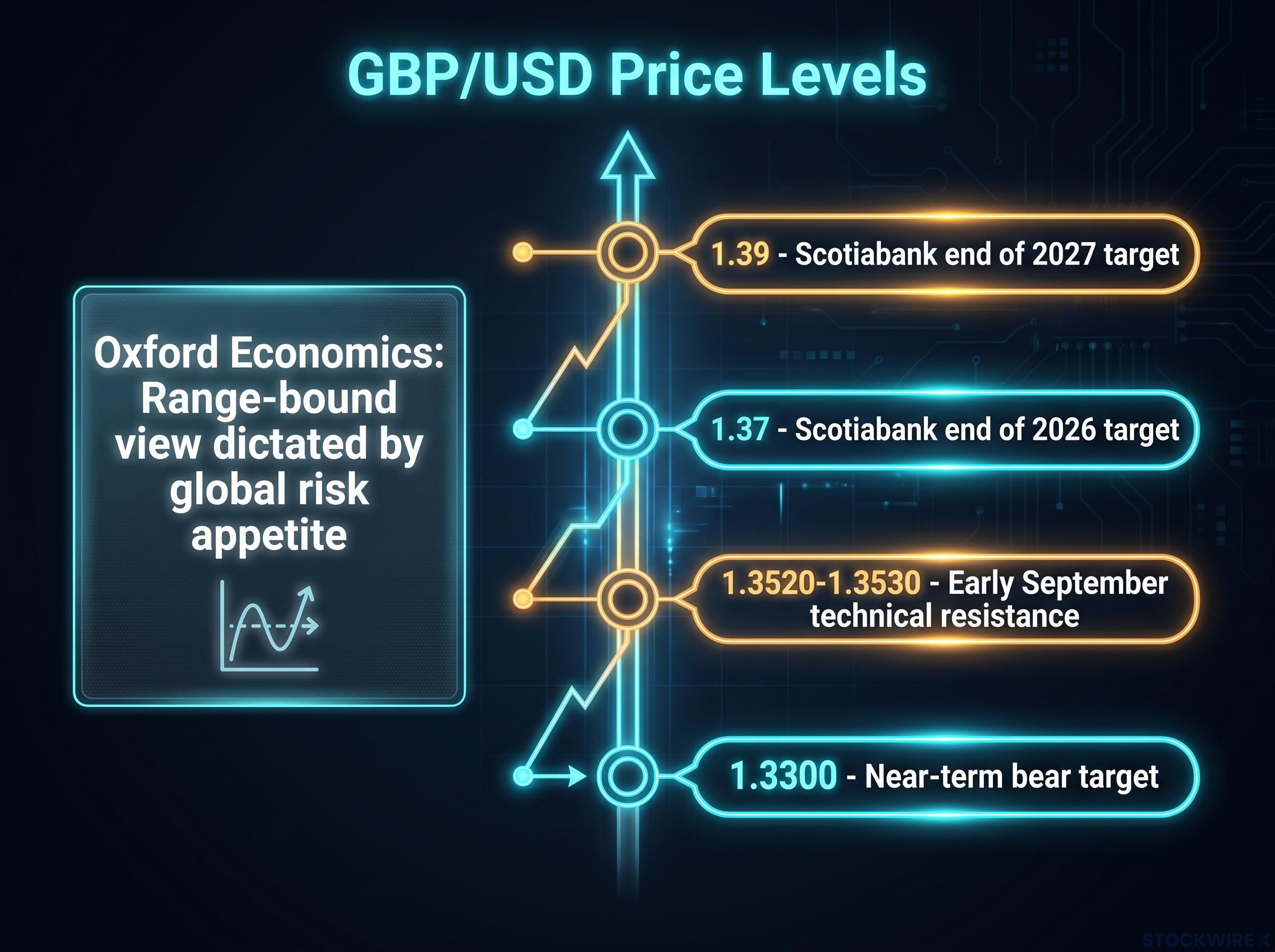
Scotiabank’s 1.37 target sits roughly 2% above current levels. If you hold sterling-denominated assets or have a GBP/USD conversion to plan, that gap between short-term bearish positioning and medium-term bullish institutional targets is itself a signal. It argues for thinking carefully about timing rather than reacting to the current low. The 15 September UK employment release is the next event most likely to shift the odds before the Fed and BoE decisions land within 24 hours of each other.
Making sense of the next 48 hours, and what they will not settle
Two central bank decisions this week will generate a wall of headlines. Most of them will be noise. The signal, if you have followed the argument, is narrower than the coverage will suggest.
GBP/USD’s current weakness reflects a forward yield-spread dynamic, not a simple spot-rate comparison. That means the pair’s direction after the decisions will depend more on the tone of the Fed and BoE statements than on the binary question of whether either hikes or holds.
Three variables will decide whether the pressure on sterling deepens, stabilises, or reverses:
- Fed statement tone. Watch the language on future hikes. Hawkish framing keeps the spread working against sterling even without an actual increase.
- BoE forward guidance. Given the UK GDP beat, look for whether the bank signals patience or leaves the door open to its hawkish minority.
- UK employment data, 15 September 2026. Released the day before the Fed decision, a strong print could reprice BoE expectations ahead of both meetings.
The binary hike-or-hold outcome matters less than the forward guidance language, because currency markets price expectations, not decisions.
With two decisions inside 24 hours and a major employment release in between, you are looking at an unusually compressed window of volatility. This framework is most valuable not for predicting the outcome but for reading whichever way the pair moves, and knowing whether that move reflects a genuine change in the divergence dynamic or just a short-term positioning flush. The mechanism working against sterling today was working in its favour only 12 months ago.
For investors wanting to position ahead of the Fed and BoE decisions rather than react after, our comprehensive walkthrough of reading macro events before they move currency markets covers OIS curve pricing, CFTC positioning data, and options risk-reversal skew, the three pre-announcement signals that reveal whether a trade is already crowded.
This article is for informational purposes only and should not be considered financial advice. Investors should conduct their own research and consult with financial professionals before making investment decisions. Past performance does not guarantee future results, and financial projections are subject to market conditions and various risk factors. Forecasts referenced here are speculative and subject to change based on market developments.