The Bank of Japan held its policy rate at 1.25% on 30 October 2026, yet it spent the meeting sounding more concerned about inflation running too hot than too cold. One board member, Hajime Takata, voted to raise rates to 1.50% immediately.
That combination makes this a hold with a tightening tilt. The Bank of Japan (BoJ) has stopped asking whether Japan should normalise policy after decades of near-zero rates. The question now is how fast and how far it goes.
The December meeting is live. Most forecasters now expect the next BoJ rate hike there, and Governor Kazuo Ueda did nothing to rule it out.
Here is what the hold signals about the timing of that move, and why hawkish language has not translated into a stronger yen.
Why the BoJ now fears an overshoot, not just a shortfall
The 8-1 vote was the visible crack. Takata wanted 1.50% now, and the rest of the board’s reasoning explains why his position no longer looks isolated.
The BoJ judged underlying inflation to be broadly in line with its 2% goal and said the balance of risks had changed. For years it guarded against inflation falling short. It now says it must also guard against an overshoot, meaning inflation settling above target.
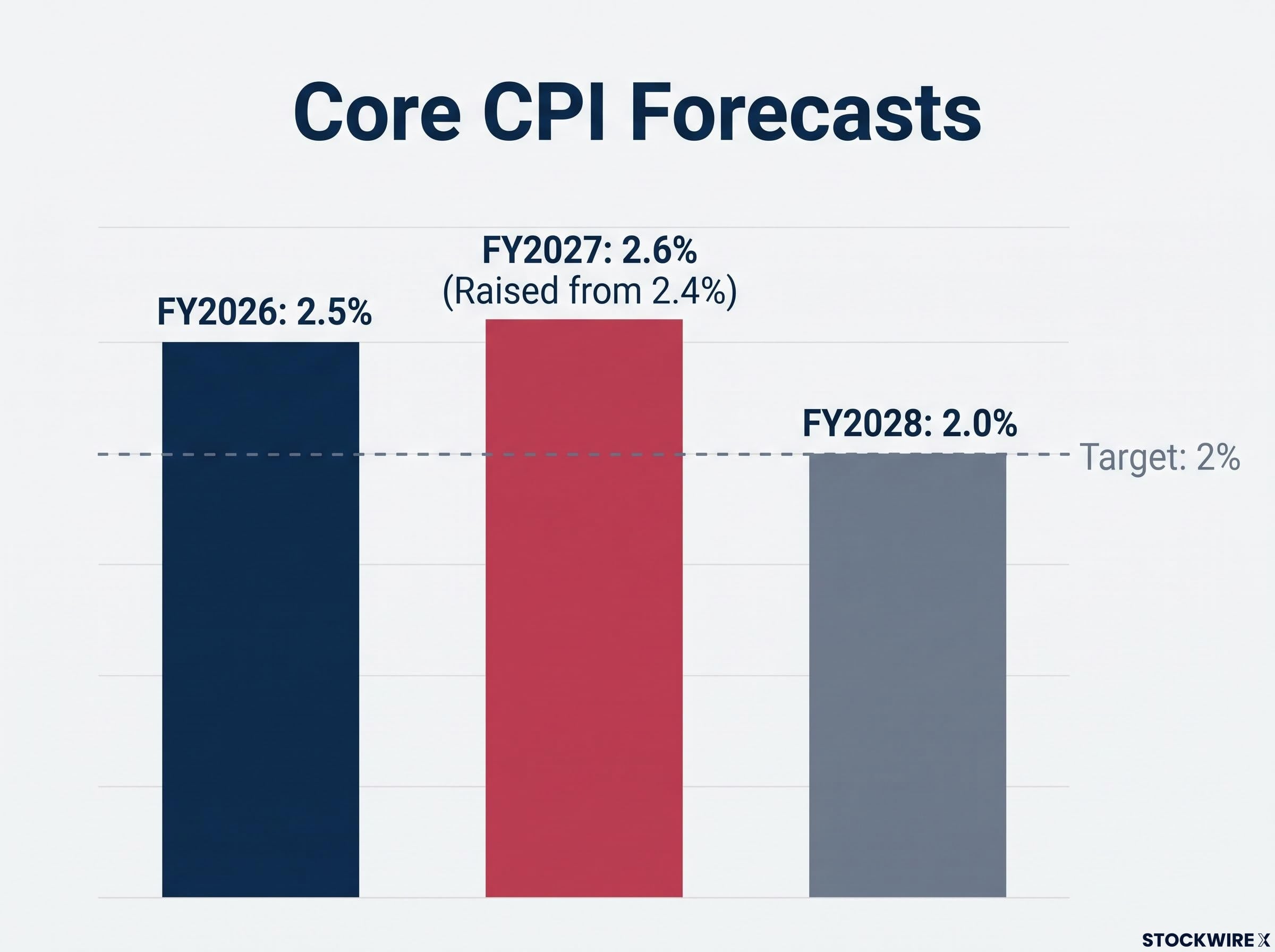
The forecast revision shows the shift. Core CPI (the consumer price index excluding fresh food) is projected as follows, with Japan’s fiscal year running April to March:
| Fiscal year | Core CPI forecast | Change |
|---|---|---|
| FY2026 | 2.5% | Unchanged |
| FY2027 (year ending March 2028) | 2.6% | Raised from 2.4% |
| FY2028 | 2.0% | Unchanged |
Growth stays modest at around 0.7% for both FY2026 and FY2027. The BoJ points to four inflation drivers:
- Crude oil prices
- Continued pass-through of wage gains into prices
- Higher semiconductor prices tied to global AI demand
- Yen weakness lifting the cost of durable goods
Reuters labelled the outcome a “hawkish hold”. Krishna Bhimavarapu of State Street Investment Management argues wages, prices and consumption are now reinforcing one another.
The BoJ does not believe inflation is permanently too high. But with real rates (the policy rate minus inflation) still negative, the raised forecast tells you the board sees current settings as too loose if prices stay above 2%. The burden of proof has shifted towards further tightening.
What Ueda said about the next BoJ rate hike
Ueda called the hold a pause. The word sounds reassuring, but he framed it as time to assess the effects of earlier hikes rather than an end to tightening.
Ueda’s message, paraphrased: The pause is not a commitment to stop raising rates. Every meeting, including December, remains open.
He said he cannot declare success until inflation is stable and sustainable around 2%, and rejected passively waiting for prices to rise. He flagged the Middle East, currency swings and AI demand as overshoot risks. He also refused to commit to December or to any fixed schedule.
Forecasters have filled that gap themselves:
| Source | Date | Expectation |
|---|---|---|
| Reuters poll | 20 October | About 70% (54 of 78) expected 1.50% this quarter |
| Vanguard | 26 October | 1.50% by end-2026 |
| CNBC survey | 30 October | All 16 economists expected groundwork for a December or January hike |
| Equiti | 30 October | 83% expected December, up from 35%; some see March and July 2027 hikes towards 2.00% |
Analyst scenarios put the terminal rate, the level where hikes stop, at roughly 1.75-2.00%. These are not BoJ forecasts. Precedent supports the hawkish reading: the September 2025 hawkish hold preceded a later hike, and the June and September 2026 increases came faster than the 2024-25 pace.
Without a fixed schedule, wage, energy and yen data between now and December will move the odds. Those are the inputs worth tracking.
How markets read the hold, and what it means for USD/JPY
The yen rallied briefly. USD/JPY slipped from about 157.79 to 157.12, and Bloomberg showed the yen up as much as 0.4% to 157.15 before most of that faded. It later traded near 157, up about 0.2% for October.
The 10-year Japanese government bond (JGB) yield fell about 5.5 basis points to 2.780%, its lowest close since 6 August. FXStreet’s Joseph Trevisani said the market was slightly disappointed by the hold, with the Fed’s policy bias offsetting the yen’s modest gain. After the July 2026 hold, the yen weakened immediately.
Hawkish direction does not guarantee a stronger yen, for several reasons:
The rate differential between the US and Japan remains the structural driver here, which is why a 250-275 basis point gap in favour of the dollar can leave the yen weak even after the BoJ delivers a hike.
- The US-Japan interest rate gap remains wide
- The Fed’s stance can outweigh BoJ signals
- Carry trades (borrowing cheaply in yen to buy higher-yielding assets) keep selling pressure on the currency
- Global risk sentiment can swamp domestic policy news
Higher rates also bite at home. Floating-rate borrowers, leveraged property firms and smaller companies face rising debt-service costs. Faster tightening could spill into global yields and trigger carry-trade unwinds.
If you hold yen exposure, the muted reaction suggests a December hike is largely priced in. The currency likely needs a further surprise or a shift in Fed expectations to move meaningfully.
What to watch before the December BoJ meeting
This hold changed the question from whether the BoJ tightens again to when. Ueda left that answer to the data, which puts four signals at the centre:
- Wage data: confirmation that pay gains are feeding prices.
- Energy prices: Middle East tensions are Ueda’s most repeated overshoot risk.
- USD/JPY levels: further yen weakness strengthens the case for a hike.
- The Fed’s path: it shapes the rate gap that drives the yen.
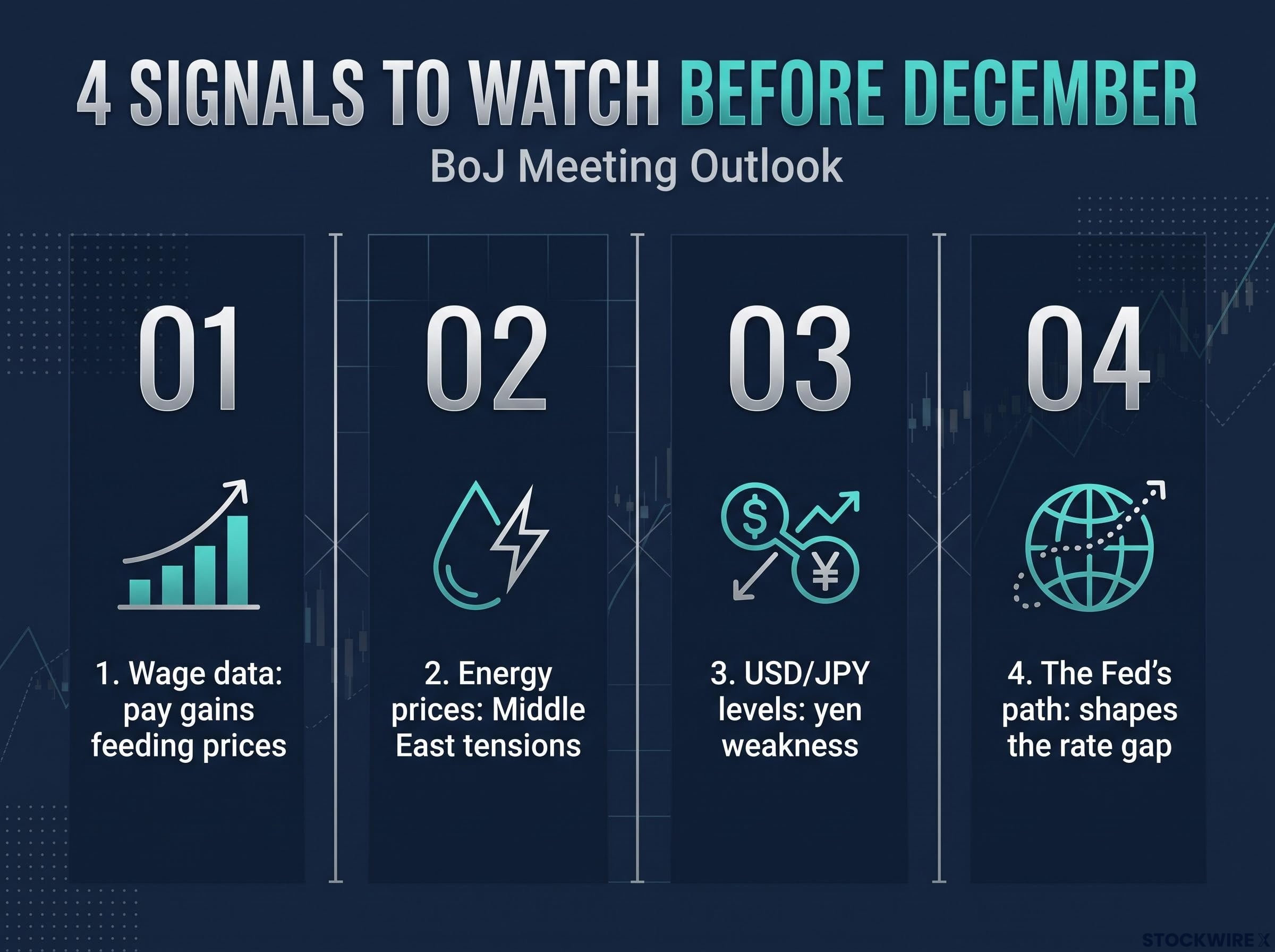
If those line up, December becomes the natural moment for the board to act.
Wage and inflation data have been running firm, with July total cash earnings up 4.7% year-on-year, the strongest gain since January 1997, and real wages rising for a seventh consecutive month.
This article is for informational purposes only and should not be considered financial advice. Investors should conduct their own research and consult with financial professionals before making investment decisions. Past performance does not guarantee future results. Financial projections are subject to market conditions and various risk factors.