The Bank of Thailand has left its policy rate at 1.00% for a fourth straight meeting, and on paper nothing has changed. The committee’s language has, though. It has quietly stepped away from the dovish tone that defined the past two years, and that shift in wording tells you more than the unchanged number does.
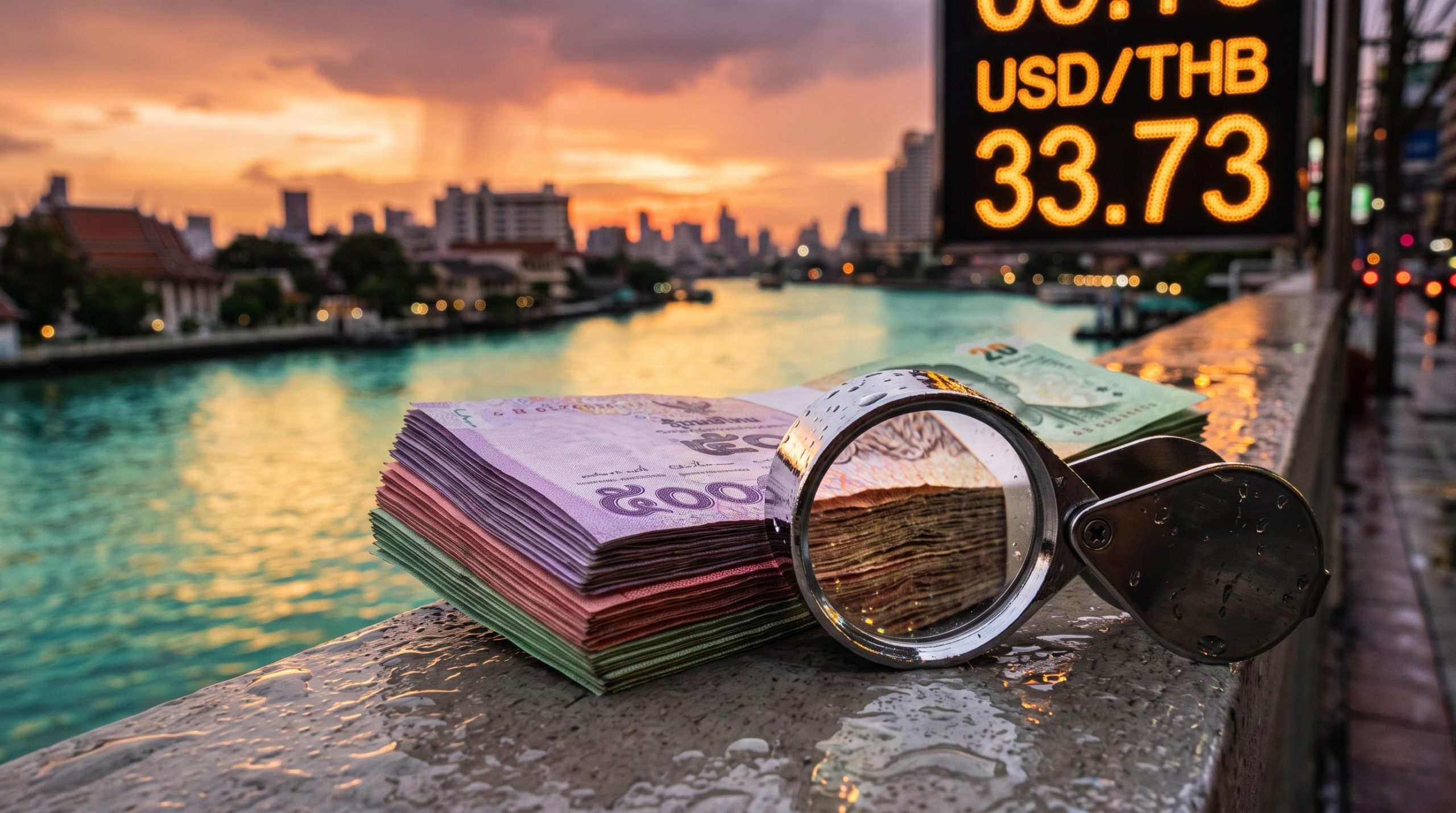
The decision came on 28 October 2026. The vote was 6-0, and markets expected it. The baht reacted little, with USD/THB sitting at about 33.73, close to the top of the 32.50-34.00 range it has held for five months.
That combination matters if you hold Thai assets or follow emerging-market currencies. A central bank on pause while its currency leans weaker is not standing still. It is choosing which risk to tolerate.
Here is how a rate on hold and a currency under pressure connect, and which signals would change the picture.
What did the Bank of Thailand actually signal in its fourth straight hold?
The headline number looks dull. The Monetary Policy Committee (MPC), the Bank of Thailand’s rate-setting panel, kept the one-day repurchase rate at 1.00%. One member was absent. The rate has sat at that level since 25 February 2026, when a split 4-2 vote cut it from 1.25%.
That February cut was the last of six cuts totalling 150 basis points (bp) between October 2024 and February 2026. A basis point is one-hundredth of a percentage point. The rate is now at its lowest since September 2022.
| Date | Decision | Vote | Tone/Key point |
|---|---|---|---|
| 25 February 2026 | Cut 25 bp to 1.00% | 4-2 | Growth below potential; downside inflation risks rising |
| 28 October 2026 | Hold at 1.00% | 6-0 | Less dovish; warns on financial-stability risks |
The October statement described the recent rise in inflation as temporary and supply-driven. It then went further, warning that keeping rates low for too long could build long-term financial-stability risks. It also stressed the need to preserve policy space, meaning room to cut later if a shock arrives.
Core inflation, which strips out volatile food and energy prices, ran at 1.50% year on year in September 2026. The bank’s growth forecasts stand at 2.4% for 2026 and 2.1% for 2027. Neither figure argues for tightening yet.
Officials have been making the same point. Assistant Governor Don Nakornthab called policy “very, very accommodative” and said rates might rise step by step as the economy strengthens. Deputy Governor Piti Disyatat went further, in comments reported by Bloomberg.
Piti Disyatat, Deputy Governor, Bank of Thailand The bank is unlikely to cut below 1.00% without a major shock, and rates will eventually rise as policy normalises, making the current level a practical floor.
Commerzbank’s Charlie Lay sees no imminent hike. In his view, a change would need either a lasting rise in core inflation or a broad recovery. Reuters and Bloomberg surveys point to a hold through end-2027, though JPMorgan, OCBC and Bank of America see a growing chance of tightening in 2027.
The question has moved from “when is the next cut” to “when might it raise”. For you, that means treating 1.00% as a floor, not a stop on the way to further easing.
When big ASX news breaks, our subscribers know first
How does a low policy rate move a currency in an emerging economy?
Most readers carry a simple rule: low rates mean a weak currency. That rule is partly right. To see where it breaks down, you need to see the separate channels at work.
- Rate differential. Thailand’s 1.00% sits against a US Federal Reserve range of 3.75-4.00%, a gap of roughly 275-300 bp. Money tends to flow towards the higher return, which pushes USD/THB up. The Fed held on 28 October 2026 by a 10-2 vote, with two members preferring a 25 bp hike, so the gap may not narrow soon.
- Oil. Thailand is a net energy importer. Higher oil means more dollars spent on imports. Reuters put Brent at about US$115.32 and US crude at US$102.78 on 28 October.
- Current-account surplus. The current account measures money flowing in from exports, tourism and income against money flowing out. When it runs a surplus, foreigners need baht, which supports the currency.
- Why the offset is not automatic. In the short run, capital flows and dollar strength can swamp trade receipts. Reuters tied recent baht weakness mainly to a stronger dollar and outflows from Thai equities, not to trade.
The lesson is about timing. Rate gaps and capital flows act within days. A trade surplus works over quarters.
Research on how US yields transmit to emerging market currencies finds that reserve buffers and external balances largely determine how much damage a dollar rally does, which is why the Thai current account matters here.
When you see a headline about the baht, ask which channel is driving it. That question lets you judge the move rather than react to it.
Why a weak baht is not all bad
A softer currency makes Thai goods and holidays cheaper for foreign buyers. Don Nakornthab has said a weak baht helps exports, provided its movement stays orderly rather than volatile.
The cost is imported inflation, especially with oil this high. The bank appears willing to accept that trade-off for now, which also explains its relaxed language on supply-driven price rises.
Where does the baht stand, and what is pulling it?
Start with the level. FXStreet put USD/THB at about 33.73 on 30 October 2026, flat on the day and near the ceiling of its five-month range.
Then add the pressures one at a time. The Fed is holding firm with a hawkish minority. Oil is above US$115. Thai rates sit among the lowest anywhere. Commerzbank sees continued downside pressure on the baht from all three, with the currency likely to stay sensitive to dollar moves and energy prices in the near term.
The oil and yield channels reinforce each other for net importers like Thailand: expensive crude widens the current-account gap just as high US yields pull capital away, which is why the baht stays sensitive to both.
The trade side offers no immediate help. Thailand ran a current-account deficit of US$12.8 billion in the first five months of 2026, according to the bank’s Q2 report.
| Driver | Direction for baht | Time horizon | Source |
|---|---|---|---|
| US-Thai rate gap (275-300 bp) | Weaker | Near term | Fed, Bank of Thailand |
| Brent near US$115 | Weaker | Near term | Reuters |
| Dollar strength and equity outflows | Weaker | Near term | Reuters |
| Expected 2027 current-account surplus | Stronger | Medium term | Bank of Thailand, Commerzbank |
Three of the four forces lean the same way. The picture is a currency pinned near the weak edge of its range by short-term forces, with one slower force pushing back.
The 2027 surplus: support or wishful thinking?
The bank expects the current account to return to surplus in 2027 on lower energy costs and a tourism recovery. FXStreet, summarising Commerzbank’s view, cites a surplus of US$18 billion. That specific figure did not appear in the official bank publications reviewed, so treat it as Commerzbank’s and FXStreet’s number rather than an official target.
The two camps stress different things. Commerzbank leans on the surplus as medium-term support. Reuters and bank commentary stress near-term rate gaps, the dollar and capital flows. A surplus may limit sustained weakness, but it does not promise a stronger baht next month.
A currency pair near the edge of its range is at a decision point. Watch for what could break the range instead of assuming it will hold.
What would end the pause, and which way could it break?
The base case is calm. Most forecasters expect 1.00% through 2027, held there by weak consumption and household debt at 85.2% of GDP at end-June 2026, among Asia’s highest.
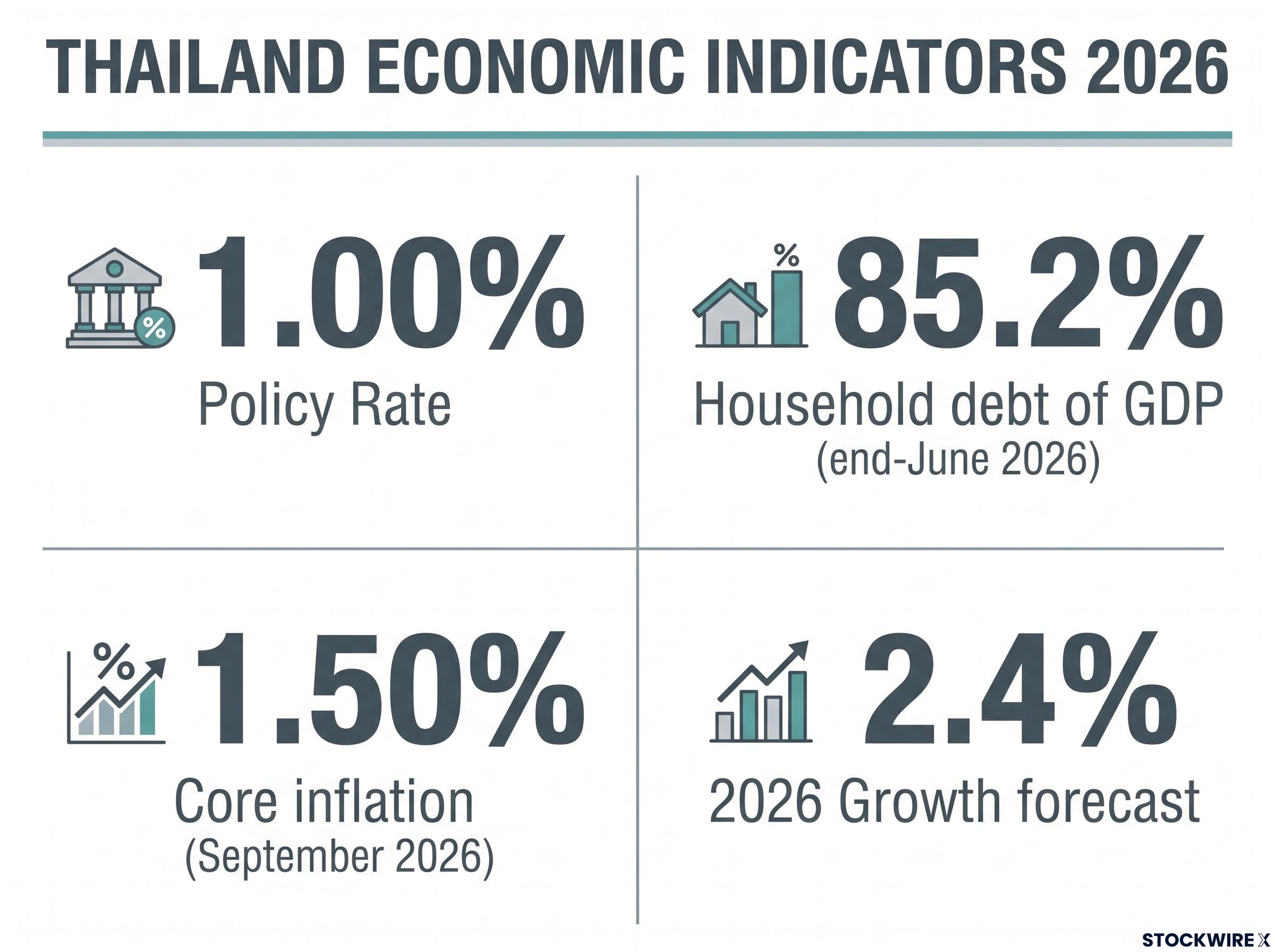
Don Nakornthab has called that debt a major structural problem. Without fixing it, he said, getting back to potential growth of about 2.7% would be difficult. The bank is leaning on targeted relief, such as the “Clear Debt, Going Forward” scheme covering 182,000 loan accounts, rather than broad rate cuts.
A hike becomes more likely if growth strengthens, if a surplus drives persistent baht appreciation, or if financial-stability worries become pressing. Oil complicates this. Expensive fuel lifts headline inflation but drains household spending, so tightening into it could choke demand further.
A cut would likely need a sharp slide in growth, an oil shock that crushes demand, or a wider global shock. Officials have signalled a high bar for that.
| Scenario | Trigger | Likely BoT response | Baht implication |
|---|---|---|---|
| Base case | Weak demand, high household debt | Hold at 1.00% | Range-bound, sensitive to dollar and oil |
| Hike | Broad recovery, lasting core inflation, stability risks | Gradual, step-by-step increases | Support as the rate gap narrows |
| Cut | Sharp growth slump or global shock | Easing below 1.00% | Added downside pressure |
These scenarios are speculative and subject to change based on market developments and economic data. The variables that decide between them are few:
- Core inflation: a sustained climb above 1.5% would test the “temporary” framing.
- Growth breadth: whether recovery spreads beyond tourism into household spending.
- Brent crude: the swing factor for inflation, the current account and the baht at once.
What a long pause tells you about the baht and Thai policy
The October hold confirms 1.00% as a floor-like setting. The bank is no longer signalling open-ended easing, and its tone points towards gradual normalisation, though not soon.
For the baht, the drivers are clear: the US-Thai rate gap, oil, the dollar, capital flows and whether the expected 2027 surplus actually arrives. Near-term forces lean weaker; the surplus is the slower counterweight.
Your decision points come down to three things. Read the wording of the next MPC statement for any firmer language on normalisation. Track monthly core inflation prints. Keep an eye on Brent, because it moves every other piece of this puzzle.
This article is for informational purposes only and should not be considered financial advice. Investors should conduct their own research and consult with financial professionals before making investment decisions.