A central bank that leaves interest rates alone looks like it is doing nothing. Bank Negara Malaysia (BNM) held its benchmark rate at 2.75% on 5 November 2026 and raised its growth view to above 5%. A day later, Commerzbank said it still expects a 25 basis point hike to 3.00% in Q1 2027.
That gap between a calm rate decision and a forecast hike is where the real story of this Bank Negara Malaysia rate decision sits. The rate in question is the Overnight Policy Rate (OPR), the interest rate BNM sets to steer borrowing costs across the Malaysian economy.
This was BNM’s final scheduled meeting of 2026, and the OPR has not moved since a cut in July 2025. The statement leaned mildly hawkish, meaning it was a little more focused on inflation risk, but it did not signal that a hike is close. According to Bloomberg, 17 of 23 surveyed economists expected the hold, so the outcome matched the majority view.
Here is why a hold today and a hike in a few months can both make sense. You will see how a central bank chooses between waiting and acting early, and what the expected path means for the ringgit and for your investment decisions.
What did BNM actually decide, and how hawkish was the tone?
The headline was simple. BNM’s Monetary Policy Committee (MPC), the group that sets the OPR, kept the rate at 2.75% and said that level remains consistent with price stability and sustainable growth.
The data behind that judgement looks strong.
| Measure | Latest figure | What it signals |
|---|---|---|
| Q3 2026 GDP (advance estimate) | 5.3% y/y, down from 6.0% in Q2 | Growth slowing from a fast pace but still firm |
| 9M 2026 GDP | 5.5% vs 4.8% in 9M 2025 | A clear step up on last year |
| 2026 growth view | Above 5% | BNM is more confident than in September |
| YTD headline inflation | 1.8% | Price rises remain contained |
| YTD core inflation | 1.9% | Underlying pressure is modest, not absent |
Core inflation strips out volatile items such as fresh food and administered prices, so it gives you a cleaner read on underlying price pressure. In September, headline inflation ran at 1.8% and core at 1.7%.
Distinguishing headline versus core inflation is the same discipline policymakers elsewhere apply, because rate tools have no transmission channel to energy-driven price spikes that never reach underlying prices.
Reading the wording changes
In September, BNM described 2026 growth as “around 5%”. In November, it said “above 5%”, pointing to strong exports, steady domestic demand and investment. For 2027, it cited the global technology upcycle, tourism and Budget 2027 measures, though it issued no new numeric forecast.
On inflation, the language grew more alert. BNM named geopolitical developments, elevated global commodity prices and adverse weather as upside risks, yet it offered no explicit guidance toward a hike. Six of the Bloomberg-surveyed economists had expected one anyway.
Keep in mind that the Q3 figure is an advance estimate and can be revised. The Department of Statistics Malaysia (DOSM) releases its detailed Q3 figures on 18 November 2026.
A hold paired with a firmer growth description tells you BNM sees less need to protect the economy. It is quietly watching for the point where support turns into overheating.
When big ASX news breaks, our subscribers know first
Why does BNM prefer vigilance over pre-emptive action?
If growth is strong and inflation risks are rising, why not hike now? The answer lies in how central banks weigh three things: how strong growth is, how high inflation is, and whether price pressure is spreading.
The distinction that matters most is between two kinds of inflation. A supply shock comes from outside, such as higher imported oil or food costs, and raising rates does not directly fix it. Demand-driven inflation comes from strong spending, fiscal support and businesses’ ability to raise prices, and that is what rate hikes are designed to cool.
BNM’s stance rests on five connected reasons:
- Above-trend growth raises demand-side risk. Growth above 5%, strong exports and fiscal support can give firms more room to pass on costs.
- Commodity inflation is a supply shock. A premature hike could weaken spending without removing the imported pressure.
- Second-round effects are the trigger. These happen when higher costs feed into wages, services prices, broader core inflation and people’s expectations.
- Vigilance preserves optionality. Holding lets BNM see whether pressure broadens without damaging growth needlessly.
- The July 2025 cut was insurance. It guarded against external risks rather than responding to collapsing inflation.
Waiting, in other words, is an active position. The next move depends on whether cost pressures spread, and that is the thing for you to track.
Why the July 2025 cut matters here
BNM cut the OPR by 25 basis points to 2.75% in July 2025, calling it a “pre-emptive measure” to protect steady growth from external risks. Before that, the rate sat at 3.00%, where it had been in July 2024. That level followed four consecutive 25 basis point hikes in 2022, which took the OPR to 2.75% by November 2022.
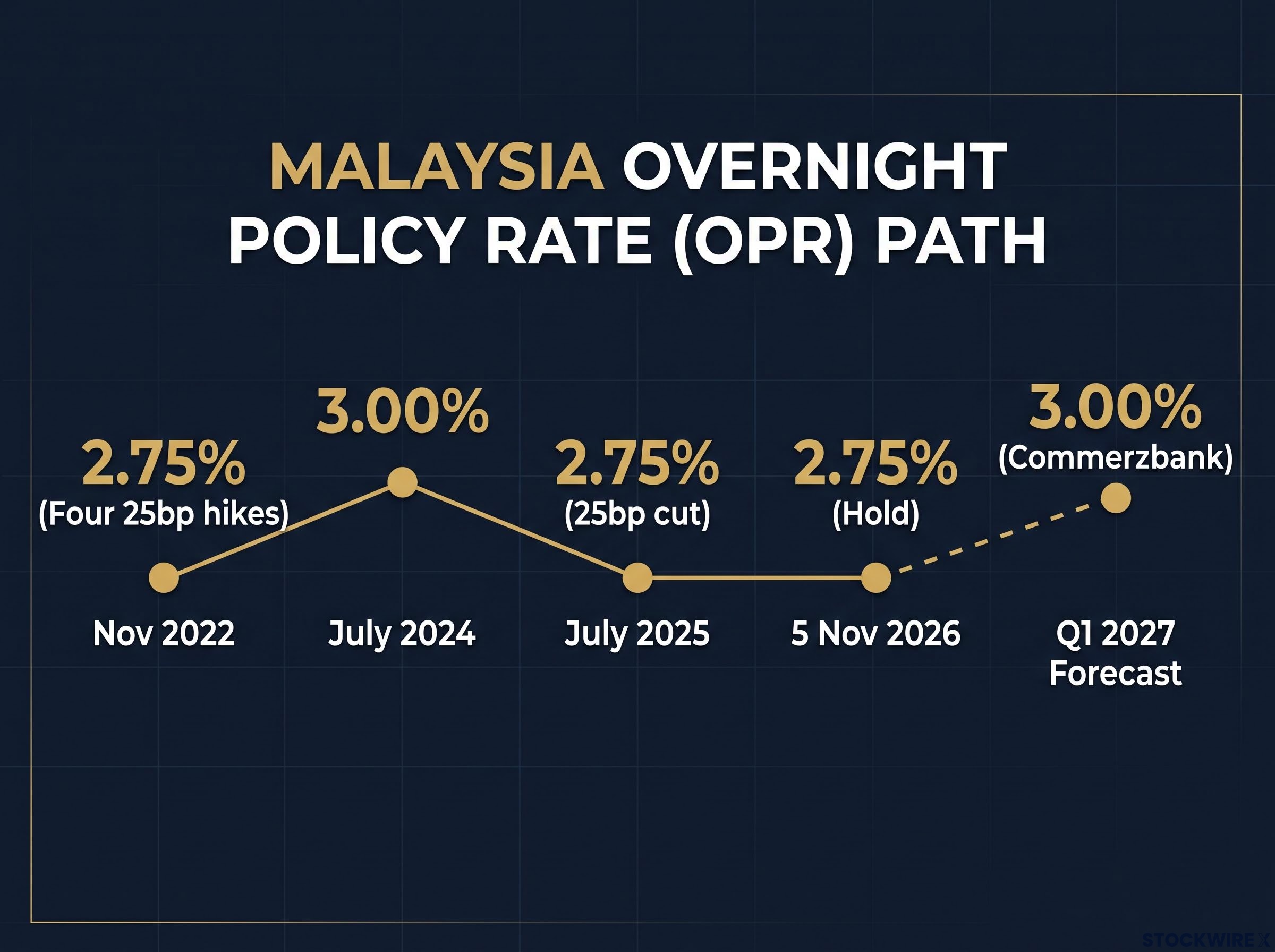
Commerzbank’s forecast of a 3.00% rate in Q1 2027 represents a return to July 2024 levels, following the 25bp cut to 2.75% in July 2025.
Commerzbank reads a 2027 hike as reversing that insurance once downside growth risks fade. Stephen Innes of SPI Asset Management frames it the same way.
Stephen Innes, SPI Asset Management A move to 3.00% would be normalisation, not aggressive tightening.
That framing matters for you. A return to 3.00% would restore a recent setting rather than launch a 2022-style cycle.
The same logic applies globally: the pace of tightening often matters more to equity returns than the direction, with mild cycles historically supporting stocks while aggressive ones have produced sharp losses.
Why does Commerzbank expect a hike in early 2027, and who disagrees?
Commerzbank economists Charlie Lay and Dr. Henry Hao set out their case via FXStreet on 6 November 2026. They expect a 25 basis point hike to 3.00% in Q1 2027, possibly at the March meeting, as a gradual step toward a neutral stance.
Their reasoning combines above-trend growth with rising inflation risks. Timing, they say, hinges on whether higher input costs turn into lasting underlying inflation.
Widen the lens and the debate narrows quickly.
| Institution or economist | View | Timing |
|---|---|---|
| Commerzbank (Lay, Hao) | 25bp hike to 3.00% | Q1 2027, possibly March |
| Maybank IB Research | Hike more plausible as inflation rises from about 1.9% to 2.2% | Early 2027 |
| Hong Leong IB | 25bp hike, not an aggressive cycle | 1H 2027, probably later in the half |
| BIMB Research | Hold at 2.75% | For now |
| RHB | Hike cannot be ruled out | Data dependent |
Dr Mohamad Idham Md Razak of Universiti Teknologi MARA (UiTM) backed a November hold but sees a hike possible in 2027. CIMB and Hong Leong also flag 2027 hikes as possible.
Nobody in this group disputes that the economy is strong. The disagreement is whether to act before second-round effects appear or after.
These are the 2027 MPC meeting dates to note:
- 21 January
- 4 March
- 6 May
- 8 July
- 9 September
- 4 November
Because most forecasters cluster around a gradual move in 2027, you can treat a hike as the base case to plan around. The exact month is the uncertain part.
What could bring the hike forward or push it back?
A forecast is a conditional path, not a date in the diary. The useful skill is knowing which signals would shift it.
Signals that pull a hike forward
Watch core inflation first, currently 1.9% year to date. If it accelerates while domestic demand stays unusually strong and Budget 2027 measures lift consumption, the case for March strengthens. Persistent commodity rises, or a ringgit weak enough to push up import prices, would add to that pressure.
Signals that push it back
A weaker technology cycle or US tariffs that damage exports would argue for patience. So would a Federal Reserve that keeps global financial conditions tight, or headline shocks that never reach core inflation.
| Signal | Direction | Effect on timing |
|---|---|---|
| Core inflation | Accelerating | Earlier hike |
| Domestic demand and fiscal support | Stronger than expected | Earlier hike |
| Commodity and food prices | Persistent rises feeding core | Earlier hike |
| Subsidy rationalisation | Embeds in wages and expectations | Earlier hike if it spreads |
| Technology cycle and US tariffs | Weakening exports | Later hike or hold |
| Federal Reserve path | Conditions kept tight | Later hike or hold |
One rule cuts through the noise. A temporary energy spike alone does not justify a hike, while sustained pass-through into core inflation would.
BNM expects inflation to edge higher in 2027 but stay contained. Tracking core inflation and the Fed’s direction gives you an early read on whether a March move is gaining or losing likelihood.
What does the expected rate path mean for the ringgit and for investors?
Rate moves matter to you most through the currency and bond markets. Here the forecast is deliberately undramatic.
Commerzbank’s ringgit view USD/MYR is expected to consolidate in the 4.00-4.10 range in the near term.
USD/MYR is the number of ringgit one US dollar buys. Commerzbank says direction will depend on:
- Global risk sentiment
- The US dollar
- Federal Reserve expectations
- Oil prices
Why would a Malaysian hike not simply lift the ringgit? Investors earn “carry” when they hold a currency with higher interest rates than the one they borrow in. A wider gap between the OPR and US rates can support ringgit assets, but that gap depends just as much on what the Fed does.
How the market reads a hike matters too. A credible move toward 3.00%, restoring the pre-July-2025 rate, may attract bond and carry flows as a sign of confidence. A hike read as a reaction to worsening conditions could deliver little currency benefit.
A weaker ringgit raises import costs, but defending the currency alone would not justify a hike, since that could needlessly weaken demand. Across ASEAN, central banks tend to hold when inflation is supply-driven and tighten when currency weakness and demand make shocks persistent. A hold amid strong growth and contained inflation can support risk assets, provided the ringgit faces no imported-inflation pressure.
The practical read is to treat the ringgit outlook as range-bound and tied to global factors, not as a one-way trade on a Malaysian hike.
Range-bound trading also reflects ringgit conversion dynamics: exporters no longer have to convert dollar proceeds, so record trade surpluses strengthen the external balance without automatically creating direct demand for the currency.
What the hold settles, and the dates that will test the hike call
The hold settles one thing: BNM is waiting to see whether cost pressures spread, not doubting the economy. A gradual return to 3.00% remains the most cited path among forecasters.
Your watch list is short:
- 18 November 2026: DOSM’s detailed Q3 GDP release
- 21 January 2027: the first meeting, where continued caution is the base case
- 4 March 2027: the most-cited window for a hike
Plan around gradual normalisation and update your view as core inflation and the Fed’s path evolve. Treat any single forecast, including Commerzbank’s, as conditional on the data.
Past performance does not guarantee future results. Financial projections are subject to market conditions and various risk factors.
This article is for informational purposes only and should not be considered financial advice. Investors should conduct their own research and consult with financial professionals before making investment decisions.