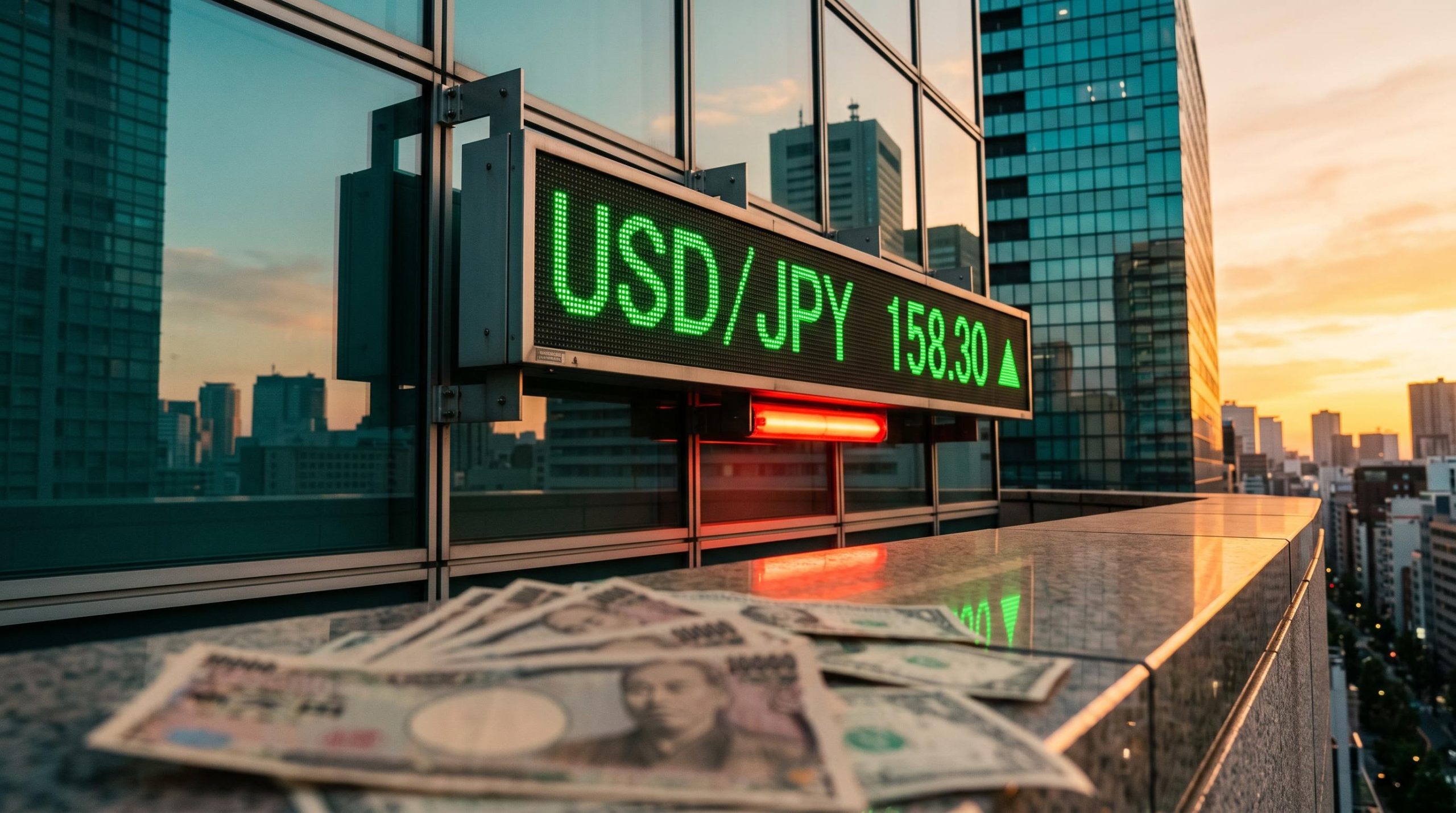
The dollar pushed back against the yen on Friday, 6 November 2026, as October payrolls came in at more than twice forecast. USD/JPY climbed to about 158.30, close to the level where Tokyo has stepped in to defend its currency before.
The US economy added 165,000 jobs in October against a 65,000 consensus. That revived the case for a December rate hike by the Federal Reserve. Japan’s roughly 225 basis point yield gap with the US keeps the yen on the back foot. A basis point is one hundredth of a percentage point.
The USD/JPY forecast now depends on two pressures pulling in opposite directions. Higher US yields pull the pair upward, while the threat of official action caps it.
Here is what the jobs data changed, why the yen struggles to benefit when markets turn nervous, and where the major bank forecasts split.
Why did a 165,000 jobs print push USD/JPY back toward 158?
The headline beat was only part of the surprise. The Bureau of Labor Statistics revised September from 29,000 to 60,000 and August from 133,000 to 186,000. That adds 84,000 jobs across the two months. Unemployment slipped to 4.1% from 4.2%, and average hourly earnings rose 0.4% in the month.
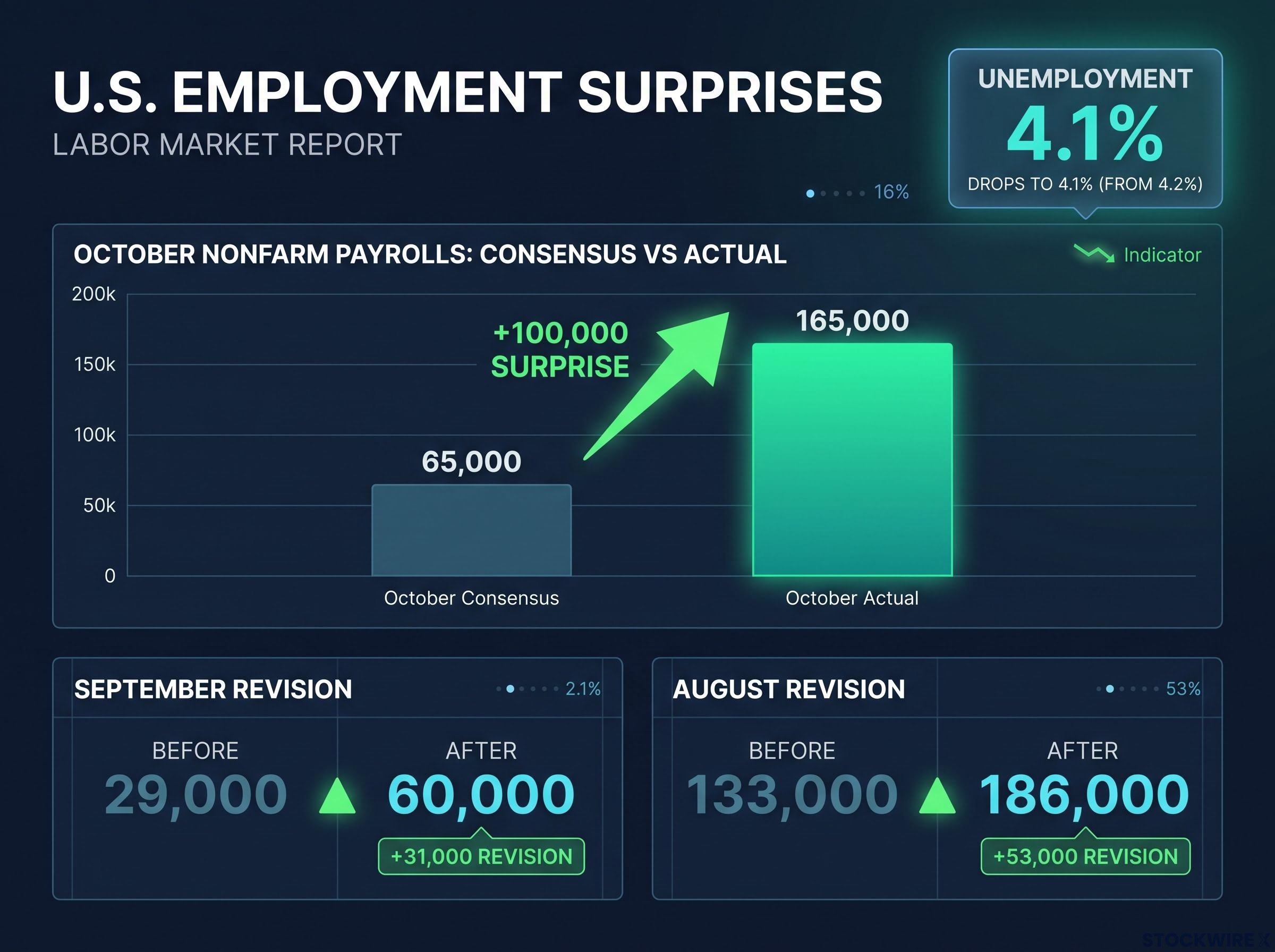
The massive October payrolls beat of 165,000 jobs was accompanied by strong upward revisions for August and September, dropping unemployment to 4.1%.
| Indicator | Latest | Prior or Expected | Note |
|---|---|---|---|
| Nonfarm payrolls (October) | 165,000 | 65,000 expected | Reuters consensus |
| Unemployment rate | 4.1% | 4.2% | Down 0.1 points |
| Hourly earnings (y/y) | 3.1% | Below 3% expected | Up 0.4% m/m |
| September payrolls (revised) | 60,000 | 29,000 | Revised up |
Each step of the market reaction followed from the last. The US 10-year Treasury yield rose 4 bps to about 4.88%, according to FXStreet. The Dollar Index (DXY), which tracks the dollar against six major currencies, recovered to near 102.15 from a five-week low of about 101.20. USD/JPY bounced from an intraday low of 157.26, ending a two-day slide.
Fed officials had already been leaning hawkish, meaning they favoured higher rates. St. Louis Fed President Alberto Musalem said more hikes could be needed, according to Reuters.
Alberto Musalem, St. Louis Fed President Inflation is a “regressive tax”, and restoring price stability matters for growth and employment.
Hike odds did not settle, though. The market priced about 67% for a 25 bp move at the 8-9 December meeting the day before the report. Odds jumped to roughly 85% after the data, then eased to about 78%. Softer University of Michigan inflation expectations helped pull them back: the one-year measure fell to 4.3% from 4.7%.
A December hike is now the base case. You should still treat one strong report, in a series that keeps getting revised, as evidence rather than proof.
The September jobs report, which came in well below the October print, had set a lower bar for the dollar, with the Fed’s hawkish signalling and a multi-year high in Treasury yields already shaping the rate-hike debate.
How the Fed’s tools feed through to the dollar
Interest rates are the Fed’s main tool for keeping inflation near 2%. When inflation runs above target, higher rates tend to lift the dollar. Cuts tend to weaken it.
Quantitative easing (QE) means creating money to buy high-grade bonds, as the Fed did in 2008, and it usually weakens the dollar. Quantitative tightening (QT) means the Fed stops buying bonds and stops reinvesting the money from maturing bonds, which usually supports the dollar. These links are not automatic, because risk shocks and worries about government debt can break them.
For USD/JPY, hawkish Fed guidance lifts US yields and widens the gap with Japan. That is why Friday’s data moved the pair.
Why can’t the yen gain more, and where does Tokyo draw the line?
The yen usually gains when markets turn nervous or when the Bank of Japan (BoJ) talks tough. Neither has worked for long this year.
Why yen support stays limited
- The yield gap dominates. Japan’s 10-year government bond (JGB) yields about 2.63%, near a four-month low, against 4.88% in the US. That gap rewards the carry trade, where investors borrow in cheap yen to buy higher-yielding dollar assets.
- Safe-haven demand is conditional. The yen rallied during the AI-led equity sell-off and the October risk-off period. It gave those gains back once US yields recovered.
- BoJ tightening is gradual. Rate rises come slowly, so they offer the yen only modest help.
- JGB yields carry fiscal risk. If Japanese yields rise in a disorderly way, investors may worry about Japan’s debt load instead of buying the yen.
What intervention has and has not done
Above 158, the pair runs into Tokyo. Finance Minister Satsuki Katayama warned that decisive action was imminent, and chief currency diplomat Atsushi Mimura called it a “final evacuation warning”. Japan’s past interventions follow a consistent pattern:
- 29 April 2024: Japan acted with USD/JPY near 160.245. The yen strengthened first.
- 1 May 2024: A second operation took the April-May total to about ¥9.79 trillion. The longer trend did not reverse.
- July 2024: Japan spent about ¥5.53 trillion, and the pair moved from about 161.76 to 157.30.
- 30-31 July 2026: Japan carried out coordinated yen-buying with US participation, spending about ¥11.7 trillion (about US$72.5 billion). Reuters reported that the effect later faded.
The pair has traded in a range since late September, after an intervention-linked drop briefly took it below 154.00. Katayama has since said Japan stays ready to respond to excessive or speculative moves.
For you, 158 is a level where the yield gap supports the pair and the threat of official action caps it. A push through 160 would test Tokyo’s resolve. It should not be read as a clean breakout.
For readers wanting to understand why Tokyo cannot act indefinitely, our full explainer on Japan’s IMF intervention limits covers the three-episode benchmark for free-floating currencies.
What do the main USD/JPY forecasts say, and what could break them?
The major forecasts span more than ten yen at the 12-month mark.
| Source | 3 months | 6 months | 12 months or longer |
|---|---|---|---|
| Reuters poll median | ~159 | ~157 | ~154 |
| Goldman Sachs | ~162 | ~163 | ~165 |
| MUFG | Not given | ~156 (end-2026) | ~152 (Q2 2027) |
Reuters-polled strategists and MUFG expect the pair to drift lower as the US rate advantage narrows and Japan normalises policy. Goldman expects the yield gap to stay wide and BoJ tightening to stay slow. The split comes down to two decisions: whether the Fed hikes in December, and whether the BoJ can tighten without stressing Japan’s public finances.
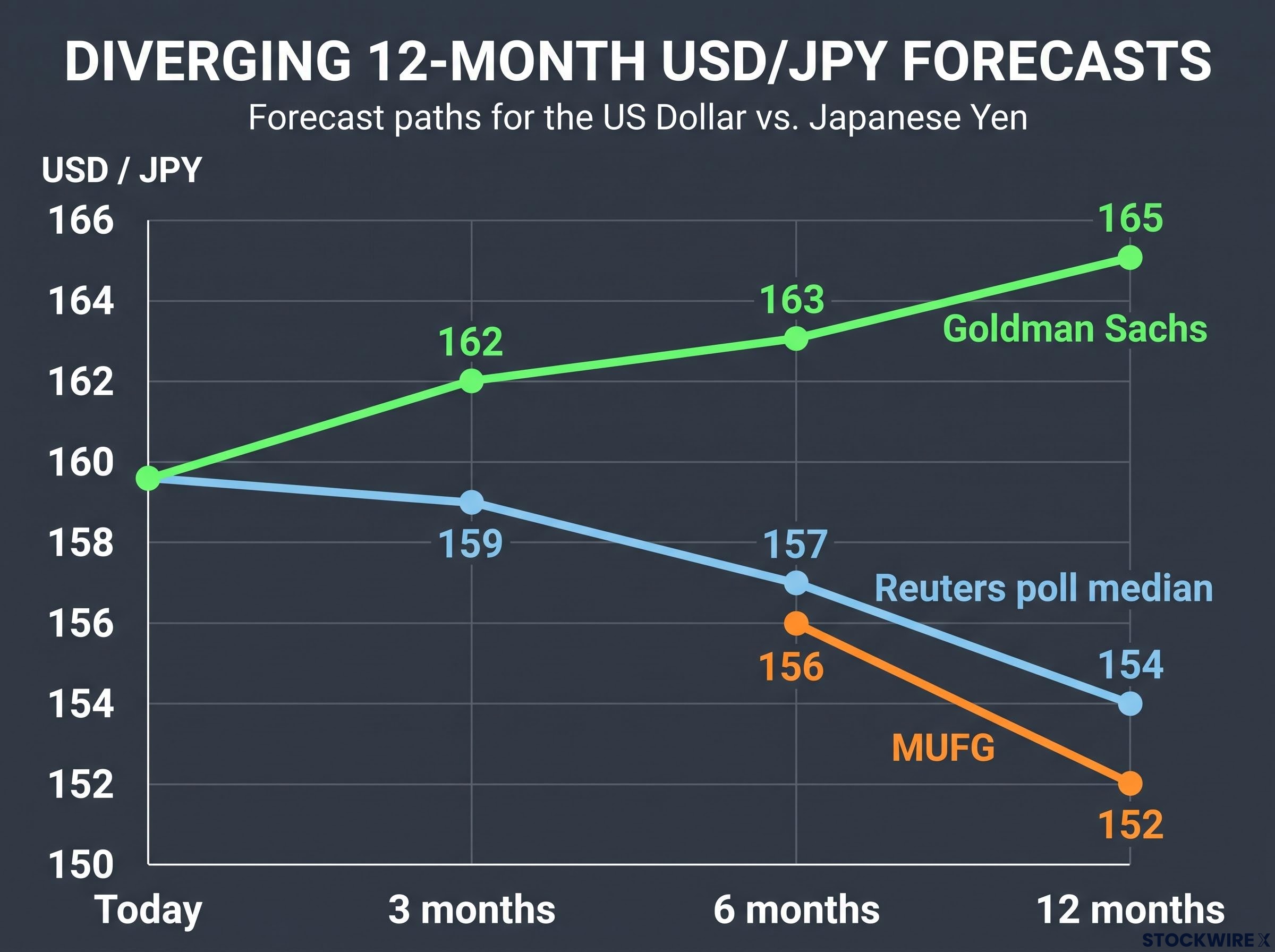
Institutional forecasts show a stark divergence, with Goldman Sachs projecting USD/JPY climbing to 165 in 12 months while others predict declines.
Reuters survey Nearly 95% of respondents said intervention alone would not stop yen weakness. Nomura’s Mari Iwashita said lasting stabilisation needs BoJ cooperation.
The near-term outlook is for volatility around 158. Upside pressure should persist while hike odds stay elevated. The sharpest downside risk is a carry-trade unwind, where investors rush to buy back the yen they borrowed. Possible triggers include:
- A Fed pause or cut
- A BoJ hike
- Falling Treasury yields
- Intervention or an equity sell-off
Stop-loss orders and margin calls, which force leveraged traders to sell, would amplify any of these moves. Payroll data also gets revised, so first prints are not final. Every forecast in the table is effectively a bet on the Fed and the BoJ, and the gap between the estimates measures how uncertain that bet is. You should not treat any one of them as consensus.
Not every sharp yen rally signals forced liquidation. Early September’s near 4% slide in USD/JPY was a case of carry trade repricing, with speculative yen shorts growing rather than collapsing.
Past performance does not guarantee future results. Financial projections are subject to market conditions and various risk factors.
What to watch between now and the 8-9 December Fed meeting
Strong payrolls keep a Fed hike in play and the yield gap wide. At the same time, the 160 intervention line and carry-unwind risk limit how far the dollar can run against the yen. Four signals will shape the next move:
- The next US inflation and labour market releases
- Fed commentary following Musalem’s hawkish remarks
- JGB yield moves and BoJ guidance
- Ministry of Finance rhetoric if USD/JPY nears 160
Treat 158 as a zone where these pressures meet, not a level the pair has settled at.
This article is for informational purposes only and should not be considered financial advice. Investors should conduct their own research and consult with financial professionals before making investment decisions.