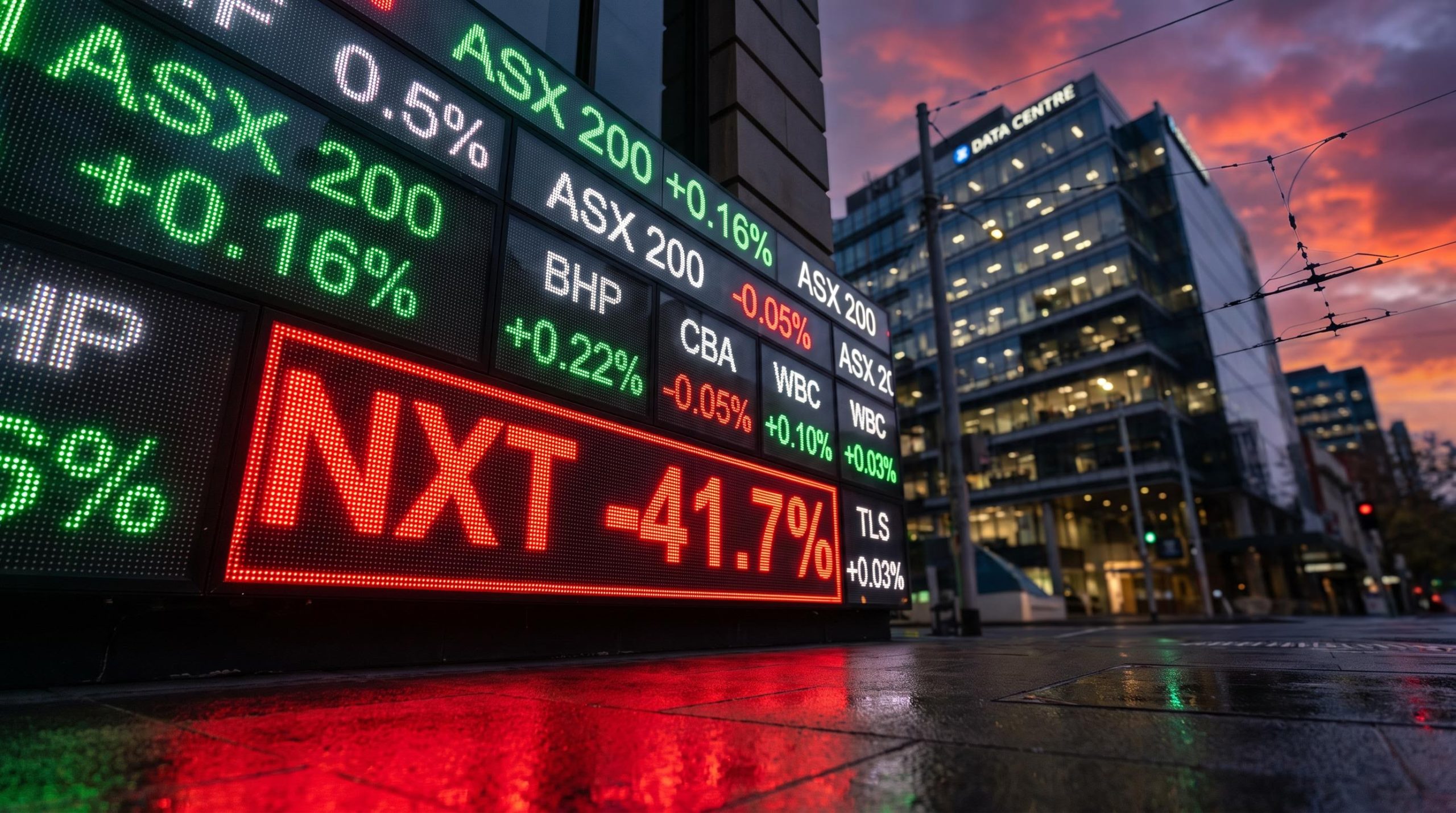
The ASX 200 closed 0.16% higher at 8,831.3 on Wednesday 21 October, a gain of 14.4 points that looked like a quiet session. It was not. NextDC lost 41.7% in a single day, and a warning from the Reserve Bank of Australia (RBA) sent rate-hike odds swinging within hours.
Three forces hit at once. RBA Deputy Governor Andrew Hauser warned before the open that the inflation outlook had worsened. The unemployment rate was sitting at a five-year high of 4.7%, and a power delay at a Melbourne data centre wiped out more than a third of NextDC’s market value.
Eight sectors finished higher. Technology, materials and real estate fell.
This wrap sorts out which moves were noise and which could affect your portfolio before the RBA’s 3 November decision.
Why did NextDC lose 41.7% while the index barely moved?
NextDC: a timing shock with a valuation sting
NextDC went into a trading halt on 19 October. When it resumed on Wednesday, the shares fell to $5.35.
The cause was a power problem, not a demand problem. Jemena Electricity Networks suspended parts of the network work needed to lift power supply to NextDC’s M3 Melbourne data centre, citing community and stakeholder opposition. Work is not expected to restart before February 2027, and the next supply increase is not expected until 2028.
The chain is simple: no grid connection means no delivery, and no delivery means no billing. About $140M of contracted customer revenue has been pushed out of FY27 rather than cancelled. EBITDA is earnings before interest, tax, depreciation and amortisation, a common measure of operating profit.
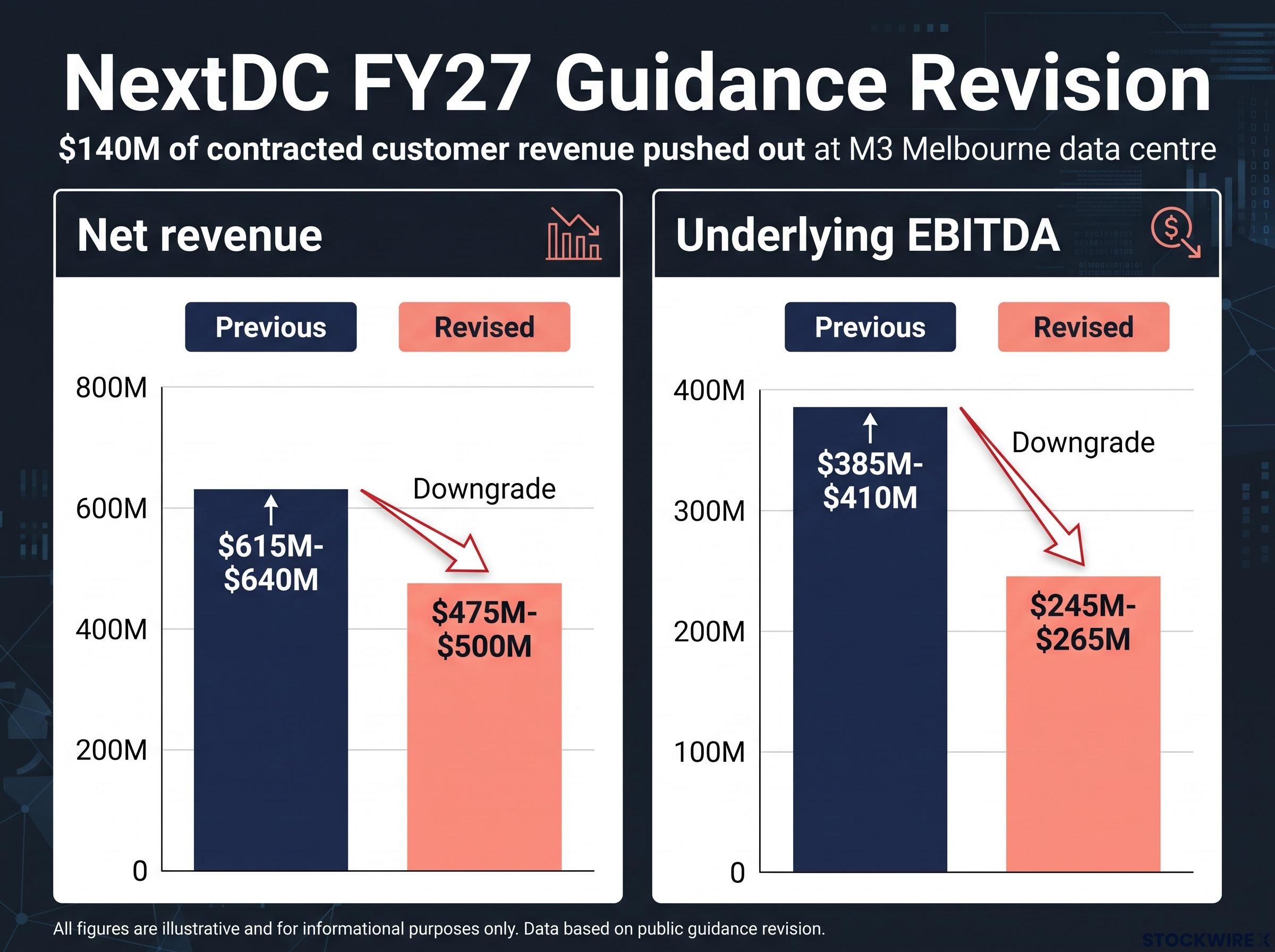
| Metric | Previous FY27 guidance | Revised FY27 guidance |
|---|---|---|
| Net revenue | $615M-$640M | $475M-$500M |
| Underlying EBITDA | $385M-$410M | $245M-$265M |
Brokers see the delay running beyond a single year. Macquarie expects M3’s final capacity stages to slip by several years. RBC Capital Markets analyst Tom Beadle called community opposition a real risk to delivery timing. Citi flagged possible earnings effects beyond FY27.
Even after the fall, the stock is not cheap. EV/EBITDA compares a company’s total value, including debt, with its operating earnings.
Still at a premium Goldman Sachs data cited by Market Index puts comparable data-centre companies near 22 times FY27 EV/EBITDA. NextDC’s revised multiple sits near 37 times.
The market is now questioning the idea that contracted data-centre demand turns quickly into revenue. If you hold any data-centre exposure, power and approvals risk deserve as much attention as order books.
For readers wanting the balance sheet angle, our full explainer on NextDC’s M3 power delay covers the A$8.7 billion liquidity position and the capex cut behind the revised guidance.
BHP and Sigma: temporary or telling?
BHP fell about 1.6%, though Forbes reported a decline closer to 2%. September-quarter copper output dropped about 19% to 401kt. Much of that drop was planned grade declines and maintenance, with Chilean weather and a Carrapateena conveyor failure adding to it.
Sigma Healthcare slipped about 2.8%. Chemist Warehouse sales rose 12.1% and like-for-like sales rose 9.8%, down from 13.5% growth over the past year. Fragrances and vitamins weakened, but the softness was limited to those categories within otherwise strong growth.
How did Hauser’s inflation warning swing rate-hike bets?
The repricing was fast. Hike odds for 3 November jumped toward 80% at one point, then settled near 50%, according to Reuters. Other intraday estimates put the odds at 41%-42%. At the start of the week, the odds were about 30%.
“The inflation outlook looks materially worse than we projected in the August report,” said Andrew Hauser, RBA Deputy Governor.
Hauser stopped short of committing to a hike. He described the policy choice as difficult, which helps explain why the market could not settle on a view. Businesses are increasingly treating 3%-3.5% inflation as a possible “new normal”. Meanwhile, the weak jobs data released last Thursday had already priced out a hike.
Reuters reported that headline inflation could reach about 4% in the September quarter. Trimmed mean inflation, which strips out the most extreme price moves, is expected to stay around 3.5%, above the RBA’s 2%-3% target band. ANZ and Reuters’ economists lean toward a hike. Goldman Sachs thinks the bar for a hike is lower but still expects a hold, with the CPI print deciding the outcome.
If you hold a mortgage or rate-sensitive assets, 3 November is a genuine coin flip.
Rate-sensitive sectors have already absorbed much of the repricing, with consumer discretionary names down roughly 30% from recent highs, while trimmed mean inflation is not expected back in the target band until 2028.
Sectors and other movers
Technology and materials led the declines. Telecommunications and defensive sectors led the gains, and the Australian dollar firmed to near 70.1 US cents.
| Sector | Move |
|---|---|
| Telecommunications | +2.23% |
| Consumer staples | +1.14% |
| Industrials | +0.99% |
| Financials | +0.96% |
| Health care | +0.87% |
| Consumer discretionary | +0.76% |
| Real estate | -0.49% |
| Materials | -1.04% |
| Information technology | -3.32% |
- Beach Energy rose 5.12% on record revenue, with guidance held.
- Northern Star gained 1.8% despite a 16% production fall, after recently rejecting Gold Fields’ bid of nearly $40 billion.
- National Bank added 1.9%, rebounding after news of a restructure involving about 2,500 job cuts.
- Woodside edged up 0.4%.
What are the catalysts before the RBA’s 3 November decision?
The session’s swings now give way to a fixed calendar:
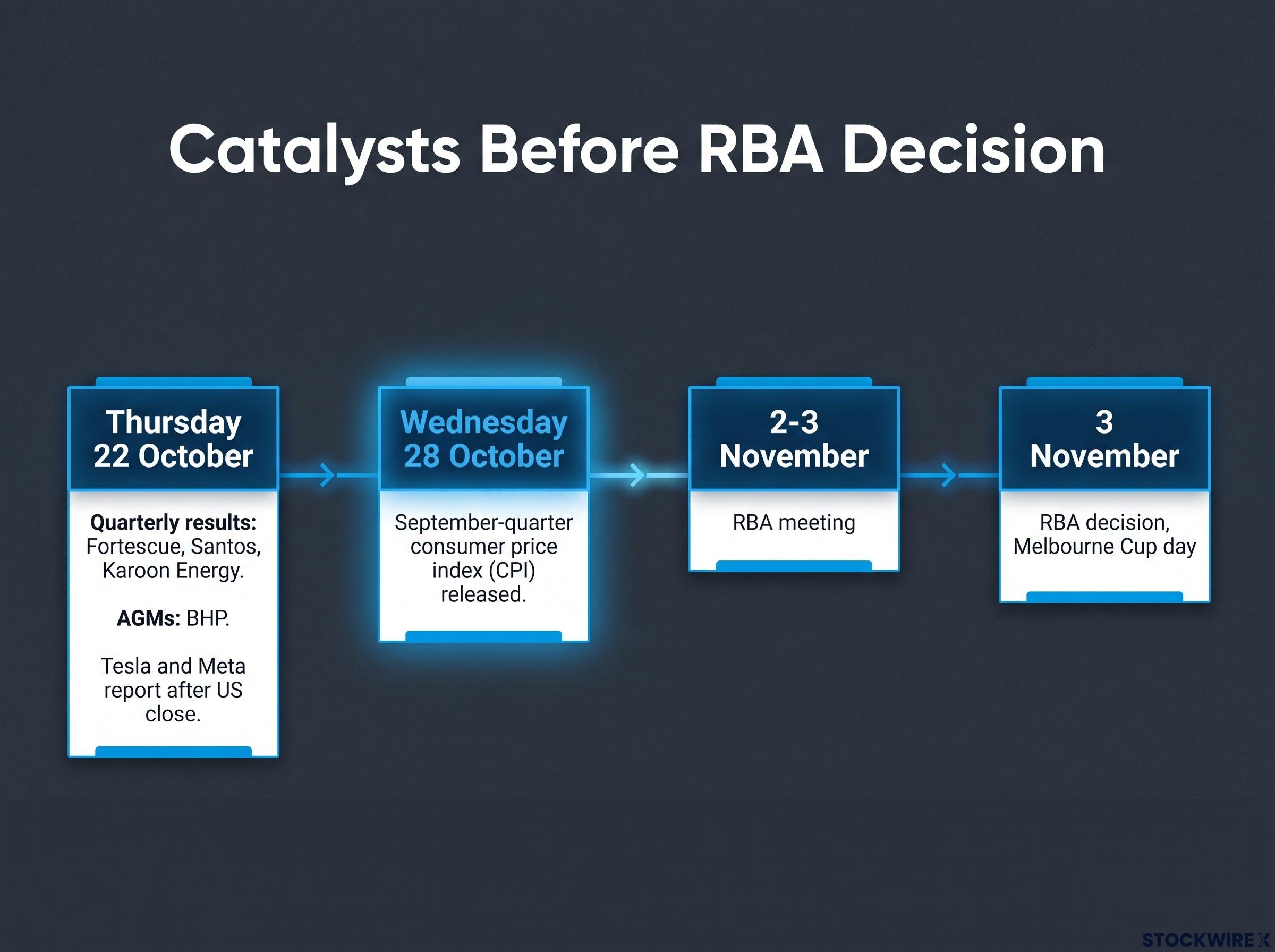
- Thursday 22 October: Fortescue, Santos and Karoon Energy release quarterly results. Several companies hold AGMs, including BHP. Tesla and Meta report after the US close.
- Wednesday 28 October: September-quarter consumer price index (CPI) is released.
- 2-3 November: RBA meeting, with the decision on 3 November, Melbourne Cup day.
CPI lands just six days before the decision, which gives it more weight than last week’s jobs data. Economists suggest that, without a downside surprise, a November hike is more likely than not. A soft print would support a hold.
The ABS Consumer Price Index release is due on 28 October, and the latest data showed headline inflation at 4.0% and trimmed mean at 3.6% in the 12 months to August.
The 28 October CPI print is the number to watch, because it will likely reset hike odds well before the RBA announces its decision.
What this session changes, and what it does not
The flat ASX 200 close hid three different stories. NextDC was a one-off stock shock driven by power constraints. BHP and Sigma showed weakness that looks temporary or confined to specific categories. Rates remain a live macro risk.
Hauser’s comments raised the stakes without settling the outcome. Between now and 3 November, watch the 28 October CPI print, any further RBA commentary and Thursday’s quarterly results.
This article is for informational purposes only and should not be considered financial advice. Investors should conduct their own research and consult with financial professionals before making investment decisions. Rate expectations and company guidance are subject to change based on market developments.