
Australia’s prudential regulator has put the financial sector on notice: artificial intelligence adoption is outpacing the governance frameworks designed to manage its risks, and the gap is no longer theoretical. On 30 April 2026, the Australian Prudential Regulation Authority (APRA) issued a formal letter to all regulated entities, setting out specific expectations across four domains after targeted supervisory engagement with large banks, insurers, and superannuation trustees conducted in late 2025. The letter arrived alongside parallel guidance from the Australian Securities and Investments Commission (ASIC), signalling a coordinated regulatory posture on AI governance across Australian financial services. What follows covers what APRA found, what it now expects from boards and accountable executives, why the cyber dimension deserves particular attention, and what the dual-regulator signal means for entities that have not yet formalised their AI governance frameworks.
How APRA’s supervisory work exposed a widening gap between AI adoption and governance
APRA’s central finding is direct: across banking, insurance, and superannuation, AI adoption is advancing faster than the governance and risk management structures meant to contain it. The observation did not emerge from desk-based policy work. It came from targeted supervisory engagement with selected large entities in late 2025, giving the finding an evidence-based character that generic industry warnings lack.
The gap between expectation and practice is not hypothetical: documented AI governance failures already on APRA’s record include a superannuation fund that misclassified vulnerable members and a general insurer whose AI pricing model was deployed without independent validation, both attracting formal remediation requirements from the regulator.
APRA’s core regulatory finding: AI adoption across regulated financial institutions is outpacing the governance and risk management frameworks designed to manage its associated risks.
The scale of what sits behind that gap matters. APRA oversees institutions holding approximately $9.8 trillion in assets on behalf of Australian depositors, policyholders, and superannuation members. When the regulator responsible for that asset base issues a formal letter, dated 30 April 2026, applying to every entity under its supervision, the governance gap moves from an abstract observation to a material, sector-wide concern.
When big ASX news breaks, our subscribers know first
What APRA is now expecting from boards and executives
The letter sets out expectations across four specific domains, each tightening the accountability net around how regulated entities deploy and oversee AI systems:
- Governance, including board literacy on AI risk and the establishment of clear AI accountability structures
- Cyber and information security, addressing weaknesses already observed during supervisory engagement
- Supplier risk, covering third-party AI providers and the dependencies entities have built around them
- Change management and assurance, requiring oversight across AI deployment processes and ongoing assurance
Coverage from Clayton Utz (published 5 May 2026) and Norton Rose Fulbright (published in May 2026) characterised the letter as a shift from generalised guidance to targeted, AI-specific supervisory expectations. That distinction matters: these are not aspirational principles. APRA has framed them as defined expectations, and entities that fall short face the prospect of stronger supervisory action.
APRA’s formal AI letter to industry sets out binding expectations across governance, cyber security, supplier risk, and change management, making explicit that entities failing to meet those expectations face the prospect of escalated supervisory action.
| Domain | Key Expectation |
|---|---|
| Governance | Boards must demonstrate literacy on AI risk and establish accountability structures |
| Cyber and information security | Entities must address AI-specific cyber weaknesses already identified by supervisors |
| Supplier risk | Third-party AI provider dependencies must be assessed and managed |
| Change management and assurance | Accountability must extend across the full AI lifecycle, not only at deployment |
From principles to practice: inventories, accountability, and fallback planning
The practical implications run deeper than the four domains suggest at first reading. APRA expects entities to establish AI inventories, a foundational governance step that requires organisations to catalogue where and how AI systems operate across their businesses. Accountability must extend across the full AI lifecycle, from development and testing through deployment to ongoing monitoring, not merely at the point a system goes live.
Analysis from Corrs Chambers Westgarth (published 18 May 2026) highlighted a further expectation: entities should maintain fallback options where high reliance on AI systems has developed. That is a concrete operational resilience consideration, requiring organisations to stress-test what happens when an AI system fails or must be withdrawn at short notice.
Vendor concentration risk sits at the centre of the supplier risk expectation, with APRA finding that some regulated entities depend on a single AI provider across multiple critical functions simultaneously, lacking any adequate contingency planning for provider failure or disruption, a pattern that creates a single point of failure running across fraud detection, credit decisioning, and compliance monitoring at once.
Why AI-enhanced cyber threats are an active supervisory concern
Cyber and information security did not appear in the letter as a forward-looking risk category. APRA included it because supervisors observed specific weaknesses during their engagement with regulated entities in late 2025. The gap between AI adoption and cyber preparedness is already visible to the regulator.
The broader threat environment reinforces the concern. APRA’s System Risk Outlook, published 21 May 2026, identifies AI-enhanced cyber sophistication as an active and evolving threat to regulated entities. The specific characteristics introduced by AI adoption include:
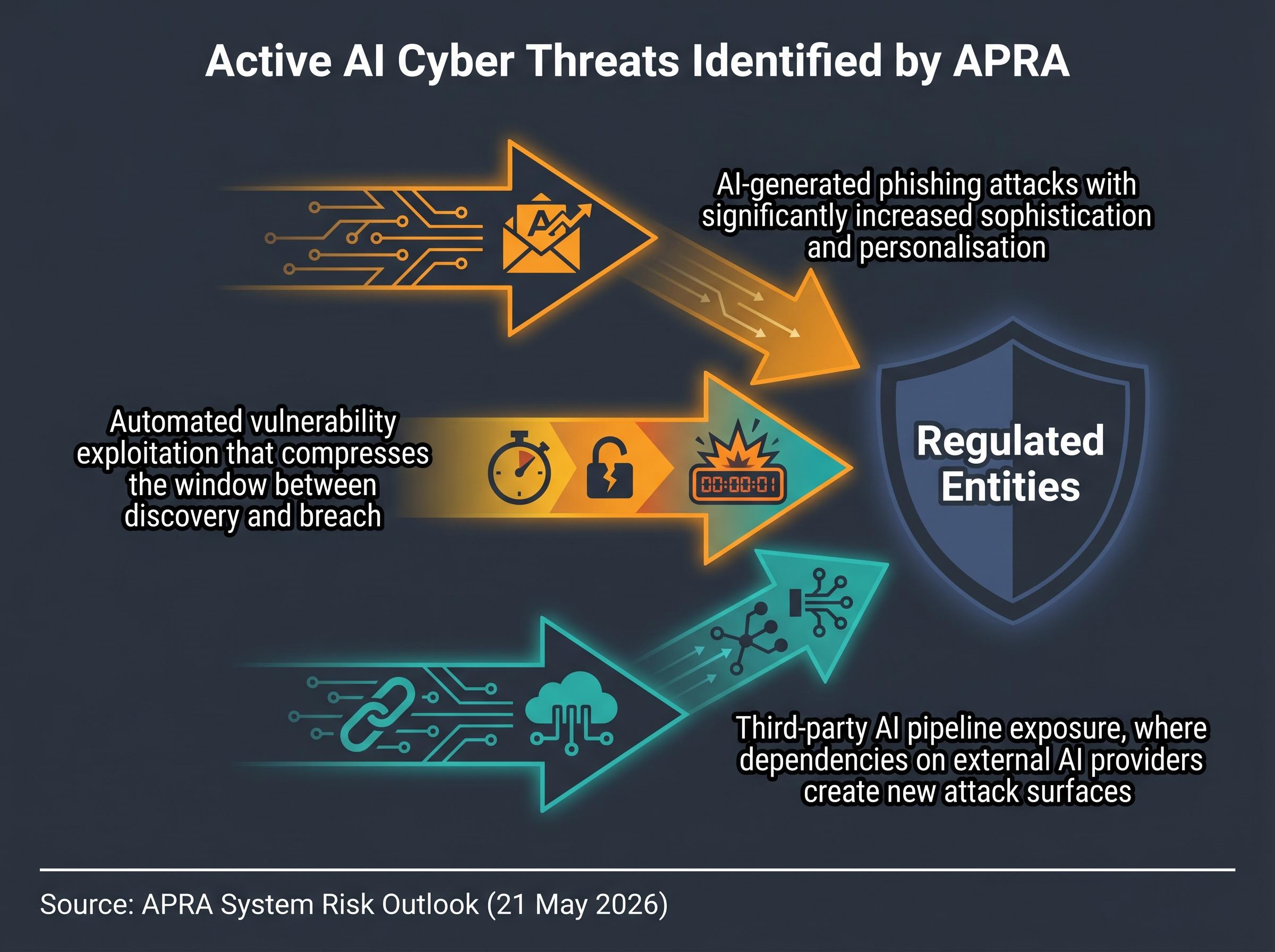
- AI-generated phishing attacks with significantly increased sophistication and personalisation
- Automated vulnerability exploitation that compresses the window between discovery and breach
- Third-party AI pipeline exposure, where dependencies on external AI providers create new attack surfaces
APRA System Risk Outlook (21 May 2026): Advanced AI models are contributing to an increasingly sophisticated cyber threat environment for Australian financial institutions, with AI-enhanced attacks identified as an active and evolving risk.
APRA Chair John Lonsdale has situated cyber risk within the regulator’s current supervisory priorities, reinforcing that this is not a secondary consideration. Entities that have not yet updated their cyber frameworks to account for AI-specific attack vectors are operating with a known gap that APRA has explicitly flagged.
ASIC enters the frame: a coordinated regulatory signal
APRA did not act alone. ASIC issued parallel AI guidance in the same reporting period, as referenced in May 2026 coverage from Corrs Chambers Westgarth and other regulatory outlets. The two agencies’ simultaneous action creates a coordinated domestic regulatory posture that covers different but complementary dimensions.
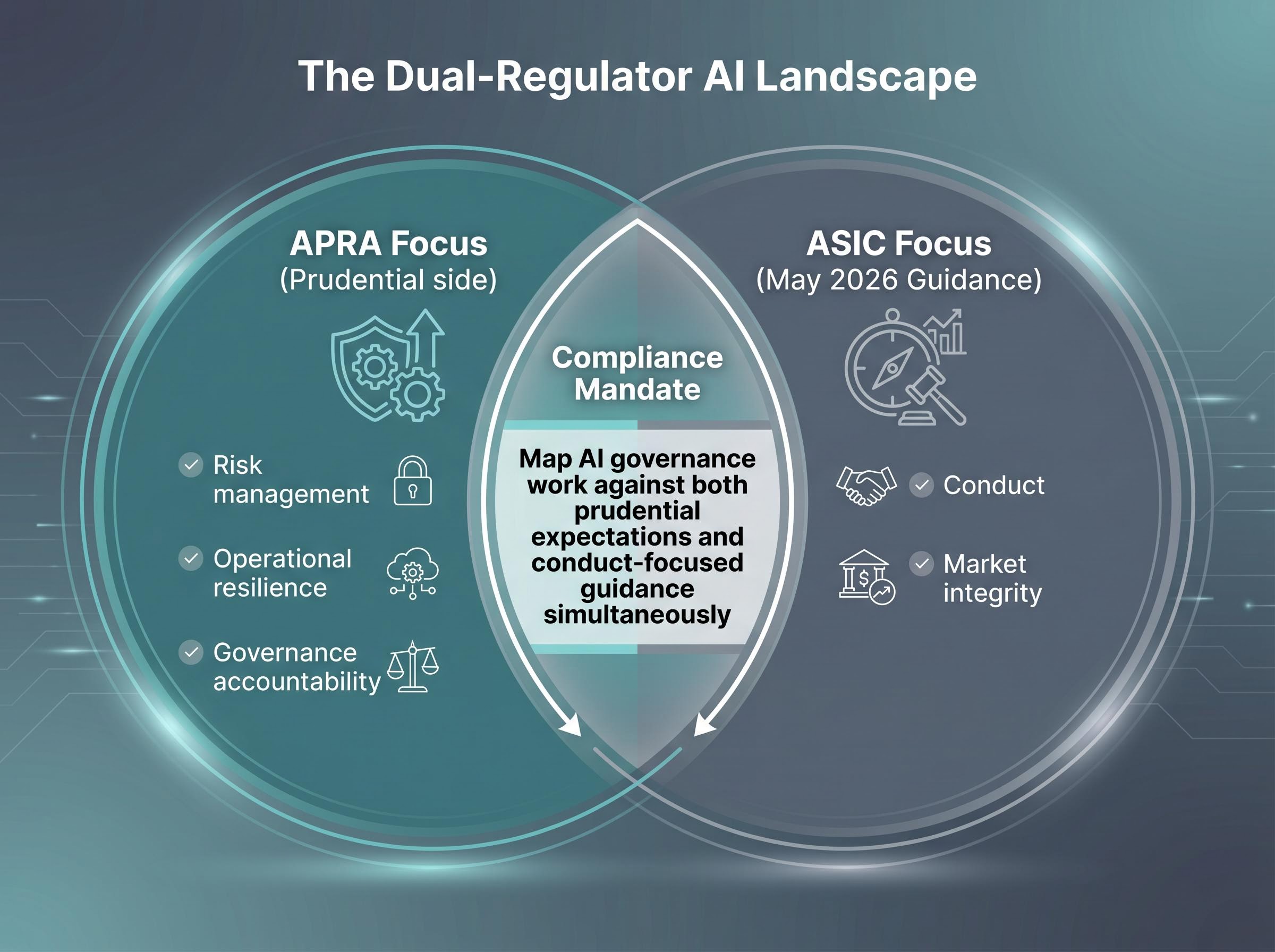
APRA’s focus sits on the prudential side: risk management, operational resilience, and governance accountability. ASIC’s mandate addresses conduct and market integrity. Together, they cover the full spectrum of AI-related risk that a bank, insurer, or superannuation fund must manage.
What dual-regulator expectations mean for compliance teams
For entities regulated by both authorities, and that includes most large financial institutions, AI governance frameworks must now satisfy two distinct but converging sets of expectations. The practical implications include:
- Compliance teams need to map AI governance work against both APRA’s prudential expectations and ASIC’s conduct-focused guidance simultaneously
- Internal frameworks cannot be built to satisfy one regulator and retrofit for the other; the architecture must accommodate both from inception
- Board reporting on AI governance may need to address prudential and conduct dimensions separately, increasing the specificity required in oversight documentation
The window for treating AI governance as a single-regulator compliance exercise has closed.
The window for action is narrowing: what regulated entities should do now
APRA’s letter does not leave the next steps ambiguous. The implied action sequence for regulated entities follows a clear priority order:
- Establish a comprehensive AI inventory covering all systems in use or under development
- Assess board-level AI literacy gaps and address them through structured education
- Audit third-party AI dependencies and ensure fallback options exist for high-reliance systems
- Stress-test AI-related cyber controls against the threat characteristics APRA has identified
APRA’s escalation signal: The 30 April 2026 letter explicitly references the potential for stronger supervisory action against entities that do not meet the expectations it sets out.
APRA has also situated Australia’s approach within a broader international trend toward AI-specific governance in financial services, referenced directly in the letter. The next edition of APRA’s System Risk Outlook is expected toward the end of 2026, meaning AI governance will remain a supervisory visibility item through the remainder of the year.
Potential CPS amendments are already being discussed at the legislative level, with the Assistant Treasurer reportedly signalling that Australia’s current principles-based approach may not hold if governance gaps persist across the sector, meaning the April 2026 letter could represent the start of a longer arc of increasing regulatory intensity rather than a one-off supervisory moment.
The combination of a formal regulatory letter, parallel ASIC guidance, and an explicitly stated escalation pathway means the cost of delayed action has risen materially since 30 April 2026.
Australia’s financial regulators have drawn a clear line on AI accountability
The shift APRA’s letter represents is not from silence to guidance. It is from guidance to expectation, with enforcement consequences attached. Board literacy, lifecycle accountability, and fallback planning are now defined regulatory requirements, not optional governance enhancements.
The stakes behind that shift are concrete: $9.8 trillion in assets, millions of superannuation members and policyholders, and a regulator that has committed its expectations to formal correspondence dated 30 April 2026. ASIC’s parallel action confirmed the signal in May 2026.
For every board member and accountable executive at an APRA-regulated entity, the risk calculus has changed. The question is no longer whether AI governance frameworks are needed. It is whether the ones in place will withstand supervisory scrutiny when APRA comes looking.
This article is for informational purposes only and should not be considered financial advice. Investors should conduct their own research and consult with financial professionals before making investment decisions.