Australia’s financial regulator has fired a formal warning shot at every bank, insurer, and superannuation fund under its watch. The Australian Prudential Regulation Authority’s (APRA) System Risk Outlook 2026, published on 21 May 2026, finds that artificial intelligence deployment across the $9.8 trillion in assets APRA supervises is outrunning the governance frameworks meant to control it. The finding is not theoretical. APRA’s thematic reviews have already documented specific governance failures, AI-enabled cyber incidents have appeared in the regulator’s reporting pipeline, and industry leaders from ANZ to AustralianSuper have acknowledged the gap publicly. What follows unpacks APRA’s findings, the dual risk AI now presents (as both a governance failure and a weaponised attack vector), the cases already on record, and what regulated entities should expect as APRA intensifies supervision through the remainder of 2026.
AI Adoption Outpaces Governance Maturity, APRA Warns
APRA’s language left little room for interpretation.
“AI and machine-learning deployment is expanding faster than the maturity of governance and control frameworks.”
Thematic reviews of data, AI, and model risk conducted across 2025-26 found that a significant proportion of reviewed entities could not demonstrate that their boards had clearly defined AI risk appetite, assigned accountability lines, or established reporting structures for AI systems. The gap was not confined to smaller institutions; APRA noted material variation across the sector.
Three categories of governance shortfall appeared repeatedly:
- Board oversight: Boards had not formally articulated AI risk appetite or assigned senior accountability for AI outcomes
- Model validation: Independent validation was inconsistently applied to high-impact AI credit and pricing models
- Data governance: Documentation of training data sources and model changes was inadequate, with limited challenge applied to vendor-supplied AI solutions
APRA stressed that it was not introducing new standards. Existing obligations under CPS 220 (Risk Management), CPS 230 (Operational Risk Management), and CPS 510 (Governance) already require what institutions are failing to demonstrate. The regulator’s position is that the deficiency is one of execution, not of regulation.
When big ASX news breaks, our subscribers know first
What APRA actually expects: how existing standards apply to AI
APRA’s prior letter to industry, issued in approximately April 2026, did not create an AI-specific prudential standard. Instead, it mapped five existing standards onto AI systems and told regulated entities the obligations are already in force.
APRA’s April 2026 supervisory letter had already placed the question of AI risk controls across Australian banks, insurers, and superannuation trustees squarely in the enforcement frame, warning that material inadequacies under existing prudential standards would attract intensified oversight rather than a grace period for voluntary uplift.
APRA’s letter to industry on AI, published on 30 April 2026, maps governance, cybersecurity, supplier reliance, and AI literacy obligations onto existing prudential standards, confirming that regulated entities face enforcement exposure under frameworks already in force rather than any forthcoming AI-specific standard.
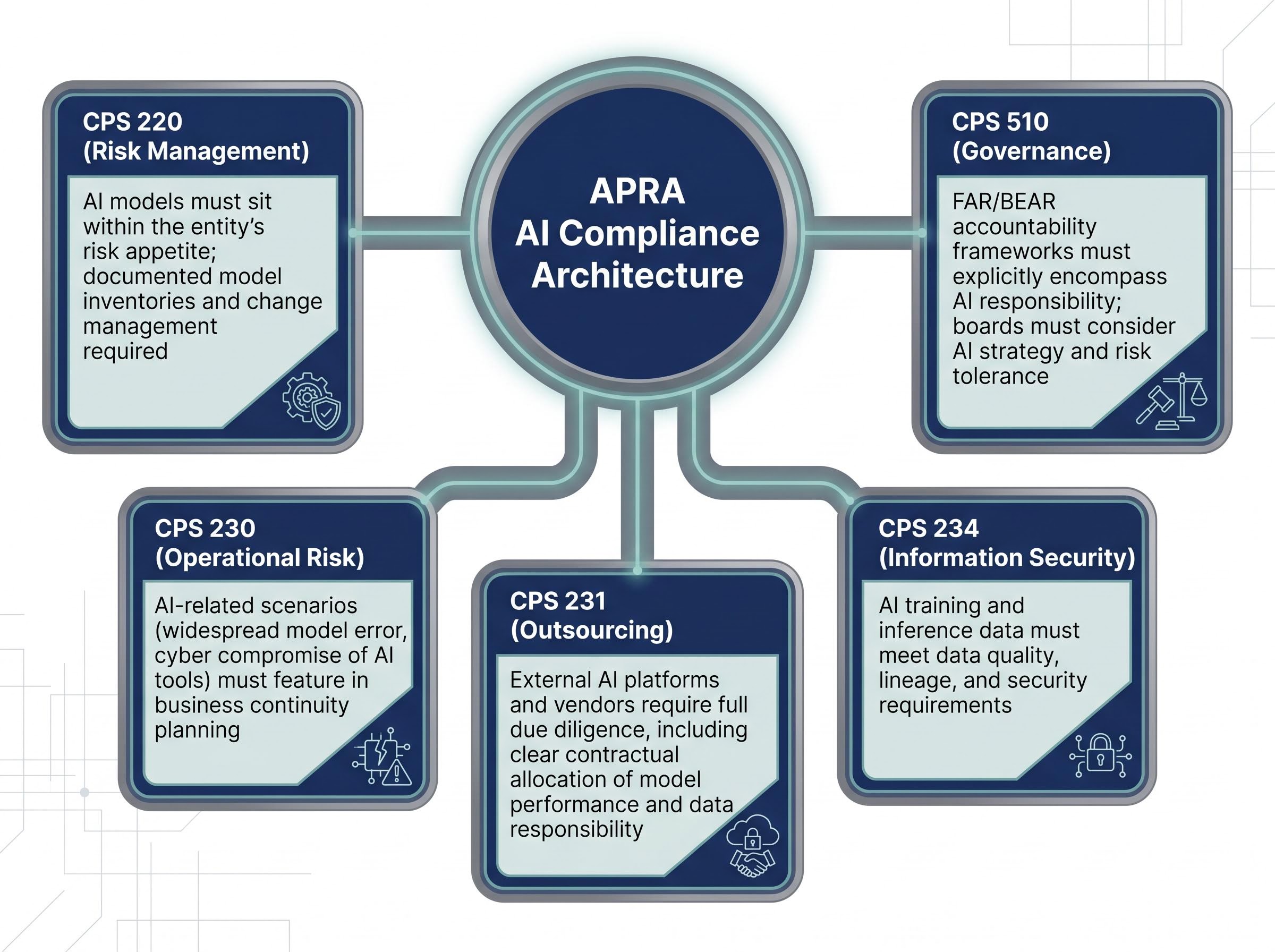
The practical effect is a compliance architecture that spans governance, risk, outsourcing, information security, and board accountability. The table below summarises how each standard applies.
| Prudential Standard | Core Obligation | AI Application |
|---|---|---|
| CPS 220 (Risk Management) | Sound risk management framework | AI models must sit within the entity’s risk appetite; documented model inventories and change management required |
| CPS 230 (Operational Risk) | Operational resilience and continuity | AI-related scenarios (widespread model error, cyber compromise of AI tools) must feature in business continuity planning |
| CPS 231 (Outsourcing) | Due diligence on material outsourcing | External AI platforms and vendors require full due diligence, including clear contractual allocation of model performance and data responsibility |
| CPS 234 (Information Security) | Information security capability | AI training and inference data must meet data quality, lineage, and security requirements |
| CPS 510 (Governance) | Board and senior management governance | FAR/BEAR accountability frameworks must explicitly encompass AI responsibility; boards must consider AI strategy and risk tolerance |
Entities must also be able to provide sufficiently explainable outputs for AI-driven decisions affecting customers, particularly where those decisions involve credit, pricing, or claims and where customers are adversely affected.
Vendor and third-party AI: the outsourcing exposure
APRA identified a heightened dependency on external AI platforms and vendors, with contracts that do not clearly allocate responsibility for model performance and data protection. Offshore data processing and AI development providers drew particular concern. CPS 231 and CPS 234 due-diligence obligations apply in full to these arrangements, and APRA’s thematic reviews found compliance uneven.
Vendor concentration risk amplifies each of these exposures: when a single external AI provider underpins fraud detection, credit decisioning, and compliance monitoring across multiple institutions simultaneously, a disruption at the provider level cascades in ways that no individual institution’s business continuity plan can absorb on its own.
AI is also the weapon: how advanced tools are sharpening the cyber threat
The governance gap is only half the picture. APRA’s Outlook documented AI being used against regulated entities, not just within them.
AI-enabled phishing and impersonation attacks targeting APRA-regulated entities increased in late 2025 and early 2026. The documented incidents fall into four categories:
- Voice cloning social engineering: APRA cited “multiple incidents” in late 2025 where criminals used AI-generated voice cloning to impersonate bank staff, targeting both customers and internal help desks
- Generative AI phishing: A large Australian bank experienced an uptick in successful phishing attempts in mid-2025, traced to highly tailored emails crafted with generative AI and targeting staff with privileged access (reported by the Australian Financial Review, 18 September 2025)
- Internal code leakage via public AI tools: A mid-tier bank discovered developers had pasted internal application code into public generative AI tools, recorded as an APRA-reportable information-security incident in 2025
- Chatbot data exposure: A health and life insurer temporarily disabled a customer-facing chatbot in late 2025 after internal testing showed it could output fragments of previous customer queries containing sensitive health information
AI voice cloning scams costing Australians an estimated AUD 25.8 million in the first half of 2025 underscore the scale of the threat APRA documented, with scammers using generative AI to produce highly convincing impersonations that bypass verification procedures that financial institutions had previously regarded as robust.
APRA warned that generative AI tools used internally are sometimes connected to sensitive datasets “without adequate access controls, monitoring, or data-loss prevention.”
The dual exposure matters because entities that have separated their cyber risk and AI governance work streams now face a regulator that views them as two sides of the same supervisory concern.
Real failures, real entities: the cases APRA has already documented
APRA’s Outlook moved beyond aggregate findings to describe specific governance failures across sectors, each anonymised but detailed enough to illustrate the pattern.
- Superannuation fund, member segmentation: An AI-based model used for member engagement incorrectly classified some older and low-balance members as low-priority, reducing outreach to potentially vulnerable members. APRA identified insufficient bias testing and inadequate board oversight of the model’s design and use.
- General insurer, motor pricing model: An AI-driven pricing model was implemented with incomplete documentation, weak independent validation, and unclear accountability for model changes. APRA required formal remediation.
Both cases illustrate the board oversight and model risk findings from APRA’s thematic reviews. Industry data from a 2025 KPMG Australian Banking Outlook report indicated that approximately 40% of surveyed Australian banks had a formal board-approved AI governance framework distinct from general IT governance, a figure that, if accurate, aligns with APRA’s finding that a significant proportion of entities lack the structures the regulator expects.
What APRA required in remediation
For the general insurer, APRA mandated formalised model-risk policies, independent validation of the pricing model, and expanded board reporting on AI system performance. APRA framed these as applications of existing CPS 220 and CPS 230 requirements, reinforcing that remediation was not about meeting a new standard but about complying with one already in force.
Industry leaders acknowledge the gap, and signal what comes next
Responses from across banking, insurance, and superannuation confirmed APRA’s findings rather than contesting them.
- Shayne Elliott, CEO, ANZ Banking Group: Said APRA’s concerns were “well-founded” and that ANZ had “slowed or halted some AI use cases where governance or data lineage wasn’t up to standard” (Australian Financial Review, 22 May 2026)
- Andrew Hall, CEO, Insurance Council of Australia: Confirmed insurers are building multi-disciplinary AI governance committees but acknowledged “work to do” to match APRA’s expectations (The Australian, 22 May 2026)
- Paul Schroder, CEO, AustralianSuper: Conceded that outsourced administration and investment functions “can obscure who is accountable for AI models” (ABC News, 22 May 2026)
- Dr. Maria O’Brien, Partner, King & Wood Mallesons: Stated APRA’s expectations “effectively set a benchmark for directors’ duties in overseeing AI,” noting failure to address known AI risks could be relevant to director liability (Australian Financial Review, 23 May 2026)
A 2025 Deloitte Australia survey found only 32% of surveyed Australian banks, insurers, and superannuation funds assessed themselves as “advanced” or “leading” on AI governance. Even well-resourced institutions are acknowledging shortfalls.
Board-level AI literacy sits at the centre of APRA’s critique, with the regulator identifying over-reliance on vendor-supplied summaries as a structural conflict that prevents boards from independently challenging management risk assessments, a pattern APRA flagged explicitly in its April 2026 supervisory letter alongside warnings that Australia’s principles-based regulatory posture may not persist if governance gaps continue.
Director liability dimension “APRA’s AI expectations go beyond mere guidance and effectively set a benchmark for directors’ duties in overseeing AI,” said Dr. Maria O’Brien, Partner at King & Wood Mallesons.
What to Expect as APRA Tightens AI Supervision
APRA has declared it will intensify supervision of AI use through the remainder of 2026, including targeted reviews and potential deep-dive examinations of high-impact AI deployments in credit, pricing, underwriting, and claims.
APRA noted that AI-related incidents are “under-reported” because entities often categorise them under broader operational or cyber events, an observation that suggests internal classification practices themselves require review.
Professor Allan Fels, former ACCC Chair, called for “closer coordination between APRA, ASIC, and the ACCC” to address the regulatory overlap that AI creates across prudential, conduct, and competition frameworks (ABC News, 22 May 2026).
Three immediate priorities emerge from the Outlook for regulated entities:
- Board-level AI risk appetite documentation: Boards must formally articulate AI risk tolerance, accountability lines, and reporting structures under CPS 220 and CPS 510
- Model validation uplift for high-impact AI: Independent validation must be applied consistently to AI models used in credit, pricing, underwriting, and claims decisions
- Vendor contract remediation: Contracts with external AI platform and service providers must clearly allocate responsibility for model performance, data protection, and incident notification under CPS 231 and CPS 234
The next System Risk Outlook is expected toward the end of 2026, providing the next public accountability checkpoint for whether institutions have closed the gaps APRA has now formally documented.
A system-wide wake-up call that arrives with a ticking clock
APRA’s System Risk Outlook 2026 has converted what many institutions treated as an emerging risk into a documented supervisory finding with named sectors, specific case studies, and a declared programme of intensified oversight. AI presents a dual challenge: internally, governance frameworks are not keeping pace with deployment; externally, AI-enabled attack tools are already appearing in APRA’s incident pipeline.
The systemic stakes are proportionate to the $9.8 trillion in assets APRA oversees. Governance failures at individual banks, insurers, or superannuation trustees carry consequences for depositors, policyholders, and fund members across the system. APRA’s deep-dive reviews are expected to produce supervisory findings by the time the next Outlook is published, likely toward the end of 2026. For boards and compliance teams, the window between warning and examination is narrowing.
Investors and compliance professionals wanting to understand the sector-wide structural dimensions of these findings will find our deep-dive into AI systemic risk across the financial sector, which examines how a single dominant AI provider failure could simultaneously impair fraud detection, credit decisioning, and compliance monitoring across the full $9.8 trillion asset base APRA oversees, and why individual institution compliance cannot close the structural gap.
This article is for informational purposes only and should not be considered financial advice. Investors should conduct their own research and consult with financial professionals before making investment decisions.