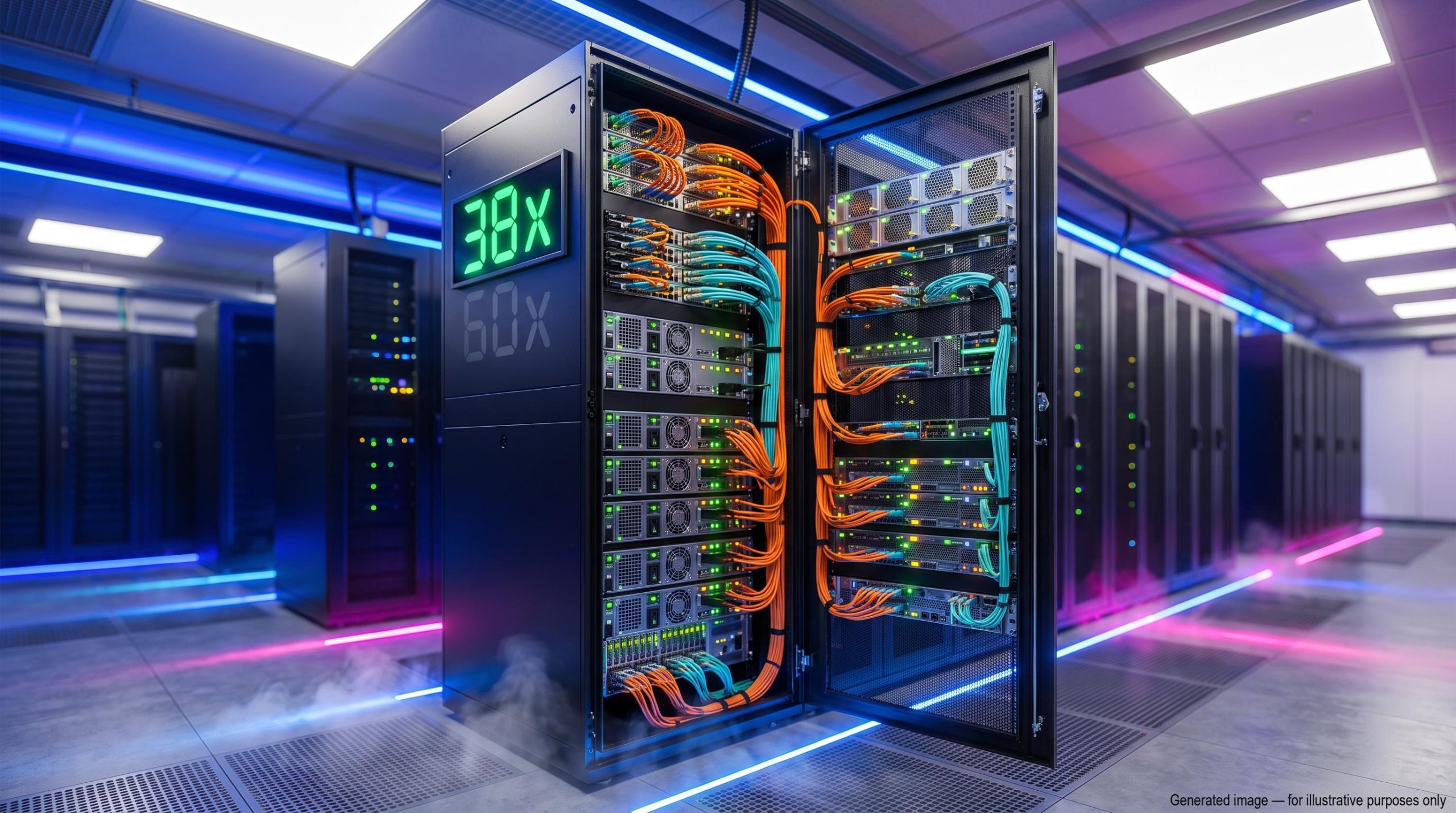
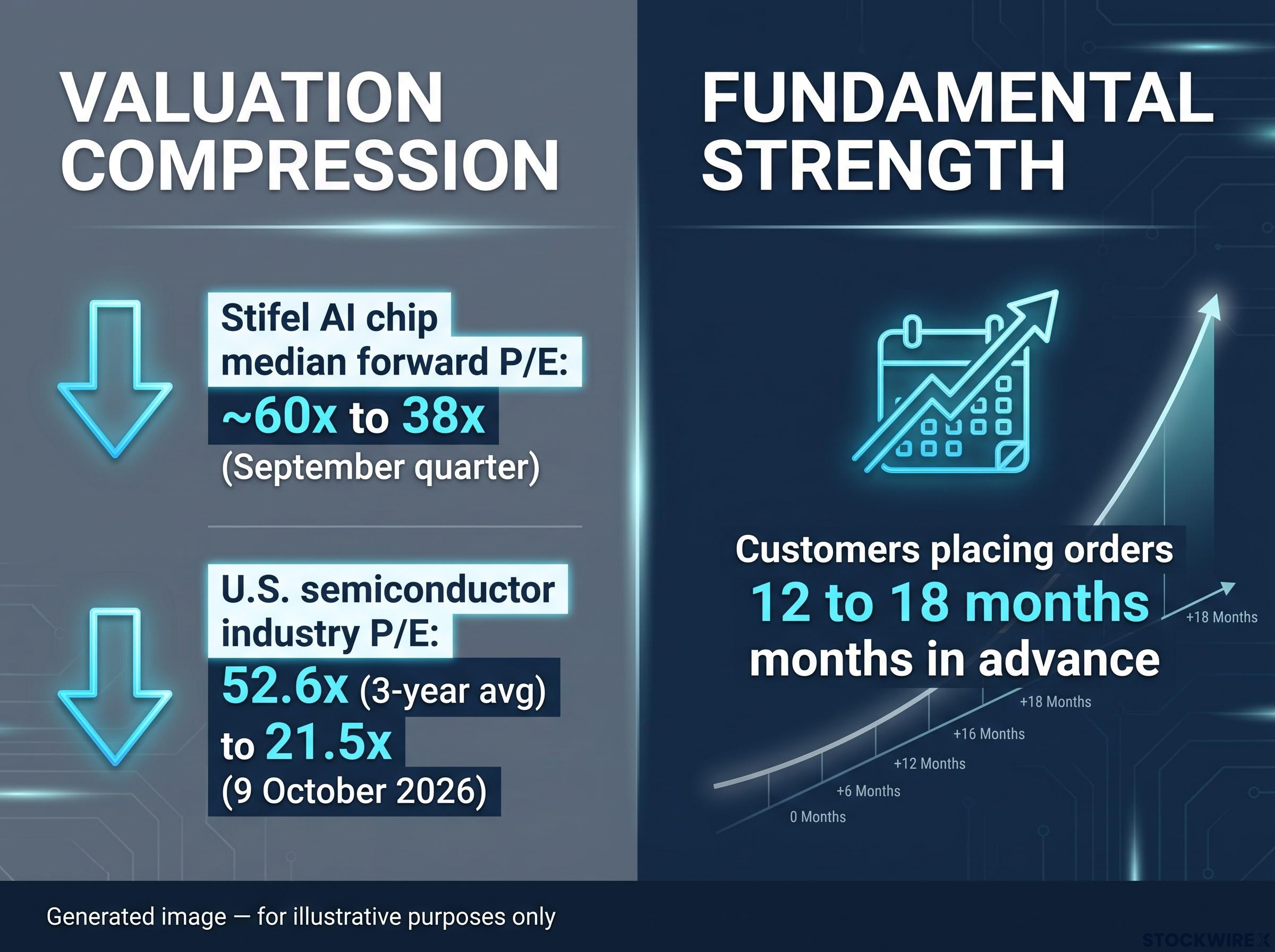
Median forward price-to-earnings (P/E) ratios across Stifel’s covered AI chip names fell from about 60x to 38x in the September quarter. Over the same period, guidance and annual outlooks across that group moved higher, which is the reverse of what a sharp drop in AI semiconductor valuations would normally signal.
Stifel set out its view in a note reported on 9 October 2026. It rates five names Buy: Monolithic Power Systems (MPWR), Marvell Technology (MRVL), Texas Instruments (TXN), MACOM Technology Solutions (MTSI) and Semtech (SMTC). The primary note was not directly accessible, so the figures below come from secondary coverage, chiefly Investing.com.
The timing matters. If you read a falling multiple as falling demand, the data suggests you may be reading the wrong signal.
Here is what the numbers say about separating a price reset from business performance, and why Stifel thinks supply limits and networking content per rack will decide what happens next.
Why did AI semiconductor valuations fall while fundamentals improved?
The headline compression looks alarming on its own. A forward P/E compares a share price with the earnings analysts expect over the next 12 months, and for Stifel’s group that figure lost more than a third of its value in one quarter.
Then the guidance arrived. According to Stifel, its covered data-centre companies guided the current quarter up sharply on a sequential basis, by double digits at the midpoint, and raised annual outlooks across the group. Customers are placing orders 12 to 18 months in advance and paying large capacity prepayments, which are upfront payments made to secure future production.
Stifel’s read Data-centre fundamentals improved over the summer earnings season while valuations reset on macro, sentiment and positioning factors rather than business performance.
Outside analysis points the same way. Gate.com described the June selloff as a partial unwinding of crowded trades, not an earnings collapse. Mitrade noted that forward P/E is a moving figure: it falls when prices drop or when earnings estimates climb, and both happened here.
| Metric | Earlier | Latest | Source |
|---|---|---|---|
| Median forward P/E, Stifel AI chip coverage | ~60x | 38x | Stifel (via Investing.com) |
| SOX forward P/E percentile | Near 99th | About 75th | Secondary analysis, unverified |
| U.S. semiconductor industry P/E | 52.6x (three-year average) | 21.5x (9 October 2026) | SimplyWall.st, unverified |
Reading the multiple correctly
The figures in that table measure different things. The Philadelphia Semiconductor Index (SOX) reading reportedly followed a June selloff of about $1.4 trillion, while SimplyWall.st’s measure covers the broader U.S. industry, not Stifel’s group. Check which multiple a headline quotes before drawing conclusions.
Semiconductor valuation frameworks differ by stock type, with PEG ratios suited to hypergrowth names and EV/EBITDA to cyclical recovery names, which is why a single sector multiple can mislead when individual companies are compared.
Share prices split too. MPWR fell just 3% in Q3, and SMTC rose 10%, the only gainer in the group.
A lower multiple on rising estimates means the market is paying less for each dollar of expected earnings. That is why you should judge a pullback by what happened to guidance, not by the price chart alone.
Where is the guidance strongest across Stifel’s five Buy-rated chip names?
The five names fall into two groups, and both point to the same theme: suppliers are capturing more dollars in each AI server rack.
| Ticker | Rating/Target | Sequential guide | Standout metric |
|---|---|---|---|
| MPWR | Buy, $1,800 | 17% | CY26E Enterprise Data floor raised to 130% |
| TXN | Buy, $360 | Not disclosed | Mostly in-house U.S. 300mm manufacturing |
| MRVL | Buy, $350 (see note) | 15% | FY28E revenue to about $18B |
| MTSI | Buy, $450 | 23% | Record 1.6x book-to-bill |
| SMTC | Buy, $220 | 20% | Over 70% booked against FY28 |
Power and analog: MPWR and TXN
MPWR, trading at $1,439.73 with a $70.8B market capitalisation, raised the floor for its CY26E Enterprise Data growth to 130% from 85% and extended its capacity goal beyond $6 billion. TXN, at $293.80, makes most of its chips in its own U.S. 300mm plants and has started raising prices customer by customer.
Both benefit from rising power density, meaning AI racks draw more electricity and need more power-management chips to handle it.
Connectivity: MRVL, MTSI and SMTC
- Marvell guided 15% sequential growth, and Stifel lifted its FY28E revenue estimate to about $18 billion from $16.5 billion, with data-centre growth above 60%.
- MACOM guided 23%, with data centre up about 35% and a record book-to-bill of 1.6x (new orders received for every dollar of sales shipped).
- Semtech guided 20%, with data centre up 45%, and Stifel lifted its target to $220 from $188.
The Oct 9 roundup cites a $350 Marvell target, while other coverage reports Stifel raised it to $370 on 7 October. That discrepancy remains unresolved.
Stifel sees networking’s growing share of the rack bill of materials, the full list of components and their cost, as the central theme of the next phase. Because these suppliers earn on content per rack rather than GPU share alone, their earnings can keep rising even if headline GPU multiples stay under pressure.
What could still derail the AI chip trade, and what should you watch?
Demand visibility looks strong, with orders stretching more than a year out. Stifel’s caution sits elsewhere.
Stifel’s flag Supply, not demand, is the main item to monitor.
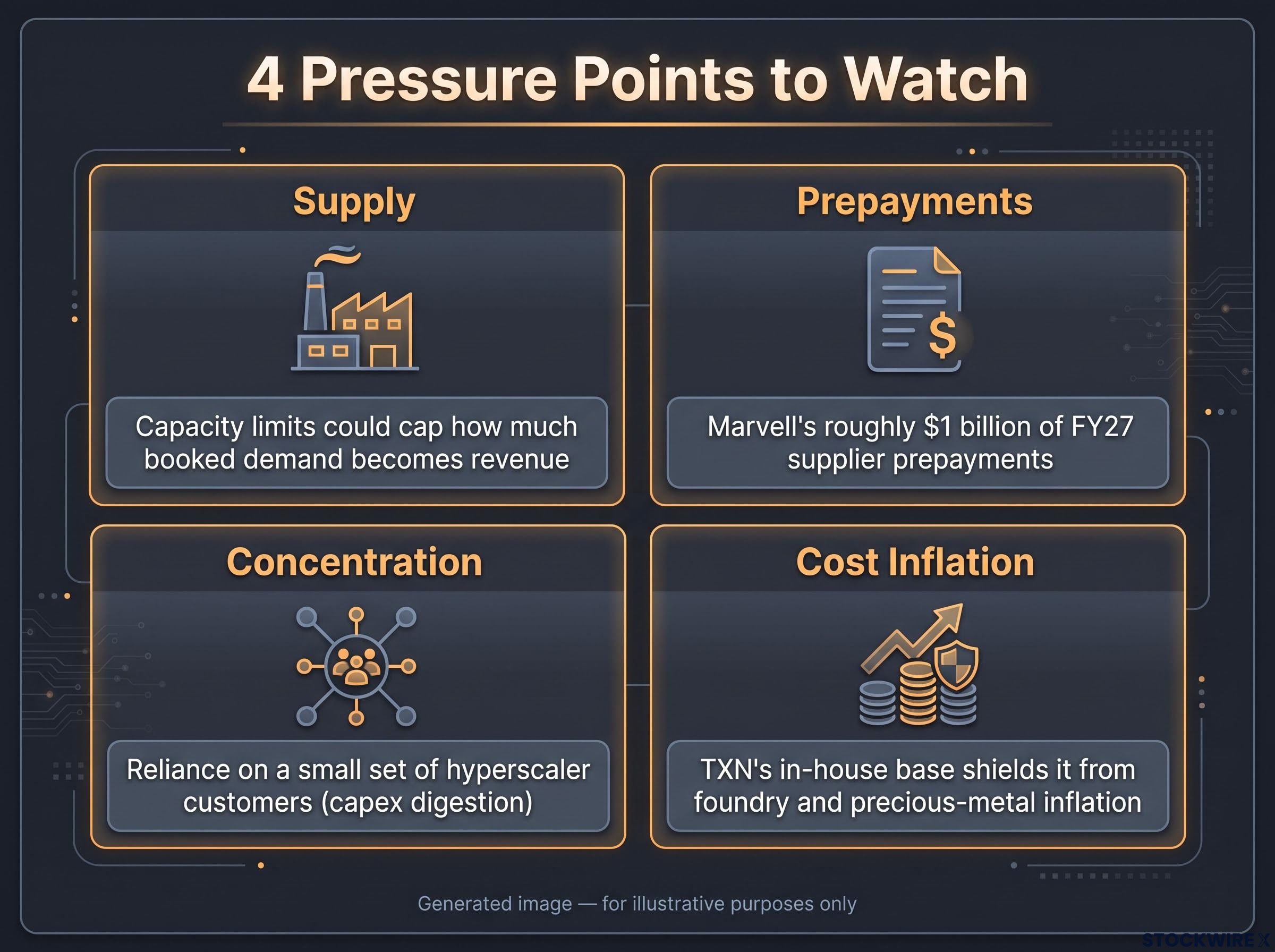
Semtech, despite being over 70% booked against FY28, warned that its secured capacity might fall short in the second half of that year. The specific pressure points:
- Supply: capacity limits could cap how much booked demand becomes revenue.
- Prepayments: Marvell’s roughly $1 billion of FY27 supplier prepayments signal conviction but could become sunk costs if demand slows.
- Concentration: reliance on a small set of hyperscaler customers leaves the group exposed to capex digestion, a pause while buyers absorb equipment already bought.
- Cost inflation: TXN’s in-house base shields it from foundry and precious-metal inflation that rivals may face.
The cautionary reading deserves weight. The SOX reportedly still sits near the 75th percentile of its historical forward range, and index multiples can mask concentration in a few mega-cap names.
General industry history offers a parallel. In the 2018-2019 memory cycle and the 2012-2015 smartphone build-out, multiples reset while revenues kept rising with content per device. That pattern is not Stifel’s argument, and it does not guarantee a repeat.
If you hold or are considering these names, the signals that matter are capacity availability and hyperscaler spending, not the daily multiple, because those determine whether guidance turns into delivered revenue.
Hyperscaler capex projected at $610 billion to $650 billion in 2026 makes concentration a macro-level issue, since four buyers account for 17% of the S&P 500 and any spending pause would flow straight through the supply chain.
What the reset changes, and what it does not
The multiple fell sharply while guidance, capacity commitments and annual outlooks rose. Stifel treats that combination as a valuation reset, not a business deterioration, and keeps Buy ratings on all five names.
What the reset does not change is the need to check each company on its own numbers. Compare the multiple you are paying with the guidance behind it, name by name, and keep supply capacity and hyperscaler capex at the top of your watchlist. Those are the variables most likely to change the picture.
For readers wanting to plan around cycle risk, our dedicated guide to semiconductor cycle investing sets out a five-indicator framework for judging when premium multiples may expire.
This article reports on an analyst view and is not personalised investment advice.
This article is for informational purposes only and should not be considered financial advice. Investors should conduct their own research and consult with financial professionals before making investment decisions. Past performance does not guarantee future results. Financial projections are subject to market conditions and various risk factors.