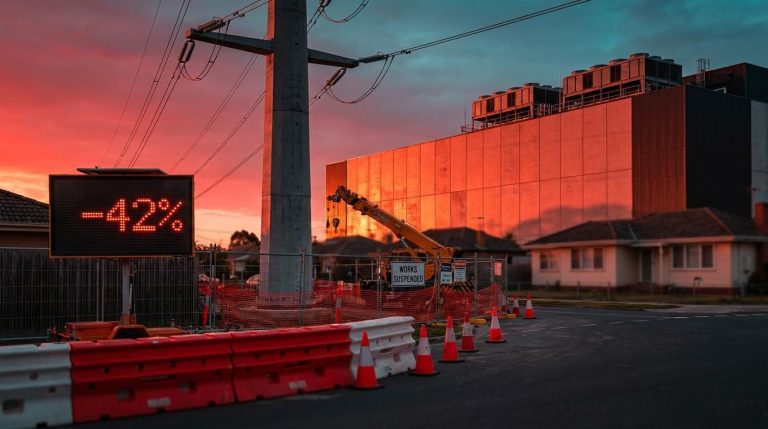
Megacap technology shares dragged the Nasdaq down about 2.6% to 2.7% on Thursday, 22 October 2026, its worst session since early June. The AI selloff stopped at the edge of the tech sector. The Philadelphia Semiconductor Index fell roughly 6.7% while consumer staples climbed more than 3%, and the equal-weighted S&P 500 was heading for its best relative day since 2024.
The trigger was not weak demand for artificial intelligence. It was a growing concern about who pays for the buildout.
Meta Platforms put that concern into hard numbers this week: its first negative free cash flow in over a decade, alongside a record reading on its credit risk.
Here is what the session reveals about AI funding risk, and whether moving into defensive stocks is a sensible response or a crowded one.
What did the market actually do on October 22?
The headline numbers understate how uneven the day was. The S&P 500 lost more than 1%, yet the Dow finished close to flat and small caps edged higher.
| Index | Close | Move |
|---|---|---|
| Nasdaq Composite | 25,988 to 26,009 | -2.6% to -2.7% |
| S&P 500 | 7,648 to 7,663 | -1.2% to -1.4% |
| Dow Jones Industrial Average | 52,750 to 52,868 | -0.20% to +0.02% |
| Russell 2000 | 2,784 | +0.11% |
| Philadelphia Semiconductor Index | 10,737.69 | -6.67% |
| VIX | 19.03 | +14.09% |
Note: The Charlotte Observer and CNBC report different closing levels; ranges reflect both.
Chipmakers had their steepest fall since July, with the semiconductor index shedding 767.87 points. The sector split was stark:
- Consumer staples: +3.11%
- Utilities: +1.98%
- Information technology: -3.00%
- Communication services: -3.02%
The damage travelled overnight into Asia. SK Hynix, Samsung and Tokyo Electron slid, the Kospi dropped more than 3%, the Nikkei 2.7% and the Hang Seng 3.1%.
That gap between tech and the equal-weighted index matters for you. The losses sat in the names that dominate cap-weighted portfolios, so an S&P 500 index fund probably felt more of this day than the broad average of stocks suggests.
When big ASX news breaks, our subscribers know first
Why did Meta’s cash burn turn a beat into a rout?
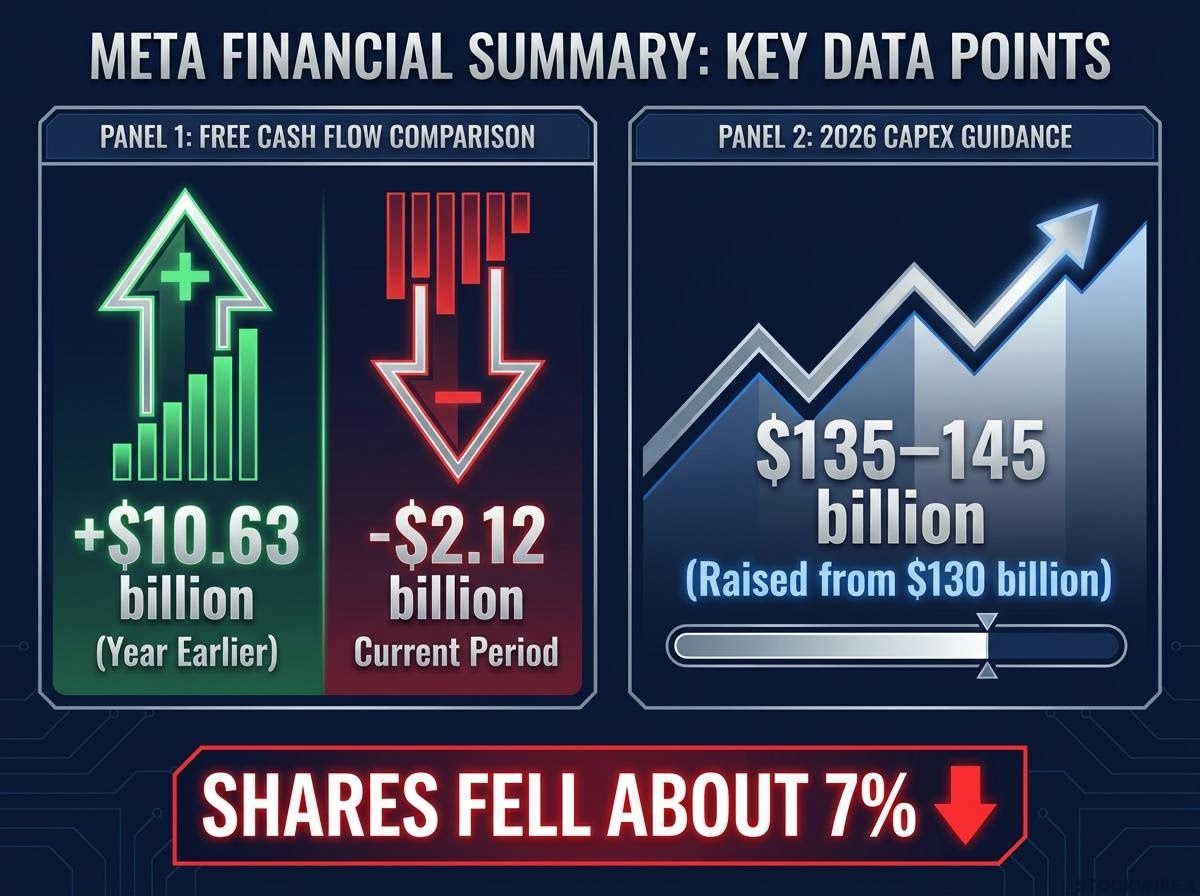
On paper, Meta delivered. Third-quarter revenue reached $64.60 billion, up 26% and ahead of the roughly $63.37 billion expected, and adjusted EPS came in near $7.40 once a $9.89 billion legal charge was stripped out (reported diluted EPS was $3.83).
The shares still fell about 7%, their largest drop since July.
The reason sat in the cash flow statement. Free cash flow, the cash left after paying for operations and investment, swung to -$2.12 billion from +$10.63 billion a year earlier. Reuters identified 2012 as the last time Meta’s cash flow turned negative, and the company lifted the bottom of its 2026 capex guidance to $135-145 billion from $130 billion.
Meta’s higher floor on 2026 spending sits inside a wider pattern, as hyperscaler capex guidance across Amazon, Microsoft, Alphabet and Meta now points to roughly $725 billion this year and a trajectory toward $1 trillion in 2027.
Meta also announced a listed Class C share with no voting rights, effective January 2027. It gives the company a way to raise equity without diluting founder-led voting control, which investors read as a financing tool rather than a shareholder perk.
The credit market sent the sharper signal. A credit default swap (CDS) is a contract that pays out if a borrower defaults, so its price, or spread, tracks perceived credit risk.
Record credit risk: Meta’s five-year CDS widened 7.6 basis points to a record 114.79 bp, on fears of more tech debt issuance.
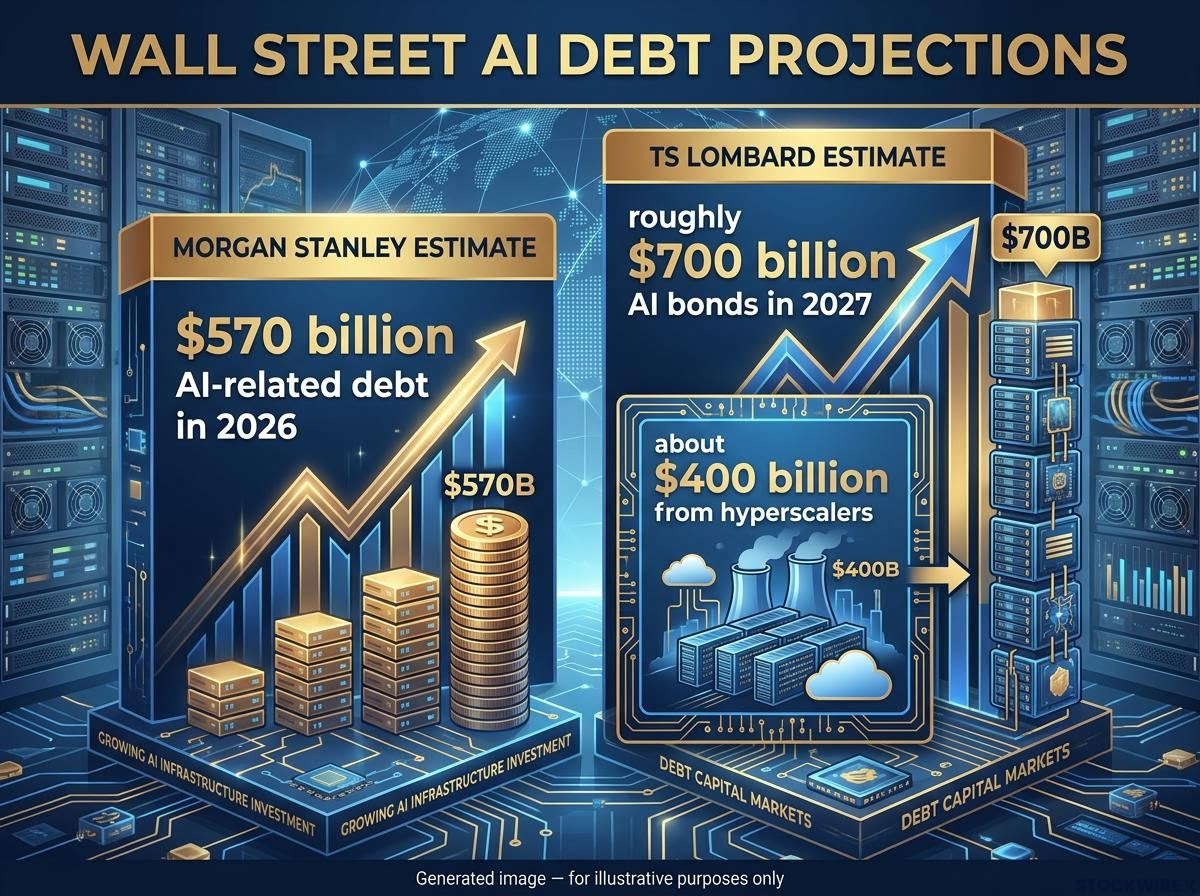
Meta is not alone in borrowing. Morgan Stanley estimates about $570 billion of AI-related debt issuance in 2026, and TS Lombard sees roughly $700 billion of AI bonds in 2027, about $400 billion of it from hyperscalers. Bonds of CoreWeave, a leveraged AI cloud provider, yield around 15%. Nvidia CEO Jensen Huang told CNBC capital is getting scarcer, while Deutsche Bank’s Jim Reid argued investors must watch credit pricing more closely as the cycle leans on debt.
The research traces the chain like this:
- Higher inflation and rate expectations lifted Treasury yields.
- Higher yields raised the return hurdle for data centres, chips and cloud infrastructure.
- Investors questioned whether future AI earnings justify current spending.
- Credit spreads widened for leveraged AI providers, then for Meta.
- Equity investors sold the most capital-hungry, richly valued tech names.
For you, the shift is clear: the AI trade is moving from cash-funded to debt-funded, so a company’s balance sheet and credit spread now matter as much as its AI revenue.
Tesla’s capex cut sends the opposite signal
Tesla beat too, with adjusted EPS of $0.48 against about $0.45. Core auto revenue fell 3% and energy revenue dropped 16% to $2.88 billion.
It cut 2026 capex to about $20 billion from $25 billion or more. The shares fell anyway, as investors treated the cut as a sign that even the biggest tech names are rationing capital.
How did short positioning and defensive buying amplify the move?
Two forces compounded each other. Hedge funds were already leaning hard against equities, and defensive earnings gave the rotation somewhere to land.
Goldman Sachs prime brokerage data shows global equity short sales outpaced long purchases by about 5 to 1 in October, with short leverage at the 99th percentile of the past five years. Goldman warned that this level of bearishness raises the risk of a sharp short squeeze, where sellers rush to buy back shares if prices rebound.
On the other side, Procter & Gamble posted Q1 FY27 organic sales growth of 4% against 2.4% expected. Lockheed Martin reported a record $292 billion backlog and raised guidance for a second consecutive quarter.
| Company | Metric | Result | Share reaction |
|---|---|---|---|
| Meta | Free cash flow | -$2.12B | Down about 7% |
| Tesla | Adjusted EPS | $0.48 | Fell |
| Procter & Gamble | Revenue / core EPS | $23.3B / $2.00 | Rose |
| Lockheed Martin | Sales / EPS | $20.7B / $7.97 | Up more than 4% |
Elsewhere, Spotify rose on 788 million monthly users, while Moderna fell as much as 26% intraday.
Shelter now carries a price. Mark Hackett of Nationwide said staples work as a hedge against tech concentration but are no longer cheap. Walmart trades at about 40 to 43 times forward earnings and Costco near 48 times. The risks include:
- Valuation: paying a premium just as the trade becomes consensus
- Rate sensitivity: bond-like stocks can de-rate if rates stay high
- Opportunity cost: if financing fears fade, expensive defensives may lag
Heavy shorting suggests Thursday’s fall may have been exaggerated and could reverse quickly, so you should not assume the direction holds.
Investors weighing the move into staples can read our dedicated guide to cyclical versus defensive stock allocation, which shows how weightings shift across economic phases.
Is this a healthy rotation or the start of a wider AI correction?
The same evidence supports both readings.
Strategists described the session as a “positioning-driven hiccup on the fringes of the AI trade.”
| Interpretation | Evidence |
|---|---|
| Positioning-driven rotation | Extreme shorting creates squeeze potential; semiconductor earnings up about 175% with a sector P/E near 14x (author commentary) |
| Start of a financing squeeze | Meta’s first cash deficit in over a decade, record CDS, CoreWeave near 15%, rising bond issuance |
D.A. Davidson’s Gil Luria accepts AI demand is real but questions whether leveraged providers can service debt at these rates. The bear risk is a reverse loop: weaker shares raise financing costs, which force capex cuts. Private credit assets, up 17% to $4.1 trillion per the Alternative Credit Council, show how much of that funding sits outside public markets.
Passive bond holders are exposed too, because investment-grade credit signals are shifting as AI-tagged debt grows to roughly 15% of the US investment-grade market and Meta’s 2036 bonds trade at triple-B-equivalent spreads.
Precedents cut both ways. The 2024 rotation and the DeepSeek shock in early 2025 point to repricing rather than collapse; the semiconductor index’s losing streak echoes October 2008, and the dot-com era warns about dependence on outside capital. These describe market behaviour, not equivalent economic conditions.
Your early signals are credit spreads and the next round of tech bond issuance, because they moved before share prices did.
What the session changes, and what it does not
Demand for AI is not in question after Thursday. The cost and source of its funding now are, and markets have started pricing that in.
Three variables will tell you which reading wins:
- Credit spreads at Meta and its hyperscaler peers
- The size and pricing of upcoming hyperscaler bond deals
- Whether crowded shorts begin covering
Defensives offer shelter, but at premium valuations. Selling tech outright could lock in underperformance if financing fears ease, so the next few weeks of credit data deserve as much attention as earnings.
This article is for informational purposes only and should not be considered financial advice. Investors should conduct their own research and consult with financial professionals before making investment decisions. Past performance does not guarantee future results, and forward-looking statements are speculative and subject to change.