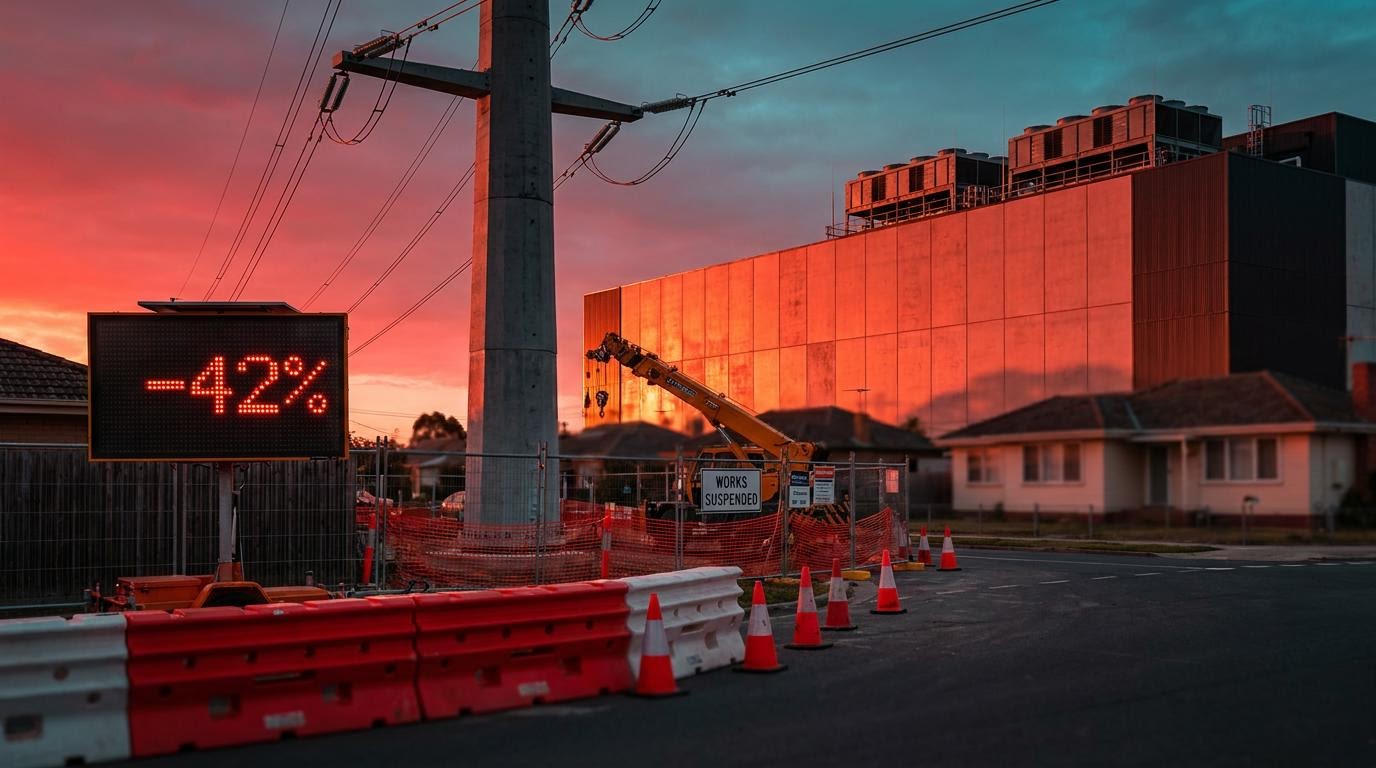
NextDC shares fell about 42% on Wednesday, 21 October 2026, to an eight-year low. The company had cut its FY2027 revenue and earnings guidance by roughly $140 million each. That price move was far larger than the earnings hit behind it, which leaves a question hanging over the NextDC share price: what exactly is the market pricing?
On Thursday, the stock recovered about 7% to roughly $5.70. Reports differ on the size of the fall: CNBC put it at 39.5%, while The Motley Fool Australia and other outlets reported about 42%.
The cause sits outside the company’s buildings. A delayed power grid upgrade at its M3 Melbourne data centre forced the revision. If the market has treated a timing delay as permanent damage, the current price may undervalue the business. If the delay keeps spreading, the price may still be too high.
Here is how to separate a recoverable timing setback from lasting impairment, using the evidence available as of 22 October.
Why did NextDC’s share price fall further than the guidance cut implies?
The stock was already weak before Wednesday. It had fallen 34% since the full-year results, so the latest drop came on top of an existing slide.
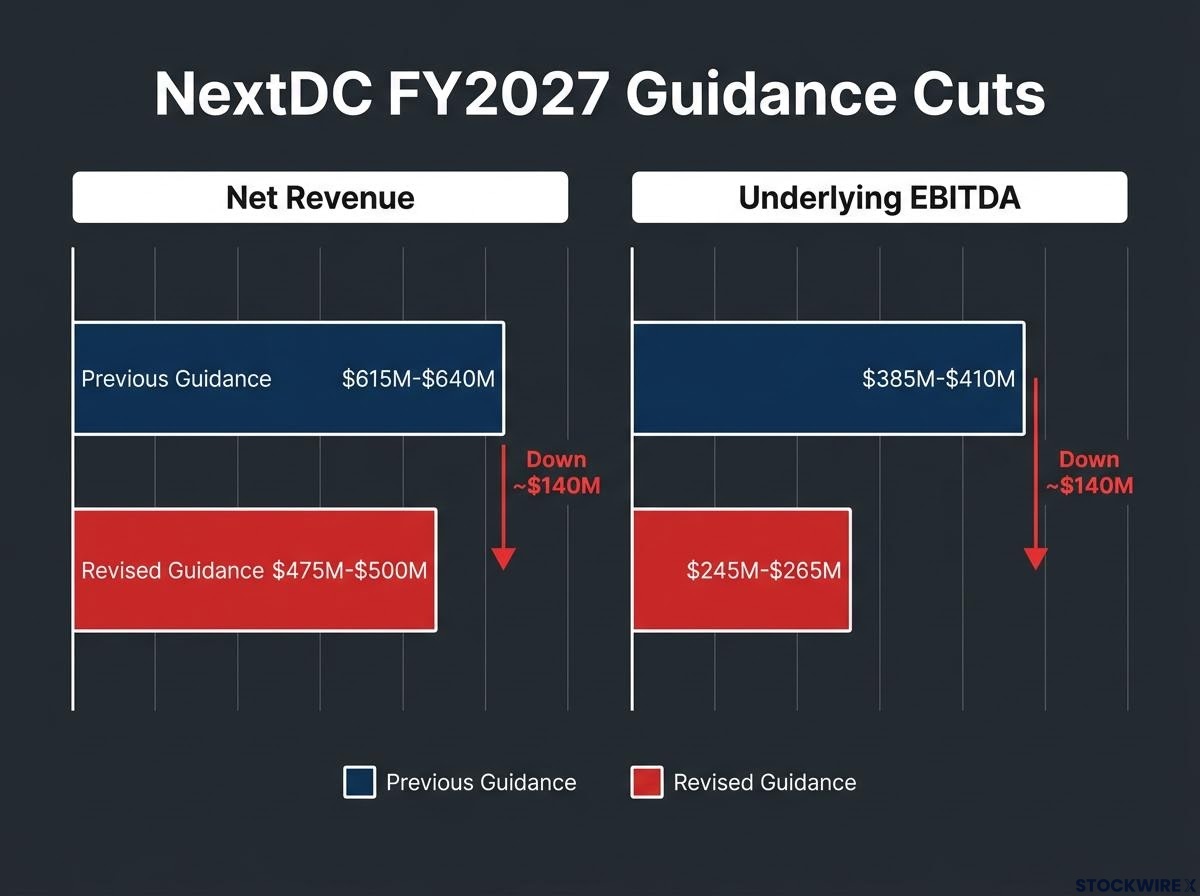
The guidance numbers show what changed. EBITDA means earnings before interest, tax, depreciation and amortisation, a common measure of operating profit. Capex means capital expenditure, the money spent building assets.
| Measure | Previous guidance | Revised guidance | Change |
|---|---|---|---|
| Net revenue | $615M-$640M | $475M-$500M | Down $140M, about 22% at midpoint |
| Underlying EBITDA | $385M-$410M | $245M-$265M | Down $140M, about 36% at midpoint |
| Capex | $5.25B-$5.75B | $4.5B-$5.0B | Down $750M; about $980M like-for-like, excluding capitalised interest |
The revised figures leave out several items:
- About $140M of FY2027 revenue tied to affected M3 contracts
- About $140M of attributable EBITDA from the same contracts
- Potential service-level credits, which are payments owed to customers when agreed capacity arrives late
NextDC said the excluded contribution could return in FY2027 if power improves. It could not estimate when.
The central question before this week was whether contracted megawatts convert to billing on schedule, and the M3 delay has now made that conversion timeline the focus of the entire investment case.
A 36% cut to one year’s earnings does not, on its own, justify a 42% fall in the company’s value. Morningstar noted the stock now trades at a price/book ratio of about 0.8, meaning below the accounting value of its assets, while most data-centre peers sit well above 1. The market is pricing a problem that reaches beyond FY2027. You need to judge whether that view holds up.
When big ASX news breaks, our subscribers know first
What went wrong at M3, and how long could the delay last?
The fault is not inside NextDC’s data halls. It sits in the poles and wires feeding them.
Jemena Electricity Networks suspended parts of its 66kV line-augmentation works supplying M3 in September 2026. Line augmentation means upgrading power lines to carry more electricity. Jemena cited safety concerns, restricted access caused by community opposition, and the local council’s refusal to give road-authority consent while further consultation ran.
The timeline now stretches in sequence:
- September 2026: Jemena suspends parts of the works.
- February 2027: The earliest date Jemena expects to restart.
- FY2028: The next increase in grid supply to M3, pushed back from FY2027.
- Later stages: Dependent on new transformers at Brooklyn Terminal Station, which are also running late.
Hall construction continues inside existing buildings, and the affected capacity remains contracted, subject to customer rights. Those rights matter. Late delivery could trigger service-level credits and, in some cases, termination rights. Morningstar flagged that substitute power could cost more, though NextDC did not put a figure on it.
Why Australian grid connections are slow
Large-load connections can take years of engineering studies, approvals, network upgrades and third-party land access. In Melbourne’s west, residents have objected to larger poles carrying high-voltage lines through their streets.
Delays tied to planning approvals and social licence are increasingly structural across Australian energy infrastructure, which suggests the community opposition behind Jemena’s suspension is not an isolated local issue.
The pressure is national. The Australian Energy Market Operator (AEMO) estimated in its 2026 Electricity Statement of Opportunities that operating data centres in the National Electricity Market had about 2.2GW of maximum connection capacity. AEMO-related reporting suggests data-centre use could climb from about 2% of national electricity consumption to 9%-10% within a decade. The Age reported that 36% of known projects listed in 2025 have since been cancelled.
Goodman Group‘s withdrawn Lane Cove proposal shows the risk is not unique to NextDC. For you, the point is that this delay hinges on approvals and third-party works, which makes its end date far harder to forecast than an ordinary building slip.
Is the selloff overdone? What Morningstar, brokers and the bears say
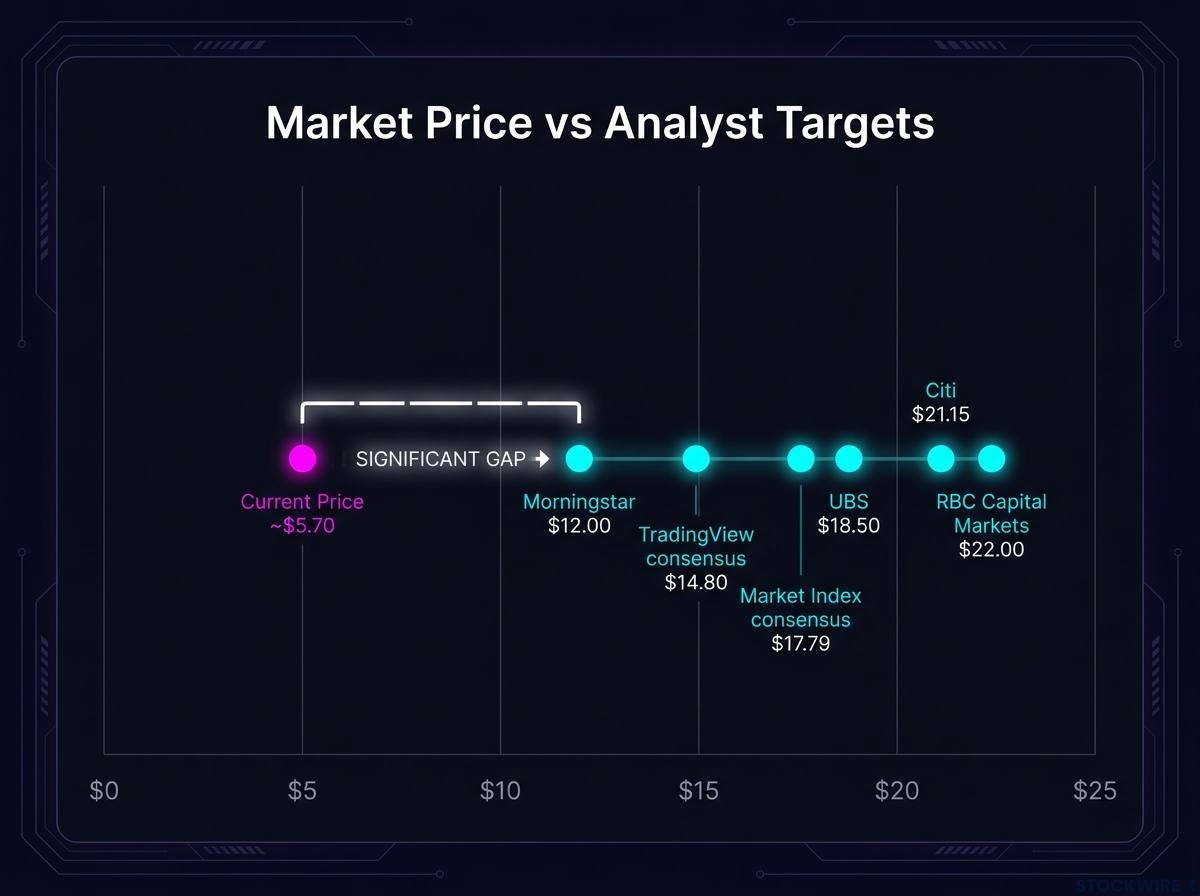
Morningstar’s Dan Baker cut his fair value estimate to $12.00 from $15.60, but argued the market went too far.
Morningstar’s view The selloff was excessive because M3 earnings are largely postponed rather than eliminated, and Morningstar sees no comparable cut to the medium-term outlook.
Most brokers still rate the stock a buy. Figures for UBS, Macquarie and Jefferies come from The Motley Fool Australia, as the primary notes were not directly accessible.
| Source | Target or fair value | Stance |
|---|---|---|
| Morningstar | $12.00 | Selloff excessive |
| Citi | $21.15 | Buy |
| RBC Capital Markets | $22.00 | Outperform |
| UBS | $18.50 | Target reduced |
| Market Index consensus | $17.79 | Strong buy |
| TradingView consensus | $14.80 | 13 of 16 buy or strong buy |
The caution is specific. Macquarie said M3’s final stages could slip by several years and NextDC has few other ways to secure power. Jefferies warned the company could narrowly meet its interest-cover ratio, a lender test of earnings against interest costs, this year and potentially breach it in 2028. Citi flagged that termination rights and service credits could affect covenant calculations, the financial conditions attached to its loans.
The balance sheet gives some room. Liquidity stood at $8.675B on 30 September 2026, including $1.275B cash and $6.7B of undrawn senior debt. NextDC expects to meet covenants at the 31 December 2026 test, and Morningstar reported the company does not intend to raise equity while S4 joint-venture talks continue.
Even Morningstar’s lowest figure sits more than double the current price. That gap only matters to you if the covenant and delivery risks Jefferies and Citi describe do not materialise.
Before the guidance cut, Morningstar already expected about A$7.9 billion of additional free cash outflow over four years, so sustained negative free cash flow was part of the thesis, and delayed billing now lengthens that period.
Bull and bear: a framework for weighing a delay against durable demand
Morningstar’s long-run case rests on cloud and AI-driven data growth, lower penetration by global operators in Australia, and interconnection, which made up about 8.6% of net recurring revenue in 2025. NextDC runs four Sydney sites, three in Melbourne, two each in Perth and Brisbane, and one each in Adelaide, Canberra, Darwin and Newman, plus Asian sites in Kuala Lumpur and Japan, with Auckland planned.
The company has responded by freezing new projects and land purchases, pausing uncontracted work and focusing capex on contracted capacity due within 12-18 months.
| Theme | Bull case | Bear case |
|---|---|---|
| Timing | Capacity stays contracted; earnings deferred | Brooklyn Terminal Station slippage extends delay beyond FY2027 |
| Liquidity | $8.675B available | Delayed billing could strain interest cover |
| Power cost and credits | Powered sites gain scarcity value | Costlier substitute power and service credits |
| Customer concentration | Strong hyperscaler demand | Large customers hold termination rights |
| Funding via S4 | Joint venture could validate asset values | Joint venture dilutes economics |
Morningstar also lists long-run risks: tenants needing less space, cloud providers building their own facilities, and virtual connectivity. Compared with the more diversified Goodman, NextDC offers more direct exposure to powered AI capacity, and more direct exposure to a single grid event.
No directly comparable recovery precedent was found. Signposts worth tracking:
- Jemena’s February 2027 restart
- The 31 December 2026 covenant test
- The S4 joint-venture outcome
- Any quantified substitute power cost
The investment case now rests on whether grid upgrades arrive on schedule, not on whether AI demand exists.
For readers weighing long-run risks beyond power, our deep-dive into data centre oversupply risk examines how pricing pressure could emerge even if AI demand holds.
What the plunge settles, and what it leaves open
The guidance cut is real but confined to one year, while the price fall implies damage stretching well beyond it. Whether that gap closes depends on one thing: whether delay hardens into impairment.
As of 22 October 2026, that outcome was not established, and the NextDC share price rebound is only a partial early signal. The nearest decision points are the covenant test on 31 December 2026 and Jemena’s earliest restart in February 2027.
Past performance does not guarantee future results. Financial projections are subject to market conditions and various risk factors.
This article is for informational purposes only and should not be considered financial advice. Investors should conduct their own research and consult with financial professionals before making investment decisions.