Adobe beat earnings estimates, raised full-year guidance, and watched its stock fall more than 5% in after-hours trading on 12 June 2026. The numbers were not the problem.
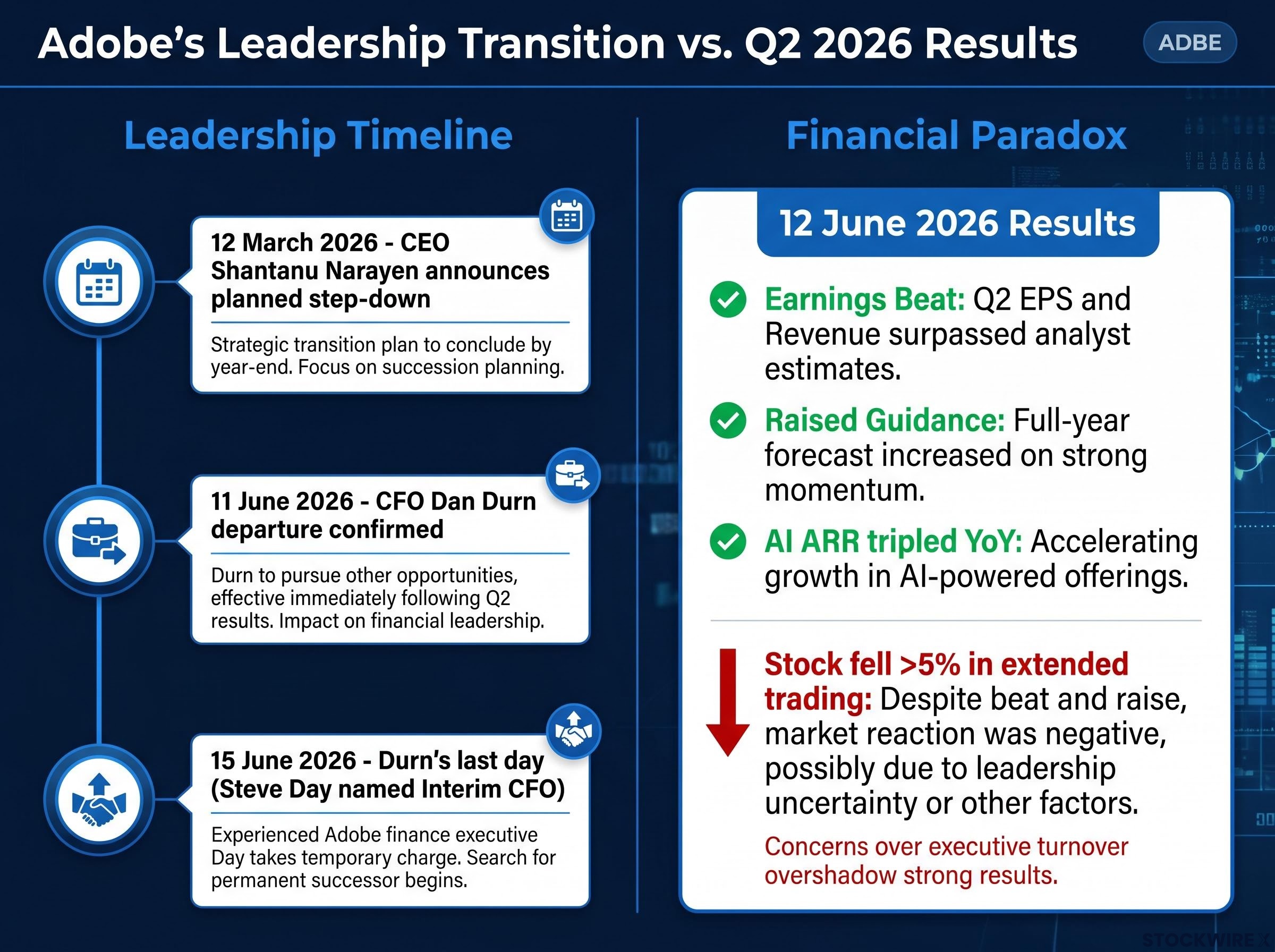
The sell-off followed confirmation that CFO Dan Durn will leave on 15 June 2026, the second consecutive quarter in which a senior Adobe executive has announced a departure. CEO Shantanu Narayen, who has led the company since late 2007, is also in an active transition period after announcing his planned step-down on 12 March 2026. That combination, a pending CEO succession and a vacant CFO seat filled only by an interim, has investors questioning who will actually lead Adobe through the most consequential phase of its AI strategy.
What follows explains what triggered the sell-off, why leadership continuity carries real financial weight, how Adobe’s underlying business actually looks right now, and which specific signals will tell investors whether this is a temporary discount or something more lasting.
A strong quarter overshadowed by a second executive exit
Adobe exceeded both revenue and earnings estimates for the quarter and raised its annual profit and revenue targets. The operational results, by any conventional measure, were strong.
Adobe’s Q2 fiscal 2026 earnings release confirmed record revenue of $6.62 billion alongside raised full-year targets for both revenue and non-GAAP EPS, providing the operational baseline against which the leadership uncertainty is being weighed.
Then the CFO announcement landed. Dan Durn’s last day is 15 June 2026. Steve Day, SVP of corporate finance and CFO of Adobe’s Customer Experience Orchestration unit, was named interim CFO while a permanent search gets underway.
Adobe shares fell more than 5% in extended trading on 12 June 2026, despite the earnings beat and raised guidance.
The broader momentum factor unwind affecting high-beta technology equities during the same week contributed market-level pressure on top of Adobe’s idiosyncratic governance risk, with high-beta stocks suffering factor-specific selling that analysts characterised as distinct from fundamental deterioration.
The CFO exit does not arrive in isolation. On 12 March 2026, Narayen publicly communicated his planned step-down after nearly two decades in the role. Two departures, side by side:
- CEO Shantanu Narayen: Announced planned step-down on 12 March 2026; remains chair and CEO during active succession period; no permanent successor named
- CFO Dan Durn: Departure confirmed 11 June 2026; last day 15 June 2026; interim CFO (Steve Day) in place; permanent search ongoing
The sequence matters. Markets are not reacting to one CFO leaving. They are reacting to a pattern that has now formed across two consecutive quarters.
When big ASX news breaks, our subscribers know first
Why investors sell even when the numbers look good
The paradox is a familiar one: a company posts a clean beat, lifts guidance, and the stock drops. The explanation sits in how markets actually work. Share prices reflect forward expectations, not backward-looking results. A strong quarter can coexist with a falling stock if the forward risk picture has worsened.
In Adobe’s case, the forward risk picture worsened materially on the same evening the backward-looking results impressed. Adobe’s AI annualised recurring revenue (ARR) tripled year-over-year, confirming that the operational engine is firing. But operational momentum and leadership certainty are separate variables, and markets price both.
What the CFO specifically represents to investors
The CFO role carries weight beyond the numbers. Guidance credibility, capital allocation decisions (buybacks, M&A timing, investment pace), and the investor-facing narrative all sit within the CFO’s domain. When that seat is vacated during a simultaneous CEO succession, institutions apply what amounts to a higher equity risk premium, the additional return investors demand for holding a stock whose governance outlook has become uncertain.
Markets typically wait for a new CFO to guide through at least one full earnings cycle before re-rating the stock. That timeline has not yet begun.
For readers who want to understand how this premium is actually measured and what historical levels imply about forward returns, our full explainer on the equity risk premium walks through Damodaran’s implied ERP methodology, 65 years of historical data across different ERP bands, and what the current reading means for expected returns across the market cycle.
What Adobe’s business actually looks like right now
Adobe’s product suite remains structurally embedded across creative and enterprise software. Photoshop, Premiere Pro, and the Adobe Firefly generative AI suite (spanning image, video, audio, and vector capabilities) anchor Creative Cloud and Experience Cloud.
The AI momentum is commercially real, not speculative. Adobe’s AI-related ARR tripled year-over-year, evidence of genuine adoption rather than feature announcements. Narayen’s earlier strategic achievement, transitioning Adobe from perpetual software licences to a cloud subscription model, was the defining move of the last decade. The AI monetisation phase is comparably consequential.
Adobe Firefly ARR metrics reported earlier in 2026 showed AI-first annualised recurring revenue exceeding $500 million, a threshold that contextualises the year-over-year tripling figure and indicates the scale of commercial adoption now underpinning Creative Cloud.
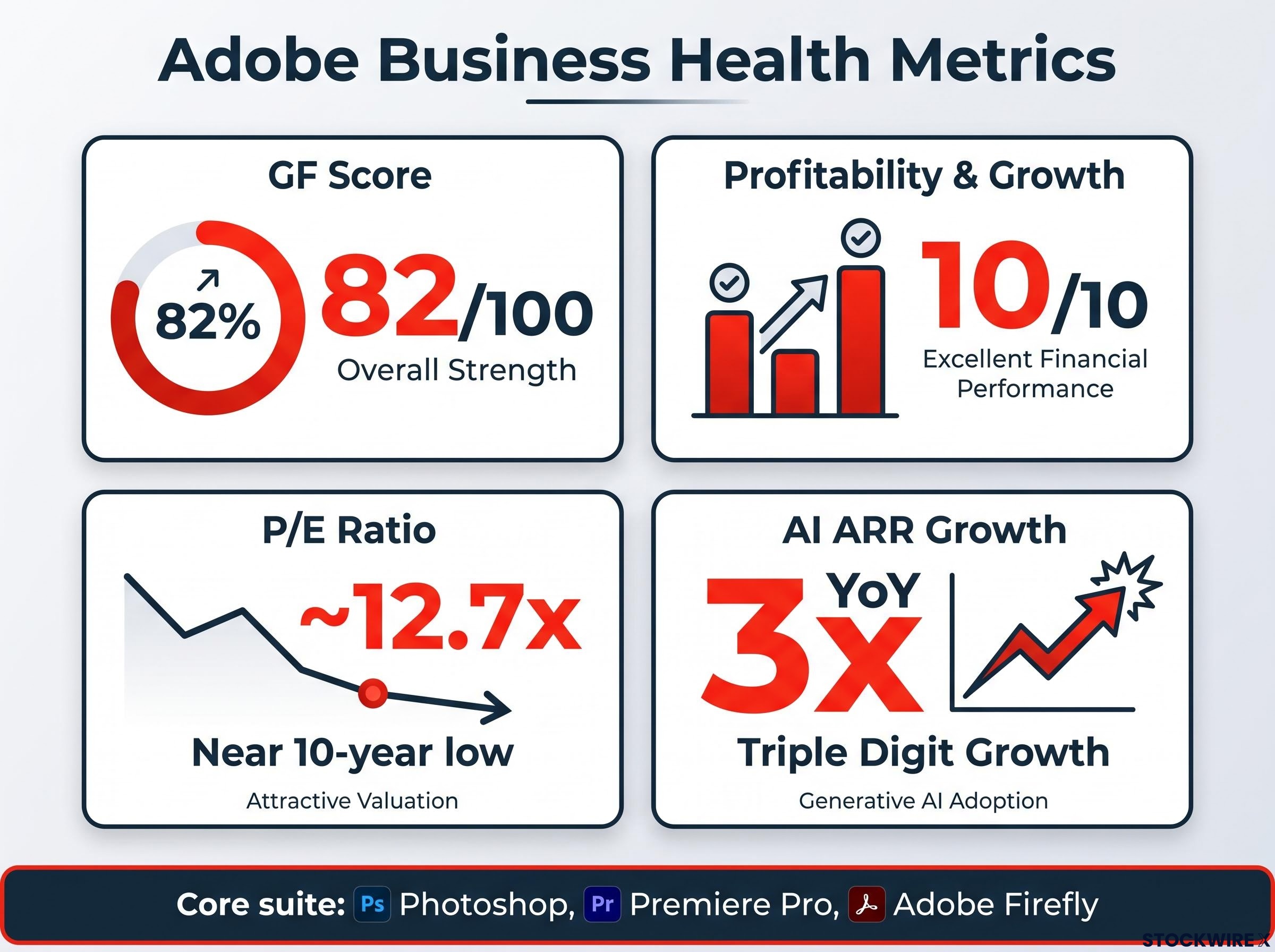
| Metric | Current Reading | What It Signals |
|---|---|---|
| GF Score | 82/100 | Strong overall business quality (directional estimate) |
| Profitability & Growth | 10/10 | Operating margins and growth trajectory remain healthy |
| P/E Ratio | ~12.7x | Near 10-year low; market already pricing elevated risk (directional estimate) |
| AI ARR Growth | 3x year-over-year | Commercial AI traction, not just feature releases |
Note: GF Score, profitability rating, and P/E figures are sourced via GuruFocus data and should be treated as directional rather than independently verified.
The gap between business quality and stock performance is the story. Adobe’s fundamentals do not look like a company in distress. The sell-off is a governance and risk-premium story, not an operational one.
The “pattern problem” and what two departures signal to Wall Street
One executive leaving can be individual. Two in consecutive quarters, at the top two roles, invites a different kind of scrutiny.
The CEO departure was announced on 12 March 2026. The CFO departure followed on 11 June 2026. Each move may have a legitimate individual explanation. But institutional investors apply pattern-recognition algorithms, both literal and cognitive, and the pattern here carries interpretive weight that exceeds the sum of the individual parts.
Three specific concerns emerge from that pattern:
- Internal alignment questions: Simultaneous vacancies at the top two roles can suggest strategic disagreement or cultural friction, even when neither departure was acrimonious.
- Talent retention risk below the C-suite: If senior leaders are leaving, institutions ask whether the next tier of product, engineering, and AI leadership is stable or similarly at risk.
- Competitive poaching pressure: AI-native competitors and large technology firms are actively recruiting experienced software executives. Two departures in rapid succession raise the question of whether Adobe is losing talent to rivals at a strategically vulnerable moment.
Investors are effectively saying: “We believe the quarter, but we don’t yet know who we’re betting on for the next decade.”
The leadership overhang functions like a valuation tax on the stock multiple. It persists until the uncertainty is resolved with credible, permanent appointments.
Five signals that will tell investors whether this discount is temporary
For anyone holding or watching ADBE through this transition, five signals will determine whether the current discount proves temporary or becomes more lasting.
Near-term signals
- Speed and calibre of the permanent CFO appointment: A respected hire with public-company experience would materially reduce uncertainty. A prolonged interim period extends the overhang.
- Clarity and continuity of the CEO succession: A successor aligned with Adobe’s AI and subscription strategy, who communicates clearly with investors, would signal continuity. A major strategic pivot under new leadership could increase volatility.
Medium-term signals
- Retention of product and AI leadership below the C-suite: Stability among engineering, product, and AI research leaders signals the execution engine is intact. Additional departures would carry disproportionate negative weight.
- Ongoing guidance execution: Consistent delivery against raised targets through a leadership transition is the fastest route to rebuilding any lost multiple.
- AI-related metric trends: The AI ARR tripling is the baseline. Sustained momentum in adoption rates, feature attach rates, and net new ARR across tougher comparisons will separate a durable growth driver from a single-quarter spike.
Markets typically wait for a new CFO to guide through at least one full earnings cycle before re-rating. That benchmark sets the minimum timeline for resolution.
Adobe’s AI era arrives at exactly the wrong moment for leadership gaps
The parallel is difficult to ignore. Narayen’s cloud subscription transition was the strategic move that re-rated Adobe over the past decade. The AI monetisation phase, now commercially underway with ARR tripling year-over-year, is comparably consequential. It is arriving at precisely the moment both the CEO and CFO seats are in transition.
The Oracle versus Adobe earnings comparison, published within the same 24-hour window as these results, quantifies a 42-percentage-point gap in 2026 share performance and maps the structural difference between companies where AI expands demand for existing products and companies where AI replicates them.
The departures do not make Adobe’s business broken. They raise the equity risk premium. That distinction is the entire investment question.
Adobe’s after-hours decline of more than 5% on a night when the company beat estimates and raised guidance is the market’s current verdict on that risk premium. The stock is not pricing operational failure. It is pricing the uncertainty of who will steer a strong franchise through its most strategically important phase.
For long-term investors, the framing that matters is this: Adobe’s ultimate trajectory depends less on whether these departures were “good” or “bad” and more on whether the incoming leadership team can compound value faster than the market’s now-higher risk expectations imply. Clean execution and credible appointments are the only things that resolve that equation.
Leadership transitions are the test Adobe cannot afford to fail
A strong quarter, strong AI momentum, and a falling stock. The market is buying the business but selling the uncertainty around who runs it next.
The investor task is two-part: assess business quality separately from leadership risk, and monitor the five forward signals before adjusting any position. Adobe’s fundamentals remain sound by profitability, growth, and competitive position metrics. The leadership picture is genuinely uncertain until both seats are permanently filled.
The distinction between permanent capital loss versus price volatility sits at the core of how value investors approach a sell-off like this one: a falling share price that reflects governance uncertainty rather than business deterioration widens the margin of safety rather than narrowing it, which is the opposite signal that volatility-based models produce.
The durable takeaway is straightforward. Headline earnings beats do not tell the full story. Knowing what to look past the numbers for, in this case, who will lead the company through its next decade, is what separates reactive trading from informed long-term investing.
This article is for informational purposes only and should not be considered financial advice. Investors should conduct their own research and consult with financial professionals before making investment decisions.