
Poland’s central bank bought 7.8 metric tonnes of gold in July 2026, lifting its total holdings to approximately 640 tonnes and inching closer to a publicly stated target of roughly 700 tonnes. That is not a headline about Poland. It is a headline about what the world’s most conservative capital allocators are doing with their reserves, and why they keep doing it.
Central banks have been net buyers of gold for thirteen consecutive years. In 2022, they added 1,136 tonnes to their reserves, a figure that represented the largest single-year acquisition in data going back to 1950. In 2023, they followed through with 1,037 tonnes. Since 2010, central banks have accumulated over 7,800 tonnes in total, with more than a quarter of that figure arriving in 2022-2023 alone.
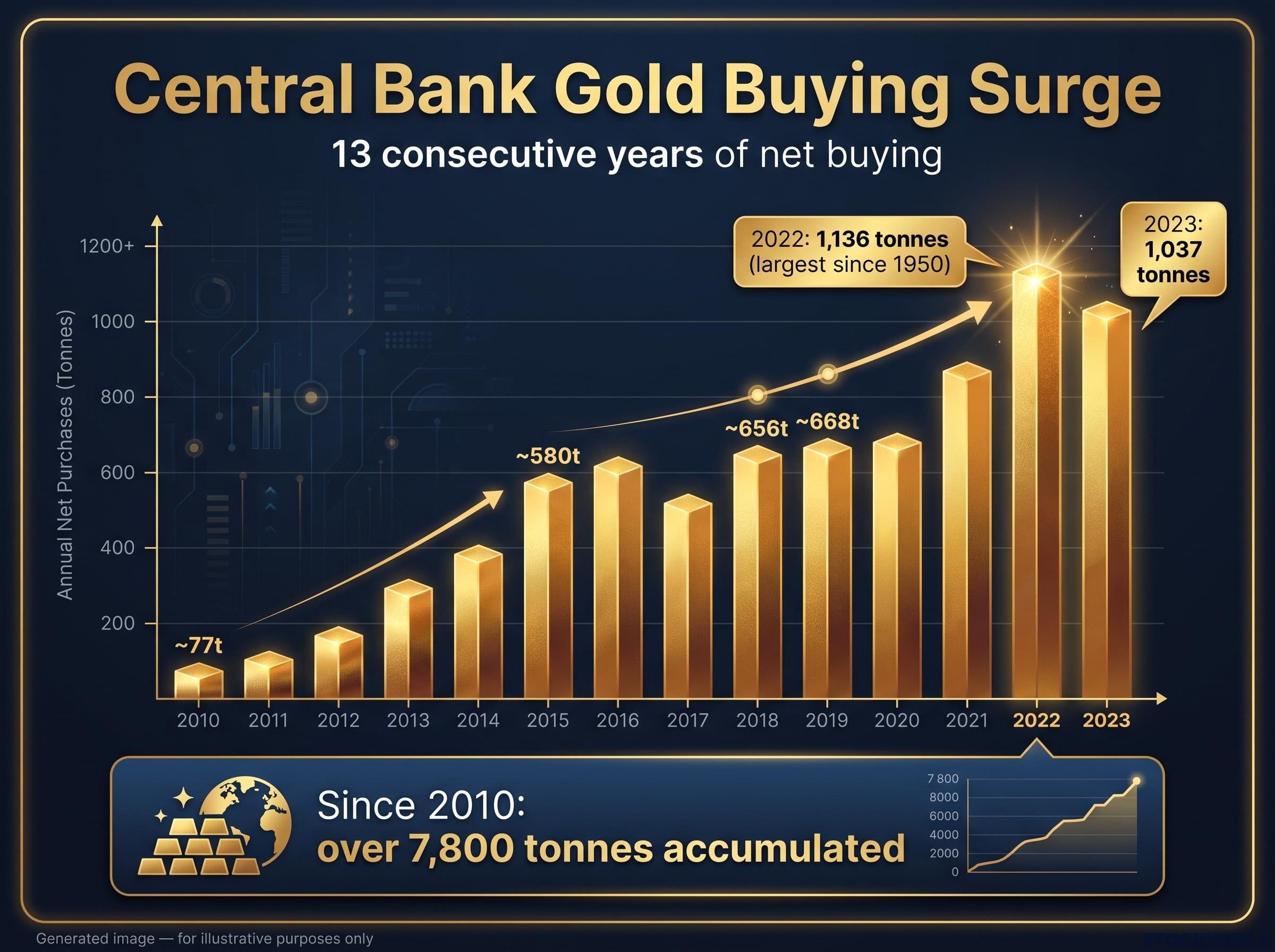
The scale and continuity of this buying tells you something important: this is not speculative behaviour, and it is not a crisis response. It is a deliberate, multi-year structural repositioning by institutions that think in decades, not quarters. Here is what is driving it, how gold actually behaves inside a portfolio, and what the central bank model means for your own allocation decisions.
What gold offers that no other reserve asset can
Gold’s defining structural property is simple to state and difficult to replicate: it carries no counterparty risk. It is not issued by any government. Its value does not depend on another country’s solvency, its central bank’s policy decisions, or its willingness to honour a claim. When you hold gold, you are not holding someone else’s promise. You are holding the asset itself.
That distinction became sharply relevant after 2022, when a substantial portion of Russia’s foreign reserves were frozen by Western governments. Reserve managers across emerging economies began explicitly linking domestic gold custody to protection against asset immobilisation. The logic is straightforward: foreign-held bonds and deposits can be blocked; gold sitting in your own vault cannot.
World Gold Council surveys confirm that reserve managers consistently cite four institutional motives for accumulating gold:
- Counterparty-risk elimination: Gold carries no credit, default, or counterparty risk, a property no sovereign bond can match.
- Sanctions resilience: Domestically held gold cannot be frozen, seized, or blocked by a foreign government, a concern that intensified sharply after Russia’s reserve freeze.
- Inflation and tail-risk hedging: Central banks operate on decade-long horizons. Gold preserves real purchasing power through wars, financial crises, currency shocks, and prolonged inflationary periods.
- Reserve-quality signaling: Countries like Poland publicly announce gold targets because larger holdings communicate financial credibility to markets and domestic audiences. Poland’s 700-tonne target is a documented example of this function in action.
These are not sentimental reasons to hold gold. They are engineered defences against specific, named systemic risks. If you hold gold for similar reasons, you are applying the same logic at a different scale.
The OMFIF Global Public Investor survey released in June 2026 marked the first time on record that more central banks declared intentions to reduce dollar holdings than increase them, a milestone that places sovereign gold accumulation in its clearest institutional context yet.
When big ASX news breaks, our subscribers know first
The slow retreat of the dollar and what is filling the gap
The US dollar remains the world’s dominant reserve currency, but its share of global reserves has been shrinking for more than two decades. The decline is not dramatic quarter to quarter. It is the kind of slow, compounding shift that is easy to miss in real time and impossible to ignore in retrospect.
The IMF characterises this trend as a “stealth erosion” of dollar dominance, driven by reserve managers diversifying into other currencies and assets, including gold.
IMF COFER (Currency Composition of Official Foreign Exchange Reserves) data tracks the movement clearly.
| Period | Dollar share of global FX reserves | Context |
|---|---|---|
| Approximately 2000-2001 | 70-72% | Post-Cold War peak of dollar dominance |
| Mid-2010s | ~65% | Gradual diversification into euro, yen, renminbi |
| Q1 2026 | 57.13% | Continued erosion; gold and non-traditional currencies gaining share |
Gold is a natural destination for reserves moving out of dollar assets because it solves a problem that no substitute fiat currency can. Switching from dollars to euros or renminbi simply replaces one country’s political and policy risk with another’s. Gold is not another country’s currency. It sits outside every government’s financial system entirely.
The de-dollarisation timeline matters for sizing the opportunity correctly: a significant portion of the measured decline in dollar reserve share since 2001 reflects exchange-rate valuation effects rather than active central bank selling, which means the structural shift is real but more gradual than headline figures suggest.
Emerging-economy central banks, particularly China, India, and Turkey, are disproportionately represented in the buying. Their motivation is direct: these are economies with the greatest strategic interest in reducing dependence on a currency system they do not control.
For you, this means central bank gold buying is not a cyclical trade on the dollar’s short-term weakness. It is a long-run structural reallocation, and understanding that distinction shapes how you should think about your own exposure timeline. This is a decade-scale force, not a quarter-scale one.
How gold actually behaves in a portfolio (and why it is not like other assets)
Gold does not move randomly. Its price responds to a set of identifiable forces, and understanding those relationships is what separates an informed gold holder from a reactive one.
Four market relationships matter most:
- Inverse relationship with the US dollar: Gold is priced in dollars and competes with the dollar as a store of value. When the dollar weakens, gold typically gains. When the dollar strengthens materially, gold tends to face pressure.
- Sensitivity to real interest rates: Real interest rates are the return on bonds after adjusting for inflation. Because gold carries no yield, high real rates raise the opportunity cost of holding it. Low or negative real yields have historically been supportive environments for gold prices.
- Safe-haven demand during market stress: Gold tends to outperform risk assets during broad sell-offs, as investors seek assets that sit outside the financial system.
- Equity correlation dynamic: When risk appetite is strong and equity markets are rising, gold demand tends to soften. When equities sell off broadly, gold’s appeal strengthens.
These are statistical tendencies documented across decades of market data, not mechanical rules that hold in every single period. But they are reliable enough that central banks and institutional investors build allocation models around them.
The stock-bond correlation breakdown documented by the BIS in 2022-2023 has accelerated institutional gold adoption beyond central banks, with BlackRock, JPMorgan, and Swiss pension funds explicitly replacing government bonds with gold as a portfolio diversifier after bonds failed to cushion the 2022 simultaneous equity selloff.
When gold earns its place in the portfolio
The safe-haven claim is not theoretical. During the 2008 financial crisis, the eurozone debt crisis, and the 2020 pandemic sell-off, gold outperformed risk assets and provided genuine diversification when equity portfolios were under the most pressure.
The World Gold Council has explicitly noted that geopolitical premium, meaning elevated demand driven by wars, sanctions, and rising geopolitical tension, has been a documented driver of central bank buying in the post-2022 period. This is not a speculative assertion. It is a named, measured force in the data.
Knowing these relationships gives you a practical advantage. When gold pulls back during a period of dollar strength, you can identify the headwind for what it is rather than misreading a currency-driven move as a fundamental breakdown in gold’s role. That distinction is what lets you hold the position through volatility instead of being shaken out at the wrong moment.
What the central bank model tells long-term investors
Central banks are the world’s most patient and strategically disciplined asset allocators. They do not chase price momentum. They do not attempt to time entries. They size a position, build it over years, and hold it through full market cycles. That approach is worth studying, not because you are a central bank, but because the logic translates directly to your own portfolio.
The single most important lesson from their behaviour is allocation over timing. The central bank model is not about identifying the optimal moment to buy gold. It is about maintaining a sized, stable position that can do its job across different market environments: hedging inflation in one cycle, providing crisis protection in another, diversifying currency exposure throughout.
The question is not “when should you buy gold?” It is “how much gold should your portfolio hold, and through what vehicle?”
A commonly discussed range for gold within a diversified portfolio is approximately 5-15% of total assets. Where you sit within that range depends on your risk tolerance, your inflation outlook, and the overall mix of equities and bonds in your portfolio. The logic is to size gold so it can meaningfully hedge against the risks you are managing without turning the portfolio into a concentrated single-asset position.
The vehicle you choose matters, because each modifies the counterparty-risk and liquidity properties that make gold distinctive in the first place.
| Vehicle | Counterparty risk | Liquidity | Key trade-off |
|---|---|---|---|
| Physical bullion | None (closest to central bank model) | Lower | Storage costs, insurance, less convenient to trade |
| Physically backed ETFs | Some (custodial dependence) | High | Ease of trading partially dilutes the no-counterparty advantage |
| Gold mining equities | Company-specific and equity-market risk | High | Leveraged to gold price, but often behaves like a cyclical stock in crises |
| Futures and derivatives | Counterparty and margin risk | High | Trading instruments, not long-term wealth preservation tools |
With central banks consistently purchasing in the range of 1,000-plus tonnes annually in 2022 and 2023, they now absorb a large and reliable share of annual mine and recycled supply. That institutional demand floor reduces gold’s dependence on retail flows or short-term sentiment, which is itself a structural support that benefits anyone holding a long-term allocation.
A structural shift, not a cycle
Central bank gold buying at this scale and with this strategic rationale is not a cyclical response to any single event. It is a structural repositioning in global reserve management, driven by forces that are not going away on a short timeline: de-dollarization pressure, the absence of counterparty risk in a world of rising sanctions regimes, and the need for long-horizon inflation protection.
The case for gold in your own portfolio rests on the same foundations. The question is not whether gold will rise next quarter. It is whether your portfolio is positioned to benefit from the structural forces that the world’s most patient capital allocators are managing over decades.
For readers wanting to stress-test the institutional demand floor thesis with current data, our full explainer on gold demand composition breaks down Q2 2026’s headline 46% investment demand decline against the record 289-tonne central bank quarter that ran beneath it, showing exactly where the structural bid held and where sequencing risk emerged.
This article is for informational purposes only and should not be considered financial advice. Investors should conduct their own research and consult with financial professionals before making investment decisions.