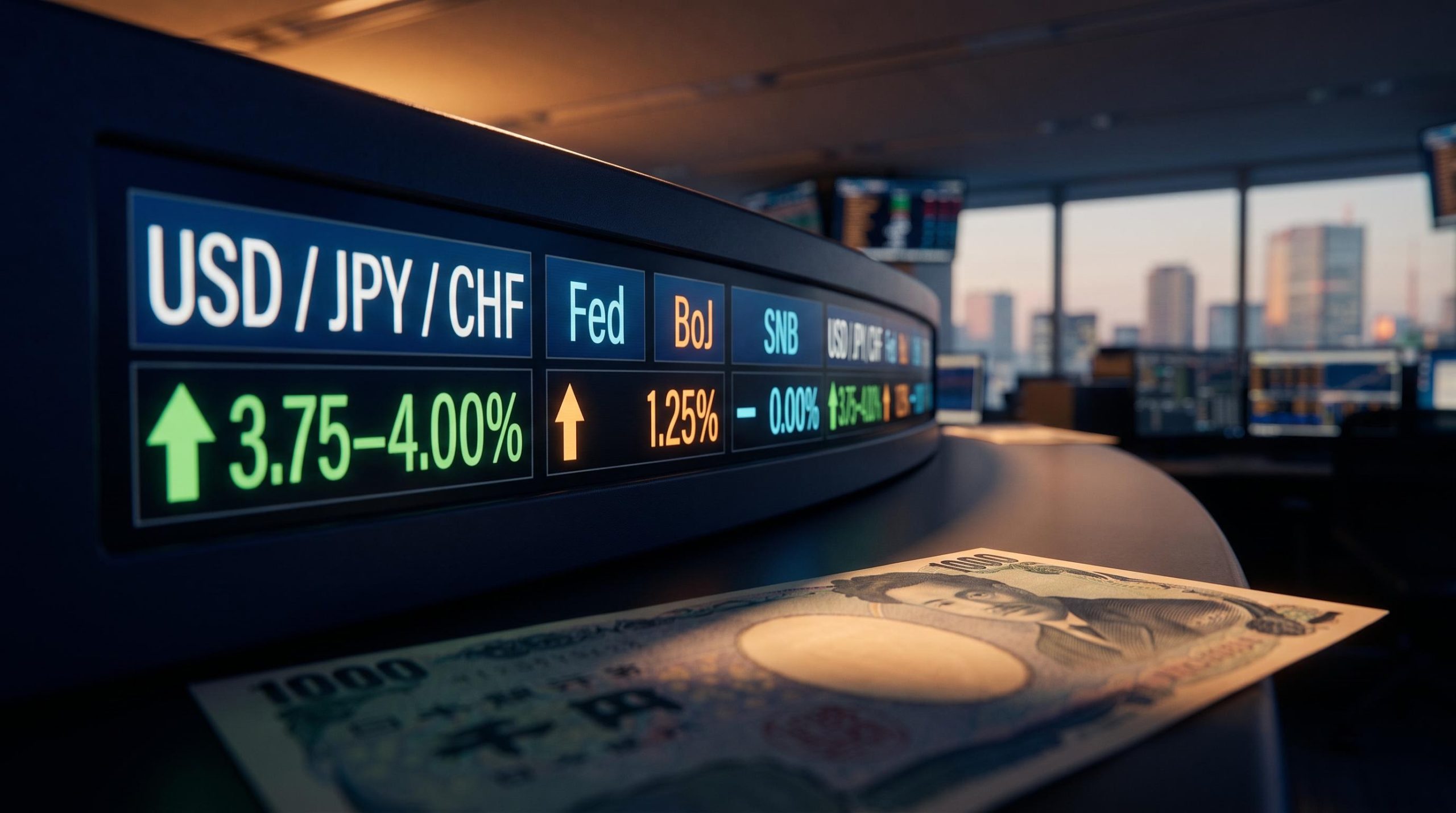
When the Federal Reserve moves its policy rate, markets across the world reprice within minutes. Traders know exactly which lever moved, who authorised it, and what it signals.
When the People’s Bank of China acts, most observers outside China are left guessing at all three. Which instrument moved? Who signed off? And what does it actually mean for the direction of the world’s second-largest economy? That gap in comprehension is a real problem, because China’s monetary authority operates a toolkit and a governance model that diverge sharply from the Western central banking framework most finance readers were trained on.
Consider the phrase Governor Pan Gongsheng uses to describe the bank’s current stance: “appropriately loose.” It sounds simple. It is not. The phrase only makes sense once you understand how the institution behind it actually works.
What follows here is the institutional map you need before any policy signal from China’s central bank can be read accurately. It covers how the bank is governed, which instruments it uses and why, what “appropriately loose” means in practice, and where the limits of its easing sit. Think of it as practical orientation, not an academic survey.
Not your typical central bank: how the PBoC fits into China’s political structure
Most finance readers carry a working assumption about central banks: they are independent. The Federal Reserve sets rates without taking orders from the White House. The European Central Bank guards its autonomy fiercely. That independence is the model you were trained on.
For the People’s Bank of China, that assumption is simply wrong.
The PBoC is owned by the People’s Republic of China and is not classified as an autonomous body. It does not hold the operational independence that defines the Federal Reserve or the European Central Bank. The distinction matters enormously the moment you try to interpret anything it says.
The PBoC’s founding legislation explicitly places the bank ‘under the leadership of the State Council,’ confirming that its operational framework is embedded within state authority rather than insulated from it, as Western central bank charters are designed to be.
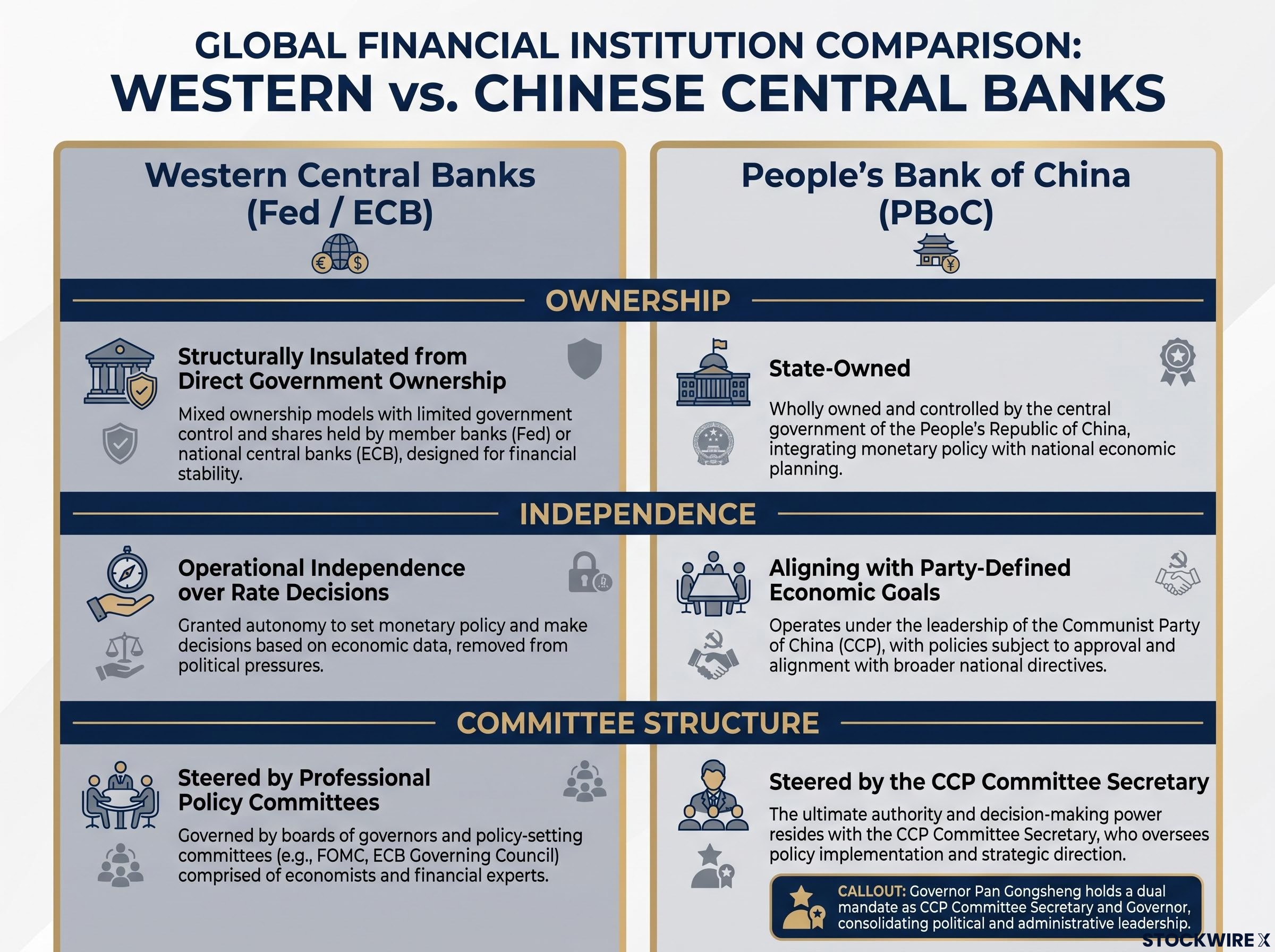
The clearest evidence sits in its leadership structure. The Chinese Communist Party Committee Secretary, appointed by the State Council Chairman, holds primary influence over the bank’s management and strategic direction. Governor Pan Gongsheng currently occupies both the CCP Committee Secretary role and the Governor position at the same time, a dual mandate that places the institution firmly inside Party governance while it operates with professional central banking tools.
Here is how the two models compare across the dimensions that matter most:
- Ownership: The Fed and ECB are structurally insulated from direct government ownership. The PBoC is owned by the state.
- Independence: Western central banks hold operational independence over rate decisions. The PBoC aligns with Party-defined economic goals.
- Committee structure: Western banks are steered by professional policy committees. The PBoC’s direction runs through the CCP Committee Secretary, a role Pan holds alongside the governorship.
Why governance structure shapes policy language
This hybrid identity produces policy communications that read differently from anything a Fed watcher is used to. PBoC statements blend standard monetary objectives, liquidity management and financing conditions, with explicit state priorities such as channelling credit toward politically designated sectors.
The clearest example came in March 2025, when Pan pledged that the bank would “guide financial institutions to increase investment in the private economy.” No Western central bank frames its mandate that way, because directing credit to a specific sector would sit outside its remit.
This is not a failure of central banking convention. It is a feature of how the institution was designed. For you as a global reader, it means every PBoC signal carries two messages at once: a technical monetary one and a political one embedded inside it. Separating the two is the first skill you need before acting on anything the bank says.
When big ASX news breaks, our subscribers know first
The PBoC’s toolkit: why China uses more instruments than the Fed
The Fed can steer an economy largely through one rate. The PBoC cannot, and the reason is structural.
China runs a bank-dominated financial system, where credit flows overwhelmingly through large, often state-owned lenders rather than through deep capital markets. In that environment, a single policy rate cannot achieve the same transmission efficiency it does in a market-driven system. So the bank uses both price-based tools (rates) and quantity-based tools (how much banks can lend), operating them as an ensemble.
Each instrument occupies a specific place in the chain that moves money from the central bank to the borrower:
- The 7-day reverse repo rate steers short-term interbank funding costs and sets the floor of China’s interest rate corridor.
- The Medium-Term Lending Facility (MLF) anchors medium-term bank funding and mechanically feeds into the next rate down the chain.
- The Loan Prime Rate (LPR) sets the benchmark borrowing costs for the whole economy.
- The Reserve Requirement Ratio (RRR) governs how much banks are permitted to lend in the first place.
The mechanical link between the MLF and the LPR is worth understanding, because it explains how a move at the top transmits downward. The LPR is set monthly by a panel of 18 banks as the MLF rate plus a spread, which means an MLF adjustment flows directly into the LPR and, from there, into corporate loans and mortgages.
Here is the current state of the toolkit:
| Instrument | Current Level | Function | What It Steers |
|---|---|---|---|
| 7-day reverse repo rate | 1.40% | Main policy rate, floor of the interest rate corridor | Short-term interbank funding costs |
| 1-year LPR | 3.00% | Benchmark lending rate | Corporate and household borrowing |
| 5-year LPR | 3.50% | Benchmark lending rate | Mortgage rates |
| Large-bank RRR | 7.50% | Quantity-based easing lever | System-wide lending capacity |
There is one more channel that operates outside the domestic rate chain: the daily USD/CNY fixing. The PBoC sets a reference rate for the renminbi each day, and when it sets that fix weaker than the market expected, participants read it as consistent with the domestic easing stance. It is a signalling tool as much as an intervention tool.
The daily yuan fixing mechanism operates through a countercyclical adjustment factor that allows the PBoC to publish a fix stronger or weaker than market inputs alone would produce, making the gap between the published rate and model-implied values the closest real-time readout of Beijing’s policy priorities.
Governor Pan has made the ensemble logic explicit. In his January 2025 BIS speech, he said the bank would “adopt a mix of monetary policy instruments including interest rates and required reserve ratio to bolster adequate liquidity and a favorable social financing environment.”
That “mix” framing carries a practical lesson for you. A move in one instrument without supporting moves in the others is often less meaningful than it first appears. The system is built to work in concert, so the silence of the supporting levers can quietly neutralise the signal from the one that moved.
What “appropriately loose” actually means in 2026
Start with the phrase, because its meaning has to be earned rather than assumed.
“Appropriately loose,” or “appropriately accommodative,” is the official label the PBoC has attached to its stance consistently across Governor Pan’s communications from January 2025 through the 2026 guidance period. Taken at face value, it sounds like a green light for aggressive easing. In practice, it means something more restrained.
Operationally, the stance is built from a specific set of settings: the 7-day reverse repo held at 1.40%, both LPRs sitting at historically low levels, ongoing open market operations supplying short-term liquidity, and selective RRR cuts used to widen bank lending capacity. Together they describe a policy that is supportive rather than tightening.
Pan laid out the intent plainly at the start of 2025:
“We will implement an appropriately accommodative monetary policy, adopt a mix of monetary policy instruments including interest rates and required reserve ratio to bolster adequate liquidity and a favorable social financing environment.” — Governor Pan Gongsheng, BIS, January 2025
The gap between that rhetoric and actual rate movement is where the real story sits. The LPRs have been unchanged for more than 15 consecutive months as of late 2026. The last cut came in May 2025, a modest 10-basis-point trim that took the 1-year LPR from 3.10% to 3.00% and the 5-year from 3.60% to 3.50%. Nothing has moved since.
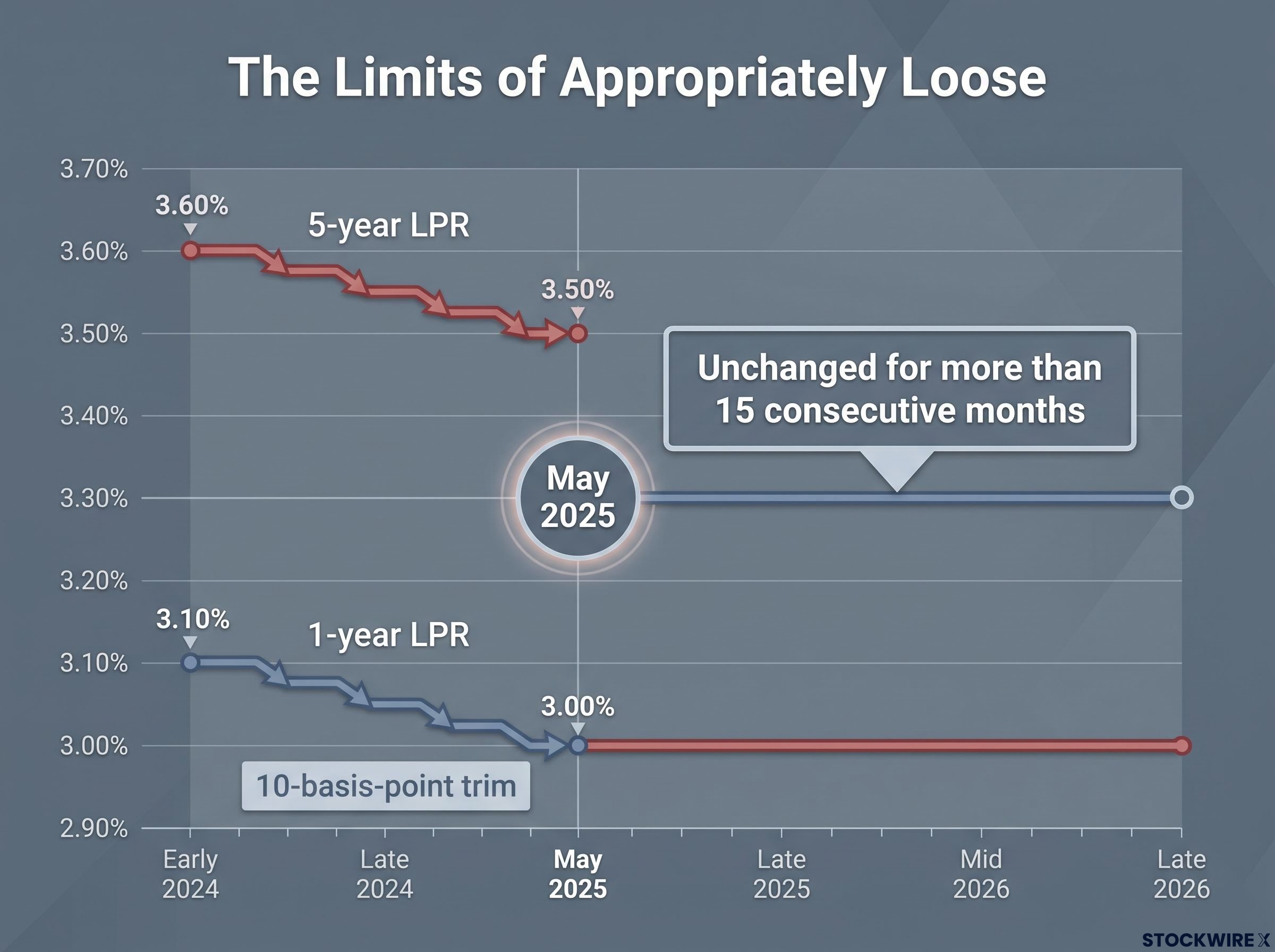
That stasis, sitting underneath continued “appropriately loose” language, tells you the bank is operating close to the edge of what it can ease without triggering the very risks it has flagged. The gap between what it says and what it does is itself a signal worth watching.
The three limits on PBoC easing
Pan has publicly acknowledged each of the constraints that box in the stance, which makes them part of the official framework rather than outside criticism.
- Currency depreciation pressure. Easing at home while global rates stay higher widens the rate differential and pushes the renminbi down. The bank has set USD/CNY fixings weaker than Reuters poll expectations, and every further cut adds to that tension.
- Financial stability. In March 2025, Pan committed to “striking a balance between short-term and long-term goals, and maintain the soundness of the banking system itself.” That line is an open admission that sustained easing can strain bank balance sheets.
- Incomplete transmission. Lower rates do not automatically reach private borrowers, because state-owned banks often respond to regulatory guidance and risk aversion rather than to marginal rate incentives.
His October 2025 Financial Street Forum speech captured the balancing act, promising to “make comprehensive use of various monetary policy tools… thereby keeping overall financing conditions relatively accommodative.”
The takeaway is straightforward. If you read “appropriately loose” as a promise of aggressive stimulus, you will be disappointed. It is better understood as a commitment not to tighten, bounded by real limits the bank has named itself.
How PBoC policy reaches the real economy (and where it does not)
Setting a rate at headquarters is one thing. Getting cheaper credit into the hands of an actual borrower is another, and in China the second step is where much of the story is decided.
The primary channels are familiar enough. Lower LPRs reduce corporate and mortgage borrowing costs. RRR cuts free up funds for banks to lend. Open market operations keep short-term liquidity ample. The FX fixing guides expectations for the renminbi. On paper, the machinery works.
The question is who actually feels it. Transmission runs strong in some parts of the economy and stalls in others:
Credit transmission failure reached an extreme in August 2026, when Chinese banks extended just CNY 60 billion in new loans against a CNY 400 billion forecast, and the PBoC responded not with easing but with an explicit endorsement of the slowdown as a quality-over-quantity transition.
- Where it reaches: state-owned enterprises, mortgage borrowers on variable-rate loans, and large corporates with full access to the formal banking system.
- Where it stalls: private small and medium-sized enterprises, sectors carrying elevated credit risk, and any borrower dependent on lenders that prioritise regulatory guidance over marginal rate incentives.
The May 2025 cut illustrates the pattern. It was aimed squarely at mortgages, through the 5-year LPR, and at general corporate lending through the 1-year LPR. Yet with both rates frozen for over a year since, the structural impact appears limited, held back by bank risk aversion and balance-sheet caution. Meanwhile, ongoing 7-day reverse repo injections keep short-term funding plentiful, but whether that liquidity flows into housing or private SMEs depends on the banks, not the rate.
Administrative guidance as a transmission tool
This is where China departs most sharply from the West. Alongside price signals, the PBoC steers credit through direct communication with financial institutions, telling them where to lend.
The March 2025 private-economy meeting is the clearest example. Pan combined low policy rates with an explicit directive to “guide financial institutions to increase investment in the private economy.” The rate was the market signal; the instruction was the administrative one, and the two arrived together.
Market analysts, including VTMarkets commentary from September 2026, note that state-owned banks often respond more to this kind of guidance than to a marginal change in policy rates. In a Western central bank, credit direction of this sort would represent a policy breach. In China, it is a standard transmission tool.
For you, that changes how a rate cut should be read. If you want to know whether a cut will lift Chinese consumption or private investment, the size of the cut matters less than whether banks receive concurrent guidance to actually deploy the capital, and that guidance often lands separately from the rate announcement.
Reading PBoC signals accurately in a global portfolio context
You now hold three layers of understanding that most casual observers lack. The governance layer tells you why political priorities show up in monetary language. The instrument layer tells you which tools move and in what order. The transmission layer tells you where easing lands and where it dies on the vine.
Turned into practice, that framework points to three observable signals worth monitoring:
- The 7-day reverse repo rate (currently 1.40%) is your primary directional indicator. A cut here signals genuine intent to ease; a hold signals caution.
- The MLF rate and monthly LPR panel decisions are your medium-term gauge. Because the LPR (3.00% and 3.50%) is mechanically tied to the MLF, movement here confirms whether easing is reaching real borrowing costs.
- The daily USD/CNY fixing is your constraint indicator. A weaker-than-expected fix shows the bank tolerating renminbi softness to keep easing; a firm fix suggests currency pressure is limiting its room to move.
Bond yield and currency dynamics in China do not always move in the directions that standard monetary theory predicts; the rare coexistence of falling government bond yields and a simultaneously firming yuan signals a configuration where the PBoC faces no current trade-off between domestic stimulus and FX stability.
The RRR at 7.50% completes the baseline picture. Together these levels describe a stance the 2026 official guidance confirms as a continued “moderately loose” orientation, reinforced by Pan’s most recent formal commitment:
“The PBoC will maintain a supportive monetary policy stance, implement an appropriately accommodative monetary policy, and make comprehensive use of various monetary policy tools.” — Governor Pan Gongsheng, Financial Street Forum, October 2025
Read the current stance for what it is: a calibrated position held within a set of real constraints, not an open-ended easing commitment. A move in any of those three signals would tell you the calibration is shifting, and that is precisely the moment to pay attention.
The institution behind the signal
Three features define the People’s Bank of China, and holding all three together is what makes its signals legible. It is embedded in CCP governance, so its statements carry political priorities alongside monetary ones. It runs a multi-instrument toolkit built for a bank-dominated economy, so its levers work as an ensemble rather than in isolation. And its current “appropriately loose” stance is bounded by currency and stability constraints it has named openly.
The practical value of that model is durable. Interpreting any single action, a rate cut, an RRR adjustment, a fixing surprise, correctly depends on knowing which constraints are binding at the time, because the same move can mean different things in different conditions.
Governance structure, instrument design, and transmission mechanics change slowly. That makes this a lasting analytical lens, not a snapshot of today’s 1.40% repo rate or 3.00% / 3.50% LPRs. Central bank literacy of this kind is an asymmetric advantage: read the institution, and every future signal it sends becomes clearer than the headline rate alone would suggest.
This article is for informational purposes only and should not be considered financial advice. Investors should conduct their own research and consult with financial professionals before making investment decisions. Past performance does not guarantee future results, and monetary policy projections are subject to changing economic conditions and various risk factors.