
Two investors can look at the same ASX stock, apply different valuation methods, and reach opposite conclusions about whether it is cheap or expensive. The disagreement is rarely about the data. It is about the lens. Australian retail investors frequently default to familiar metrics, most commonly dividend yield, without considering whether that metric suits the type of company they are assessing. This mismatch between metric and business model is one of the most common sources of poor valuation judgements on the ASX. What follows is a practical guide to two widely used stock valuation methods: dividend yield and price-to-sales (P/S) ratio. Each is explained with real ASX companies, Amcor (ASX:AMC) and Sonic Healthcare (ASX:SHL), used throughout as illustrations. Readers will learn which metric suits which type of business, how to avoid the most common mistakes with each, and when to move beyond simple multiples toward more rigorous valuation tools.
The right valuation metric depends on the business, not the investor’s preference
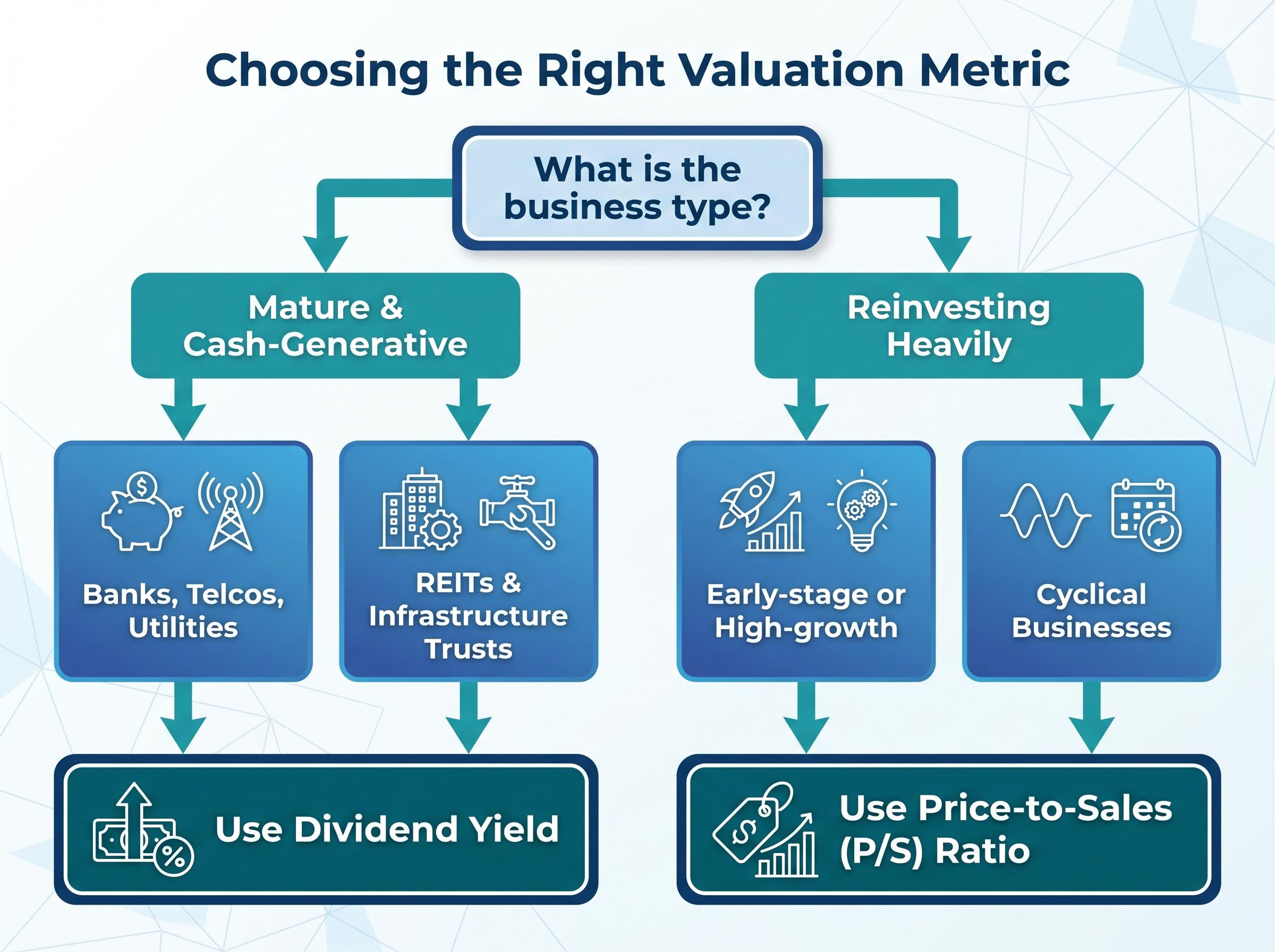
Different business models generate value in structurally different ways. A mature packaging company that distributes most of its earnings as dividends operates nothing like a healthcare services business reinvesting heavily into growth. The metric that best captures value in one will mislead in the other.
Dividend yield is appropriate for businesses that pay out a large share of their earnings to shareholders. P/S ratio is appropriate for businesses where current earnings are temporarily suppressed, volatile, or being reinvested entirely, making revenue a more stable basis for comparison.
No single metric is universally correct. Using the wrong one does not produce a mathematical error; it produces a misleading conclusion. The calculation is right, but the answer is irrelevant.
Dividend yield and P/S ratio sit within a broader family of fundamental analysis metrics that each answer a different question about the same company: P/E examines earnings relative to price, EPS tracks per-share profit growth, return on equity measures capital efficiency, and revenue growth signals trajectory, none of which dividend yield or P/S captures on their own.
According to Rask Media and Livewire Markets commentary, yield suits “mature, cash-generative dividend payers” while P/S suits companies “reinvesting heavily.” On the ASX, this maps to a recognisable split between income-oriented and growth-oriented sectors.
Businesses where dividend yield is the natural starting point:
- Stable, recurring cash flows (banks, telcos, utilities)
- High payout ratios and established distribution histories
- Limited reinvestment requirements relative to earnings
- REITs and infrastructure trusts distributing most of their income
Businesses where P/S ratio is more informative:
- Revenue growing while earnings are temporarily suppressed or volatile
- Heavy reinvestment into research, expansion, or acquisitions
- Cyclical businesses where earnings swing sharply between peaks and troughs
- Early-stage or high-growth companies not yet optimising for profit
The decision framework is straightforward: identify the business type first, then select the metric that fits.
When big ASX news breaks, our subscribers know first
What price-to-sales ratio reveals that dividend yield cannot
Price-to-sales ratio is calculated by dividing a company’s market capitalisation by its annual revenue. It exists because earnings can be temporarily unreliable. A company reinvesting all its profits into growth, absorbing a one-off restructuring charge, or cycling through a low point in a commodity price may report depressed or negative earnings while its revenue remains stable. In these cases, P/S provides a cleaner basis for comparison than earnings-based metrics.
A low P/S is not automatically attractive. The ratio says nothing about profitability. A business with structurally thin margins, such as a supermarket retailer or industrial distributor, may appear cheap on P/S while being fairly valued or even expensive on earnings-based metrics. Margin structure determines whether low P/S represents an opportunity or simply reflects the economics of the business.
P/S comparisons are only meaningful within the same sector. According to Stockopedia and Morningstar AU, software companies structurally command higher P/S multiples than supermarkets because their margins and scalability are fundamentally different. Comparing the two is, as Stockopedia’s factor guides note, “meaningless.”
Sonic Healthcare (ASX:SHL) illustrates this in practice. As of May 2026, Sonic Healthcare trades on a P/S ratio of approximately 1.10x, compared to its five-year historical average of approximately 1.94x. At the time, SHL was trading approximately 2% above its 52-week low.
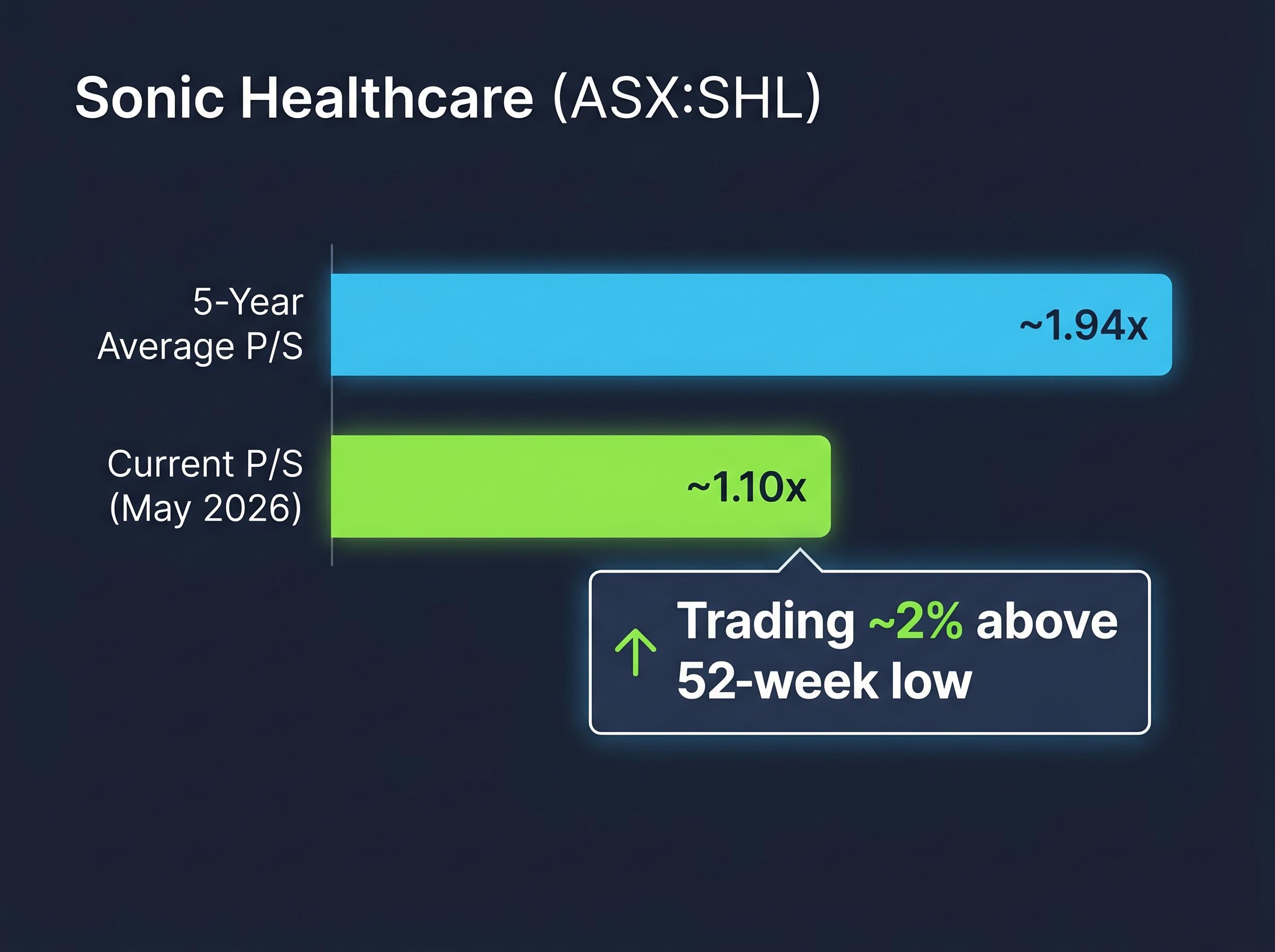
| Metric | Value | Analytical question raised |
|---|---|---|
| Current P/S (May 2026) | ~1.10x | Is this discount to history a buying opportunity, or has the growth thesis weakened? |
| Five-year average P/S | ~1.94x | Have margins compressed, or is the market mispricing a temporary earnings headwind? |
A below-average P/S on a growth-oriented healthcare business opens a question rather than providing an answer. The metric identifies a stock worth investigating further; it does not confirm undervaluation on its own. Morningstar AU and Stockopedia both emphasise that P/S must be interpreted alongside margin trends and growth rates before drawing conclusions.
The application of P/S ratio for growth platforms extends beyond healthcare services: Netwealth (ASX: NWL) currently trades at approximately 21.53x, a discount to its five-year historical average of 23.72x, illustrating how a below-average P/S on a high-recurring-revenue business opens the same analytical question the Sonic Healthcare reading raises, without providing an answer.
What dividend yield actually tells you about an ASX company
Dividend yield is calculated by dividing the annual dividend per share by the current share price, expressed as a percentage. It reflects two moving parts: the dividend paid and the price at which the stock trades. When either changes, the yield moves.
This matters because a rising yield can mean two very different things. If the dividend has grown, the rising yield signals increasing shareholder returns. If the share price has fallen, the rising yield may signal deteriorating fundamentals. Investors must determine which force is driving the number before treating the yield as attractive.
For Australian investors, franking credits add a material layer. Fully franked dividends carry attached tax credits that increase the effective after-tax return for eligible shareholders, particularly retirees and those in lower tax brackets. Grossed-up yield, which accounts for the franking credit, is more accurate than the raw cash yield alone. ASIC’s MoneySmart guidance notes that historical dividends are not a guarantee of future performance, reinforcing the need for context beyond the headline number.
For Australian investors comparing income stocks, the grossed-up dividend yield is the figure that matters, not the raw cash return, because fully franked dividends carry attached tax credits that can be worth as much as 43% above the headline cash payment for eligible shareholders including SMSFs in pension phase.
The ASX fundamental analysis course explicitly notes that high dividend yields represent past payouts and carry no guarantee of future dividend amounts, reinforcing why payout ratio and free cash-flow coverage must accompany any headline yield reading before an investment decision is made.
Amcor (ASX:AMC) provides a concrete current example. As of May 2026, Amcor carries a dividend yield of approximately 4.73%, positioning it as a mature large-cap industrial company where yield is a relevant screening metric for income investors. Amcor’s most recent annual dividend exceeded its preceding three-year average, indicating dividend growth rather than price decline as the primary yield driver.
A high dividend yield can signal either generosity or distress. The payout ratio and free cash flow coverage distinguish between the two. Without checking both, the headline yield is incomplete information.
Before relying on any quoted yield figure, four practical checks apply:
- Payout ratio: Is the company distributing a sustainable share of earnings, or paying out more than it earns?
- Free cash-flow coverage: Can the business fund its dividend from operating cash flow after capital expenditure?
- Grossed-up yield including franking: What is the after-tax return once franking credits are factored in?
- Forward earnings outlook: Are analysts expecting earnings to support, grow, or reduce the current dividend?
The traps that catch ASX investors using these metrics in isolation
Both dividend yield and P/S ratio have well-documented failure patterns on the ASX. These traps follow predictable sequences, and recognising them in advance is materially more useful than learning from a loss.
- The yield trap. A company’s share price falls as fundamentals deteriorate. Because trailing yield is calculated from the last twelve months of dividends divided by the current (lower) price, the reported yield spikes. Investors attracted by the apparently high yield buy the stock. Management subsequently cuts the dividend to preserve cash, and the share price falls further. This pattern is well documented in Australian commentary on highly leveraged property and infrastructure trusts, where Motley Fool AU and Livewire have identified cases of high trailing yields preceding distribution cuts. Cyclical resource companies present a variation: yields that appeared “exceptionally high” at peak commodity prices were based on windfall profits that proved unsustainable. Investors who extrapolated those trailing yields forward faced significant disappointment when commodity prices normalised.
- The P/S trap. A structurally low-margin business (supermarket retailer, industrial distributor) trades on a low P/S multiple because its net margins are thin. Investors purchase the stock on the basis of a “cheap” P/S reading, expecting margin expansion that never materialises because the economics of the business do not support it. In the opposite direction, ASX technology stocks traded on very high P/S multiples during the 2020-2021 period of growth-stock optimism. By 2022-2024, as growth slowed and interest rate rises compressed valuations, those multiples de-rated significantly, even as revenue continued to rise. Investors who relied solely on P/S as a “growth at any price” indicator were caught in the de-rating.
Both traps share the same root cause: treating a screening tool as though it were a valuation conclusion. Yield and P/S identify stocks worth investigating. They do not confirm whether those stocks are cheap or expensive.
When to move beyond simple multiples to DCF and DDM analysis
Dividend yield and P/S are first-pass tools. There are specific circumstances where those tools become insufficient, and recognising them is a skill in itself.
Four situations signal that a company warrants discounted cash flow (DCF) or dividend discount model (DDM) analysis rather than a multiple-based assessment:
- Earnings or dividends are expected to change materially: A company mid-turnaround or approaching a step-change in profitability cannot be valued accurately from trailing multiples alone.
- The business has a long-duration growth profile or reinvests heavily: Companies compounding revenue at high rates over many years require modelling of future cash flows, not just comparison to today’s revenue.
- Capital structure or cyclicality distorts current earnings: Highly leveraged businesses or cyclical industries produce earnings figures that swing sharply between peaks and troughs, making snapshot multiples unreliable.
- The company operates in infrastructure, utilities, or early-stage technology or healthcare: Livewire contributors have identified these categories specifically as areas where EV/EBITDA and P/S alone are inadequate due to complex capital structures and heavy reinvestment.
DDM is the appropriate model for stable, mature dividend payers where the dividend stream is the primary return mechanism. It explicitly models the expected future dividend path and discounts it back to a present value. DCF is the appropriate model for growth businesses where free cash-flow trajectory determines intrinsic value.
Rask Media’s investor education encourages retail investors to treat simple multiples as “quick filters,” with DCF applied to growth stocks and DDM applied to stable dividend payers once a stock has passed the initial screening stage. Morningstar AU uses DCF as the basis for its fair-value estimates and star ratings on ASX stocks, particularly for wide-moat and long-duration growth companies.
Both methods require more inputs and judgement than a simple ratio. That complexity is precisely what makes them more informative in the situations where multiples mislead.
For investors ready to move from screening into a structured multi-method framework, our dedicated guide to ASX share valuation methods walks through a five-step sequence covering P/S, EV/EBITDA, DCF, and DDM in combination, with Flight Centre used as a worked example of how a low P/S can mask high debt levels invisible to the ratio alone.
Choosing your metric is the first decision in any ASX valuation
The reader who started this article defaulting to a single familiar metric now has a repeatable decision sequence for the next ASX company they assess:
- Identify the business type. Is this a mature, cash-generative company distributing most of its earnings, or a growth-oriented business reinvesting heavily?
- Select the metric that fits. Dividend yield for the former; P/S ratio for the latter.
- Apply it as a screening filter, not a valuation conclusion. A high yield or low P/S identifies a candidate for further analysis; it does not confirm value.
- Check the supporting context. For yield: payout ratio, free cash-flow coverage, franking, forward earnings. For P/S: margin structure, sector average, growth rate, leverage.
- Escalate to DCF or DDM when the screening stage reveals a candidate worth modelling. This is where valuation moves from comparison to intrinsic-value estimation.
Amcor illustrates steps one through four in practice: a mature industrial where yield is the natural starting point, checked against payout ratio and dividend growth trends. Sonic Healthcare illustrates the same sequence from the P/S side: a growth-oriented healthcare business where a below-average P/S reading opens the analytical conversation rather than closing it.
The consistent message across Australian sources, including Rask, Morningstar AU, Livewire, and ASX investor education, is that multiples are best for screening and peer comparison, with DCF or DDM as the next step for shortlisted candidates. ASIC MoneySmart, ASX investor education resources, and Rask Education all offer Australian-specific material for investors looking to develop their valuation skills further.
Disciplined metric selection is itself a core investing skill. The right method does not guarantee the right answer, but the wrong method virtually guarantees the wrong question.
This article is for informational purposes only and should not be considered financial advice. Investors should conduct their own research and consult with financial professionals before making investment decisions.
—