The SpaceX IPO roadshow kicks off June 8, 2026, and for most retail investors, the path to shares runs through exactly one brokerage. With a valuation target above $2 trillion, a 30% retail share allocation that is structurally unprecedented for a deal this size, and an indication of interest (IOI) window expected to open in early June 2026, the timeline gives investors only weeks to get into position.
Broker access is the bottleneck. **E*TRADE, via parent company Morgan Stanley as lead underwriter, is the only confirmed retail access point. Every other major platform, including Robinhood and SoFi**, remains unconfirmed or reportedly excluded.
This guide explains which brokers are confirmed, which are out or uncertain, how **E*TRADE and Fidelity** compare if Fidelity joins, what investors need to do right now to submit an IOI, and what alternative exposure options exist for those who cannot or choose not to participate in the IPO directly.
Why getting into the SpaceX IPO is harder than it sounds
Most retail investors assume that any major US brokerage will carry an IPO this large. That assumption misreads how IPO share distribution works. Shares are not listed on a platform for open purchase; they are allocated by underwriters, and the lead underwriter controls which retail brokers receive inventory.
Morgan Stanley is the lead underwriter on the SpaceX offering. Its retail distribution arm is **E*TRADE**, which gives ETRADE a structural advantage that no other brokerage can replicate through platform features or marketing alone. The allocation pipeline runs from Morgan Stanley’s book to ETRADE’s retail clients. Other platforms would need a separate syndicate arrangement to offer shares, and none have confirmed one.
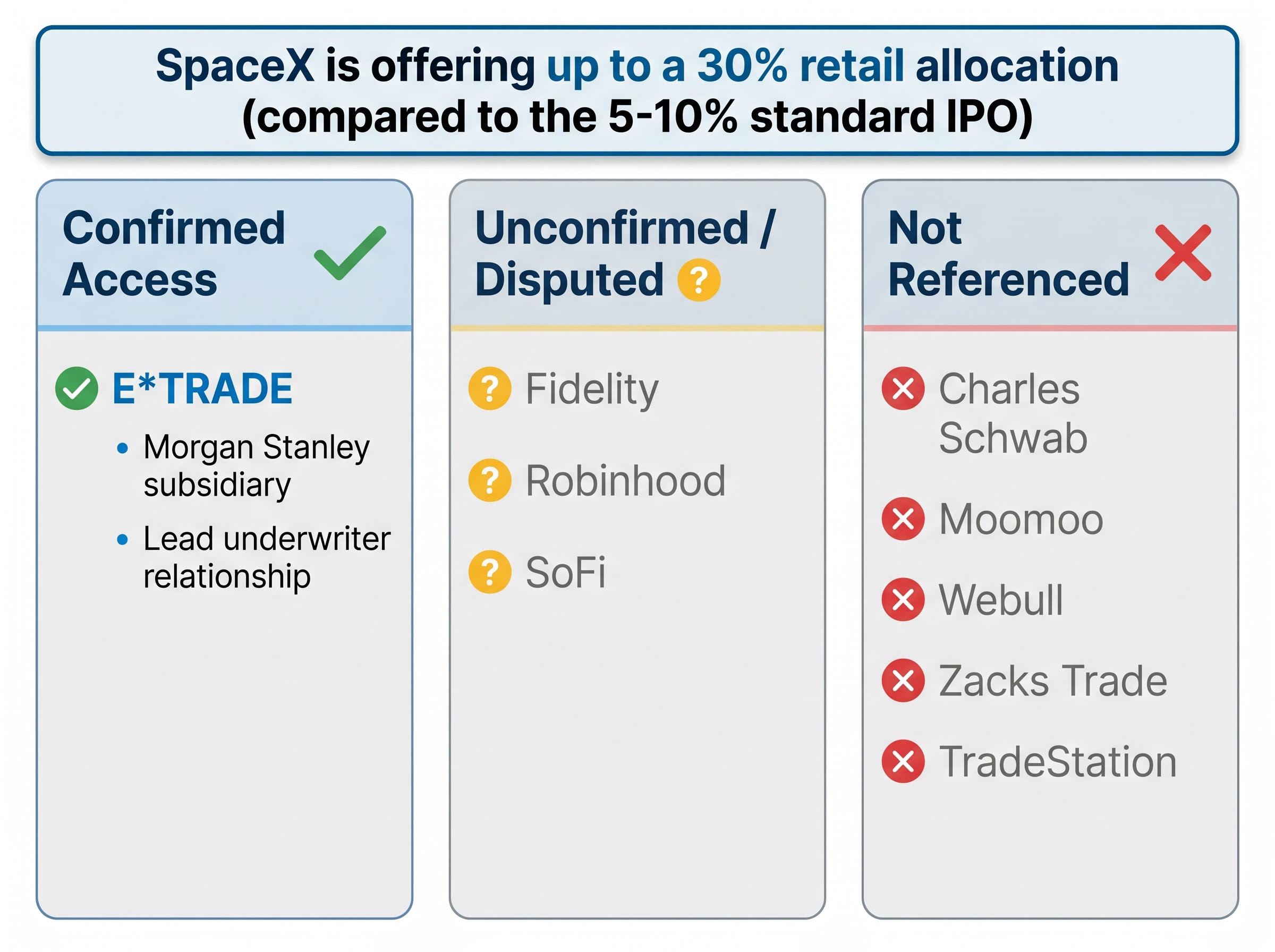
The retail allocation in context: SpaceX is making up to 30% of shares available to retail investors, compared to the 5-10% allocation typical in standard IPOs. This is historically large, but it does not guarantee individual investors will receive shares. Broker eligibility is the first filter; account size and demand are the next.
With the roadshow starting June 8, 2026, and IOI submissions expected to open in early June, the access question is not theoretical. Investors on the wrong platform may have no path to participate, regardless of how much capital they are willing to commit.
When big ASX news breaks, our subscribers know first
The confirmed and unconfirmed broker list, ranked by access certainty
The broker access picture for the SpaceX IPO is unusually murky for a deal of this size. Below is the clearest available ranking as of early May 2026, based on the Reuters report of 30 March 2026, subsequent public statements, and outreach by NerdWallet to individual platforms.
| Broker | Access Status | Basis for Status | Action for Investors |
|---|---|---|---|
| E*TRADE | Confirmed | Morgan Stanley subsidiary; lead underwriter relationship | Open or activate account now; enable IPO notifications |
| Fidelity | Unconfirmed | Speculation based on high-profile IPO history; no official statement | Monitor for announcement; do not rely on as primary path |
| Robinhood | Disputed / Unconfirmed | Reuters reported potential exclusion; Elon Musk disputed on X (April 2026); no official comment from Robinhood | Do not assume access; open E*TRADE as backup |
| SoFi | Disputed / Unconfirmed | Reuters reported potential exclusion; Musk disputed; NerdWallet outreach yielded no official comment | Do not assume access; open E*TRADE as backup |
| Charles Schwab | Not Referenced | Not mentioned in Reuters reporting on the offering | No evidence of participation; do not rely on |
| Moomoo / Webull / Zacks Trade / TradeStation | Not Referenced | Not mentioned in Reuters reporting on the offering | No evidence of participation; do not rely on |
The pattern is clear. **E*TRADE is the only platform with a confirmed structural link to the offering. Fidelity carries the strongest unconfirmed speculation, but speculation is not access. For Robinhood and SoFi, the situation is actively contested, with Reuters reporting exclusion and Musk publicly disputing those claims in April 2026** without either platform issuing a formal clarification.
Investors who act on assumptions about broker access risk missing the IOI window entirely.
How E*TRADE and Fidelity actually compare as platforms
For investors weighing whether to open a new **E*TRADE account or wait on Fidelity**, the comparison below focuses on the criteria most relevant to IPO participation and ongoing platform use.
| Criteria | E*TRADE | Fidelity |
|---|---|---|
| IPO Access Confirmed | Yes (Morgan Stanley relationship) | No (unconfirmed) |
| Platform Usability | Complex navigation noted by users | Strong mobile app; multiple NerdWallet Best-Of awards |
| Asset Range | Stocks, bonds, options, mutual funds, ETFs, futures; no crypto | Stocks, bonds, options, ETFs, mutual funds, precious metals, crypto |
| Research Tools | Standard suite | Strong stock screener; research consistently rated above peers |
| Cash Yield | Minimal yield on uninvested balances | Competitive cash management options |
Fidelity is the stronger all-round platform. Its mobile experience, research tools, cryptocurrency support, and customer service have earned it consecutive annual recognition from NerdWallet. **E*TRADE** trails on usability and offers no cryptocurrency trading, and its cash yield on uninvested balances is notably low.
None of that changes the access equation. **E*TRADE** is the only confirmed path to SpaceX IPO shares.
Directional recommendation: Open or activate an **E*TRADE account now, regardless of whether Fidelity** eventually confirms participation. If Fidelity joins the offering, investors who hold accounts on both platforms will have two paths rather than one. If it does not, E*TRADE holders will be the only retail investors with confirmed access.
Step-by-step: how to submit your indication of interest before the window opens
The IOI submission step is the single most time-sensitive action in this process. Missing it means missing the offering, regardless of account status. IOI submissions are expected to open in early June 2026, aligned with the June 8 roadshow start, and the submission window may be short.
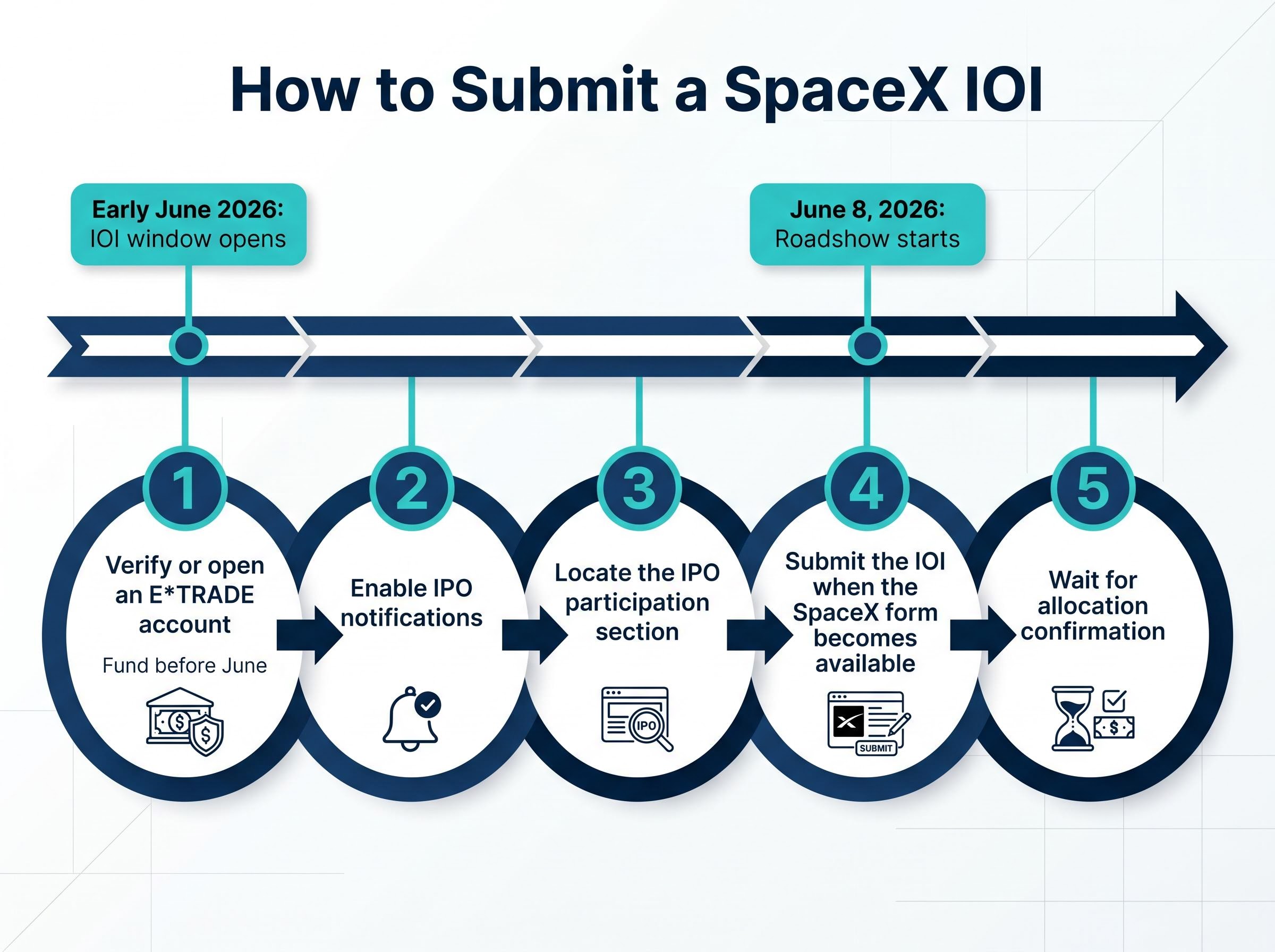
- **Verify or open an E*TRADE account.** If an existing account is dormant, log in and confirm all personal and financial details are current. If opening a new account, complete identity verification and fund the account before June.
- Enable IPO notifications. Navigate to the E*TRADE app or web portal and activate alerts for new IPO offerings. This ensures the SpaceX listing appears as soon as it becomes available.
- Locate the IPO participation section. E*TRADE’s IPO Centre (or equivalent section) will display available offerings. Monitor this section from early June onward.
- Submit the IOI when the SpaceX form becomes available. The form will ask for the number of shares or dollar amount of interest. Complete it promptly; demand is expected to be high, and the window may close quickly.
- Wait for allocation confirmation. After submission, E*TRADE will confirm whether shares have been allocated prior to the listing date.
Non-binding, but non-negotiable: Submitting an IOI is not a binding purchase commitment. Investors can withdraw before final pricing. However, failing to submit an IOI will result in zero allocation. There is no workaround.
No official account minimum has been announced for the SpaceX IPO via E*TRADE. Historical patterns from Morgan Stanley-led offerings suggest account size and activity may influence allocation outcomes, but no SpaceX-specific thresholds have been published.
What to do if you cannot get IPO access, and why that may not be a disadvantage
For the majority of retail investors who will not receive an IPO allocation, the question shifts from “how do I get shares” to “what is the best way to gain SpaceX exposure.” Several options are available immediately, and the historical data on IPO performance suggests that waiting may carry less risk than participating at offering price.
Immediately accessible alternatives:
- ERShares ETF: Approximately 23.3% SpaceX exposure via a special purpose vehicle; 0.75% expense ratio; available through any brokerage
- EchoStar (SATS): Public company with indirect SpaceX exposure; available via any brokerage
- Alphabet (GOOGL): Holds a SpaceX stake; available via any brokerage
For accredited investors, the Cosmos Fund offers pre-IPO SpaceX exposure with an approximate $25,000 minimum investment, available on select platforms including SoFi Private Markets. Interval fund structures and venture capital routes also exist, though these carry limited redemption windows and are not liquid investments.
| Option | Brokerage Needed | Minimum Investment | Liquidity | Exposure Type |
|---|---|---|---|---|
| ERShares ETF | Any | Price of one share | Daily (exchange-traded) | ~23.3% SpaceX via SPV |
| EchoStar (SATS) | Any | Price of one share | Daily (exchange-traded) | Indirect public proxy |
| Alphabet (GOOGL) | Any | Price of one share | Daily (exchange-traded) | Indirect (holds SpaceX stake) |
| Cosmos Fund | Select platforms (e.g., SoFi) | ~$25,000 | Limited redemption windows | Direct pre-IPO |
The historical case for patience: According to Nasdaq analysis of IPOs from 2010 to 2020, roughly two-thirds of IPOs underperformed the broader market by year three. At a revenue multiple well above 100x on approximately $15.6 billion in revenue, SpaceX’s IPO pricing leaves limited room for execution missteps. Buying on the open market after the initial listing period may carry less risk than participating at IPO pricing.
Analyst consensus broadly supports this framing: submit an IOI if eligible, but treat ETF exposure as a legitimate strategy rather than a consolation prize.
Investors exploring the broader sector rather than a single IPO allocation will find our deep-dive into publicly traded space stocks, which covers seven companies with one-year returns ranging from 271% to over 1,000%, including fundamental revenue data for names like Rocket Lab and context on the long-run $1-1.8 trillion global space economy thesis.
The risks every SpaceX IPO investor needs to price in before June
The SpaceX IPO carries several distinct risks that warrant sizing before submitting an IOI or positioning in proxy investments.
- Valuation risk: A revenue multiple well above 100x on approximately $15.6 billion in revenue prices in substantial future growth across Starlink, Starship, and launch services. Any miss on growth projections could produce a significant post-IPO price decline.
- Allocation uncertainty: Even with a 30% retail allocation, individual investors may receive far fewer shares than requested. Broker participation, account eligibility, and overall demand all reduce the final allocation per investor.
- IPO volatility: Large high-profile IPOs frequently experience significant price swings in the weeks following listing, as initial pricing discovery unfolds and lock-up expectations shift.
- Access limitations: Retail access remains brokerage-dependent, with confirmed access through **E*TRADE** only at the time of writing. Platforms that have not confirmed participation may never receive allocation.
- Liquidity risk for pre-IPO vehicles: Interval funds and private fund structures (such as the Cosmos Fund) typically carry limited redemption windows and are not liquid investments.
A detailed SpaceX valuation analysis using EBITDA multiples and discounted cash flow projections puts the overvaluation risk at approximately 30%, with no S-1 publicly filed and unverified financials still the baseline for any pricing decision retail investors are currently working from.
According to SEC Investor Alerts on IPOs (2026), past IPO performance is not indicative of future results, and investors should expect heightened volatility in the initial listing period for high-profile offerings.
Tax considerations for SpaceX IPO investors
Tax treatment varies by holding period and investment vehicle. IPO shares sold within one year of purchase are subject to short-term capital gains tax rates of up to 37%, depending on income bracket. Shares held longer than one year qualify for long-term capital gains rates of up to 20%, per IRS Topic 409 (2026 guidelines).
The IRS Topic 409 capital gains guidance establishes the holding period thresholds and rate schedules that determine whether IPO share sales are taxed as short-term income or at the preferential long-term rate, a distinction that materially affects after-tax returns for investors who sell within the first year of listing.
Standard brokerage tax rules apply to ETF positions such as ERShares, SATS, and GOOGL; distributions and sales are taxed under normal equity rules. Pre-IPO fund structures, including interval funds and venture capital vehicles, may carry different tax treatment. Investors using these vehicles should consult a tax adviser regarding pass-through structures and redemption-triggered events.
The bottom line on SpaceX IPO access: act on what is confirmed, prepare for what is not
The access picture for the SpaceX IPO is narrower than the hype suggests. One platform is confirmed. Several are disputed or silent. The IOI window opens in weeks, not months.
Here is the action hierarchy, ranked by urgency:
- **Open or activate an E*TRADE account now. This is the only confirmed retail access point. Complete identity verification and fund the account before early June 2026**.
- Submit an IOI as soon as the form becomes available. Monitor E*TRADE’s IPO section from early June; the roadshow begins June 8, 2026, and the submission window may be brief.
- Position in ETF proxies immediately. The ERShares ETF (approximately 23.3% SpaceX exposure), EchoStar (SATS), and Alphabet (GOOGL) are available through any brokerage today, without waiting for IPO access confirmation.
Analyst consensus supports a measured approach: submit an IOI if eligible, diversify via publicly traded proxies for immediate exposure, and avoid committing to IPO pricing purely on momentum given the elevated valuation multiples. For most retail investors, the best SpaceX position may be one that does not depend on receiving an IPO allocation at all.
This article is for informational purposes only and should not be considered financial advice. Investors should conduct their own research and consult with financial professionals before making investment decisions. Past performance does not guarantee future results. Financial projections are subject to market conditions and various risk factors.