When Australian inflation rises, the textbook reflex says the dollar should weaken. Yet the opposite has been happening. Over the twelve months to mid-September 2026, the Australian dollar climbed roughly 7.49% against the US dollar, and it did so while inflation pressure kept the Reserve Bank of Australia in tightening mode.
That paradox sits at the centre of how RBA monetary policy shapes the Australian dollar. The RBA has three levers it can pull: interest rates, quantitative easing, and quantitative tightening. Each one pushes the AUD in a specific direction, and knowing which direction matters more than ever if you invest, run a business with offshore exposure, or simply watch the cost of imports climb.
After reading this, you will know exactly which RBA decisions move the dollar and in which direction, why moderate inflation has recently strengthened rather than weakened it, and where that relationship breaks down. The goal is a working mental model you can apply the next time the RBA speaks or an inflation print lands.
The RBA’s three tools and what each one does to the dollar
The RBA’s job is to keep inflation inside a 2-3% target band while supporting full employment and the broader economic welfare of Australians. Currency stability sits within that mandate too, though the AUD is never targeted directly. It moves as a by-product of the RBA’s rate decisions.
The RBA’s inflation target explainer sets out why price stability is defined as CPI growth within the 2-3% band, and how the cash rate serves as the primary instrument for keeping inflation inside that range while supporting employment and economic welfare.
The Board meets eight times a year on a scheduled basis, with room for emergency sessions when conditions demand. Those meetings are where the three tools get deployed.
How each tool pushes the dollar
The first and most important tool is the interest rate. When the RBA lifts the cash rate, it is directly improving the return you receive for holding Australian-dollar assets relative to comparable assets elsewhere. Higher returns pull foreign capital in, and that inflow bids the AUD higher. Cut rates, and the reverse happens.
The second tool is quantitative easing (QE), where the RBA creates money to buy bonds from financial institutions. This floods the system with liquidity and pushes yields down, which shrinks the return advantage of Australian assets and tends to weigh on the dollar.
The third tool is quantitative tightening (QT), the reversal of QE. The RBA stops buying and lets bonds mature without reinvesting, draining liquidity and supporting higher yields. That makes Australian assets more attractive again and tends to support the AUD.
| Policy Tool | RBA Action | Effect on AUD Yield Attractiveness | Directional Impact on AUD |
|---|---|---|---|
| Interest rates | Raises the cash rate | Increases the return on AUD assets | Strengthens AUD |
| Quantitative easing | Buys bonds, adds liquidity | Suppresses yields, reduces the return advantage | Weakens AUD |
| Quantitative tightening | Lets bonds mature, drains liquidity | Supports higher yields | Supports AUD |
The through-line is yield attractiveness. Rates are the primary lever; QE and QT are reinforcing or offsetting forces operating on the same underlying logic. Once you see that, every RBA announcement becomes readable as either a tailwind or a headwind for the dollar.
When big ASX news breaks, our subscribers know first
How interest rate changes actually reach the exchange rate
The cash rate does not move the dollar on its own. What matters is the interest-rate differential: how Australia’s rate compares with those of peer economies, especially the US Federal Reserve. A cash rate of 4.35% only helps the AUD if it sits above, or is expected to stay above, what you can earn elsewhere.
This is the mechanism that drives the carry trade. Investors borrow in currencies with low rates and deploy the funds into higher-rate currencies, pocketing the yield difference. Every time capital flows into AUD assets to capture that gap, it adds to demand for the dollar and pushes it up.
A September 2026 AUD/USD analysis noted that the “rate differential still favours the Aussie,” with the RBA at 4.35% and the Fed expected to deliver at most one more hike, keeping AUD attractive within the G10 group of major currencies.
Global central bank divergence became the defining macro theme of mid-2026, with the RBA hiking to 4.35% while the Fed, ECB, and Bank of England all held, a gap of up to 235 basis points that made Australian-dollar assets structurally attractive to yield-seeking capital.
Here is the transmission chain in sequence:
- The RBA lifts the cash rate.
- Australian yields rise relative to peer economies.
- Carry traders and portfolio managers shift funds into AUD-denominated assets.
- Increased demand bids the dollar higher.
- Expectations of further hikes extend the effect forward in time.
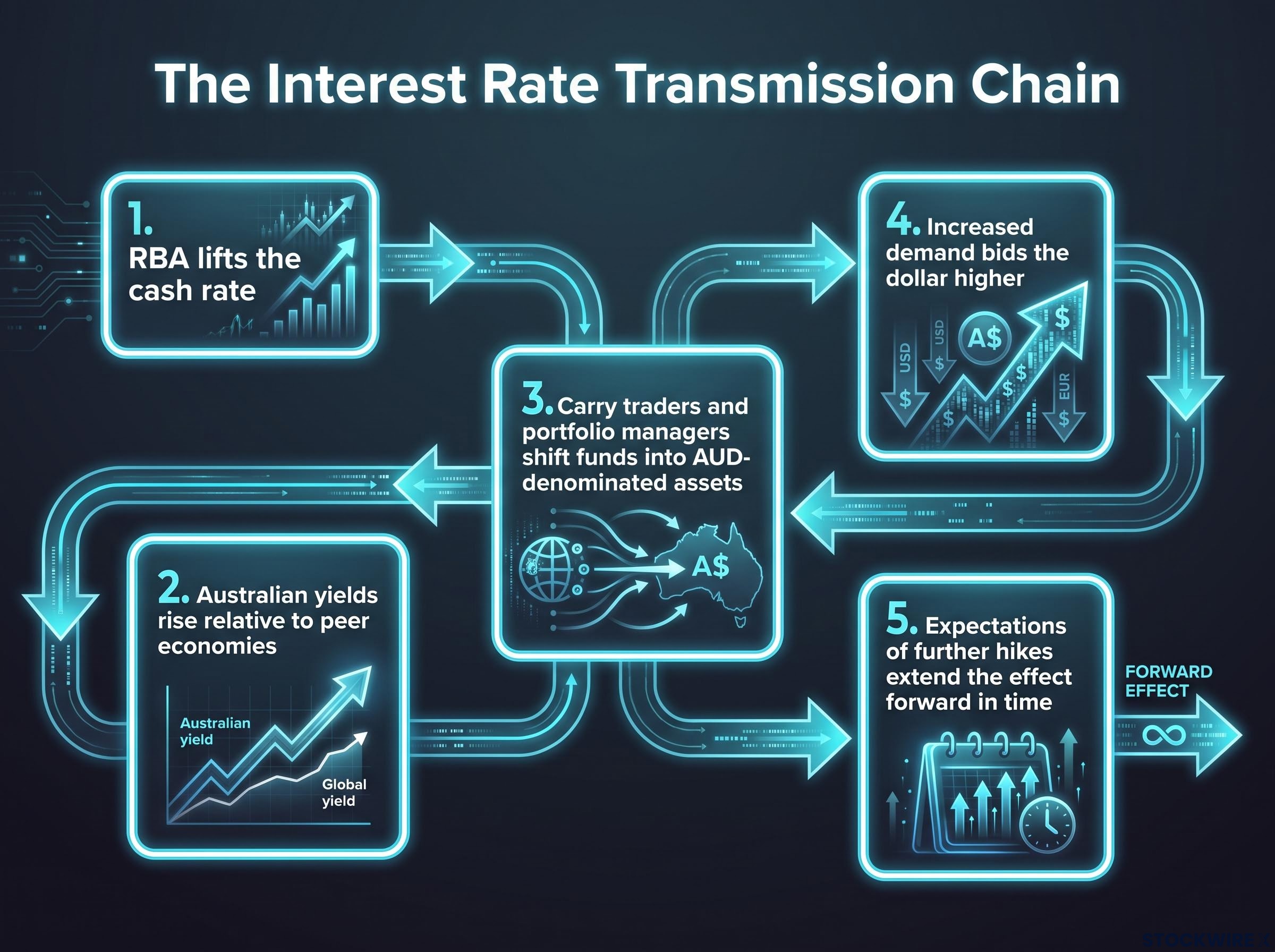
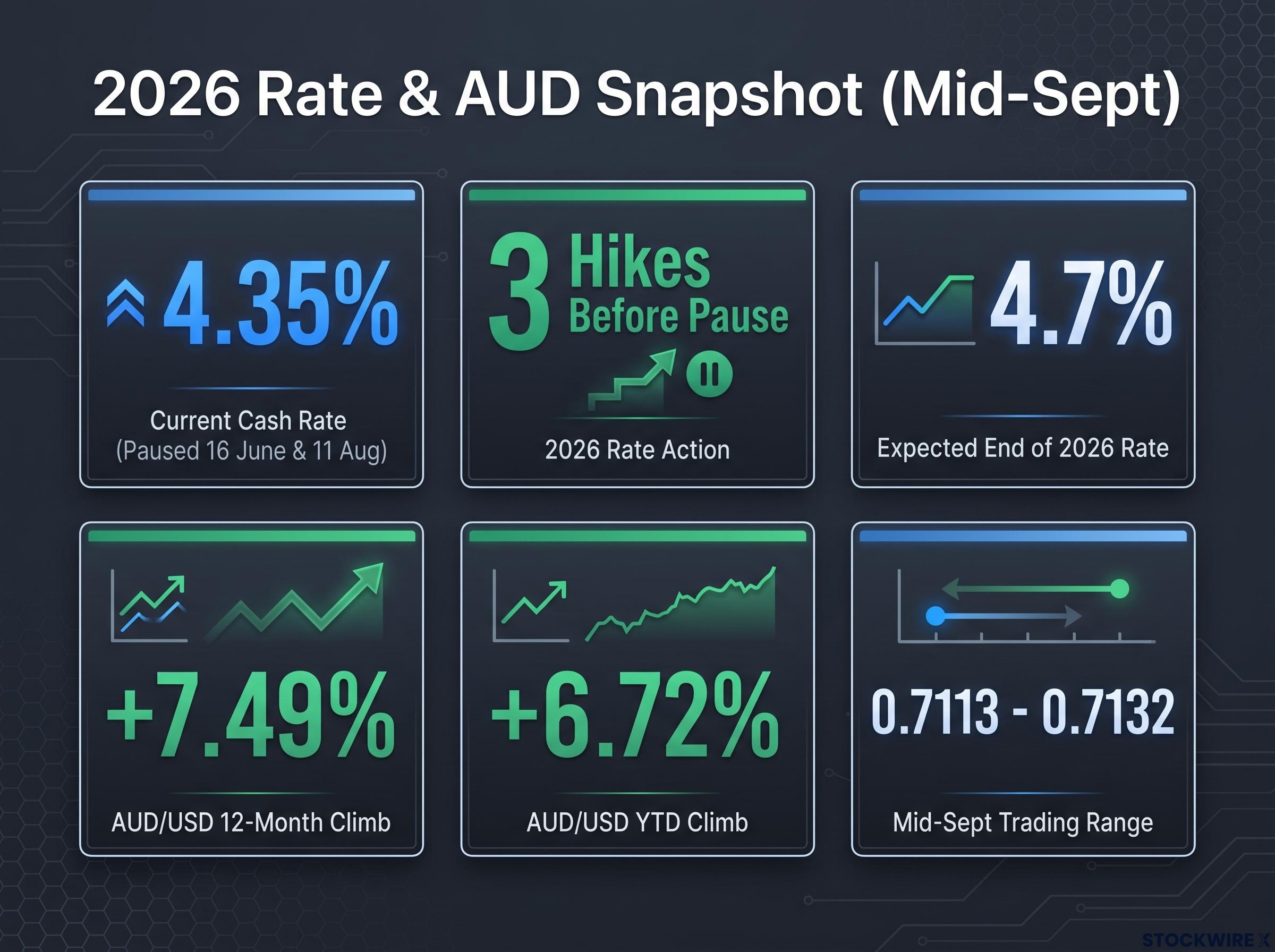
That final step is the expectations channel, and it is why the dollar can move before the RBA does anything. Markets price in anticipated moves, not just current ones. The RBA’s May 2026 Statement on Monetary Policy showed market participants expecting the cash rate to rise a further 60 basis points to roughly 4.7% by the end of 2026, and the AUD had already been capitalising that view. The RBA hiked three times in 2026 before pausing, and by mid-September the dollar was up 6.72% year-to-date.
For you as a currency watcher, this is the practical point: a single RBA statement that shifts the market’s expectation for the next meeting can move the AUD before any rate change occurs. The tone of the RBA’s communication matters as much as the decision itself.
There is a ceiling to this, though. Strategists at Brown Brothers Harriman argue the carry advantage is real but that policy is already doing a lot of the work.
Brown Brothers Harriman on the limits of tightening Policy is already “somewhat restrictive,” meaning much of the AUD’s support comes from rate differentials already achieved rather than endless further hikes. Beyond a point, additional tightening delivers diminishing marginal currency gains and can eventually weigh on growth.
Why rising inflation can actually strengthen the Australian dollar
The old intuition runs like this: inflation erodes purchasing power, so a currency losing value at home should lose value abroad too. That logic is not wrong historically, and it still shapes how a lot of people react to a hot inflation print.
But the modern mechanism works differently. In globally integrated capital markets where money moves freely across borders, moderately elevated inflation triggers a central bank response: rate hikes. Those hikes raise yields, draw in foreign capital, and lift the currency. The rate-response channel now dominates the purchasing-power erosion effect, at least while inflation stays moderate.
The core insight Moderately elevated inflation, met by credible tightening, translates into higher yields that draw in capital and strengthen the currency rather than eroding it.
The 2025-2026 cycle is the clearest recent illustration. The RBA hiked in May 2026 explicitly to bring inflation back toward its 2-3% band. Over the same stretch, the dollar rose 7.49% across twelve months and 6.72% year-to-date, moving from 0.6683 to 0.7132 by mid-September. Commentary from Mitrade and Brown Brothers Harriman tied that strength directly to the carry advantage at 4.35%. Inflation was not sinking the dollar; the RBA’s response to it was lifting it.
Inflation and rate expectations moved in lockstep through early 2026: when Australia’s headline CPI hit 4.6% in March, markets immediately priced a 62% probability of a hike at the May meeting, a live demonstration of the rate-response channel dominating the purchasing-power erosion effect.
This dynamic only holds under specific conditions. Treat these three as guardrails:
- RBA credibility must be intact. The effect works while markets believe the RBA can steer inflation back to target, as the downward-sloping CPI projections in the May and August 2026 Statements on Monetary Policy suggested.
- Inflation must stay moderate. Contained inflation invites a measured rate response. Runaway inflation invites something else entirely.
- External conditions must not overwhelm domestic policy. Global shocks can drown out the yield signal regardless of what the RBA does.
What this means in practice is a shift in your first question. When an Australian inflation print comes in hot, do not ask “does this weaken the dollar?” Ask “does this make an RBA rate hike more likely?” If it does, the net effect on the AUD is more likely to be positive than negative.
When the conventional wisdom reasserts itself
The relationship flips if inflation spirals beyond what the RBA can credibly control. At that point, markets stop rewarding higher nominal yields and start demanding higher risk premia, or exit AUD altogether despite the rate advantage. The purchasing-power erosion effect reasserts itself, and the old textbook logic returns. The modern mechanism is a moderate-inflation phenomenon, not a universal law.
What limits the RBA’s grip on the Australian dollar
The mental model you have built so far is clean, and it needs one honest complication. The AUD wears two hats at once. It is a G10 currency driven by rate differentials, and it is a commodity currency and China proxy driven by global risk appetite and Australia’s terms of trade. Both identities are always live.
That second identity is why RBA policy can be overridden. Three external forces regularly compete with, and sometimes overwhelm, the yield signal:
The AUD’s commodity currency drivers, including iron ore prices, Chinese industrial demand, and global risk sentiment, sit alongside the yield signal as simultaneous forces that can override domestic rate policy in any given session, which is why a single-factor rate model routinely underestimates the dollar’s actual range.
- Commodity prices and terms of trade, especially iron ore, which shape the value of Australia’s exports.
- China’s economic cycle, given how dependent Australia’s export income is on Chinese demand.
- Global risk-off episodes, which weaken the AUD regardless of how attractive domestic yields are.
The mid-2026 pause showed what happens when the RBA steps back. The Board held at 4.35% on 16 June 2026 and again on 11 August 2026, and with no active policy driving the currency, the AUD began trading as a function of incoming data, Fed policy, and global sentiment. It consolidated near 0.71-0.72 during the pause.
The width of possible outcomes is worth noting. Across 2026 to mid-September, AUD/USD ranged from 0.6668 to 0.7257, a spread that a single-factor model would never explain on its own. Domestic rates set the baseline, but external forces stretch the range.
History underlines the same point. During the COVID era, the RBA’s rate cuts and asset purchases coincided with a weaker AUD, while the later normalisation and tightening supported recovery as global conditions stabilised and Australian yields regained their edge.
The synthesis is this: RBA policy reliably steers the dollar through rate differentials when global conditions are stable. When a major external shock hits, whether a commodity slump, a China slowdown, or a risk-off panic, the relationship is temporarily severed, not permanently broken. For you, that means domestic policy is the dominant driver most of the time, but you have to watch commodity markets and Chinese data alongside it, because either can override the yield signal without warning.
Reading RBA signals before the dollar moves
Put the whole framework together and it collapses into a three-step reading practice you can run at any RBA meeting, inflation release, or China demand shock:
- Interpret the rate decision and the language around it. The decision sets the baseline yield advantage, but the forward path matters more. Read the post-meeting statement for what it signals about the next move, not just the current one.
- Read inflation data through the rate-expectations lens. A hot print is not automatically bad for the dollar. Ask whether it makes a hike more likely, because that is what actually moves the AUD in the current environment.
- Check the external conditions. Scan commodity prices, Chinese data, and global risk sentiment. If those are stable, domestic policy is in the driver’s seat. If a shock is building, the yield signal may be about to get overridden.
Forward guidance language often moves the AUD more than the rate decision itself; when the RBA held at 4.35% in June 2026, analysts found that specific phrases in Governor Bullock’s statement shifted terminal rate pricing on futures curves by up to 25 basis points without a single basis point change in the cash rate.
As at mid-September 2026, the cash rate sat at 4.35%, with market pricing implying a possible move toward 4.7% by year-end, and AUD/USD traded in the 0.7113-0.7132 range, near the upper end of its 2026 band. That is the yield advantage doing its work in stable conditions.
The most useful habit to carry forward is simple. When the RBA publishes its post-meeting statement, read it not only for the rate decision but for the language on the inflation outlook and the forward path of rates. That is where the real AUD signal lives. With eight scheduled meetings a year plus the detailed Statements on Monetary Policy, you get a regular cadence of signals to track.
This article is for informational purposes only and should not be considered financial advice. Investors should conduct their own research and consult with financial professionals before making investment decisions. Past performance does not guarantee future results, and all currency figures reflect conditions as at mid-2026, offered as illustrations rather than fixed facts.