
Approximately 96 out of every 100 stocks listed on U.S. public markets have contributed nothing, net, to wealth creation over their lifetime. All the gains belong to the remaining 4%, or fewer.
This is not a market anomaly or a product of recent technology-driven concentration. It is a structural feature of equity markets that has persisted across nearly a century of data, confirmed by peer-reviewed research and reinforced by institutional analysis published as recently as 2024. The implications for how Australian investors think about portfolio construction, the cost of sitting on the sidelines, and the decisions that define long-term financial outcomes are profound.
What follows explains the mechanics behind power law investing: what the empirical evidence actually shows, why markets are structurally skewed toward extreme concentration, how landmark historical examples illustrate the principle at human scale, and what this means for Australian investors navigating an AI-accelerated market in 2026.
The numbers that make most investors uncomfortable
The empirical foundation for this discussion rests on a single, continuously updated body of research. Hendrik Bessembinder’s work on wealth creation in U.S. public stock markets, most recently covering the period 1926-2022 (SSRN abstract_id=4448099), found that approximately 3.4-4% of listed stocks generated all net wealth creation relative to Treasury bills across the entire sample period.
Approximately 3.4-4% of listed U.S. stocks generated all net equity wealth creation across nearly a century of market history. The remaining 96%+ collectively failed to outperform short-term government bonds over their full listing lives.
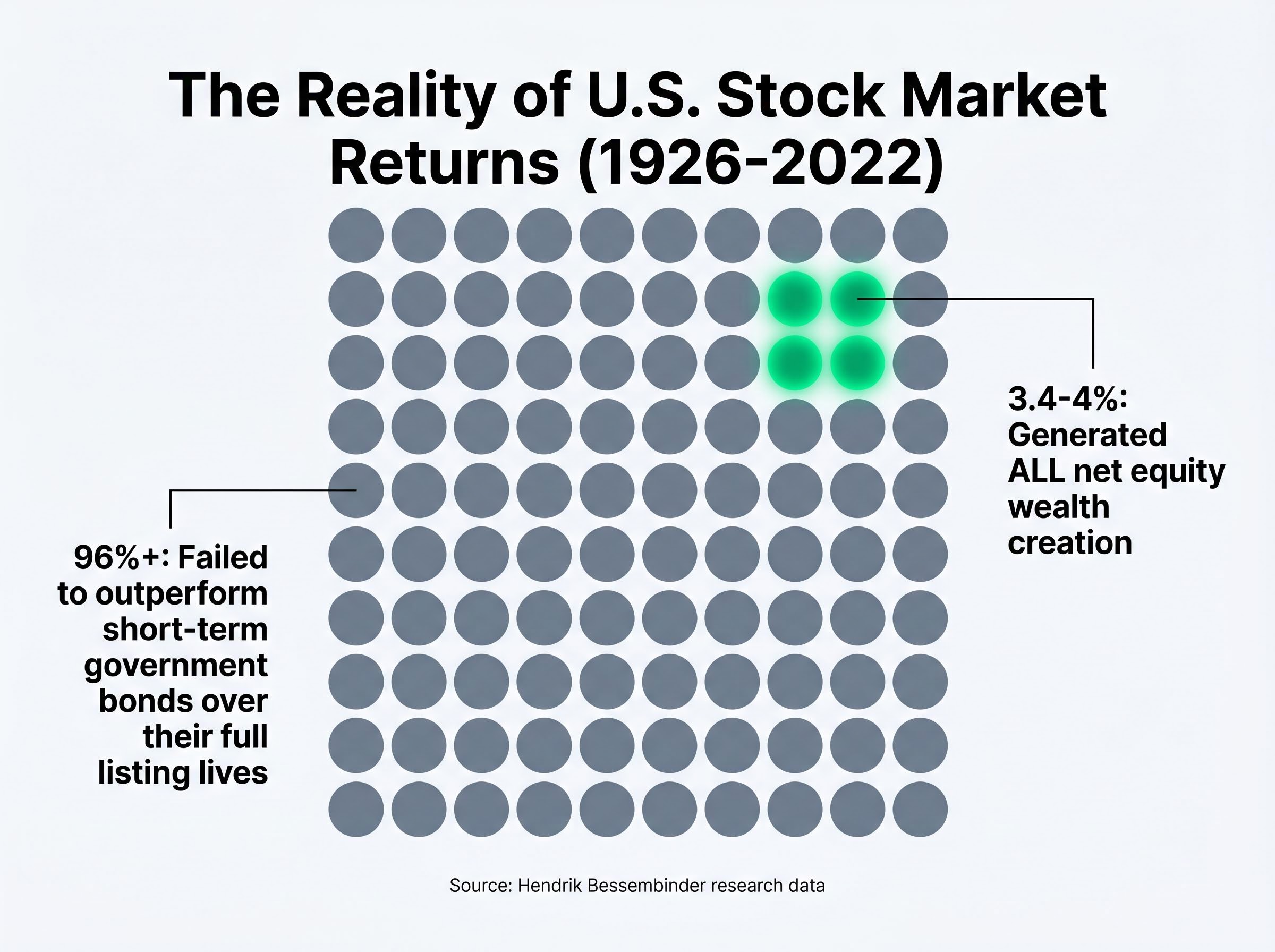
The majority of individual stocks, measured over their complete lifetimes as public companies, actually underperformed short-term government bonds. This is not a statement about short-term volatility. It is a statement about the permanent distribution of returns across all publicly traded equities.
Complementary institutional research published in 2024 confirms that the same dynamic is accelerating in the current market environment:
- MSCI Research Insight (March 2024): a shrinking group of mega-cap companies explains a disproportionate share of index returns, particularly after 2020.
- S&P Dow Jones Indices (February 2024): a small group of large-cap names dominates index performance globally, not just in the United States.
- The concentration is even more extreme when viewed at the individual stock level: research cited in Australian investment commentary suggests as few as 1 in 72 listed companies accounts for the bulk of long-run wealth creation.
Understanding the statistical baseline is the prerequisite for every decision that follows. Without grasping just how extreme the concentration is, the practical implications for portfolio construction and conviction sizing cannot land properly.
When big ASX news breaks, our subscribers know first
What a power law actually means and why markets produce them
What the distribution actually looks like
Most people intuitively assume investment returns follow something resembling a normal distribution, where most stocks cluster around an average and extreme outcomes are rare in both directions. The actual distribution of lifetime stock returns looks nothing like this. It follows a power law: most individual stocks deliver returns near zero (or negative), and a tiny number generate returns so large they account for virtually all net wealth creation.
A useful way to grasp the difference is the distinction between human height and human net worth. Height is normally distributed; most adults are within a narrow range of the average, and no one is ten times taller than anyone else. Net worth follows a power law; a small number of individuals hold wealth that is thousands or millions of times greater than the median. Stock market returns behave like net worth, not like height.
Why equity markets are structurally skewed toward this shape
Three structural features of equity ownership produce power-law outcomes. These are not new to the AI era, though they are intensified by it.
- Compounding advantages for winners. A stock that gains 10x on a small initial base creates portfolio weight that grows exponentially. The tail compounds matter far more than the median outcome, because a single 100x winner overwhelms dozens of modest gainers.
- Winner-take-most dynamics in large addressable markets. Industries with network effects, high switching costs, or scale-driven cost advantages tend to concentrate market share in one or two dominant firms. The winner captures a disproportionate share of the total profit pool.
- Asymmetric upside structure of equity. The most an investor can lose on any single stock is 100% of the invested capital. The potential upside is theoretically unlimited. This asymmetry means the distribution of possible outcomes is inherently right-skewed; the positive tail is longer and fatter than the negative tail.
These drivers explain why passive index investors participate in power-law winners automatically (the winners grow into larger index weights), while active stock-pickers who spread capital equally across many positions can inadvertently exclude or underweight the very stocks responsible for all the returns.
History’s most instructive case studies in power-law concentration
The statistical principle becomes more tangible through specific historical examples, each operating at a different scale.
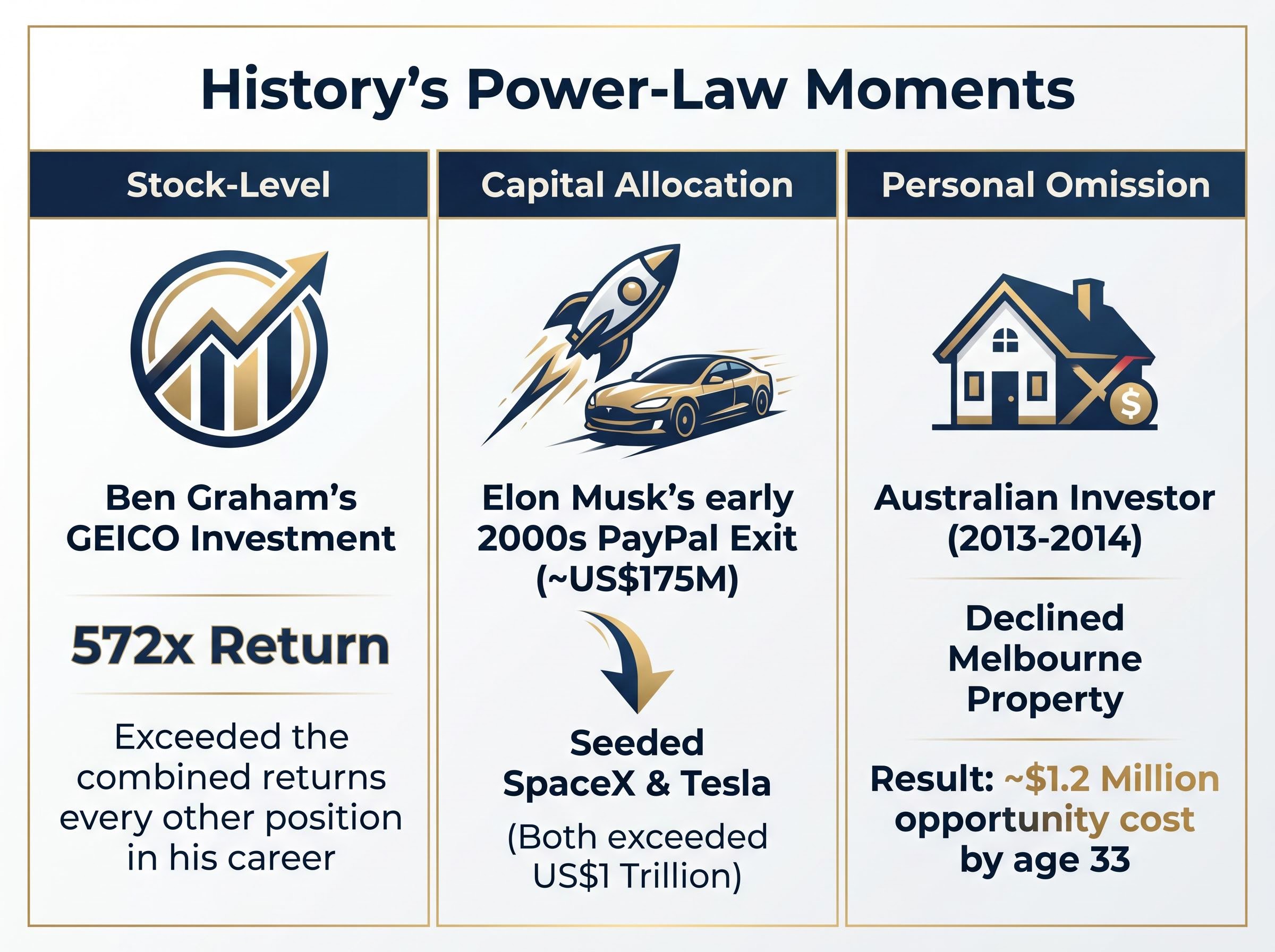
Ben Graham’s single investment in GEICO returned 572 times his invested capital, exceeding the combined returns of every other position in his career.
Graham, widely regarded as the founder of value investing, built a career analysing hundreds of companies. Yet one position, GEICO, generated more wealth than everything else combined. The lesson is not that Graham was lucky. It is that the power-law distribution meant that even a disciplined, diversified career could be defined by a single holding.
Elon Musk’s exit from PayPal in the early 2000s yielded approximately US$175 million. That single liquidity event seeded two companies, SpaceX and Tesla, each of which subsequently reached valuations exceeding US$1 trillion. The power-law benefit did not come from the original exit; it came from recognising the next level of the distribution and concentrating capital there.
At a more personal scale, an Australian investor’s decision not to purchase a Melbourne property in 2013-2014 carried an estimated opportunity cost of $1.2 million by age 33. The decision was not a disaster in the conventional sense; it was simply the absence of action on a single high-quality opportunity. Power laws punish omission as severely as they reward conviction.
| Decision/Event | Type of Power Law Moment | Outcome | Key Lesson |
|---|---|---|---|
| Graham’s GEICO investment | Stock-level concentration | 572x return; exceeded all other career gains | One position can define an entire investment career |
| Musk’s PayPal exit (~US$175M) | Decision-level capital allocation | Seeded SpaceX and Tesla (both exceeded US$1 trillion) | Recognising the next distribution level matters more than the initial exit |
| Melbourne property (2013-2014) | Personal omission | ~$1.2 million estimated opportunity cost by age 33 | Inaction on a high-quality opportunity carries compounding cost |
How AI amplifies existing market concentration forces
Power-law concentration in equity markets predates artificial intelligence by decades. Bessembinder’s data covers 1926-2022, a period in which the structural drivers of concentration, compounding, network effects, and asymmetric upside, operated without any contribution from AI. The current AI cycle is not creating a new phenomenon. It is accelerating an existing one.
Three properties specific to AI as a technology explain why the acceleration is so pronounced:
- Near-zero marginal distribution cost. Software products built on large language models can be deployed globally with almost no incremental cost per user, enabling revenue growth that physical product companies cannot match.
- Elimination of adoption friction. AI products require no installation manuals, no specialised training, and no hardware upgrades. The barrier between awareness and usage has been reduced to a text prompt.
- Data-network compounding advantages. AI models improve as they process more data. Companies with the largest user bases generate the most training data, which produces better models, which attract more users. The feedback loop compounds the leader’s advantage over time.
OpenAI’s annualised revenue run-rate grew from approximately US$1.6 billion in late 2023 to approximately US$20-25 billion by early 2026, according to Reuters reporting on an OpenAI CFO statement from January 2026.
Anthropic, the second-largest standalone AI company, grew from effectively zero revenue before March 2023 to an annualised run-rate of approximately US$9 billion by early 2026. These trajectories illustrate power-law winner dynamics operating within the AI sector itself.
Platinum Asset Management warned in 2024 that Australian investors using passive global ETFs carry substantial implicit concentration in the “Magnificent Seven” U.S. mega-cap technology stocks. Research from the BlackRock Investment Institute (2024) reached a similar conclusion, noting that structural mega-forces, including AI, are driving increased concentration in a small group of companies capturing outsize value.
This does not mean concentration is inherently beneficial. AQR Capital Management (2024) cautioned that over-concentration in glamour stocks increases risk and that diversified factor investing helps investors avoid reliance on picking the tiny set of winners. The tension between recognising power-law dynamics and managing concentration risk is real, and it is particularly acute for Australian investors whose regulatory environment emphasises diversification.
What this means for how Australian investors should actually behave
Acknowledging the regulatory baseline
ASIC and its MoneySmart consumer education platform consistently emphasise diversification as a core investment principle and explicitly warn against putting all capital into a small number of positions. This guidance is appropriate for the broad retail investor population, particularly those with limited time, sector-specific expertise, or capacity to absorb concentrated losses.
Understanding power-law dynamics does not mean abandoning diversification. It means applying it more deliberately, with awareness of what equal-weight spreading across dozens of positions actually costs in long-run expected return.
A practical framework for power-law-aware investing
If approximately 3.4-4% of stocks generate all net wealth creation, systematically avoiding concentration means systematically avoiding the winners. Morgan Housel, writing for Collaborative Fund, has observed that many investors’ largest long-run errors are failures to hold or buy exceptional companies, rather than the more visible errors of buying poor ones.
Three considerations follow from this:
- Size positions proportionally to conviction, not equally by default. When the evidence for a specific company’s competitive advantage, addressable market, and management quality is substantially stronger than for other positions, the allocation should reflect that difference. Equal weighting is a deliberate choice, not a neutral one.
- Recognise that inaction carries asymmetric cost. Ben Carlson of Ritholtz Wealth Management has demonstrated that missing the market’s best days leads to dramatically lower long-term returns. The same logic applies at the individual stock level: the cost of not owning the rare power-law winner compounds over time in a way that the cost of a bad active pick does not.
- Distinguish deliberate diversification from reflexive dilution. Diversification that spreads risk across genuinely uncorrelated opportunities serves a clear purpose. Diversification that dilutes every position to the point of irrelevance, because no individual allocation is large enough to affect portfolio outcomes, defeats the purpose of being invested in equities at all.
This article is for informational purposes only and should not be considered financial advice. Investors should conduct their own research and consult with financial professionals before making investment decisions.
The rarest resource in long-term investing is not capital, it is recognition
Power laws are not a strategy to implement. They are a structural reality to understand. The data from nearly a century of U.S. market history is settled: a tiny fraction of stocks generates all net wealth creation, and the majority of individual equities underperform government bonds over their lifetimes.
What changes when investors absorb this evidence is not their portfolio mechanics but their attention. The scarce resource is not capital or access. It is the willingness to recognise exceptional quality early, and to act on that recognition when the consensus has not yet arrived.
The question for Australian investors in 2026 is not whether power laws exist. The evidence is settled. The question is whether individual investors are positioned, psychologically and practically, to benefit from them.
Graham’s GEICO return was available to anyone willing to do the analytical work and hold the conviction. Musk’s PayPal exit mattered not because of the cash it generated but because of the next-level distribution it funded. The investors and founders who recognised the scale of AI’s structural shift 12-18 months before consensus arrived are the ones positioned for the next phase of concentration.
The distribution does not change. The only variable is recognition, and the willingness to act on it.