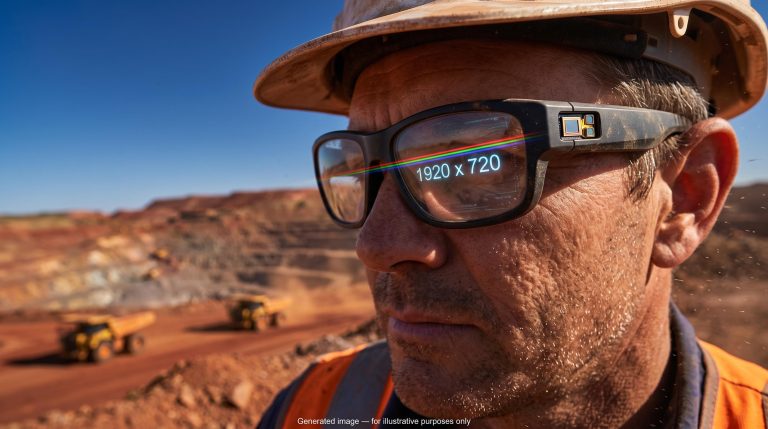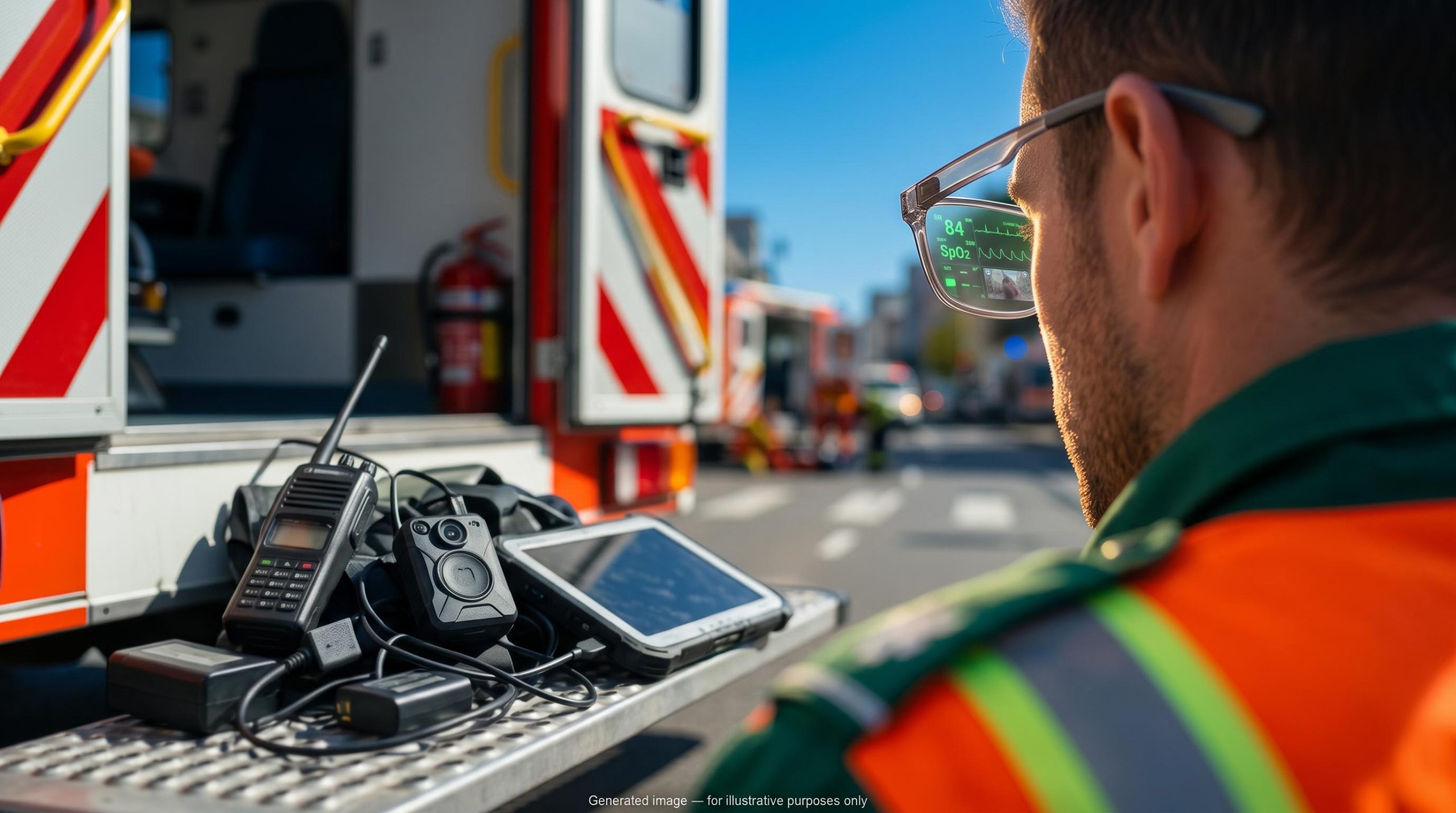
The shift starts the same way for a lot of frontline workers. There is a radio on the shoulder, a camera clipped to the chest and a phone or tablet in a pocket, and each one comes with its own battery, mount and training session. It looks like capability, and the instinct is that more devices must mean a better-equipped responder.
The direction of wearable technology for frontline workers is now running the other way. Instead of adding gadgets, the industry is consolidating them into a single heads-up wearable, a display worn in front of the eyes. That is a category shift you can watch as a technology investor.
After this, you will have a plain-language picture of why consolidation matters. You will also have four questions you can apply to any ASX wearables or defence technology company.
Why does carrying more devices make frontline work harder?
Start with the kit itself. A typical frontline stack looks something like this:
- Shoulder radio: voice contact with dispatch, plus a battery and a mount
- Body-worn camera: evidence capture, plus another battery, a mount and a docking routine
- Phone or tablet: data and messaging, plus charging and a pocket it has to fit in
- Separate display (sometimes): extra information, plus more weight and more training
Each device solves a real problem. Each one also adds weight, another battery to watch and another procedure to learn.
The bigger cost is attention. Every glance down at a screen is a glance away from the scene, and you end up with a worker whose focus is split between what is happening in front of them and the devices strapped to them.
What the NIJ and RAND report found
This is not a new complaint. In 2017, RAND prepared Wearable Technologies for Law Enforcement: Multifunctional Vest System Options for the US National Institute of Justice (NIJ), the research arm of the US Department of Justice.
The report named three challenges directly: the size and weight of the equipment officers carry, the growing number of batteries, and the need for mounting and docking systems for body-worn cameras. It also made a point about adoption that matters for anyone selling into this market.
Key finding According to the report, bulk and appearance matter and can be significant factors in whether wearable technologies are adopted.
RAND concluded that major incremental improvements were already available using commercial technology at the time. In plain terms, agencies want fewer, lighter and more integrated devices.
That tells you something about how these buyers think. They weigh batteries, bulk and load as heavily as features, so a product that adds to the pile starts behind.
When big ASX news breaks, our subscribers know first
Why do winning frontline products replace devices instead of adding one?
Here is the concept at the heart of this category: in frontline technology, the winning product replaces devices rather than adding one more.
A heads-up wearable puts information, communications and video into your line of sight. You no longer need to look down at a phone, carry a separate camera or manage several batteries, because one device is doing the work of three or four.
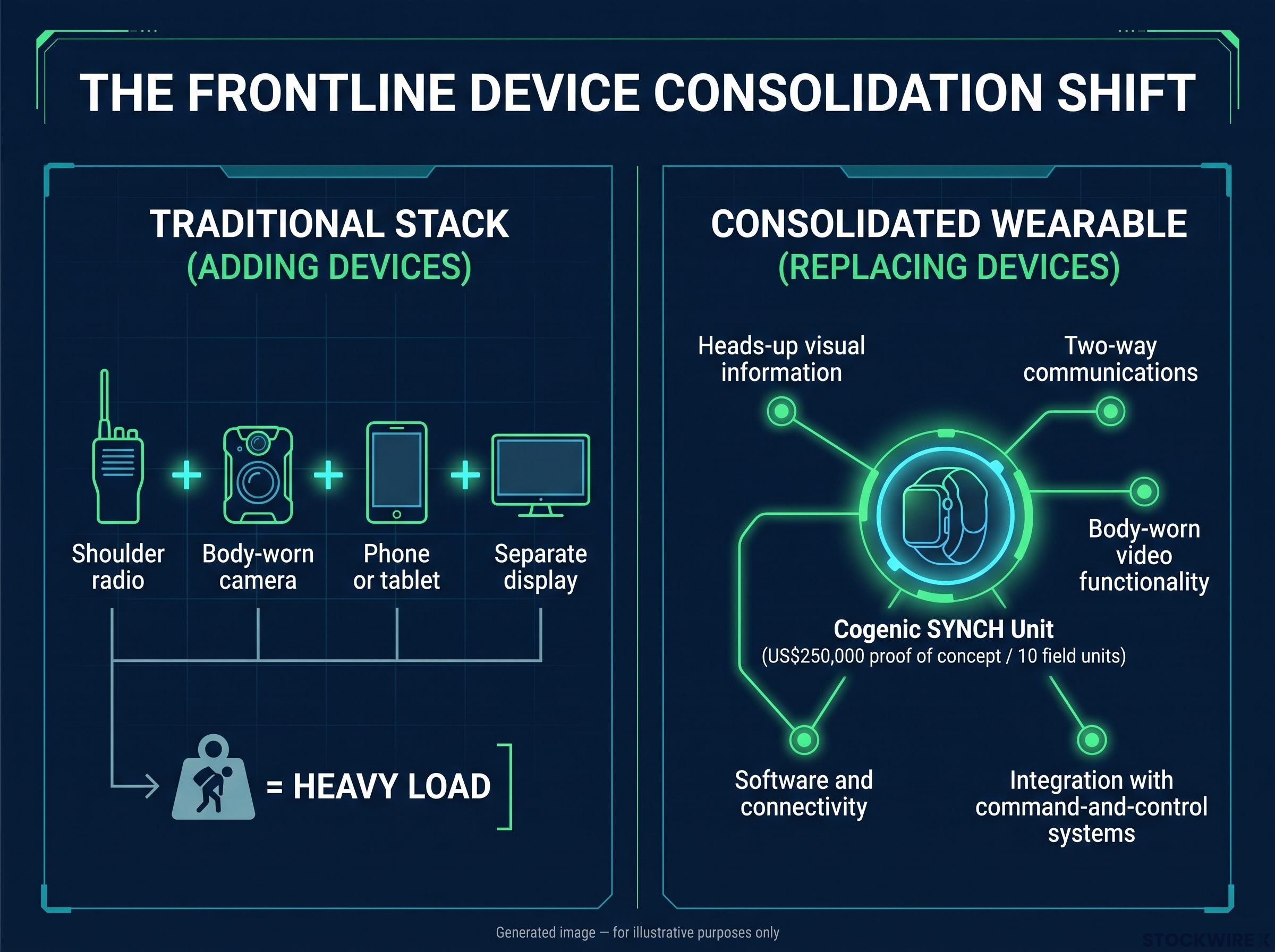
The Cogenic SYNCH unit consolidates traditional equipment, backed by a US$250,000 proof of concept for 10 field units.
The evidence from emergency medical services (EMS), the paramedic and ambulance sector, points the same way. A Pace University EMS project funded by the Agency for Healthcare Research and Quality and completed in 2024 built smart glasses linked to a hospital system for live video and real-time patient data sharing. A simulated EMS crossover trial published on 2 June 2026 found that, across 16 sessions, smart glasses produced a higher completion rate for physician-prompted critical tasks than radio or phone.
The pilot randomized crossover trial also recorded a trade-off: smart glasses lengthened interaction durations, so you should weigh faster task completion against the extra time each exchange can take before judging any heads-up display as a clear win.
Design still matters. Research on split attention shows a poorly built display can simply swap one overload for another, so integration only works when it is done well.
From a single gadget to a connected platform
Once the device count drops, value moves. A standalone display is a one-off hardware sale, while a connected platform becomes the working link between the responder, dispatch and command.
| Layer | What it does | Why it moves value beyond the gadget |
|---|---|---|
| Display, voice and video | Hands-free information plus two-way communication | Replaces separate radio and screen |
| Camera and evidence workflow | Captures and manages body-worn footage | Ties the device into legal and reporting processes |
| Connectivity and dispatch data | Links the wearer to networks and live job information | Makes the device part of daily operations |
| Command-and-control software | Feeds field information to supervisors and command | Embeds the platform in the customer’s systems |
| Device management, security and support | Keeps fleets updated, secure and maintained | Creates recurring service revenue |
When you assess a wearables company, the useful question is how many devices the product replaces and what recurring software and services sit around it. How impressive the gadget looks on its own matters far less.
How does Cogenic’s SYNCH proof of concept put consolidation into practice?
What the proof of concept includes
The concept becomes concrete in a deal announced on 21 October 2026. Cogenic, a subsidiary of Energy Technologies (ASX: EGY), signed a binding Heads of Agreement with MEEP Advanced Enterprise Communication, trading as Synch, with an Effective Date of 20 October 2026. Under the agreement, a US$250,000 proof of concept covers ten field-operational units.
According to the company, each unit is expected to include:
- Heads-up visual information
- Two-way communications
- Body-worn video functionality
- Software and connectivity
- Integration with command-and-control systems
All of this sits in one lightweight wearable designed for field use, and Cogenic retains its existing and core IP under the agreement. The company states its laser engine is readable in direct sunlight.
The payment schedule, the Master Agreement scope and the question of regional exclusivity sit in the full agreement terms, which show how the framework is structured beyond the headline proof-of-concept figure.
Set that list against the device stack from the first section. The radio, the camera and the screen are all answered in a single unit.
How the business is built
The company’s 22 October 2026 investor presentation describes a fabless model. Fabless means the company designs its technology and keeps the IP in-house, while outside partners handle mass production. At its core is a proprietary custom MEMS chip; MEMS stands for micro-electro-mechanical system, a tiny chip with moving parts that here steers the laser.
The company describes three revenue streams:
- Device sales: illustrated by the SYNCH framework
- Recurring management software: ongoing revenue from running device fleets
- Per-unit royalties: illustrated by the five-year Master License Agreement with Amalgamated Vision, paying a 5% royalty on gross sales of finished products
That gives you three ways the company intends to earn from the same core technology.
What four questions help you assess any wearables or defence technology company?
Public-safety and defence buyers typically move from a paid proof of concept to acceptance criteria, then a framework agreement, then purchase orders once acceptance is reached. With that path in mind, here is a portable screen, with Energy Technologies’ company-reported answers alongside.
- Does the product replace devices or add one more? Cogenic’s proof-of-concept platform combines heads-up information, two-way communications and body-worn video in one wearable.
- Does it plug into the systems the customer already runs? The proof of concept includes integration with command-and-control systems.
- Who owns the core technology? Cogenic retains its existing and core IP under the SYNCH agreement.
- Is there a path from trial to orders? The agreement sets a framework for purchase orders of up to US$10 million following proof-of-concept acceptance, a framework ceiling with no minimum beyond the US$250,000 proof of concept.
You can run these four questions over any ASX wearables or defence technology name and quickly see where a company is strong and where it is still building.
How has Energy Technologies moved from IP acquisition to field-operational glasses?
Energy Technologies is based in Brookvale, New South Wales, and reports that it was established in 1983. Its operations include Bambach Wires and Cables and Dulhunty Poles, alongside Cogenic Pty Ltd, which carries the wearables strategy.
| Date | Company-reported step | What it adds |
|---|---|---|
| March 2026 | Acquired Maradin’s laser optical engineering IP portfolio of 14 global patents (StockWire X coverage, 22 March 2026) | The core display technology |
| July 2026 | Five-year Master License Agreement with Amalgamated Vision at a 5% royalty (StockWire X coverage, 23 July 2026) | A licensing route to market |
| 21 October 2026 | Binding Heads of Agreement with Synch (full terms in StockWire X coverage, 21 October 2026) | A framework for complete field units |
| 22 October 2026 | Investor presentation | The platform and business model set out |
Amalgamated Vision is developing heads-up display solutions for AFWERX, the US Air Force’s innovation arm, and NASA projects. These are Amalgamated Vision’s own development projects using Cogenic’s technology, not contracts held by Cogenic.
Cogenic’s defence licence with Amalgamated Vision is aimed at military-grade heads-up displays, and it was built on the laser beam scanning platform that the company’s earlier patent acquisition made possible.
With Synch, the company says it intends to explore homeland security, law enforcement, medical first response and defence applications after initial deployment. Each step builds on the last: IP, then a licence, then a binding framework for working units. That is the shape of progress to look for in any wearables company.
The milestones that take Energy Technologies from agreement to deployment
In about seven months, Cogenic has moved from acquiring a laser display IP portfolio to a defence-linked royalty licence and a binding framework for field-operational smart glasses. The company has set out the next steps:
- Synch Master Agreement: execution targeted within 60 days of the 20 October 2026 Effective Date.
- Unit delivery: ten field-operational units targeted within six months of the Effective Date.
- Acceptance: proof-of-concept acceptance under the agreed testing criteria.
- Orders: purchase orders under the framework, following acceptance.
The Annual General Meeting is scheduled for 30 November 2026. With delivery and testing ahead, Energy Technologies (ASX: EGY) is working through a defined path that the company expects will take its consolidated wearable from agreement to field deployment.
This article is for informational purposes only and should not be considered financial advice. Investors should conduct their own research and consult with financial professionals before making investment decisions.
Disclosure: Energy Technologies (ASX: EGY) is a commercial client of StockWire X. It did not commission this article.