Australian investors will happily spend an evening comparing whether Tuesday or Thursday is the better day to buy their ETF. The research says that choice is worth about two basis points a year, roughly a rounding error, across nearly three decades of data.
That gap is so small it barely qualifies as a variable. Yet it soaks up an enormous amount of the attention self-directed investors give to their contribution strategy, while a much larger lever sits untouched.
This piece unpacks two connected findings. The first is that dollar cost averaging frequency, whether you invest daily, weekly, or monthly, is essentially a non-event for your long-term returns. The second is that the genuine difference-maker is behavioural: automating your contributions the moment your salary lands, so the money never gets the chance to become something else.
After reading this, you will know exactly which scheduling decisions you can stop agonising over, and the single habit change that is likely to do more for your position than any timing tweak you could make. The framing is built for a salaried Australian investor, because that is who this maths serves best.
Does it actually matter whether you invest daily, weekly, or monthly?
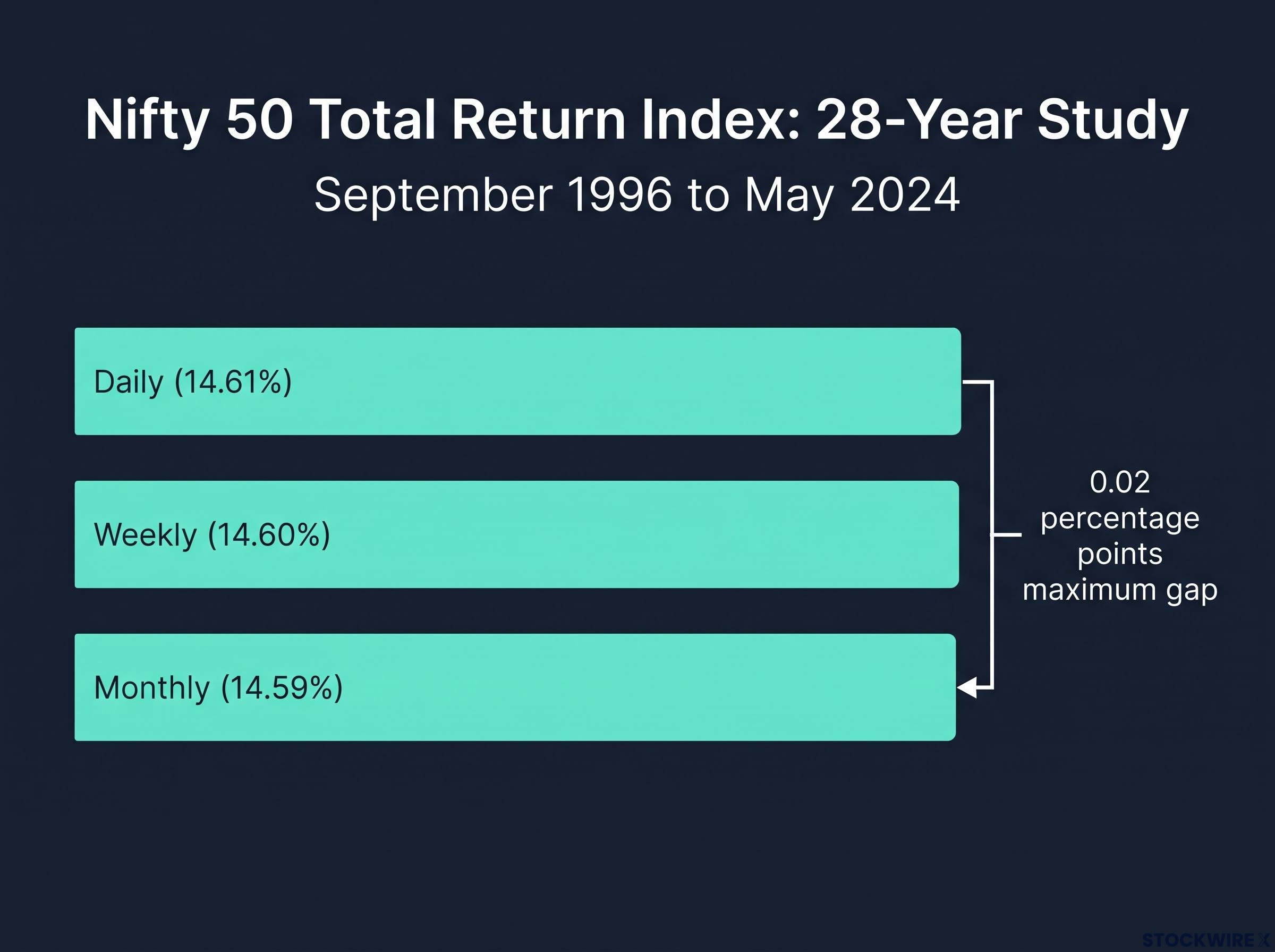
Start with the evidence that dissolves the question. A study spanning roughly 28 years, from September 1996 to May 2024, tested daily, weekly, and monthly dollar cost averaging against the Nifty 50 Total Return Index. The annualised returns landed at 14.61% for daily, 14.60% for weekly, and 14.59% for monthly.
| Contribution frequency | Annualised return | Gap vs best |
|---|---|---|
| Daily | 14.61% | 0.00 pp |
| Weekly | 14.60% | 0.01 pp |
| Monthly | 14.59% | 0.02 pp |
Read those numbers again, because the spread between the best and worst frequency across 28 years was just 0.02 percentage points per year.
What two basis points actually means Over an entire investing lifetime, the choice between daily and monthly buying moves your return by two-hundredths of a single percentage point annually. Staying invested at all, by contrast, is worth double-digit percentage points. The frequency decision is noise. The participation decision is everything.
This is not a quirk of one index. A 2020 study in the European Journal of Operational Research found that changing DCA contribution frequency has what the authors described as a non-monotonic and complex effect on risk and the risk-return trade-off. In plain terms, there is no clean rule where daily always wins or monthly always wins. The effect wobbles depending on conditions, which is another way of saying it is too small and inconsistent to build a strategy around.
So here is what that finding buys you. Every hour you were about to spend researching the optimal contribution day can be redirected toward a decision that genuinely moves your outcome, and that decision is how quickly and how automatically your money reaches the market in the first place. Hold that thought, because it is where this whole piece is heading.
When big ASX news breaks, our subscribers know first
Why brokerage costs are the one frequency variable that genuinely does matter
Frequency does not matter for returns. It matters enormously for costs, because every time you press the buy button on a fee-charging platform, you pay for the privilege.
That is the brokerage drag principle, and the maths is refreshingly simple. If your broker charges a flat fee per trade, splitting your contributions into more frequent, smaller parcels means paying that fee more often on less money each time. The fee is fixed; your buy amount shrinks; the percentage lost to brokerage climbs.
Here is what that looks like across the major Australian platforms as of 2026.
| Platform | ASX brokerage | Fee-free or low-cost note |
|---|---|---|
| CommSec | $5 up to $1,000; $10 for $1,001-$3,000; $19.95 for $3,001-$10,000 | CommSec Pocket: $2 up to $1,000, then 0.20% |
| Pearler | Flat $6.50 per trade | Reducible to $5.50 via prepay credits |
| Superhero | From $2 per trade | Low entry point for small parcels |
| Stake | $3 per ASX trade | Separate FX fee applies on US trades |
| SelfWealth | Flat $9.50 per trade | Flat regardless of trade size |
Now watch how quickly this bites. Suppose you invest $20 every day into a single ETF on a platform charging $2 a trade. Over a year you deploy roughly $7,300, but you also rack up around $730 in brokerage. That is approximately 10% of your contributions gone to fees before the market has done anything at all.
The lesson is not that daily investing is bad in principle. It is that daily investing of small amounts on a fee-charging platform is mathematically self-defeating. Your optimal frequency is not a question about markets; it is an arithmetic question about your specific broker, and the answer flips depending on which one you use.
The maths of brokerage fee compounding shows why this is not a minor inconvenience: US$3,270 in fees paid over a decade of monthly contributions compounds to approximately US$7,100 in forgone future value at 8% annual returns, a structural drag that dwarfs any frequency-related return difference.
Here is how to translate that into a decision:
- Fee-charging broker: aggregate your contributions into weekly or monthly buys so each trade carries a larger amount and the fixed fee shrinks as a percentage.
- Fee-free or near-free platform: frequency becomes genuine personal preference, so match it to your payroll cycle or whatever feels easiest to sustain.
- High-frequency small amounts: always calculate the annual brokerage cost first, because that number tells you immediately whether your schedule is quietly bleeding your returns.
What the research on lump-sum investing reveals about the real enemy: idle cash
There is a more useful way to frame the entire frequency debate, and it starts with a finding that seems, at first, to have nothing to do with regular contributions.
When an investor has a large sum of cash sitting ready, the research consistently shows that investing it all at once beats spreading it out through dollar cost averaging.
The debate over lump-sum versus DCA is older than most retail investors realise, and Vanguard’s historical research across Australian, US, and UK markets consistently finds lump-sum investing outperforms in approximately 68% of scenarios, a figure that rises further when accounting for the equity risk premium available to fully invested capital.
The lump-sum finding Vanguard’s analysis of rolling one-year periods from 1976 to 2022 found that lump-sum investing beat cost averaging 61.6% to 73.7% of the time depending on the market, with typical annualised edges of 0.42 to 2.4 percentage points. Morgan Stanley’s study of over 1,000 overlapping seven-year periods showed lump-sum advantages in more than 56% of cases.
The reason is straightforward: markets rise more often than they fall, so capital that is fully invested earlier captures more of that upward drift and the equity risk premium, the extra return investors earn for holding shares over cash. Money that sits on the sidelines earns none of it.
Picture $100,000 invested immediately, earning 2% in the first month. That produces $2,000 in gains that then keep compounding for the rest of the horizon. Under a 12-month DCA schedule, only a fraction of that capital is in the market during those early months, so most of it earns nothing while it waits.
This is not an argument to abandon dollar cost averaging. For a salaried investor, DCA is not a choice you make; it is the natural result of being paid in instalments. The lump-sum finding is really a finding about cash drag, the cost of holding money out of the market, and that is the point that reframes everything.
How this changes the calculation for salaried investors
You do not receive your income as a windfall. You receive it fortnightly or monthly, in pieces. That gradual arrival is exactly why the lump-sum logic reinforces automating your salary contributions rather than stockpiling cash to invest manually later.
Each paycheck is the closest thing you have to a lump sum. Deployed immediately, it starts earning the equity risk premium at once. Left sitting in a transaction account while you wait for the right moment, it does nothing but forgo compounding.
The Australian investor Etschmann built a portfolio from $1,000 to millionaire status over roughly a decade using precisely this structure: money moved automatically to her brokerage the moment it arrived, then auto-bought shares once the balance hit a set threshold. The automation section develops how that works, but the principle is already clear. The enemy is not your schedule. The enemy is the gap between money landing and money working.
Why automation is the behavioural infrastructure that makes all of this work
Understanding the research is one thing. The reason it so often fails to translate into wealth is that the deployment decision depends on human willpower, and willpower is not a strategy.
Automation removes that dependency, and it does so by countering two well-documented psychological forces. Dr Dutta of UNSW BusinessThink and Professor Slonim of the University of Sydney explain that people are wired for present bias, valuing immediate rewards over delayed ones, so saving feels like a genuine loss to the “present self.” The second force is status-quo inertia, where the effort of actively choosing to invest each pay cycle means the decision quietly never gets made.
The cost of leaving these forces unchecked is measurable. 2024 research by Hendry found that present-biased households are approximately 11 percentage points less likely to hold even one month of income in liquid assets.
The behavioural barriers to staying invested extend well beyond present bias and status-quo inertia: around 30.9% of investors who panic-sold during a major market downturn never re-entered equities, permanently forfeiting recovery gains that an automated contribution schedule would have captured throughout the decline.
Automation counters four distinct barriers at once:
- Present bias: it reframes investing as a non-negotiable bill deducted before you feel the money, not a sacrifice made in the moment.
- Status-quo inertia: it makes investing the default, so inaction now works in your favour rather than against it.
- Financial fragility: pre-committing funds builds the buffer that willpower alone tends to erode.
- Willpower dependency: it removes the need to make the right decision repeatedly, which is where most plans quietly break.
Australia already runs the largest proof of this concept in the world. Compulsory superannuation is behavioural insight written into policy: money is deployed automatically before anyone gets the chance to redirect it, and it has built retirement balances that voluntary saving never would have.
Setting up automation in the Australian context
Beyond compulsory super, salary sacrifice lets you automate additional pre-tax contributions, and the modelled outcomes are substantial. Super SA’s model shows “Kate” on a $90,000 salary sacrificing $22,132 annually, projected to add roughly $444,734 to her super by age 67 while saving about $7,082 in annual income tax.
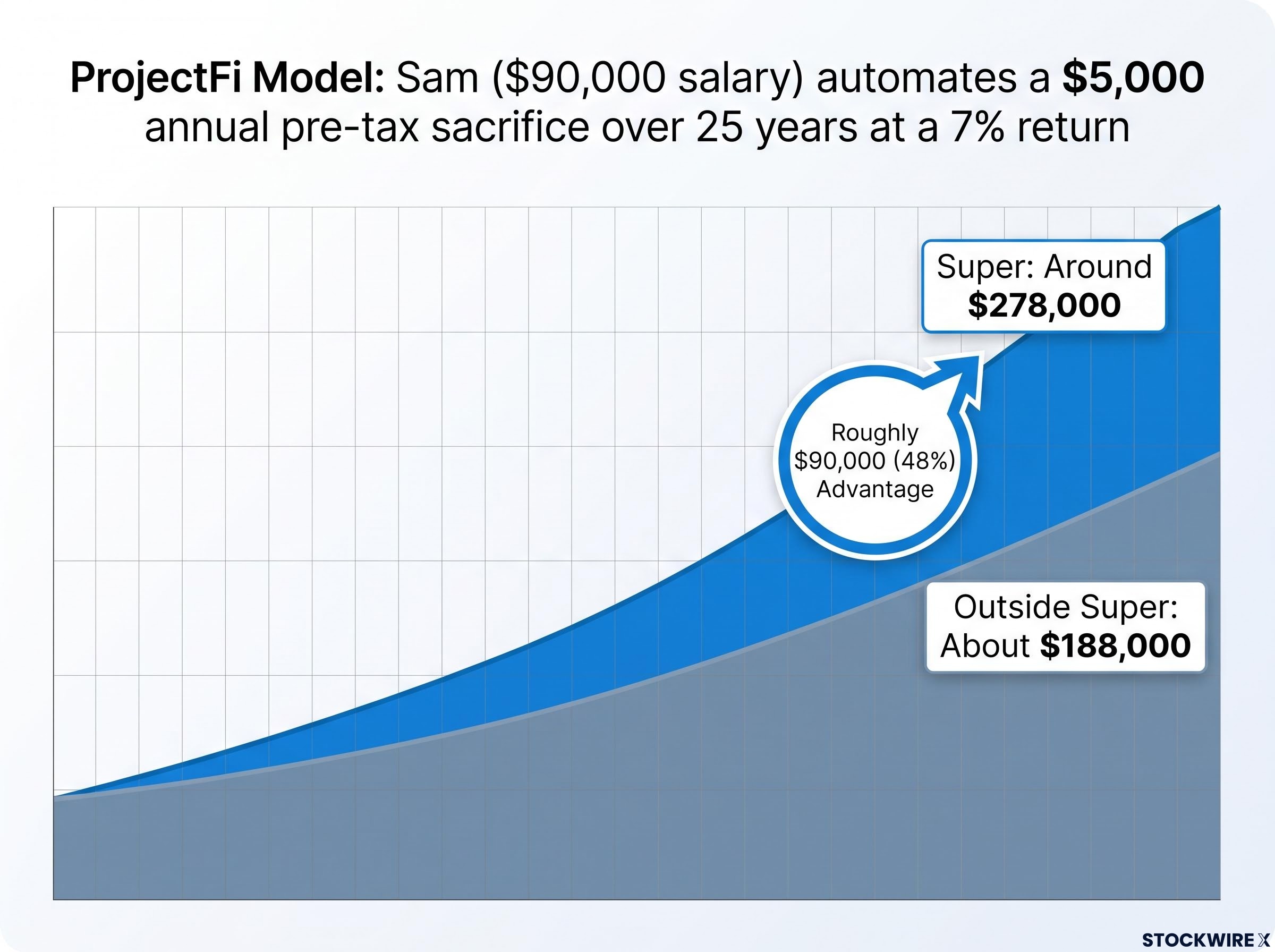
The wealth gap automation builds ProjectFi’s model shows “Sam,” also on $90,000, automating a $5,000 annual pre-tax sacrifice. Over 25 years at a 7% return, his super reaches around $278,000. The same amount invested outside super after tax reaches only about $188,000, a roughly $90,000 or 48% advantage driven by concessional tax and uninterrupted automation.
You have three practical pathways to build this infrastructure:
- Salary sacrifice into super: pre-tax and highly tax-efficient, but subject to Australian Taxation Office (ATO) contribution caps that set a firm ceiling on how much you can funnel through.
- Auto-invest on platforms like Pearler: post-tax and flexible, buying automatically once your balance hits a threshold you choose.
- Scheduled bank transfers: timed to land the day after payroll, moving money to its destination before it can become discretionary spending.
The specific mechanism matters far less than the structural principle. Move the money before it has the chance to become something you spend.
When rigid automation works against you, and how to calibrate it
Automation is powerful, but treating it as untouchable can quietly create the fragility it was meant to prevent. These are not warnings that undermine the case; they are the adjustments that keep a good habit sustainable.
The first risk is liquidity. Automated contributions that leave no accessible buffer can force you into high-interest credit card debt when an unexpected expense arrives, and that debt reverses the compounding advantage you were building.
The second consideration is temperament. For genuinely loss-averse investors, dollar cost averaging works as behavioural insurance against the regret of deploying a lump sum right before a fall. The return premium you surrender, that 0.42 to 2.4 percentage points Vanguard identified, can be a fair price for the discipline it buys you to stay invested.
The third is uniquely Australian: super lock-in. Money automated into superannuation is inaccessible until preservation age under ATO rules, so aggressive super automation can leave you asset-rich and cash-poor before retirement.
Automation is the infrastructure, not the strategy Setting and forgetting builds the habit. Reviewing it periodically against your actual cash flow and liquidity needs is what keeps it from becoming a stress mechanism.
Run through these four checkpoints before locking in any automated schedule:
- Emergency buffer: confirm you hold enough accessible cash to cover unexpected expenses without borrowing.
- High-interest debt: clear expensive debt first, because paying it down usually beats any investment return.
- Super versus accessible balance: check you are not locking away money you may need before preservation age.
- Contribution cap headroom: verify your salary sacrifice sits within ATO caps to avoid penalty.
The ATO concessional contributions cap sets the annual ceiling on pre-tax super contributions including salary sacrifice, and exceeding it triggers an excess concessional contributions tax charge on the overage, so verifying your headroom before locking in an automated sacrifice amount is a necessary regulatory step.
This article is for informational purposes only and should not be considered financial advice. Investors should conduct their own research and consult with financial professionals before making investment decisions. Past performance does not guarantee future results, and financial projections are subject to market conditions and various risk factors.
The two decisions that actually determine your long-term investment outcome
Strip away the noise and the picture is simple. The frequency of your DCA contributions is worth about 0.02 percentage points a year, so it is not a lever worth pulling. The only scheduling factor that genuinely changes your outcome is whether brokerage cost is reasonable relative to how much you invest each time.
Two decisions do the real work, and both are far more tractable than the timing question you probably arrived with:
- Deploy money as soon as it arrives. The lump-sum research, where immediate investing wins 61.6% to 73.7% of the time, is really a message about cash drag. Every day your salary sits idle is a day it forgoes the equity risk premium.
- Automate that deployment. Willpower is unreliable and present bias is relentless, so removing the decision from each pay cycle is what turns intention into a balance that compounds.
The Australian infrastructure to do both already exists: superannuation, salary sacrifice, and auto-invest platforms like Pearler. The research points clearly in one direction, and your scarcest resource is not money but attention. Spend it where it generates returns, not where it merely generates the feeling of control.
For readers wanting to see these costs in concrete dollar terms, our full explainer on the most expensive investing mistakes models how a single year of delay cuts terminal wealth by approximately $28,000, nearly eight times the contribution skipped, making inaction a more costly variable than asset selection for most portfolios.