You have felt it before, or you have watched it happen to someone else. A shattered ankle on a football oval. A fall from height on a job site. A car folded against a guardrail on a quiet stretch of road. And then, in the middle of all that noise and fear, someone reaches into a kit and produces a small green plastic tube, hands it over, and tells you to breathe.
Almost every Australian could describe that little green whistle in detail. Its shape, its colour, the way you suck on it and the pain begins to soften within a minute or two. Far fewer could name the company that makes it, and fewer still would guess it trades on the ASX. That gap between a famous product and an invisible manufacturer is not an accident. It says something real about how emergency medical devices move through our lives.
What follows is the story behind something you have almost certainly held, or seen someone else hold, made by a company you have almost certainly never heard of.
The moment almost every Australian knows, even if they have never thought about it
The green whistle does not belong to one setting. It turns up wherever Australians hurt themselves, which is to say almost everywhere.
Think about the places it lives. A paramedic pulls it from an ambulance kit. A surf lifesaver has one in the bag on the sand. A club trainer keeps one on the sideline. It sits in defence force field kits and in the drawers of hospital emergency departments. The settings confirmed in research from Medical Developments International and CSIRO include:
- Ambulance and paramedic services
- Hospital emergency departments
- Defence forces
- Surf lifesaving organisations
- Sports and community clubs
That spread matters, because it explains something about how the product became so familiar without any of us being asked to remember it.
Getting the green whistle
Australians do not call it methoxyflurane. They call it the green whistle, and the phrase “getting the green whistle” has become a casual shorthand, used the way someone might describe getting stitches or being put in a splint. A product only earns a colloquial name when it has become genuinely ordinary, part of the furniture of everyday life. Oxford University Press even profiled the “green whistle” as its Word of the Month, situating it as a distinctly Australian device that has become routine in pre-hospital and sporting settings.
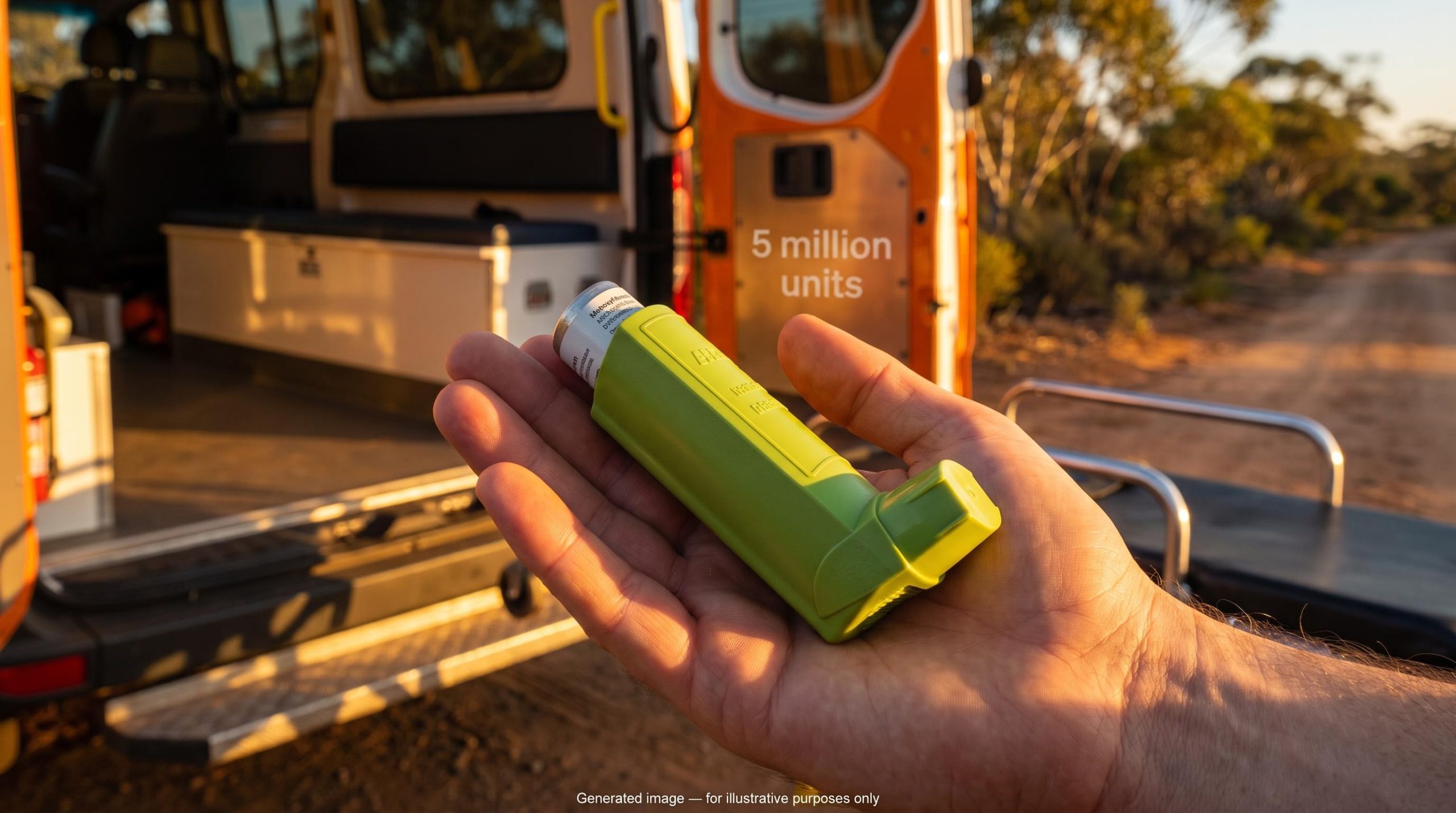
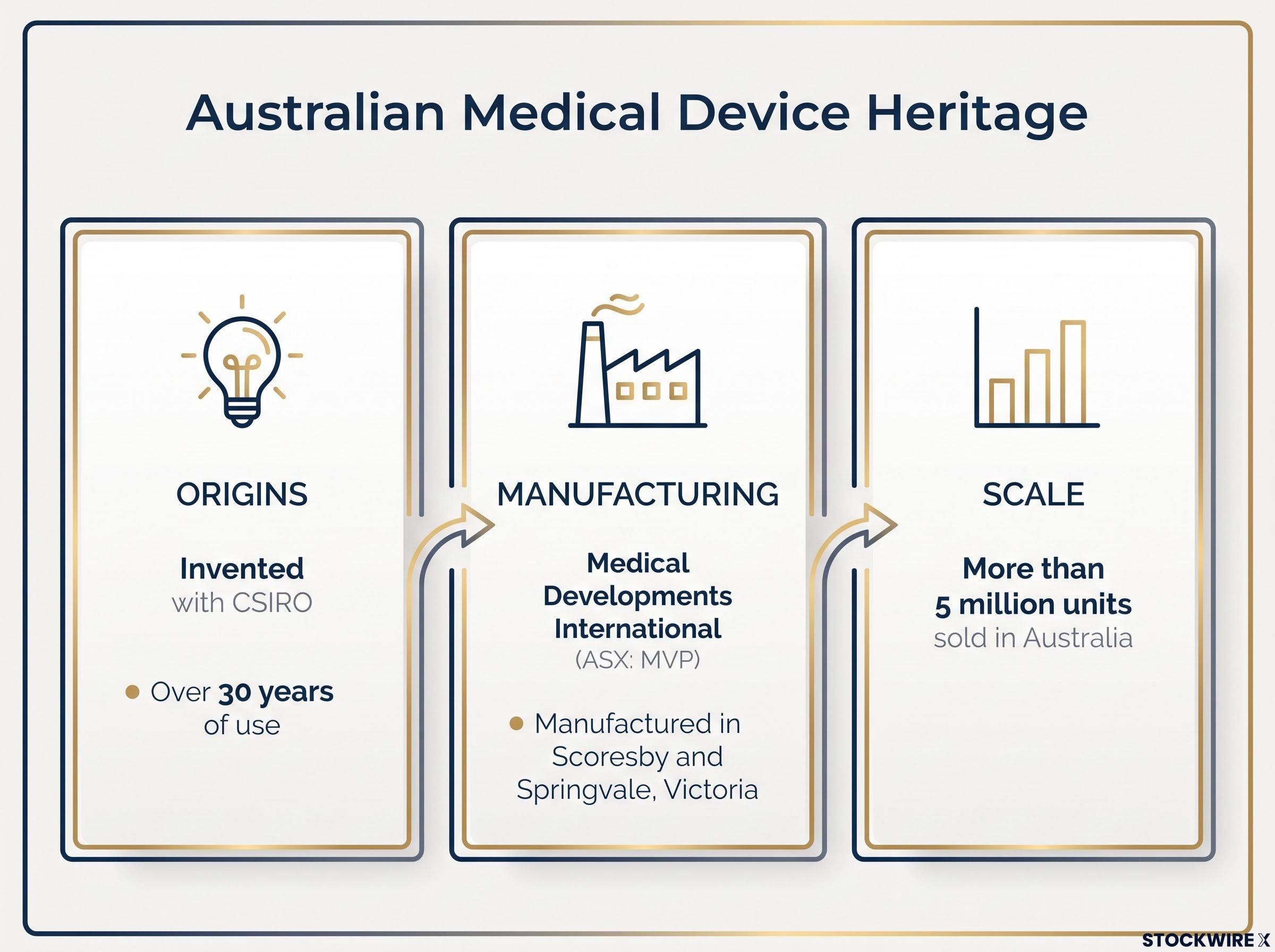
That is the kind of recognition brands spend fortunes chasing and rarely buy. This one arrived the slow way. According to figures reported by Medical Developments International, more than 5 million units have been sold in Australia, across more than 30 years of use (some accounts stretch that closer to four decades).
For you, that number is not really a sales figure. It means the green whistle has almost certainly already appeared in the life of someone you know, at one of their worst moments, even if neither of you ever learned its name.
When big ASX news breaks, our subscribers know first
What is actually inside the green whistle, and why does it work without a needle
You know what it looks like. What you may never have been told is why it is built the way it is, and why that design was harder to achieve than it sounds.
Inside is a drug called methoxyflurane, a rapid-acting, non-opioid inhaled painkiller. You breathe it in through the handheld inhaler, and it goes to work on moderate-to-severe pain within a minute or two. The whole thing comes as a 3 mL dose in one small device.
Here is what makes it practical, stripped down to the essentials:
- Non-opioid and non-narcotic
- Non-addictive
- Needle-free
- Self-titrated, meaning you control your own dose
- Portable enough for a beach, a paddock or a roadside
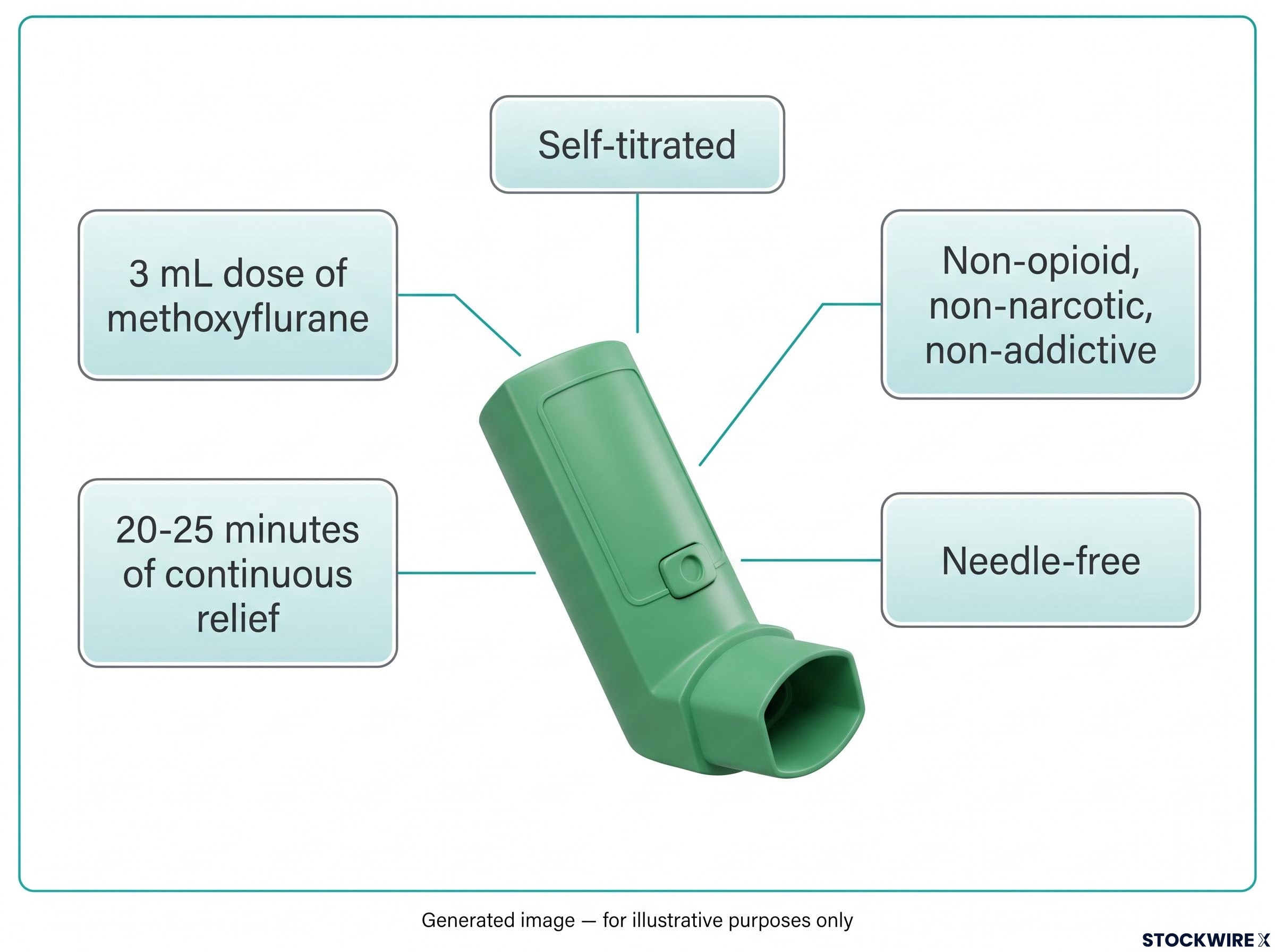
Self-titration is the quietly clever part. You breathe through the inhaler as much or as little as you need, which means you regulate your own pain relief. That matters on a chaotic trauma scene, where a single paramedic often cannot stay dedicated to one patient. One device gives 20-25 minutes of continuous relief, and you can stretch that further with intermittent inhalation.
“I use it mainly for extrication, for procedural pain, and as first-line analgesia when IV access is delayed,” an Australian paramedic on a Western Australian service explained, adding that the inhaler also helps distract patients while a line is being established.
The clinical evidence backs the everyday experience. A systematic review of inhaled low-dose methoxyflurane found that every included study reported effective and rapid analgesia for moderate-to-severe pain, alongside a good safety profile.
There are caveats, and honest ones. There are dose limits per session, and services use charcoal filters and vehicle ventilation to manage staff exposure in enclosed spaces, with occupational guidance on how often it should be used in close proximity. On the historical concern about kidney injury, one emergency physician noted that since the introduction of the 3 mL dose, methoxyflurane-related renal injury has been rare in their practice.
For you, the needle-free design is the whole story. It is the reason the green whistle can sit in a surf lifesaver’s kit on a beach rather than stay locked in a hospital drug cabinet. That portability is precisely what made nationwide familiarity possible.
Made in Victoria, invented with the CSIRO: the Australian manufacturing story behind the moment
Here is the part almost nobody knows. The company behind the green whistle is Medical Developments International, and it trades on the ASX under the ticker MVP.
It manufactures the product, sold under the name Penthrox, at its own facilities in Scoresby and Springvale in Victoria. Every unit in every ambulance kit, every surf club bag, every emergency department drawer, was made in those two suburbs.
The origins run deeper still. Penthrox was invented in Australia in collaboration with the CSIRO, our national science agency. That places it in a tradition of Australian biomedical innovation aimed at field-ready, pre-hospital solutions rather than purely hospital-bound technology. The Oxford University Press Word of the Month profile offers external cultural validation of that distinctly Australian identity, from a source with no commercial stake in it.
Why you have never heard the company’s name
If the product is this famous, why is the maker invisible? The answer is built into the moment of use.
When the green whistle comes out, every scrap of attention in the room is on the patient. Nobody at a crash site or a sideline injury stops to read the manufacturer’s name off the device. There is no natural moment to notice who made it, which is exactly how a product can achieve genuine nationwide familiarity while the company behind it stays almost entirely unknown.
There is a practical footnote worth holding onto. Because MVP is ASX-listed, its financials and regulatory progress are publicly disclosed, available to anyone who knows where to look.
There is a practical footnote worth holding onto. Because MVP is ASX-listed, its financials and regulatory progress are publicly disclosed, available to anyone who knows where to look, and ASX medtech valuation frameworks covering gross margin, revenue growth, and balance sheet health can be applied to MVP just as readily as to larger names like Cochlear.
For you, that reframes the whole thing. What you thought of as a moment of relief is also a manufacturing story: an ASX-listed Victorian company with two suburban sites has been quietly producing one of the country’s most recognised medical products for over three decades.
Beyond Australian ambulances: where the green whistle is going next
The green whistle is not a nostalgia piece resting on its Australian reputation. It is actively gaining ground in new markets, and the most striking part of that expansion is about children.
According to Medical Developments International, the product is approved for sale in 12 European markets. In the United Kingdom, its marketing authorisation was renewed on 11 November 2025, with the indication broadened to patients aged 6 years and older, per the Summary of Product Characteristics on medicines.org.uk (MA number PL 42467/0001, text revised 15 June 2026).
| Market | Regulatory status | Age range | Notes |
|---|---|---|---|
| Australia | Established | Adult use | 30+ years of documented use |
| 12 European markets | Approved | Per local approvals | Company-reported |
| United Kingdom | MA renewed Nov 2025 | 6 years and older | Indication broadened; SmPC via medicines.org.uk |
That age change carries more weight than a line in a regulatory file. For young patients, the prospect of an injection is frequently the most distressing element of any medical encounter, and a device that delivers effective pain relief without a needle removes that fear entirely.
A systematic review of inhaled methoxyflurane for acute paediatric pain concluded that distressed children are likely to find inhalers more acceptable than needles, alongside the finding that all included studies reported effective and rapid analgesia for moderate-to-severe pain.
The commercial numbers suggest the international push is more than regulatory ambition. For the full FY25 year (ended 30 June 2025), Medical Developments International reported Pain Management revenue of $26.2 million and group revenue of $39.1 million. Pain Management is driven overwhelmingly by green whistle sales.
The most recent quarter told a similar story. In Q4 FY25, reported to the ASX on 31 July 2025 via its Appendix 4C and Quarterly Activity Report, Pain Management revenue reached $7.4 million, up $1.6 million on the prior corresponding period, which the company attributed to higher pricing and volume in Australia and Europe.
One high-stakes hurdle remains unresolved. US regulatory approval has not been granted, and there is no confirmed timeline for it, so treat it as future context rather than a done deal.
US regulatory approval timelines for Australian-developed medical devices have ranged from relatively swift 510(k) clearances to multi-year processes requiring substantial clinical evidence packages, a variance that makes the absence of a confirmed US timeline for MVP’s Penthrox product a material factor rather than a minor footnote.
For you, the paediatric approval is not a footnote. It means the needle-free moment of relief Australians have known for three decades is now becoming available to injured children across the UK and EU, a quietly significant expansion of what this product does in the world.
For readers wanting to understand why US market access matters so much for ASX-listed pain management companies, our full explainer on US Medicare reimbursement for pain devices covers how CMS billing codes, RTM eligibility, and reimbursement rate structures shape commercial viability for devices seeking entry into the US$3 billion pain assessment market.
A product you have almost certainly seen, made by a company Australia has not yet met
Go back to that green plastic tube in someone’s hand. You now know what is inside it, why it works without a needle, who makes it, where it is made, and where it is heading next. That is a more complete picture of one of Australia’s most quietly significant medical products than most Australians have ever assembled.
There is a broader point tucked inside this one. Medical device makers routinely operate in near-total public obscurity even when their products become culturally familiar, because the moment of use in an emergency swallows all available attention. Medical Developments International is simply an unusually clear example of that gap.
None of this is a nudge to buy anything. It is a shift in recognition. The green whistle is genuinely Australian-invented, developed with the CSIRO, and still manufactured in suburban Victoria after more than thirty years, now reaching patients in more than a dozen countries.
The next time you see it, or hear someone mention getting the green whistle, you will know the name behind it: a Victorian company that has been present, unnoticed, at millions of Australians’ worst moments.
This article is for informational purposes only and should not be considered financial advice. Investors should conduct their own research and consult with financial professionals before making investment decisions. Past performance does not guarantee future results, and financial projections are subject to market conditions and various risk factors.
—