
There is a habit that quietly wrecks more retail options trades than any bad directional call: buying a naked long call ahead of an earnings report. You might guess the direction perfectly, watch the stock rally, and still lose money.
The reason is implied volatility. Options get expensive before a binary event, then the premium collapses the moment the announcement lands. That collapse, known as an implied volatility crush, can turn a correct directional bet into a losing position.
The statistical picture behind why most options buyers lose is stark: SEBI data covering FY22-FY24 found 93% of retail derivatives traders ended negative, with implied volatility crush, time decay, and oversizing identified as the three primary culprits across losing positions.
Intermediate and institutional traders sidestep this by using term structure to their advantage, harvesting rich front-month premium to finance a longer-term directional view. With Coinbase (COIN) options pricing sitting elevated in late September 2026, a simple long call is arguably the worst tool for the job. This guide gives you a complete framework for structuring, adjusting, and managing a defined-risk, multi-leg call crab options strategy that meaningfully lowers your cost basis heading into a major volatility event.
Deconstructing the call crab options strategy
Start with the problem the crab is built to solve. A naked long call in a volatile name like Coinbase is expensive, and most of what you pay is extrinsic value, the portion of the premium tied to time and volatility rather than actual intrinsic worth. That extrinsic value bleeds away as expiration approaches, working against you every single day.
The call crab fixes this by making other traders pay for part of your position. It pairs a standard call debit spread in the front month with a long call in a further-dated expiration cycle, so the near-term premium you sell subsidises the longer-term view you actually want to hold.
The structure has three distinct legs:
- The back-month long anchor: A single long call in a further expiration cycle. This is your core directional exposure and the leg that caps risk on the short calls above it.
- The front-month short spread body: Two short calls in the near-term expiration, sold to collect rich extrinsic value and drive down your cost.
- The front-month defining long wing: One long call at a higher strike in the same near-term cycle, which caps the upside risk created by the two short calls.
That final wing is what converts an otherwise dangerous position into a defined-risk trade. Without it, two short calls would leave you with uncapped losses if the stock rocketed higher. With it, your maximum loss is strictly limited to the net debit you paid to open the entire structure.
This is the interpretation that matters for your account. The multi-leg architecture means your worst-case outcome is known and fixed before you ever click confirm. You participate in upside volatility without exposing your trading account to the runaway losses that naked short calls can produce if your thesis is wrong.
The term structure mechanics are the engine underneath. Near-term options carry the highest implied volatility ahead of an event, so selling them captures the fastest time decay and the fattest event premium. The back-month long, sitting in a later cycle, retains its value far more durably because it does not fully embed the near-term catalyst.
Calendar spread mechanics share conceptual ground with the crab structure: near-term implied volatility on earnings-week options typically runs 1.5x to 3x higher than the next expiration out, and that differential is the same structural engine the crab harvests through its short front-month legs.
The directional bias here is neutral to bullish. You want the stock to drift higher toward your short strikes, not explode past them.
Once you grasp how the short front-month legs subsidise your long back-month view, you stop seeing complex options orders as a black box. You can apply the same logic to any high-volatility stock in your portfolio that carries a steep volatility term structure into a catalyst.
When big ASX news breaks, our subscribers know first
Building the Coinbase earnings position for Q3 2026
Theory only gets you so far. Here is how the numbers actually stacked up on a real Coinbase call crab constructed in September 2026, with Coinbase trading around $194 and 30-day at-the-money implied volatility hovering in the low-to-mid 60% range.
The setup used four legs across two expirations:
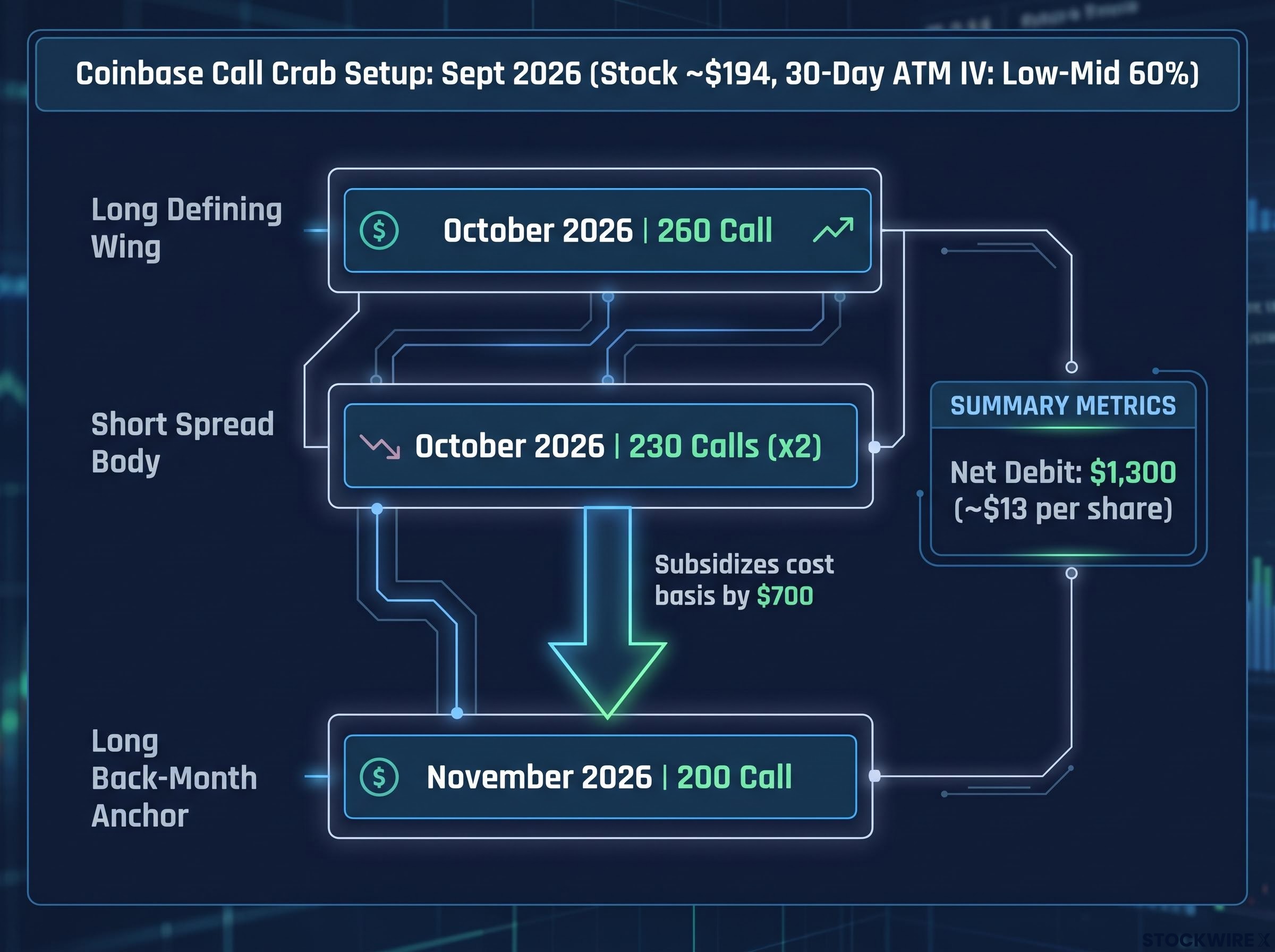
| Leg Type | Strike Price | Expiration Cycle |
|---|---|---|
| Long back-month anchor | 200 call | November 2026 |
| Two short spread body calls | 230 calls (x2) | October 2026 |
| Long defining wing | 260 call | October 2026 |
The crab component spans a 30-point spread width, from the 230 short strike to the 260 defining long. The whole structure was opened for a net debit of roughly $1,300, or about $13 per share.
The expiration staggering is deliberate, and it is the safest part of the design. Coinbase is expected to report Q3 2026 earnings on 29 October 2026 after market close, though the company has not officially confirmed the date and major calendars including MarketBeat and Wall Street Horizon list it as unconfirmed pending Coinbase’s own announcement. The short October legs are structured to be closed or expired before that binary event, so you capture their extrinsic value decay without carrying earnings-gap risk in the short calls.
Now the cost mechanics. The long November 200 call on its own contained roughly $2,000 of extrinsic value at entry. Selling the two October 230 calls and buying the single October 260 defining long reduced the overall cost basis of that November anchor by approximately $700.
The capital efficiency in one number Harvesting front-month premium cut roughly $700 off the cost basis of the back-month long call. You paid about $13 per share for the full structure instead of paying up for the naked November call outright.
That is the whole point of the trade in a single figure. Paying $13 for this defined-risk structure rather than around $20 for the naked November call shows you exactly how aggressively front-month premium can subsidise a longer-term bullish view.
The profit picture depends on how Coinbase behaves. The maximum theoretical intrinsic value of the trade sits near $3,000. A measured 15-20 point upside move evaluated at the end of September was modelled at roughly $600 in profit, without adjusting any volatility assumptions.
If the stock keeps grinding higher, a further rally of around 20 points toward the 210 level within the following week was estimated to add another $300-$400. Held to October expiration with the November call still in the money and retaining extrinsic value, the projected yield rose to roughly $1,500.
The lesson from these numbers is not the exact profit figure. It is the template: real strike selection and expiration staggering you can replicate on your own platform, on any name with a steep volatility term structure into earnings.
Three predefined adjustment pathways for defensive management
Setups look clean on paper. Live markets do not cooperate. Coinbase might decline, consolidate, or chop sideways, and the difference between a rescued trade and a panicked one is whether you mapped your adjustments before you clicked buy.
Deciding how to defend a position while it is bleeding is how traders make expensive mistakes. Having a protocol ready means you execute a plan rather than react to a screen. Here are three adjustment pathways to define before entry.
- Narrow the crab from 30 points to 20 points wide. If the stock stalls, shift the short strikes down from 230 to 220 and pull the defining long down from 260 to 240. Because you paid only $13 against a 30-point spread, a tighter 20-point restructuring still leaves room for a positive maximum profit scenario while repositioning the trade closer to where the stock actually sits.
- Replace the crab component with a diagonal spread. You can remove the October crab entirely and swap it for a 10-, 15-, or 20-point wide diagonal spread. A 15-point wide diagonal was cited as achievable while still maintaining a positive maximum profit relative to the debit paid, giving you a cleaner directional structure if the multi-leg body stops working.
- Roll the short options further out in time. Pushing your short strikes into a later week captures additional premium and drives the net debit down further. The time value available is real: a 35-day 220-strike short option was quoted near $7.00, while the 42-day equivalent sat at roughly $10.00. That $3.00 difference for a single extra week shows how much premium sits in the calendar.
Collecting an extra $3 or so through a roll or adjustment could take your net debit from $13 down toward $10 or below. Every dollar shaved off the debit lowers your break-even and your maximum loss.
This is where long-term profitability actually gets built. Knowing how to manipulate your strikes after the trade goes live hands you multiple avenues to salvage a losing position or scratch the trade at break-even, rather than watching it drift to maximum loss.
Having these three moves mapped before entry means you are following a mathematical protocol, not clicking sell in a panic when the position turns against you.
Pricing the dual threat of crypto volatility and implied volatility crush
Every adjustment above assumes ordinary conditions. Coinbase does not always trade under ordinary conditions, and that is the risk you must respect most.
Coinbase carries a dual identity. It is a technology company reporting real earnings, and it is a direct proxy for the crypto market, with revenue and profit tightly correlated to Bitcoin prices and trading volume. Its options price in broad cryptocurrency swings alongside company fundamentals. According to BeinOptions, typical implied volatility for the stock ranges from 65% to 120%, with spikes above 150% during crypto booms, a baseline volatility regime that is structurally high even outside earnings.
The earnings behaviour compounds this. Across all 22 post-IPO reports since the April 2021 direct listing, the average peak earnings-day move has been 11.1%, according to Earnings-Watcher data updated in September 2026. Options markets have repeatedly underpriced this, with actual moves exceeding the implied move in roughly 41% of reports.
Post-earnings volatility crush on high-profile stocks like Nvidia has repeatedly punished short-dated call buyers even when results beat estimates, with the stock ending the following week lower in seven of the last eight quarters and an implied move of 6.5% set against a historical actual swing of 7.4-7.6%, confirming that options markets systematically underestimate realised moves.
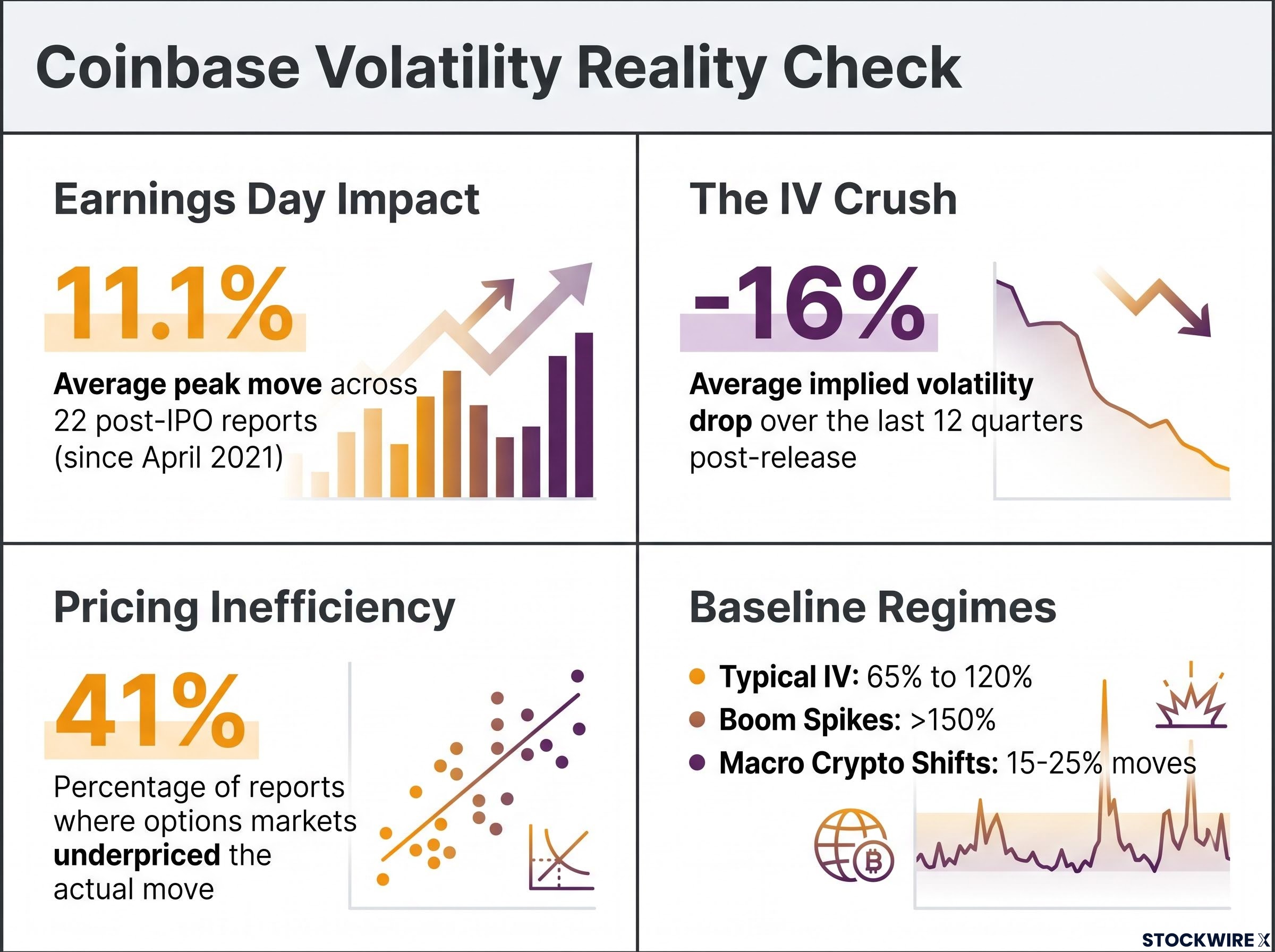
Then comes the crush. Implied volatility has fallen by approximately 16% on average across the last twelve quarters following the release, per Moomoo analysis. That collapse is precisely why a naked long call so often loses even when direction is right, and precisely why the crab is engineered to harvest that premium through its short legs instead of being victimised by it.
Here is the interpretation you cannot skip. Because Coinbase can move 15-25% on macro crypto shifts alone, according to ApexVol, you must size this trade to survive an adverse gap regardless of how well the spread is structured. A beautiful position on paper still hits maximum loss fast if Bitcoin swings hard against you overnight.
Contextualising the math within the reality of the crypto market keeps you from being blindsided by exogenous volatility that standard options pricing models frequently fail to anticipate.
Managing early assignment and position sizing
Coinbase options are American-style, which means any short in-the-money leg can be assigned early, particularly deep in the money or as expiration approaches. In a call crab, that risk lives in your short October legs. Assignment on one leg while another remains open can leave you with unintended exposure, so these structures demand active monitoring and a plan for what you do if assignment happens.
Position sizing is the final discipline. Standard risk-management guidance from educators including Tom Sosnoff recommends limiting defined-risk options trades to 1-3% of total account equity per position, and for a crypto-adjacent name carrying correlated portfolio risk, sizing toward the lower end is prudent. If you already hold Bitcoin or Ethereum proxy exposure elsewhere, size this trade smaller still.
FINRA guidance on retail options account approval establishes that brokers must assess your experience, financial situation, and risk tolerance before permitting access to multi-leg options strategies, which means complex structures like the call crab may require a higher approval tier than a basic long call.
This article is for informational purposes only and should not be considered financial advice. Investors should conduct their own research and consult with financial professionals before making investment decisions. Past performance does not guarantee future results, and financial projections are subject to market conditions and various risk factors.
Executing complex term structure trades with discipline
The core advantage of this strategy is straightforward once you have seen it work. You cap your risk at the net debit paid while manipulating time and volatility to lower the overall cost of a longer-term bullish view, turning the implied volatility crush that punishes naked call buyers into a source of premium instead.
None of that edge survives poor execution. The success of complex options structures rests entirely on predefined exit plans and strict adherence to position sizing. The mathematics are only as reliable as your willingness to follow the adjustment protocols before emotion takes over.
Your next step is practical. Review your upcoming earnings calendar and look for candidates with steep volatility term structures, names where near-term implied volatility sits far above later cycles into a catalyst. Those are the setups where harvesting front-month premium to finance a back-month directional view does its best work, and where the discipline you build here pays off.
Theta decay as a structural edge appears in credit spreads just as it does in the crab’s short front-month legs: a bull put spread placed at a 15-delta short strike encodes roughly an 85% probability of profit at entry, illustrating how defined-risk structures turn time into an ally rather than a liability.