Most people picture the same thing when they hear “Bitcoin in a retirement account”: buying a coin, watching it swing, and hoping it climbs by the time they retire. That picture is now out of date.
By late 2026, Canadian investors can hold engineered exchange-traded funds that wrap options strategies and leverage around Bitcoin proxies, producing risk and reward profiles that look almost nothing like simply owning the asset. A Bitcoin RRSP allocation in Canada no longer has to mean spot exposure at all.
What follows here is a working framework for evaluating how these derivative-based funds actually operate, so you can decide whether their income and growth mechanics have any place in your own retirement plan.
Regulatory reality and the tax-sheltered strategy
The first question most investors ask is whether the Canada Revenue Agency (CRA) even allows this. The answer is more straightforward than the products themselves.
Canadian-listed funds structured as mutual fund trusts or corporations, and listed on a recognised exchange, are treated as qualified investments for registered plans. That means they are eligible for your RRSP, TFSA, RRIF, RESP, and FHSA in the same way any conventional ETF would be.
Here is the part that matters most: the CRA focuses on the legal form and listing status of the security, not on what the fund holds underneath. A fund built on Bitcoin, leverage, and daily options is judged by its wrapper, not its contents.
That distinction is your green light. Funds listed on the TSX and Cboe Canada, the two exchanges where the products in this guide trade, clear the eligibility bar regardless of how exotic their internal strategy is.
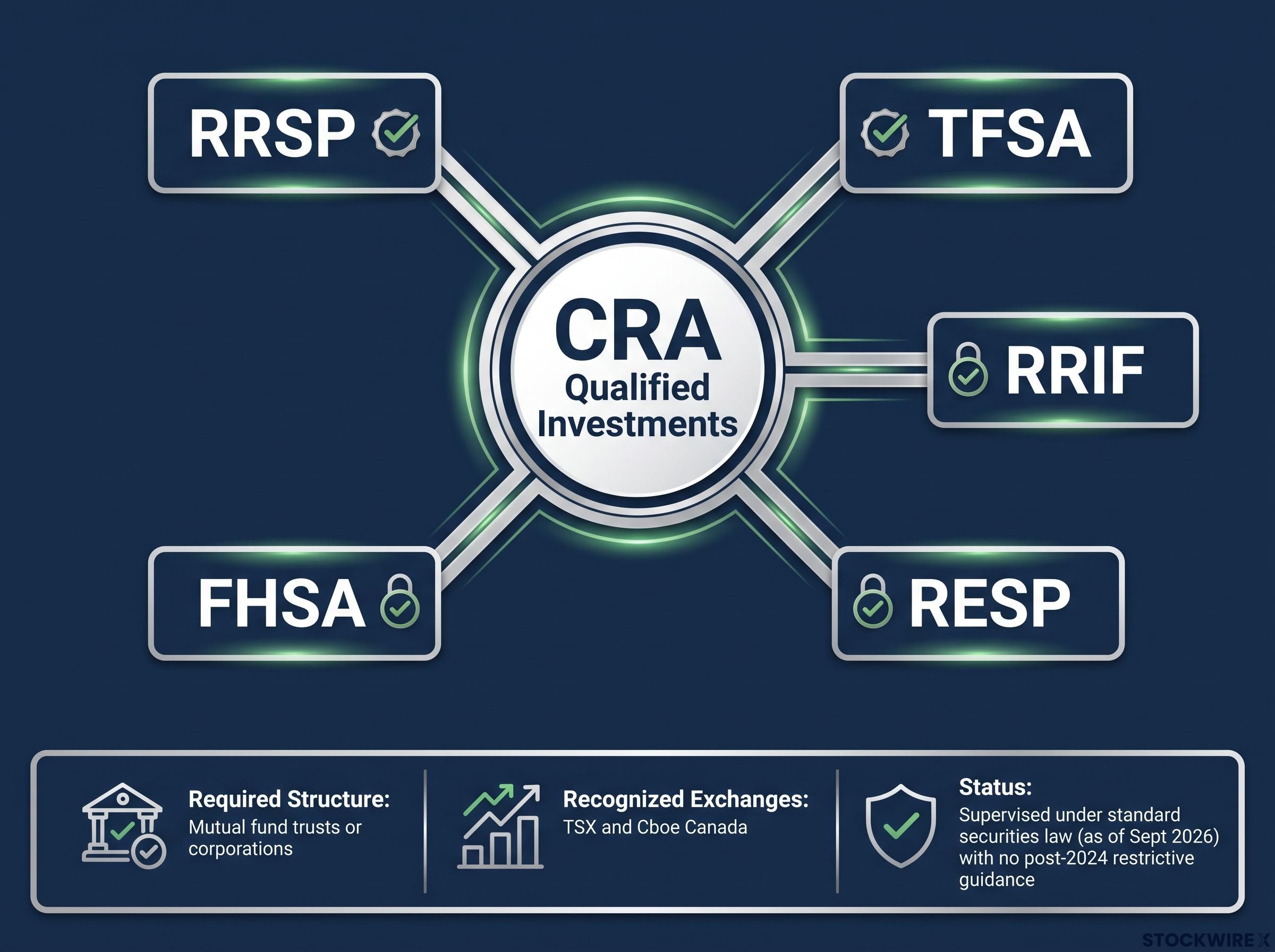
There has also been no tightening of the rules. No post-2024 guidance from the CRA specifically restricts crypto ETFs inside registered accounts, and the Canadian Securities Administrators (CSA) have not carved these out as a separate product category. The existing framework, which supervises these funds under standard securities law with enhanced risk disclosure requirements, remained in effect as of September 2026.
So why bother sheltering them at all? Because these are high-turnover, derivative-heavy funds. They throw off continuous distribution income, they realise gains through constant rebalancing, and they write options that generate ordinary income rather than clean capital gains.
Held in a taxable account, all of that activity would be taxed as it happens. Held inside an RRSP or TFSA, the distributions and internal churn are sheltered, which is precisely why conviction-driven investors are drawn to registered accounts for these strategies.
Covered call ETF tax treatment in Canada splits a single distribution into up to five separate categories on the T3 slip, each taxed at a different rate, which is precisely why sheltering these funds inside an RRSP or TFSA produces such a meaningful advantage over holding them in a taxable account.
There is one boundary you cannot cross, however.
The shelter has a limit A registered account protects you from tax on income and gains. It does nothing to protect you from the underlying market loss. A leveraged Bitcoin position can still fall hard inside an RRSP, and the tax shelter will not soften the blow.
Understand the wrapper, select correctly listed products, and you can legally shelter the income. What you allocate, and how much, is a separate decision entirely.
When big ASX news breaks, our subscribers know first
Capturing the overnight premium with BDAY mechanics
The Hamilton Enhanced Bitcoin DayMAX ETF, ticker BDAY, is built around a genuinely unusual idea: capture income during the trading day, but keep full exposure alive for the hours when Bitcoin tends to move most.
Start with the base. BDAY holds IBIT, the iShares Bitcoin Trust ETF, as its primary exposure, giving it roughly full participation in Bitcoin’s price. On top of that, it applies a modest 25% leverage, and the leveraged portion is used to buy QQQM, a Nasdaq-100 tracker.
The income engine sits in the options. BDAY writes zero-DTE options daily on QQQM. Zero-DTE means zero days to expiration: the options are opened and expire within the same trading session, then reset the next day.
That daily cycle is the whole point. Selling ultra-short-term options monetises intraday volatility, turning the market’s daytime churn into premium income that flows back to the fund.
Zero-DTE mechanics generate income by monetising intraday volatility, but the same dealer hedging flows that make premium collection possible also create outsized price pinning and amplification effects that can affect the QQQM exposure sitting inside BDAY’s structure.
The trade-off is a cap. While those options are live during regular trading hours, upside above the strike price plus the premium collected is surrendered. If Bitcoin spikes at 11am, the fund does not fully capture it.
Once the options expire at day-end, the cap disappears. The fund holds unencumbered exposure overnight, on weekends, and through holidays.
This is where the design becomes clever for this specific asset. Digital assets often make their biggest directional moves while traditional markets are closed. By capping some daytime upside for income while keeping exposure uncapped after hours, you are effectively selling the quiet hours to stay fully invested during the hours the asset actually tends to run.
Here are the three trade-offs to weigh against a straightforward leveraged spot fund:
- Income versus pure upside. A plain 1.5x or 2x Bitcoin ETF chases price amplification and pays little income. BDAY sacrifices some upside during trading hours to generate regular distributions.
- Intraday cap versus overnight freedom. BDAY’s options cap intraday spikes above the strike, but the fund retains full participation in overnight and weekend moves once those options expire.
- Path dependency. All leveraged and option-overlaid funds are path-dependent, meaning the sequence of daily moves affects returns, not just the start and end price. BDAY’s daily writing adds a further layer, so it will not cleanly track a 1.25x spot Bitcoin chart.
For context, BDAY carries a management fee of 0.85%, held $21.8M CAD in assets as of 31 August 2026, and launched on 24 June 2026. It is an early-stage fund, so published long-term performance is not yet available.
The takeaway is about expectations. Understanding the path dependency of daily options tells you not to expect a tidy leveraged price chart. You are buying an income strategy with a directional core, not a leveraged tracker.
Evaluating MSTE and the MicroStrategy proxy risk
If BDAY is about clever timing, MSTE is about a very different bet: exposure to Bitcoin through a company rather than the coin itself.
Harvest Portfolios Group builds the MSTE fund, formally the Harvest Strategy Inc. Enhanced High Income Shares ETF, by holding MicroStrategy shares with a covered call overlay and modest internal leverage. A covered call is an options contract sold against a stock you own, generating income in exchange for capping upside. There is no spot Bitcoin inside the fund at all; the exposure is entirely a corporate proxy.
That structure has attracted serious money. MSTE’s assets grew rapidly through 2025 and 2026, surpassing $400M CAD, reaching $438.79M CAD by 11 September 2026, up from roughly $281M CAD at the end of 2025.
What makes the fund so magnetic is the yield. As of early September 2026, MSTE reported a trailing 12-month distribution yield of 104.60%.
Now hold that figure next to the price. Over the same period, MSTE’s year-to-date price performance was negative 31.62%.
That gap is the entire story. The eye-watering yield is not free money. It is a deliberate conversion of MicroStrategy’s extreme volatility into cash flow, and that cash comes partly at the expense of your invested capital when the underlying falls.
| Ticker | Issuer | Underlying asset | Options strategy | Target leverage |
|---|---|---|---|---|
| BDAY | Hamilton ETFs | Bitcoin (via IBIT) | Zero-DTE options on QQQM | 25% |
| MSTE | Harvest Portfolios Group | MicroStrategy (indirect Bitcoin) | Covered calls on MSTR | Modest internal leverage |
The two funds share a Bitcoin thesis and almost nothing else. One tracks the asset directly with a timing overlay; the other tracks a leveraged corporate holder of the asset and converts its swings into income. Your risk exposure is fundamentally different depending on which you choose.
Managing high-distribution cash flows
A yield above 100% creates a problem most investors never anticipate: what to do with all that cash.
Inside your registered account, those distributions land as cash. If you leave them sitting there, your target allocation quietly erodes, because the units that generated the cash may be falling in price at the same time.
This is the mechanical trap of covered call strategies in a down market. The fund pays you generously while the underlying capital depreciates, and unless you manually reinvest those distributions, you end up holding a shrinking position propped up by a stream of cash you never redeployed.
Covered call strategies in a down market expose the structural asymmetry that high yields obscure: Canadian data from 2022 shows leveraged covered call funds fell 18-31% while their benchmarks declined far less, a pattern that mirrors the MSTE dynamic where distributions continue while unit price erodes.
Reinvesting is not optional if your goal is maintaining exposure. To keep the speculative sleeve at its intended size, you have to actively put the cash back to work rather than treating the yield as a payout to spend.
Sizing your speculative sleeve for retirement resilience
None of these mechanics matter if the position is too big. This is where excitement about fund features has to give way to cold arithmetic.
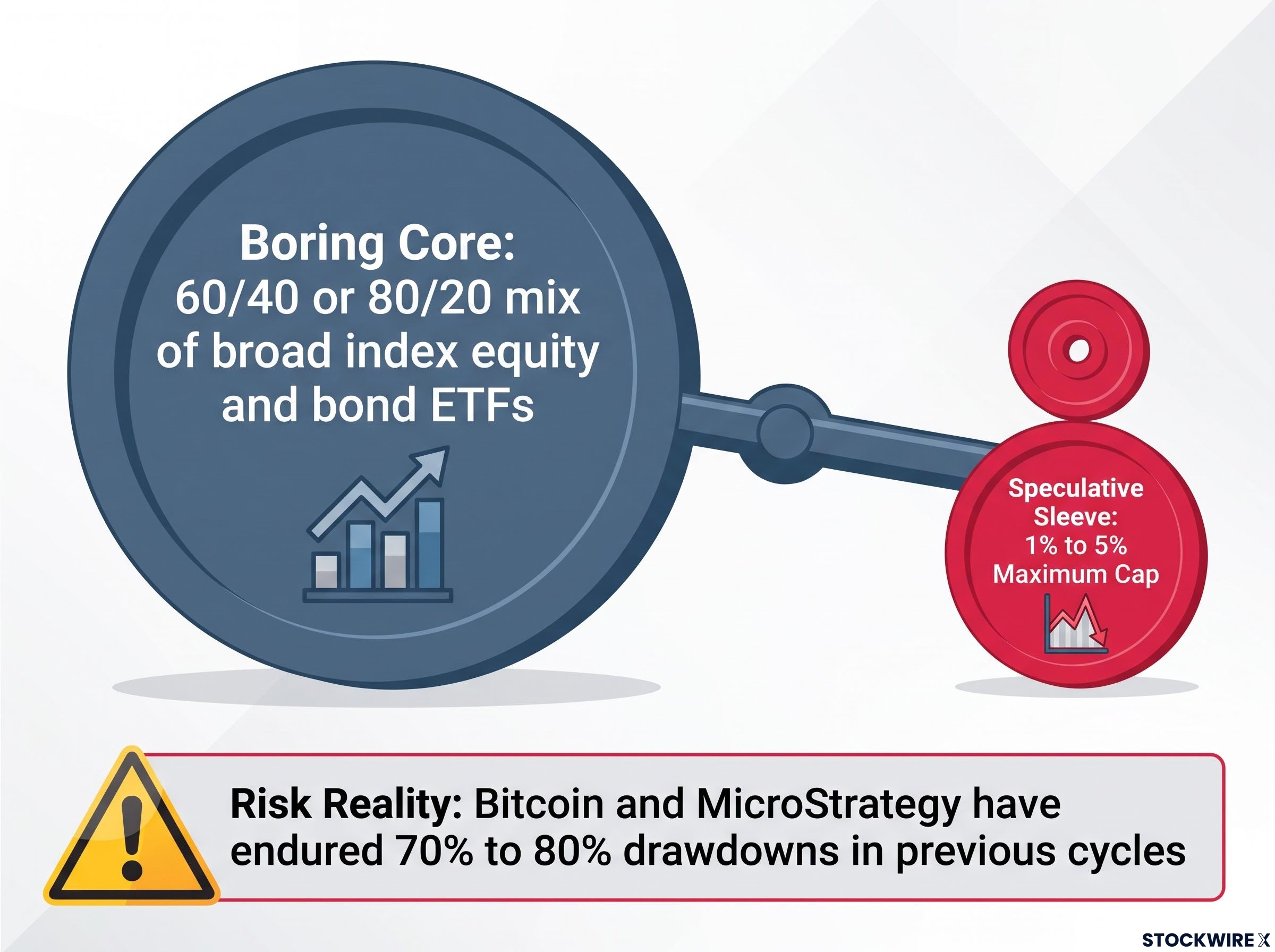
The consensus among Canadian financial planners is remarkably consistent. Across MoneySense, Morningstar Canada, CFA charterholders, and FP Canada planners, commentary spanning roughly 2021 to 2026 has repeatedly framed crypto and crypto-adjacent ETFs as speculative satellite holdings, with total allocations of 1% to 5% of portfolio value at most.
There is a hard reason for that ceiling. Both Bitcoin and MicroStrategy have endured drawdowns of 70% to 80% in previous cycles. Add leverage and daily options to assets that already fall that far, and the potential for damage inside a retirement account is real.
The structure most investors settle on is a barbell: a large, boring core paired with a small, high-risk tip. The core is broad index equity and bond ETFs, often a 60/40 or 80/20 mix. The speculative sleeve is a tightly capped slice, mentally written off as high-risk, where gains are welcome but severe volatility is expected and accepted.
The discipline is as much emotional as mathematical. Investors who kept crypto exposure under roughly 5% consistently report handling drawdowns better than those who went bigger, and many who oversized their positions later cut them after underestimating the stress of watching a retirement balance swing wildly.
Here is how to integrate a speculative sleeve without endangering the rest:
- Build the core first. Anchor the portfolio in diversified index ETFs at your chosen 60/40 or 80/20 weighting before adding anything speculative.
- Set a hard cap. Decide on a total speculative allocation of 1% to 5% and treat it as a rule, not a suggestion.
- Split the sleeve deliberately. If using multiple products, weight them within the cap, for example a small BDAY position alongside an even smaller MSTE holding.
- Size for total loss. Cap the allocation at a level where a complete wipeout would not move your retirement date.
- Rebalance and reinvest. Trim back to target when the sleeve runs up, and reinvest distributions to hold the position steady.
Your RRSP protects you from tax. It cannot protect you from a devastating loss. The strict sizing rule exists to protect you from your own behaviour, so a speculative thesis never threatens the core financial security the account was built to provide.
For investors wanting a complete framework for structuring the core portfolio before adding any speculative sleeve, our dedicated guide to the retirement bucket strategy walks through how to size and manage all three buckets across a 30-year retirement, including how to sequence withdrawals without selling equities at a loss.
Establishing your framework for complex alternative allocations
Three distinct approaches now sit under the same “Bitcoin exposure” banner, and they are not interchangeable. Straight spot exposure tracks the asset directly. BDAY layers a zero-DTE income strategy over that exposure while preserving overnight upside. MSTE abandons spot entirely for a covered call proxy on MicroStrategy, converting volatility into cash flow at real cost to capital.
The regulatory path is clear: these funds are fully permitted inside your RRSP, TFSA, and FHSA. The responsibility for surviving their volatility rests entirely on how you build the portfolio around them.
So the decision is yours to make honestly. Does the income these complex wrappers generate justify the added path dependency and capital risk, or would simpler spot exposure serve your retirement thesis better?
This article is for informational purposes only and should not be considered financial advice. Investors should conduct their own research and consult with financial professionals before making investment decisions. Past performance does not guarantee future results, and financial projections are subject to market conditions and various risk factors.