In the seven trading days after the August 2026 reporting season closed, nine ASX directors reached into their own pockets to buy shares in companies whose prices had just tumbled. In the same window, one executive chair sold 5 million shares and walked away with roughly $41 million.
That split is the reason director transaction disclosures are worth reading at all. The buyers were putting personal capital at risk against falling prices; the seller was crystallising a fortune after a spectacular run. Both are legal, both are disclosed, and both tell you something, but not the same thing.
Here is a structured way to interpret what these specific transactions are signalling, and just as importantly, what they are not. By the time you finish, you will know which of these signals carry genuine weight and which need more scrutiny before you act on them.
Where nine directors put their own money after results season
The August 2026 reporting season produced unusually clean conditions for reading insider activity. Blackout periods, the windows when directors are barred from trading before results, lifted across multiple companies at once, releasing a tight cluster of purchases in late August and early September. Three buying events stand out, and the contrast between them is the whole story.
Start with Ansell. On 31 August 2026, roughly a week after the company posted a 14.56% result-day gain to a five-year high, two non-executive directors bought in. Jonas Samuelson paid $39.84 a share for a $149,400 stake, his first purchase since joining the board. Debra Goodin spent $100,515 at $40.96. Both bought near the top of the 52-week range, and by the 4 September close the stock sat at $42.26. These directors bought into confirmed strength, after the good news was already in the price.
Now the other side. At IPH Limited, shares fell 11% on result day and a further 5.7% afterward. On 1 September 2026, three directors stepped in. CEO Anthony O’Malley bought $99,882 worth at $3.33, his first transaction since taking the top job in July 2026. Katharine Mason spent $66,001 at $3.32, and Peter Warne committed $48,345 at $3.33.
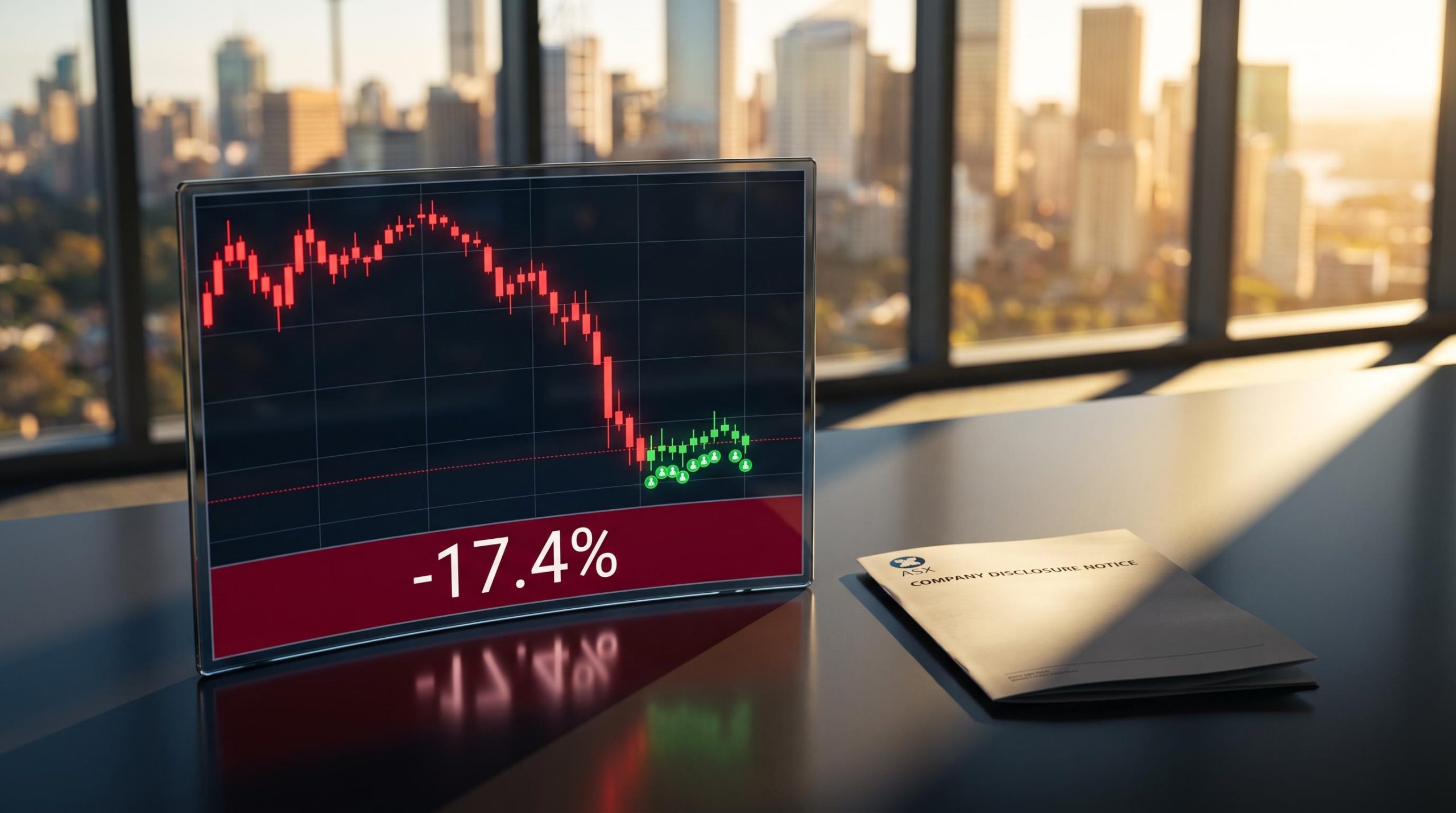
Pexa Group was the sharpest fall of all.
Pexa shares dropped 17.4% on result day (28 August 2026), closing within a few cents of the stock’s 52-week low.
Four directors bought into that weakness within two trading days. Mark Joiner paid $6.87 for a $103,050 stake, Melanie Willis spent $100,078 at $7.28, Janelle Hopkins added $29,000 at $7.25, and Jeffrey Smith committed $75,643 at $7.17.
| Director | Company | Date | Price Paid | Total Outlay |
|---|---|---|---|---|
| Jonas Samuelson | Ansell | 31 Aug 2026 | $39.84 | $149,400 |
| Debra Goodin | Ansell | 31 Aug 2026 | $40.96 | $100,515 |
| Anthony O’Malley | IPH | 1 Sep 2026 | $3.33 | $99,882 |
| Katharine Mason | IPH | 1 Sep 2026 | $3.32 | $66,001 |
| Peter Warne | IPH | 1 Sep 2026 | $3.33 | $48,345 |
| Mark Joiner | Pexa | 31 Aug 2026 | $6.87 | $103,050 |
| Melanie Willis | Pexa | 31 Aug 2026 | $7.28 | $100,078 |
| Jeffrey Smith | Pexa | 1 Sep 2026 | $7.17 | $75,643 |
The distinction that matters for you is the market context at the moment of purchase. The IPH and Pexa directors bought into double-digit single-day falls, taking on visible downside risk with their own money. That is the condition under which insider purchases carry the most signal weight, because the buyer only wins if their read of an overdone sell-off proves correct.
When big ASX news breaks, our subscribers know first
What the Genesis Minerals sale actually signals (and what it does not)
$41 million. 5 million shares. That is the headline from Genesis Minerals, and it looks, at first glance, like an insider heading for the exit.
The detail dismantles that reading. Executive Chair Raleigh Finlayson sold 5 million shares at $8.27 on 2 September 2026, generating proceeds of roughly $41.35 million, through MSH Group Pty Ltd, a family entity he directs and part-owns. He publicly stated he has no plans for further sales in the medium term.
Appendix 3Y disclosures are the raw material every assessment begins with, lodged within five business days of any securities transaction, but the filing itself only tells you what happened, not what it means for the company’s actual trajectory.
The scale of what he kept matters more than what he sold. Finlayson retained 32,097,917 shares, meaning the sale represented under 15% of his total holding. This is a founder trimming a minority slice, not a founder walking away.
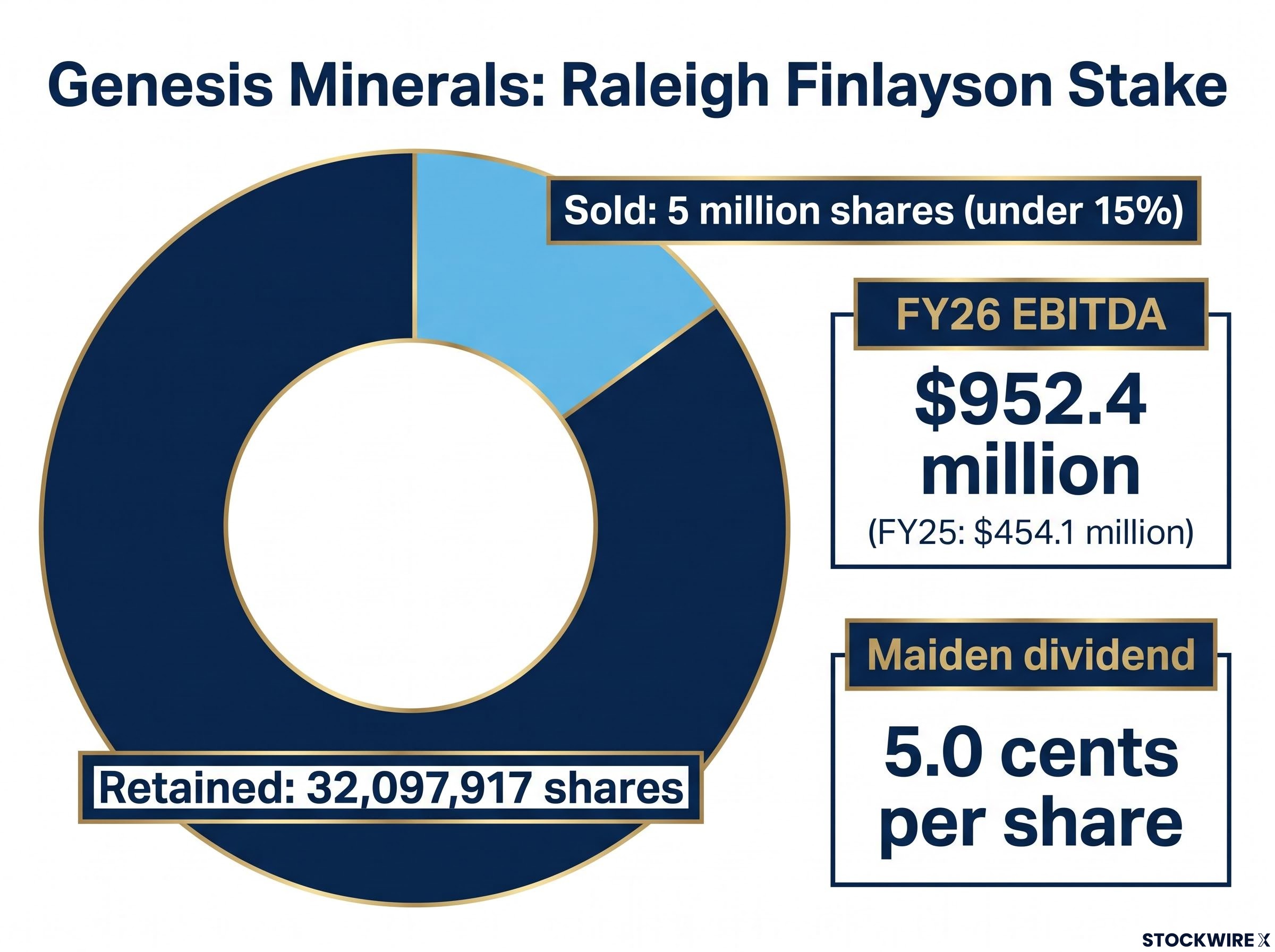
Then there is the backdrop. The sale followed a company-record FY26 result: EBITDA of $952.4 million, more than double the $454.1 million posted in FY25, alongside a maiden fully franked dividend of 5.0 cents per share with a record date of 10 September 2026. According to Perplexity research that is flagged as unverified, the shares had appreciated roughly 130% since August 2025. Nothing here resembles a retreat from conviction.
Why large sales by founders rarely mean what they look like
A genuinely bearish insider sale usually looks different: it sits close to negative news, it exits most or all of a position, and it comes with no commitment to keep holding. Finlayson’s sale fails every one of those tests. The common non-bearish motivations for large disposals are these:
- Wealth diversification: reducing exposure to a single stock that has come to dominate a personal balance sheet.
- Estate and intergenerational planning: arranging the transfer of assets across a family, often through trusts and related entities.
- Tax crystallisation: realising gains or funding upcoming tax obligations in an orderly way.
- Liquidity needs: freeing cash for property, other business ventures, or philanthropy, entirely separate from any view on the company.
Australian fund managers typically discount even sizeable insider selling unless it coincides with company-specific bad news. Selling under 15% of a founder-level stake after a 130% run and a record earnings result is routine wealth management. You should weight it accordingly, which is to say, lightly.
How to read insider signals without overfitting them
The instinct to treat every insider sale as a warning and every purchase as a green light is exactly what leads investors astray. What you need is not a checklist but a habit of assessment you can reuse on any future disclosure.
Begin with the asymmetry principle.
Insider buys are cleaner signals than insider sells. A director who buys with personal cash only profits if the shares hold or rise, so the purchase is a one-directional bet on value. Sells carry many motivations unrelated to the company’s outlook.
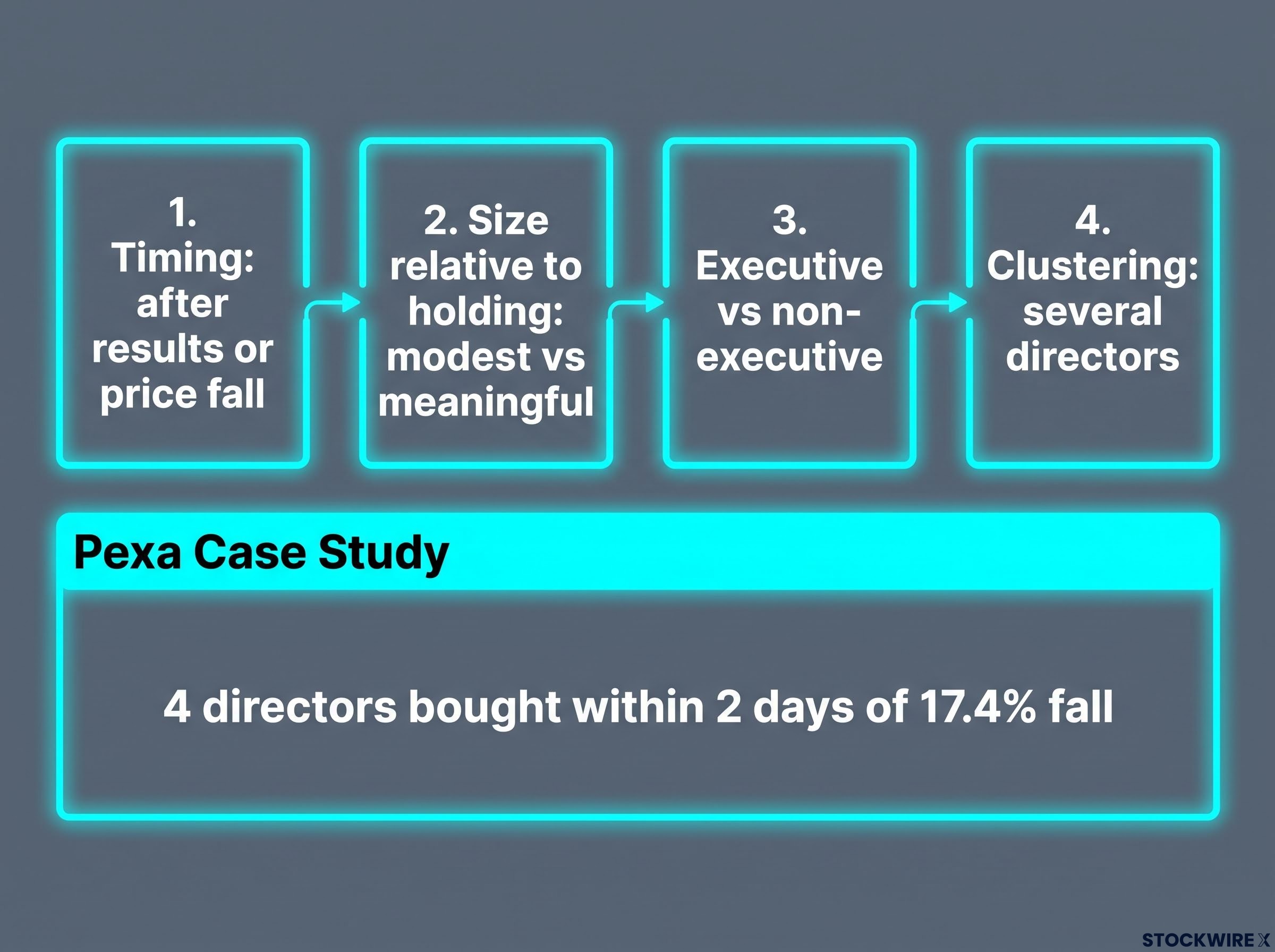
Once you accept that buys are the more informative side, four filters help you judge how much weight a given purchase deserves:
Aggregated insider sell-to-buy ratios across US markets reached an 11:1 level in H1 2026, and the analytical lesson from that dataset carries over to the ASX context: the absence of insider buying is often more informative than the presence of insider selling, because purchases require genuine conviction while sales carry many structural motivations.
- Timing: Did the purchase come soon after results, particularly after a price fall? Buying into weakness is a stronger statement than topping up after a rally.
- Size relative to holding: A modest top-up is symbolic. A purchase that meaningfully changes a director’s exposure, or an initial stake by someone with little prior “skin in the game,” carries more information.
- Executive versus non-executive: Executives such as CEOs and CFOs hold the deepest operational insight, so their buying tends to say more about near-term conditions than a non-executive’s alignment purchase.
- Clustering: Several directors buying at once strengthens the read, though be alert to clusters of small symbolic purchases that may be more about reassuring the market than deploying conviction capital.
Applying the filters: the Pexa case
Run Pexa through the filters and the picture sharpens. On timing, four directors bought within two trading days of a 17.4% fall, at prices near the 52-week low, right as the blackout lifted. On size, the amounts ranged from $29,000 to $103,050, moderate rather than transformational. On role, the buyers were a mix rather than a dominant executive signal. On clustering, four directors moving together is genuinely notable.
Compare that with IPH, where CEO Anthony O’Malley made his first purchase since taking the role. When an incoming chief executive buys with their own money in their opening weeks, they are making a public statement of personal conviction that is far harder to dismiss as mere signalling than a non-executive’s top-up.
It is worth noting that broker sentiment and insider sentiment can point in opposite directions. Macquarie held a Neutral rating on IPH after the result, wanting evidence of improved filing activity first. That divergence does not resolve itself; it is your job to decide which read you find more persuasive, given that director buying at IPH and Pexa eliminates none of the underlying risks, from Pexa’s proposed IPART fee cut to the anticipated double-digit fall in Australian property transfer volumes in FY27.
What the August 2026 reporting season reveals about the buy signal environment
Step back from the individual names and a pattern emerges. The concentration of these transactions between 31 August and 2 September 2026 was not coordination. It was structure.
ASX trading window rules bar directors from dealing during pre-results blackout periods. Once results are announced and cleared, that pent-up activity releases in a wave. Reading the timing as unusual or as evidence of collusion misses the point entirely; the timing is a regulatory artefact, and the real signal lives in the content.
ASX reporting season volatility is structurally elevated: JPMorgan’s dataset shows more than one third of ASX 200 companies recorded moves exceeding three standard deviations on their reporting days in February 2026, which helps explain why director purchases clustered so tightly in the days immediately after the August 2026 blackout windows lifted.
That content differs sharply by company. Ansell directors bought into confirmed strength: FY26 sales landed 3.5% above consensus, adjusted NPAT 4.6% above Morgans’ estimate, and FY27 EPS guidance came in with a midpoint about 11% above prior consensus. IPH and Pexa directors bought into confirmed weakness: IPH revenue fell 2.1% short of consensus and underlying EBITDA 3.2% below forecasts, while Pexa’s FY27 revenue guidance midpoint sat roughly 6.7% under estimates and its EBITDA midpoint around 10.2% below.
| Company | FY26 vs Consensus | Result-Day Reaction | Insider Action | Context |
|---|---|---|---|---|
| Ansell | Beat | +14.56% | Buy | Post-rally |
| IPH | Miss | -11% | Buy | Post-weakness |
| Pexa | Guidance miss | -17.4% | Buy | Post-weakness |
| Genesis Minerals | Beat | Strong result | Sell | Portfolio management |
The Genesis Minerals sale sits outside the buying cluster entirely, and reading it as a negative call on FY27 would be a mistake. It is founder-level portfolio management after EBITDA doubled to $952.4 million and a maiden fully franked dividend was declared.
Three things to hold onto about the post-results window:
- Blackout structure explains the timing; directors trade when they are permitted to, not when they choose to.
- Concentration of transactions in a few days is normal, not coordinated.
- Timing alone is not the signal. Who bought, how much, and at what price against what market backdrop is where the read lives.
What the pattern shows is insiders differentiating hard by fundamentals, buying into companies where the market may have overreacted to short-term guidance misses. That is precisely the circumstance where historical study of insider purchases has found the strongest forward-looking signal.
Reading director transactions as one input, not the input
Nine buys and one sale across four companies. The honest task now is to calibrate what that data can and cannot tell you, so you leave better equipped rather than more confident than the evidence warrants.
The most informative transactions here are the IPH and Pexa purchases. Directors bought into market pessimism with visible personal exposure, and the IPH CEO’s first-week purchase is the single sharpest signal in the set. The Ansell buys confirm board alignment, but they carry less weight because directors paid a premium after the good news was priced in.
None of this eliminates the underlying risks. Pexa still faces IPART’s proposed 20% cut to regulated per-transaction fees from FY28, plus management’s own warning of a double-digit decline in property transfer volumes in FY27. IPH still contends with falling US PCT filing volumes, adverse currency, and Macquarie’s Neutral stance. Ansell, meanwhile, closed at $42.26 on 4 September, up around 10% since its result.
Insider transactions are a sentiment cross-check, not a valuation substitute. Director buying after a fall tells you the people closest to the business think the market is wrong. It does not tell you they are right.
The repeatable habit is simple: locate the transaction, identify the market context, run the four filters, then cross-check against fundamentals and broker commentary. That process works well beyond these four names and this reporting season.
For readers wanting to understand the full personal risk framework that governs when and how ASX directors can legally trade, our dedicated guide to director liability in Australia covers the dual enforcement model, the non-delegable duties under the Corporations Act, and what ongoing regulatory exposure looks like after an executive departs.
This article is for informational purposes only and should not be considered financial advice. Investors should conduct their own research and consult with financial professionals before making investment decisions. Past performance does not guarantee future results. Financial projections are subject to market conditions and various risk factors.