Algorithmic trading took decades to travel from Wall Street server rooms to the average retail platform. The next shift, according to Chris Weston of Pepperstone, could arrive in roughly five years: agentic trading as a mainstream default for ordinary traders. The research landscape, as it stands, is a lot more cautious than that headline suggests.
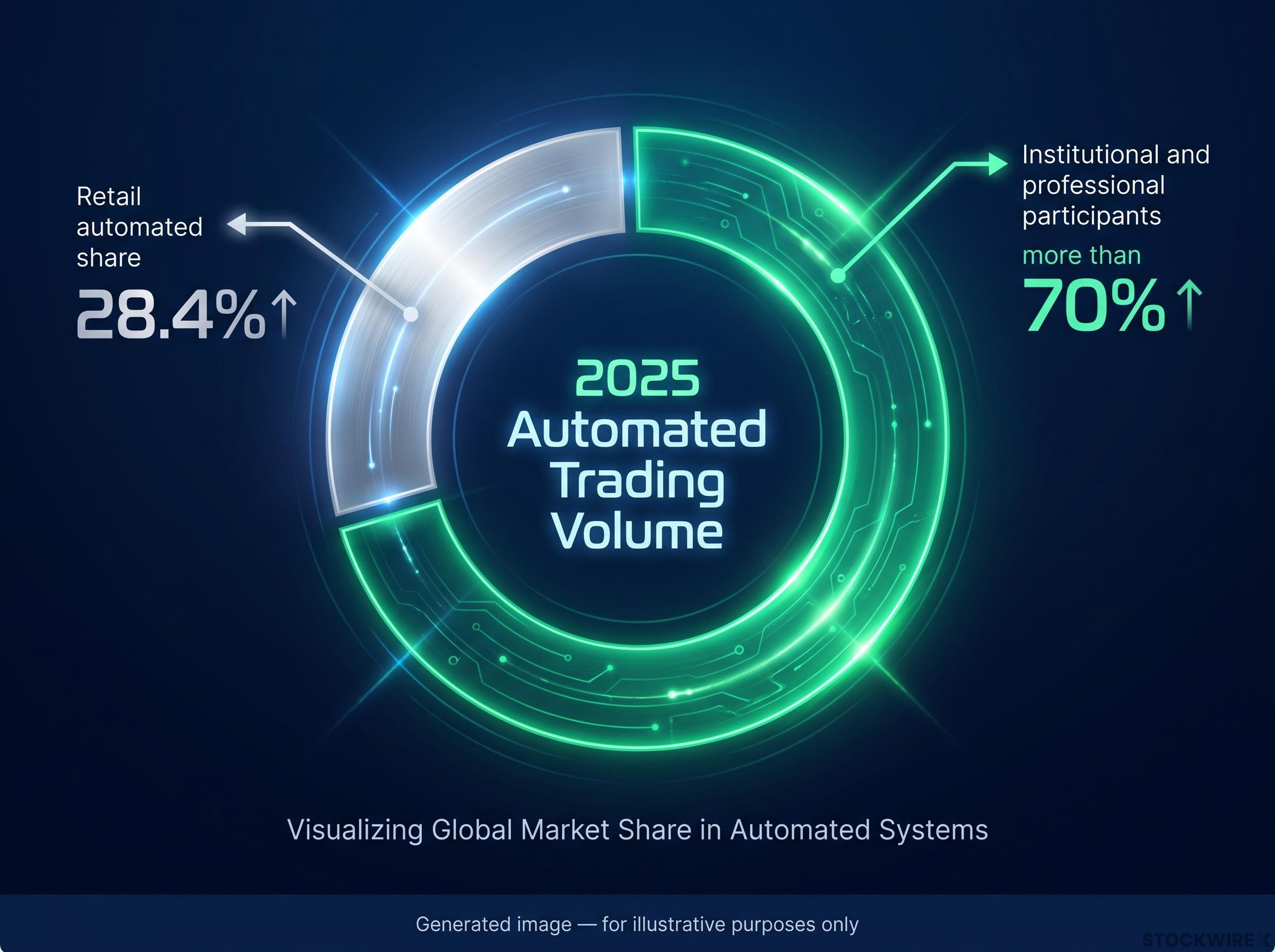
That gap between the pitch and the evidence is the whole story here. Algorithmic trades already account for roughly two-thirds or more of stock trading volume in major markets, yet retail investors only reached around 28.4% of automated trading volume by 2025. Agentic AI trading is being floated as the next leap beyond that, and most retail traders are meeting the term with almost no grounding in what it actually takes to build or run one.
Here is what this covers: what agentic trading is at a mechanical level, what infrastructure sits beneath it, what the performance evidence genuinely shows, and how to judge that five-year claim for yourself instead of taking it on faith.
What agentic AI trading actually means (and how it differs from a standard bot)
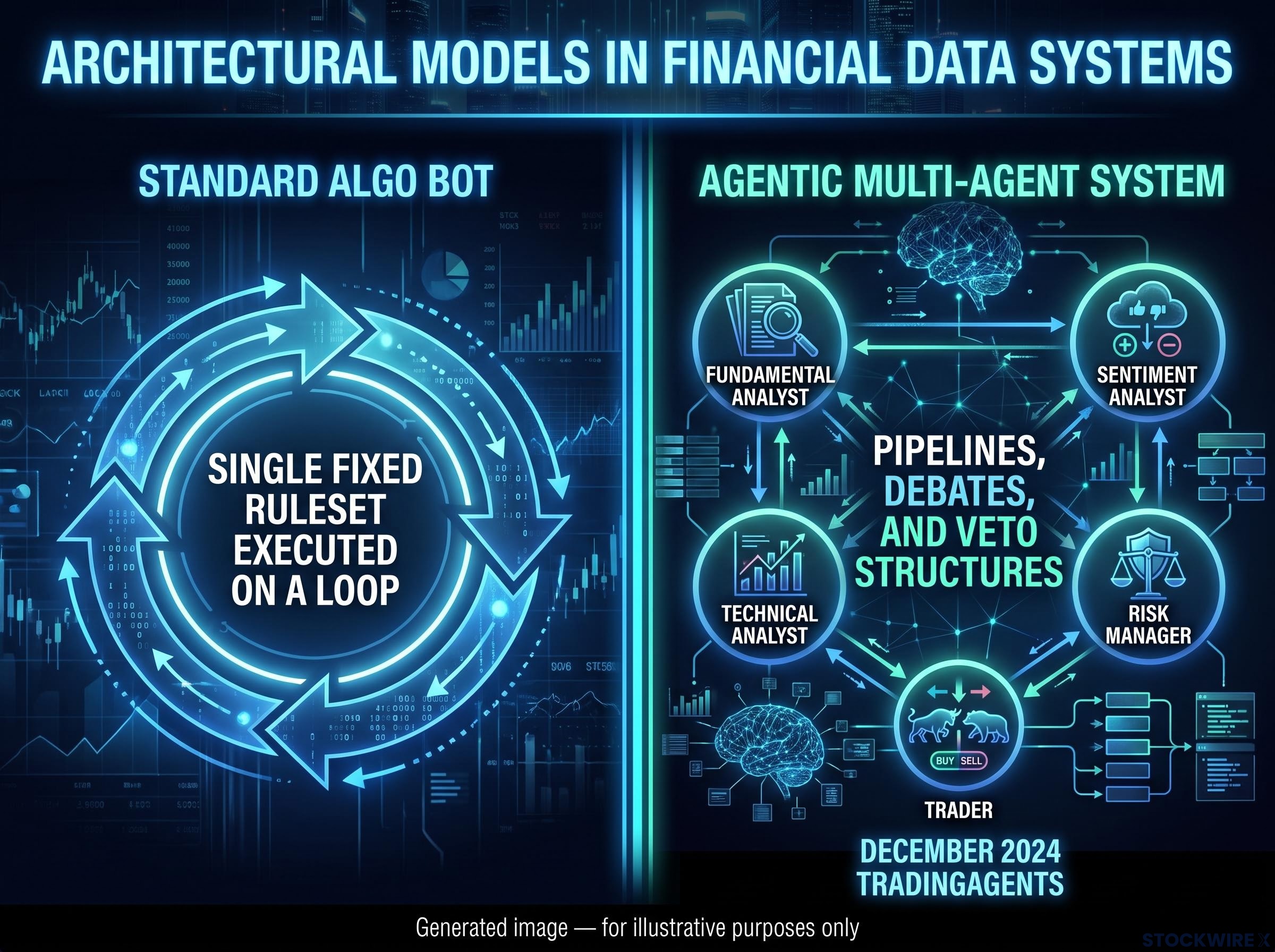
You probably already have a working picture of an automated trading bot. It follows a fixed set of rules: if this indicator crosses that threshold, buy; if the stop-loss triggers, sell. One program, one ruleset, running on a loop.
An agentic system breaks that picture apart. Instead of a single program executing fixed rules, it deploys multiple specialised AI components, each holding narrow authority over one defined task, and has them interact with one another before anything gets traded.
The word “agentic” is doing specific work here. It refers to the autonomous, goal-directed behaviour of each component and to the structured coordination between them, not simply to AI being used somewhere in the pipeline.
Unlike traditional algorithmic systems that follow fixed rules, AI trading systems adapt their own behaviour from incoming data, which makes their failure modes less transparent and considerably harder for retail traders to anticipate before problems compound.
The clearest way to see the difference is to put the two side by side.
| Attribute | Standard algo bot | Agentic multi-agent system |
|---|---|---|
| Decision structure | Single fixed ruleset executed on a loop | Distributed across specialised components that each decide within their remit |
| Role specialisation | None; one program does everything | Separate agents for strategy, risk, execution, and information |
| Coordination mechanism | None required | Pipelines, debates, and veto structures between agents |
| Failure mode | Rule misfires or bad parameter | Cascading errors where one agent’s mistake propagates through the team |
The distinction is not cosmetic. You are not evaluating a faster, smarter single tool. You are evaluating a coordinated team with its own organisational logic, and that changes what can go wrong just as much as what can go right.
The standard agent roles in a multi-agent trading system
Academic frameworks and live platforms converge on the same division of labour, where each agent holds narrow authority over a defined input space:
- Strategy or analyst agents: generate trade ideas from technical indicators, fundamentals, sentiment, and alternative data.
- Risk agents: enforce position size limits, leverage caps, stop-loss rules, and portfolio-level drawdown constraints.
- Execution agents: interact with broker APIs, choose order types, and manage slippage so orders respect the risk limits.
- Information-gathering agents: fetch, filter, and summarise news, filings, and price data for the other agents to act on.
The TradingAgents research framework (Yijia Xiao et al., arXiv:2412.20138, December 2024) makes this concrete with five named roles: a fundamental analyst, a sentiment analyst, a technical analyst, a risk manager, and a trader, who debate and collaborate before any decision is executed. On the practitioner side, Obside describes each strategy as an isolated agent with a narrow job, restricted inputs, and defined authority, with risk limits enforced at execution time rather than buried inside the strategy logic (Obside, July 2026).
When big ASX news breaks, our subscribers know first
The infrastructure behind an agentic trading system
Understanding the agents is one thing. Running them is another. Four concrete requirements sit beneath any working agentic system, and they stack on top of one another.
- Orchestration and state management. This is not simply running several scripts at once. It means enforcing isolation so one misbehaving agent cannot compromise the whole account, and managing the shared state that agents pass between each other.
- Broker and data integrations. Live deployment needs real-time market data feeds and broker API connections, wired reliably enough to trust with capital.
- Latency and throughput management. The agents must reach decisions under live market conditions, which means the whole system has to meet market-data latency and order-routing constraints.
- Token and cost budgeting. Repeated agent debates and cross-checks are computationally expensive. Every round of deliberation costs money, and that has to be balanced against speed, especially for intraday trading.
Read top to bottom, these are cumulative dependencies, not an independent checklist. Each one assumes the one above it already works.
The architectural insight that matters most Obside’s design principle is that a data-gathering agent misclassifying an event should never be able to cascade into concentrated exposure. Risk limits must be enforced at execution time, as a separate layer, not written into the strategy logic itself.
That separation is the single thing to look for when you evaluate any agentic platform today. The practical question is not whether the AI looks impressive. It is whether the infrastructure beneath it enforces risk limits independently of strategy logic, because that is what stops a single agent error from becoming an account-level event.
Not every product exposes this complexity. WunderTrading, for instance, abstracts agentic features behind a consumer interface, offering personalised assistants that remember your risk tolerance, favourite setups, and performance history (WunderTrading, April 2026). At the broker level, Pepperstone is building API-based infrastructure for these approaches, with cTrader currently positioned as the best available option for retail traders exploring them (Chris Weston, Pepperstone).
The same intent-abstraction dynamic powering consumer agentic AI infrastructure is now being applied to trade execution, where agents intercept and route decisions before a human operator would ordinarily have intervened, raising parallel questions about where durable value accumulates in the stack.
The sophistication of the design directly shapes live outcomes. A two-month live multi-market benchmark (arXiv:2510.11695, October 2025) ran LLM agents across crypto and equity markets in real time and found their risk behaviours varied by architecture. In other words, how you build the system changes how it behaves with real money, which is exactly why this remains the territory of technically capable traders rather than a plug-and-play option.
What the performance evidence actually shows
Start with the result everyone cites. TradingAgents reported superior cumulative returns and Sharpe ratios versus traditional baselines over its test window of June to November 2024 (Yijia Xiao et al., arXiv:2412.20138). The Sharpe ratio measures return relative to the risk taken, so a higher figure suggests better reward for the volatility endured.
Now the caveat that reframes it. That result came from a backtest, a simulated run over historical data, covering roughly six months and a single market regime. Impressive on paper is not the same as durable in live markets.
Why backtests flatter agentic systems more than simpler strategies
Two specific failure modes inflate backtested numbers, and multi-agent language-model systems are especially prone to both.
The first is lookahead bias. This happens when the data a model trained on overlaps with the period it is being tested on, letting it effectively recall outcomes rather than predict them. Because large language models are trained on vast historical text, they can carry knowledge of what happened into a test that is meant to simulate not knowing, which quietly flatters the results.
Lookahead bias in backtests is not unique to multi-agent systems: empirical work on algorithmic earnings trading shows that models trained on historical text can carry implicit knowledge of outcomes into test windows that are meant to simulate genuine uncertainty, quietly inflating apparent edge.
The second is memorisation. This is when a model fits itself to historical patterns that do not actually repeat in future markets. A simple rule-based algo has few moving parts to overfit; a multi-agent system with several language models reasoning in concert has far more surface area to latch onto patterns that will not hold.
The live-market record is where the optimism meets friction.
The calibration anchor Approximately 90% of retail algo traders fail to beat a simple S&P 500 buy-and-hold strategy in their first year of live trading (TradeAlgo 2026, drawing on FINRA analyses).
The nuance matters too. A study of 1,200 retail accounts found algorithmic traders outperformed discretionary traders by 2.1 percentage points annually on a risk-adjusted basis, yet both groups still underperformed the S&P 500 after costs (Journal of Portfolio Management, cited by TradeAlgo 2026).
There are genuine live signals worth noting. The October 2025 multi-market benchmark described “promising capabilities” from LLM agents operating in real time. On the institutional side, RBC’s Aiden, a deep reinforcement-learning execution agent, is reported to have handled around $1 trillion in trades and cut execution costs by 15% by 2025, though these figures remain unverified against independent sources and should be read with that caveat attached.
The gap between backtested results and live performance is the single most important thing to internalise. The systems that look most impressive on paper are often the ones most aggressively optimised to the past.
Is mainstream retail adoption five years away? A realistic assessment
The democratisation case has real evidence behind it. WunderTrading already offers personalised agentic assistants to retail users. No-code platforms like Tickeron and Kryll.io lower the technical barrier by letting people backtest and deploy strategies without writing code. And broker-level infrastructure, such as Pepperstone’s API development, is being built specifically to support retail adoption.
The entrenchment case carries equal weight. Institutional and professional participants still account for more than 70% of automated trading volume as of 2025. Retail algorithmic volume in CFD and forex rose from roughly 10% in 2010 to around 30-40% by 2024 (Vuetra, June 2025), which is meaningful growth but still below half of that segment’s volume. Algorithmic trading itself took decades to reach its current institutional dominance.
| Dimension | Democratisation case | Entrenchment case |
|---|---|---|
| Adoption data | Retail automated share reached 28.4% of automated volume by 2025, up from 8-12% in 2010 | Institutional and professional participants still hold more than 70% of automated volume |
| Infrastructure access | No-code platforms and broker APIs lowering the barrier for retail users | Multi-agent orchestration and risk isolation still favour well-resourced firms |
| Performance evidence | Backtests and short live benchmarks show promising capabilities | Durable multi-year live outperformance versus simple benchmarks remains undemonstrated |
So which way does it break? Rather than a verdict, here are the three variables that will most determine whether the five-year claim proves accurate:
- Regulatory clarity. Bodies including the SEC, ESMA, ASIC, and FINRA have frameworks for algorithmic trading, but specific guidance on autonomous agentic systems is still emerging. The open questions are who bears liability when an autonomous agent decides badly, and how multi-agent decisions can be audited and explained.
- Robust live performance data. The field needs multi-year live results, not six-month backtests, before retail trust can be earned at scale.
- Infrastructure abstraction. Whether brokers can hide the orchestration complexity enough for non-technical traders to use these tools safely.
FINRA’s AI in securities guidance identifies the same accountability gaps that make agentic systems harder to regulate than standard algorithmic bots, particularly around how multi-step autonomous decisions can be traced, attributed, and audited after the fact.
The five-year timeline is a practitioner’s optimistic estimate, not a consensus projection. Whether it holds for retail traders depends less on the AI maturing and more on whether infrastructure barriers and regulatory frameworks resolve alongside it.
What to do with this information if you are a retail trader today
This is not a binary of try it or avoid it. Where you sit depends on your technical capability and your risk tolerance, and there are three honest positions.
- Observe and build literacy. For most readers, this is the right place to start.
- Follow the space and learn the mechanics without deploying any capital.
- Build the skill of interrogating performance claims, which stays valuable no matter how fast the technology moves.
- Explore with defined limits. For traders comfortable with platform tools and clear on their risk appetite.
- Use no-code or platform-level agentic tools, such as WunderTrading’s retail features, with firm risk limits set in advance.
- Check whether the platform enforces risk at the execution layer rather than inside strategy logic, and whether it shows you live performance data rather than backtests.
- Build or customise frameworks. For traders with genuine technical expertise only.
- Deploying or adapting a multi-agent framework like TradingAgents means working with publicly available but technically demanding code.
- Paper trade thoroughly, meaning simulated trading with no real money, before committing any live capital.
Copy trading is worth understanding as a lower-complexity stepping stone. Pepperstone operates its own proprietary copy trading platform across iOS, Android, and web, which is one concrete example of the adjacent capability, mentioned here to illustrate rather than endorse.
For most retail traders right now, the most valuable move is not deploying an agentic system at all. It is developing the evaluative literacy to assess performance claims accurately, because that skill will matter regardless of how quickly the technology arrives.
This article is for informational purposes only and should not be considered financial advice. Investors should conduct their own research and consult with financial professionals before making investment decisions. Past performance does not guarantee future results, and forward-looking projections are subject to market conditions and various risk factors.
Agentic AI trading is real, but so is the distance from the brochure
Something genuinely new is happening. Agentic systems are a real architectural step beyond single-algorithm bots, and the infrastructure to support them at the retail level is being actively built right now.
Hold that alongside what the evidence says. Live-market performance data is thin, and the retail underperformance figures apply to algo trading broadly, not only to its most basic forms. Adding more sophisticated machinery does not automatically fix the problem.
Two things would most change this picture: robust multi-year live performance data from retail-deployed multi-agent systems, and regulatory clarity on liability and auditability that gives platforms the confidence to offer these tools at scale.
Treat the five-year projection as a marker to watch, not a certainty to plan around. The advantage you walk away with is not knowing exactly what to do today. It is knowing which questions to ask when the next agentic trading product or claim lands in your feed.