Most traders pick a platform the way they pick a broker: they go with whatever they were handed first, or whatever a forum recommended. But the platform you trade on shapes what strategies you can run, how fast you can act, and whether your automation survives contact with live markets.
That is a consequential choice to leave to defaults.
MT4 still commands deep loyalty even as MT5 has overtaken it in global trading volume. TradingView has crossed 100 million users while running almost zero execution of its own. cTrader holds a small but fiercely dedicated community. Each platform quietly embeds a set of assumptions about how you trade.
When your strategy and your platform are misaligned, the friction shows up in slippage, missed signals, and workarounds you build instead of solutions you actually want.
This guide gives you a framework for matching each platform to the trading style it was built for. The question is not which platform is best in the abstract. It is which one fits what you are actually doing, so you can diagnose platform-related friction in your own workflow and act on it.
Why the platform you choose is a strategy decision, not a software preference
Here is the uncomfortable part: platform choice is not cosmetic. The four main options are not competing versions of the same tool. They are four different operational philosophies, and each one assumes something different about how you work.
MT4 assumes you want to run existing automation. MT5 assumes you want broad asset access and modern computation. cTrader assumes you care about execution precision down to the order ticket. TradingView assumes charting and community come first and execution can be routed elsewhere.
You might think pricing is the thing that separates them. It usually is not. Brokers such as Pepperstone apply identical spread pricing across every platform they offer, which means the pricing argument for platform selection is a red herring. The real differentiators are toolset, asset access, and automation capability.
Two axes structure the whole decision, and they are worth holding in your head for the rest of this guide:
- Execution environment: automated versus discretionary. Does your edge live inside code, or inside your own judgement?
- Asset scope: single-market versus multi-asset. Do you trade one instrument deeply, or many across a single screen?
Where you sit on those two axes tells you more than any feature list. And the ground beneath you is moving.
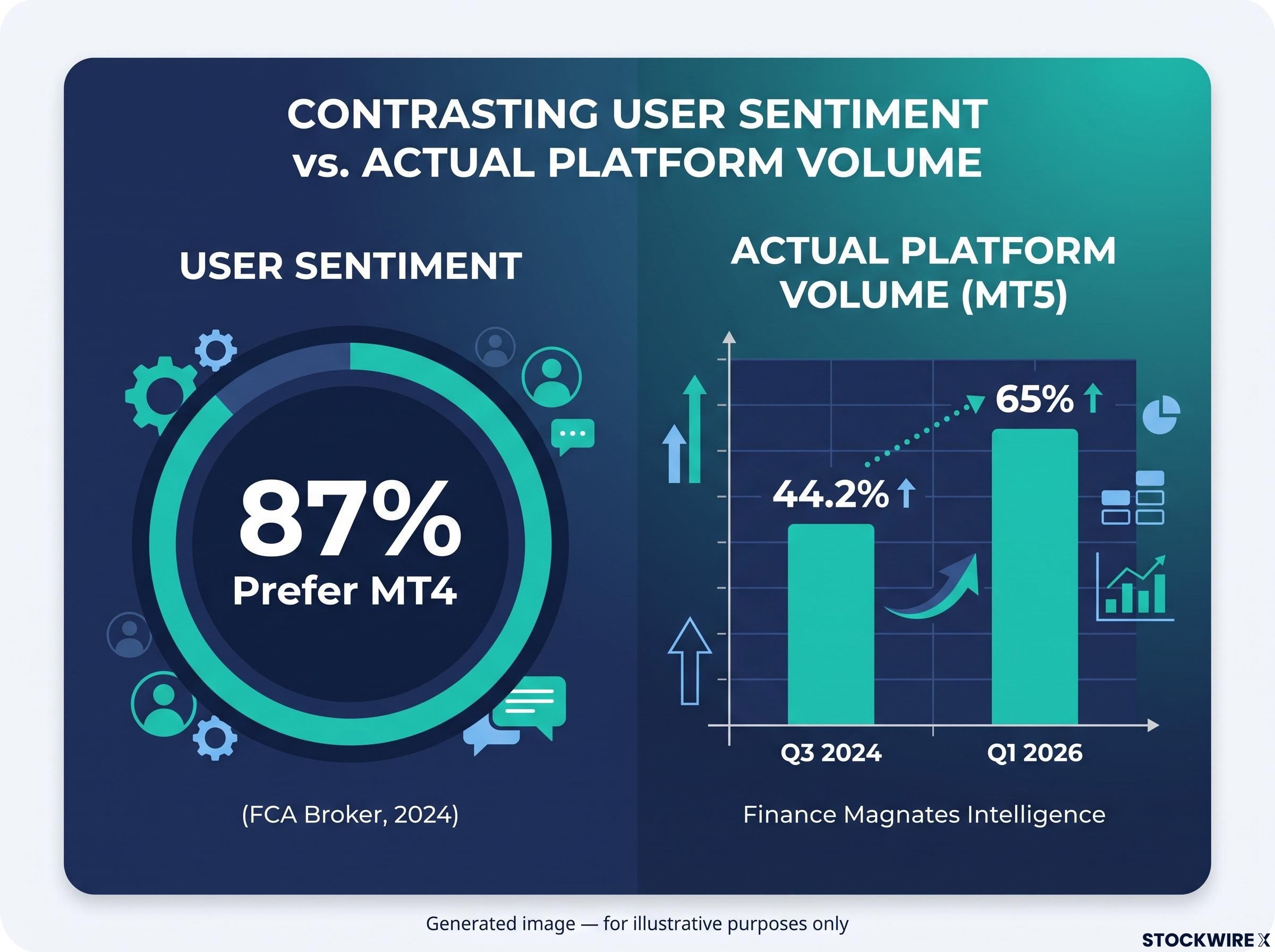
The market is already migrating MT5 now holds roughly 65% of MetaTrader trading volume as of Q1 2026 (Finance Magnates Intelligence), up from 44.2% in Q3 2024.
That shift tells you something about convenience. Traders who stay on MT4 because it is familiar are not standing still. They are being left behind by broker development priorities and ecosystem investment, which are now flowing toward the newer platform.
One more input matters: frequency. Execution speed and transaction costs matter enormously to a high-frequency trader placing around twenty trades a day. They matter far less to someone executing a few times a week. Your trade frequency is a direct input to the platform decision, not an afterthought.
The note that execution speed matters far more to a trader placing around twenty trades a day reflects a wider truth about high-frequency infrastructure: firms operating at the extreme end of that spectrum invest in co-located servers and custom execution environments that retail platforms cannot replicate, making the gap between retail and institutional scalping a structural rather than a skill issue.
When big ASX news breaks, our subscribers know first
What each platform was actually built to do
Understanding why each platform was designed the way it was makes the suitability patterns in the next section feel almost inevitable. So here is the origin logic behind each one.
MT4 is the legacy automation hub. Its strength today is not technical superiority; it is the sheer depth of its existing Expert Advisor (EA) and indicator library. An EA is an automated program that executes trades on your behalf based on coded rules. A decade of these tools were built specifically for MT4, and that library is the real reason people stay.
MT5 is the modern successor, and it is where development is heading. It offers broader asset access, a 64-bit architecture, and improved backtesting (the process of testing a strategy against historical price data before risking live capital). Build 5200 in August 2025 extended OpenBLAS support and enhanced MQL5 controls, improving numerical performance for algorithmic and optimisation workloads.
The telling detail is the December 2024 shift to 64-bit-only installers. That tells you MetaQuotes has already made the decision for you: any serious algorithmic workflow built on MT4 is being built on infrastructure the vendor has stopped improving.
cTrader is the precision execution platform. It offers Level 2 depth-of-book, meaning you can see the full ladder of buy and sell orders sitting in the market rather than just the best available price. It is ECN-native, built to route your order directly to liquidity providers, and it has a smaller user base that does not leave.
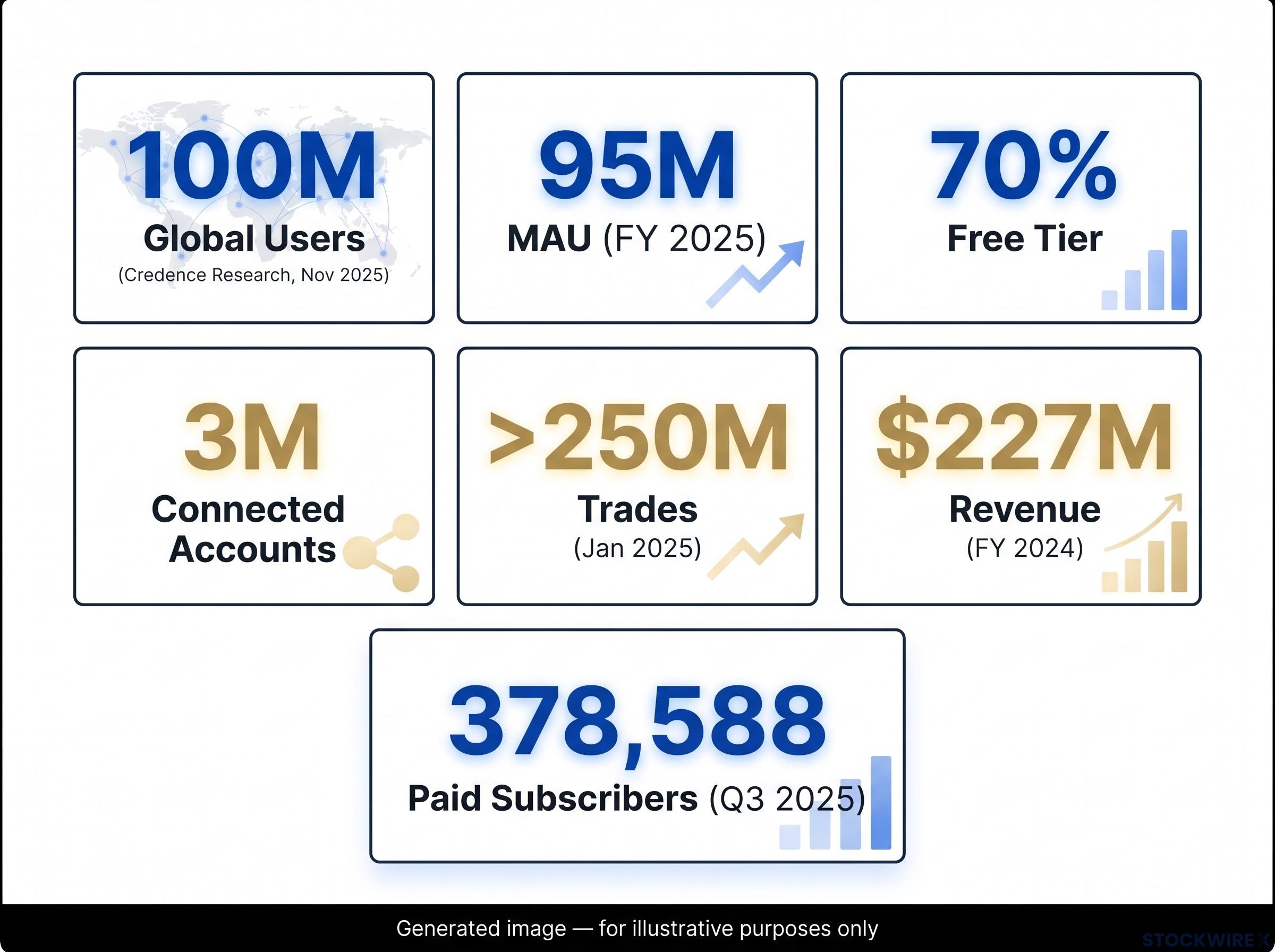
TradingView is the analysis and community layer. With more than 100 million users globally (Credence Research, 8 November 2025) and 95 million monthly active users in FY 2025, it is the charting environment practitioners actually open. Chris Weston of Pepperstone uses it personally alongside a Bloomberg terminal. Its 2024-2025 additions include multiple exit levels for bracket-style risk management, seconds bars built from tick data for ultra-short-term charting, and the Rank Correlation Index indicator (version 28.2.0, October 2024).
TradingView’s charting environment supports thousands of community-published technical indicators, but volume and signal quality vary considerably; only a small subset of technical indicators have demonstrated consistent utility across live trading conditions, and the platform’s openness to community scripts makes distinguishing signal from noise a genuine discipline.
| Platform | Primary design purpose | Automation language | Asset scope | Key distinguishing feature |
|---|---|---|---|---|
| MT4 | Legacy automation hub | MQL4 | Primarily FX, narrower | Vast existing EA and indicator library |
| MT5 | Modern multi-asset successor | MQL5 | Multi-asset, incl. share CFDs | 64-bit architecture, improved backtesting |
| cTrader | Precision ECN execution | cBots (C#) | FX and CFDs | Level 2 depth-of-book |
| TradingView | Analysis and community layer | Pine Script | Multi-asset research | Charting plus 100M+ user community |
A note on cTrader’s position in the ecosystem
cTrader’s smaller broker network is both its limitation and its signal. It is a specialist ECN platform, not a mass-market product, and that shapes who it is right for: traders who value execution quality over the widest possible choice of brokers.
It also carries built-in copy trading through cTrader Copy, which matters whether you are a signal provider looking to share a strategy or a follower looking to mirror one. That feature keeps its dedicated community engaged, which is part of why cTrader users tend to stay put.
Matching platform to trading style: the decision matrix
You now know what each platform was built for. The real question is which category your own trading actually falls into, because the platform choice should follow your behaviour, not your aspirations.
There are four broad archetypes. Find yours honestly.
If you are an algorithmic or EA-driven trader, MT5 is where new development belongs, thanks to its 64-bit architecture, OpenBLAS support, and MQL5 enhancements. MT4 remains the host only for existing legacy EA libraries that cannot be ported without recoding. If your edge already lives in MT4 code, that is a genuine reason to stay, not a general preference.
If you are a scalper or high-frequency trader, cTrader’s Level 2 depth-of-book and advanced order ticket are built for you. MT5 is also viable where your broker provides robust high-frequency infrastructure. TradingView, by contrast, is better used for the analysis before the trade than for execution in very short timeframes.
cTrader’s Level 2 depth-of-book gives scalpers visibility into order queue depth, but volume confirmation remains a separate discipline: knowing whether a breakout has real participation behind it requires reading volume relative to recent averages, not just seeing the order ladder.
If you are a macro or multi-asset discretionary trader, TradingView is the de-facto analysis environment. It is what Chris Weston of Pepperstone reaches for alongside Bloomberg, with execution routed through an integrated broker. Trading indices, FX, crypto, and equities on one screen is exactly what it was designed for.
If you are a beginner or less technical retail trader, TradingView is the low-friction entry point for charting and community learning, with roughly 70% of its user base sitting on free tiers. MT4 offers simple execution familiarity, and MT5 becomes the recommendation once you want broader instruments or more sophisticated order types.
Now the non-obvious tension. Many traders think they belong in one archetype while their actual behaviour places them in another. The data makes this gap visible.
Preference versus behaviour 87% of surveyed retail forex traders still report preferring MT4 (FCA Broker, 2024). Yet actual volume shows MT5 holding roughly 65% of MetaTrader activity.
That gap tells you something you should take seriously. Traders say they prefer MT4, but the market is already voting with its activity. The space between stated sentiment and actual behaviour is exactly where migration friction accumulates, and where you do not want to be caught.
| Trading style archetype | Recommended platform | Why it fits | What to watch out for |
|---|---|---|---|
| Algorithmic / EA-driven | MT5 (new), MT4 (legacy) | 64-bit, MQL5 enhancements for new builds | Legacy EAs need recoding to port |
| Scalping / high-frequency | cTrader, MT5 | Level 2 depth, fast order entry | Needs broker infrastructure to match |
| Macro / multi-asset discretionary | TradingView | Cross-market charting on one screen | Execution quality depends on broker link |
| Beginner / less technical | TradingView, MT4 | Free tiers, community, simple execution | Graduate to MT5 as needs grow |
Migration risk and the real cost of switching platforms
Switching platforms is not a neutral event, and most guides skip the half of the decision that actually hurts: what you stand to lose.
Start with the MT4-to-MT5 move, which looks simple and is not. The two platforms use different execution modes. MT4 defaults to hedging, where you can hold opposing positions in the same instrument. MT5 can run in netting mode, where those positions are consolidated into one. They also use different EA languages, MQL4 versus MQL5, so your automation does not simply carry across. And from the December 2024 builds onward, MT5 is 64-bit-only, which means older hardware becomes a compatibility barrier and a genuine infrastructure cost.
Before you move a single live strategy, work through this:
- Audit your existing EAs for MQL4 versus MQL5 compatibility, and budget for recoding where they do not port.
- Test execution mode differences, netting versus hedging, on a demo account before committing real capital.
- Verify your hardware meets the 64-bit requirement so you are not blindsided by an installer that refuses to run.
Here is the honest framing. If your trading edge lives inside a live MT4 EA that has never been back-tested on MT5, the question is not which platform is better. It is what the cost is of proving your strategy behaves the same way on the new platform. That cost is real and specific, and it is a legitimate reason to stay put until you have a concrete gain to justify the move.
Regional context matters too. North America is the one market where MT4 still leads MT5 on web visibility, which tells you the surrounding ecosystem of broker support, EA libraries, and forums remains more accessible there than its global position suggests.
The TradingView execution dependency
cTrader carries a different risk: lock-in. Its smaller broker network means that if you build strategies on cTrader and later want to switch brokers, you may be forced to switch platforms too. Your platform choice quietly constrains your future broker choice.
TradingView flips the usual assumption entirely. Execution quality is a broker variable, not a platform variable. Latency, order handling, and slippage are all determined by how well your broker has integrated TradingView, not by TradingView itself. With 3 million connected brokerage accounts executing more than 250 million trades by January 2025, an enormous volume of execution flows through those integrations, which means evaluating TradingView without evaluating the broker behind it is only half an assessment. Several brokers now offer direct integration with live pricing and order management from the chart.
Practical steps to audit your own platform fit before you commit
Rankings and reviews only take you so far. The platform that fits you is the one that holds up against your own strategy, so here is a repeatable process for working that out yourself.
Start by answering four questions honestly about your actual workflow:
- Do I run, or plan to run, automated strategies? If yes, your execution model matters more than your charting.
- What is my typical daily trade frequency? Twenty trades a day and three a week point to very different platforms.
- Do I trade across multiple asset classes, or am I single-market? This decides whether multi-asset scope is a need or a nice-to-have.
- How dependent is my edge on specific order types or execution features? If Level 2 depth is central to your approach, that narrows the field immediately.
Your automation answer has a clear directional result. Automation-heavy workflows cluster on MT5 for broker-executed algorithms and on TradingView for script-based signal generation. Where your execution actually happens tells you which way to lean.
Then run a demo account as a live test, not a feature tour. Clicking through the interface tells you nothing about how the platform behaves under pressure.
Fit reduces friction later cTrader users tend not to migrate away once they adopt it. That retention pattern is a signal: getting the fit right early saves you the switching cost down the line.
Running a demo for at least two weeks on your actual strategy is not cautious behaviour. It is the minimum viable test for whether the platform’s execution model and toolset will hold up when real money is on the line. The free-tier reality makes this realistic: roughly 70% of TradingView’s user base sits on free access, so a genuine zero-cost trial period before you commit to a paid plan or integrated account is standard, not a favour.
Finally, validate your shortlist against broker access before you decide anything:
- Verify the platform is actually available through the broker you want to use.
- Confirm your preferred account type supports that platform.
- Check instrument coverage on that specific platform, since availability can differ even within one broker.
Complete this audit and you will not be second-guessing your platform choice three months into live trading.
Where this goes next
The platform landscape is still moving, and that is the point: making the call now with a clear framework beats waiting for the ground to settle on its own.
The structural direction is clear. MT5 is taking volume share from MT4 and the trend is accelerating, not plateauing. TradingView is consolidating as the research and charting layer for retail and professional traders alike. cTrader is positioning itself as the most suitable option for AI-driven and agentic trading workflows within broker ecosystems that support it. MT4 remains viable only where you have a proven, specific reason to stay.
cTrader is positioning itself as the most suitable option for AI-driven and agentic trading workflows partly because AI trading systems adapt their own behaviour from incoming data, making execution environment and order transparency more consequential than they are on platforms designed for discretionary use.
The trajectory in one line MetaTrader volume share has moved from 44.2% MT5 in Q3 2024 to roughly 65% by Q1 2026, six quarters of steady migration.
Broker behaviour is a major force here. Brokers are already defaulting new accounts to MT5, limiting new MT4 openings in some cases, and expanding TradingView integrations. That means the platform you use in two years may partly be decided by your broker’s roadmap, not just your preference. Aligning the two now is how you avoid being forced into a migration later. TradingView’s reported FY 2024 revenue of $227 million and 378,588 paid subscribers as of Q3 2025 point to commercial sustainability, though both figures come from a single unverified source and should be treated as indicative rather than confirmed.
Three signals are worth monitoring going forward:
- Whether your broker is limiting new MT4 account openings.
- Whether your broker has added or expanded TradingView integration.
- Whether MetaQuotes releases further MT5-only architectural improvements.
The right platform today is the one that fits your strategy today. Re-run the audit periodically, especially when you change brokers or add new instruments, and the decision stays durable rather than becoming tomorrow’s migration project.
This article is for informational purposes only and should not be considered financial advice. Investors should conduct their own research and consult with financial professionals before making investment decisions. Past performance does not guarantee future results, and forward-looking statements about platform adoption are speculative and subject to change based on market and vendor developments.