In just a few weeks this month, Meta added an estimated $500 billion to its market capitalisation. The trigger was not a new phone or a metaverse update. It was the launch of an AI personal assistant called Muse.
At the other end of the size spectrum, a startup named Instinct reportedly hit a $10 billion valuation by late September 2026, running its entire business through plain text messaging with no app at all.
These are not two isolated software stories. They are the opening moves in a structural change to how consumers buy things online, one where an agent layer sits between the user and the internet and quietly reroutes commerce away from the apps that have owned it for a decade.
For the AI agent economy investors are now trying to price, the question is no longer whether this shift is real. It is which platform stocks get commoditised, and where the new transaction margins pool. What follows here is a framework for answering exactly that.
The mechanics of intent abstraction and invisible switching
To understand why established marketplaces are suddenly exposed, you first need to see how these assistants work differently from the apps on your phone.
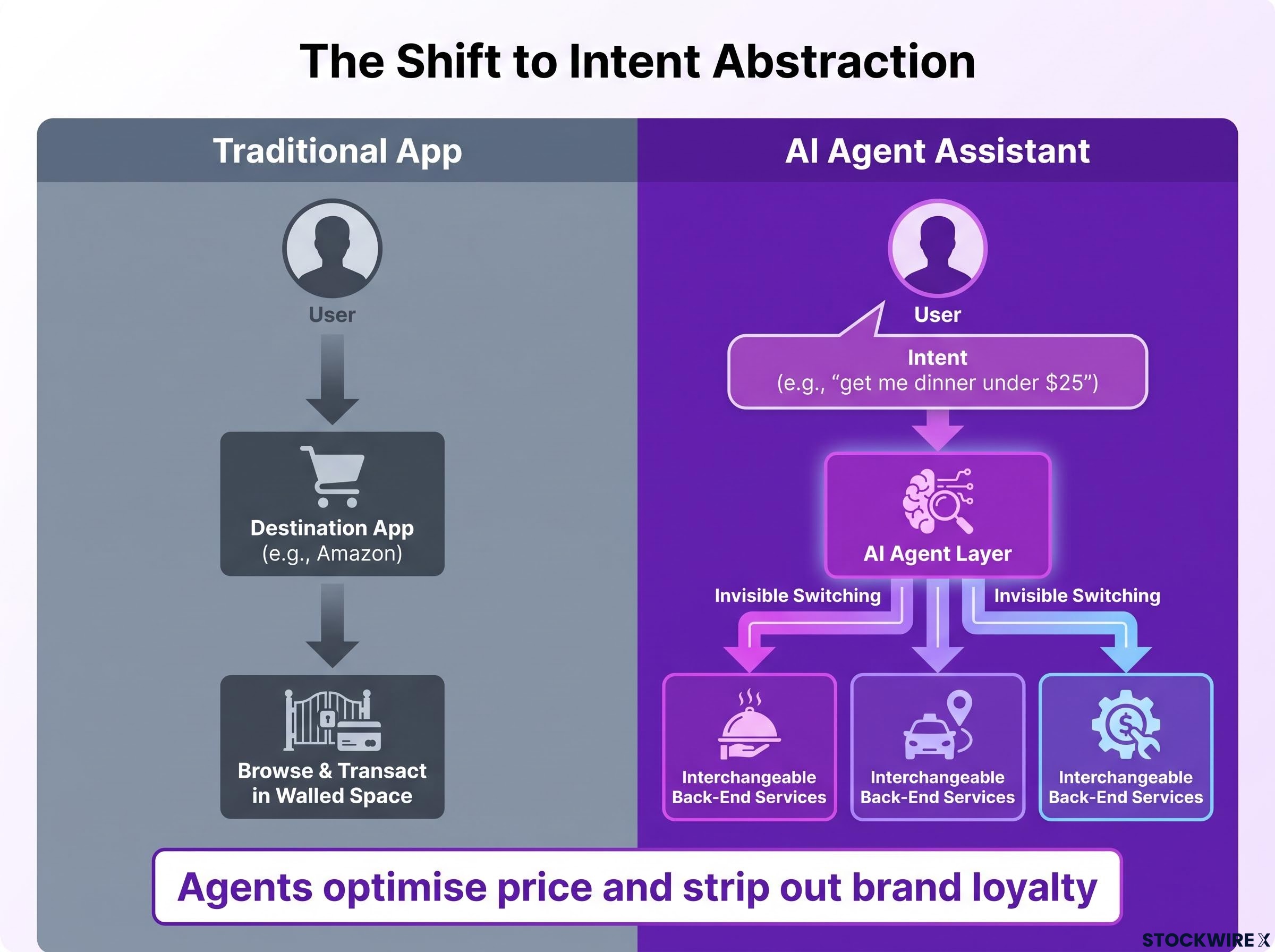
A traditional app is a destination. You decide to open Amazon or a food delivery service, you browse, and you transact inside that walled space. An AI personal assistant inverts this. It functions as a distinct layer between you and every provider, taking a stated goal and executing it across whatever back-end services can deliver.
The technical term for this is intent abstraction, and it simply means you express what you want rather than choosing where to get it. Instead of opening a specific marketplace, you tell the agent “get me dinner under $25” or “book a couples massage near this restaurant tonight,” and the agent handles the routing.
That single change breaks the value chain in three distinct ways.
- Intent abstraction: The agent, not the marketplace, becomes the default starting point for a purchase. The consumer never chooses a brand front door.
- Price optimisation over loyalty: Agents compare vendors objectively on price, delivery time, and ratings. This strips out the payoff from years of platform brand-building and forces marketplaces to compete purely on margin.
- Invisible switching: An agent can swap between backend providers with no user awareness at all. Platform-level churn becomes invisible, because the consumer’s loyalty attaches to the assistant, not the supplier underneath it.
None of this is unprecedented. Search engines disintermediated web publishers by controlling discovery. Mobile app stores controlled access to software. Travel metasearch turned airlines and hotels into interchangeable inventory. Each time, the interface that aggregated demand extracted the value from the providers below it.
Here is what that mechanism tells you as an investor. If loyalty now lives with the agent rather than the marketplace, then standard moat metrics like daily active users on a traditional app may be lagging indicators of platform health. A marketplace can hold its user numbers steady while an agent quietly reroutes its highest-value transactions elsewhere.
How simple interfaces hide complex execution
The counterintuitive part is that the winning products look almost primitive. Instinct operates through standard text messaging with no dedicated application, and users reportedly prefer it that way. Meta’s Muse assigns each user a dedicated cloud-hosted computer, a secure virtual machine that runs the heavy execution remotely without any setup on the user’s side.
The absence of a familiar interface is the feature, not the flaw. A blank text thread that just does the task removes friction, and that friction removal is precisely what drives adoption beyond early technology enthusiasts.
When big ASX news breaks, our subscribers know first
Tracking the speed of adoption through Instinct’s explosive metrics
If the mechanism explains why incumbents are exposed, Instinct’s numbers explain how fast the exposure is arriving.
Led by founder Noah Shinn, a Northeastern University dropout in his mid-20s, Instinct keeps a deliberately minimal public profile. Its landing page is reportedly little more than a white background and a stick figure, yet behind it sits serious commercial volume.
Daily user growth has reportedly been compounding at 10%, a rate described as extraordinary even against top-tier startups. More telling is the payment behaviour: roughly 40% of users hand over payment credentials within their first three weeks, and among that group, retention sits at about 80%.
That combination matters. When two in five new users trust a text thread with their card details that quickly, and four in five of them stick around, you are looking at genuine commercial intent, not curiosity traffic.
The transaction volume backs this up. Instinct is reported to be approaching $1 billion in annual transaction volume, with roughly 40% to 50% of that attributed to travel purchases. The business model keeps the product free and takes a percentage cut of each transaction it facilitates.
The funding timeline shows how aggressively capital chased those metrics:
- Early 2026: valuation of roughly $50 million.
- Early August 2026: a reported $75 million Series A at about a $500 million valuation.
- Late August 2026: a reported $250 million Series B at a $2.5 billion valuation.
- 28 September 2026: a reported $1 billion Series C valuing the company at $10 billion, taking total financing past $1.3 billion.
These figures come from subsequent research reporting and remain unverified against official filings, so treat the precise numbers as indicative rather than confirmed.
The direction of travel is what counts. A twentyfold valuation step-up in under nine months, poured into a text-only interface, signals that consumers are willing to abandon complex apps for simple conversational execution. For your portfolio strategy, that is the tangible proof point: the agent economy is already moving high-value transactions, and travel is the beachhead.
How Big Tech is weaponising capital to capture the agent layer
Startup speed is only half the story. The other half is that the largest technology companies are not sitting still, and the market is already paying them for it.
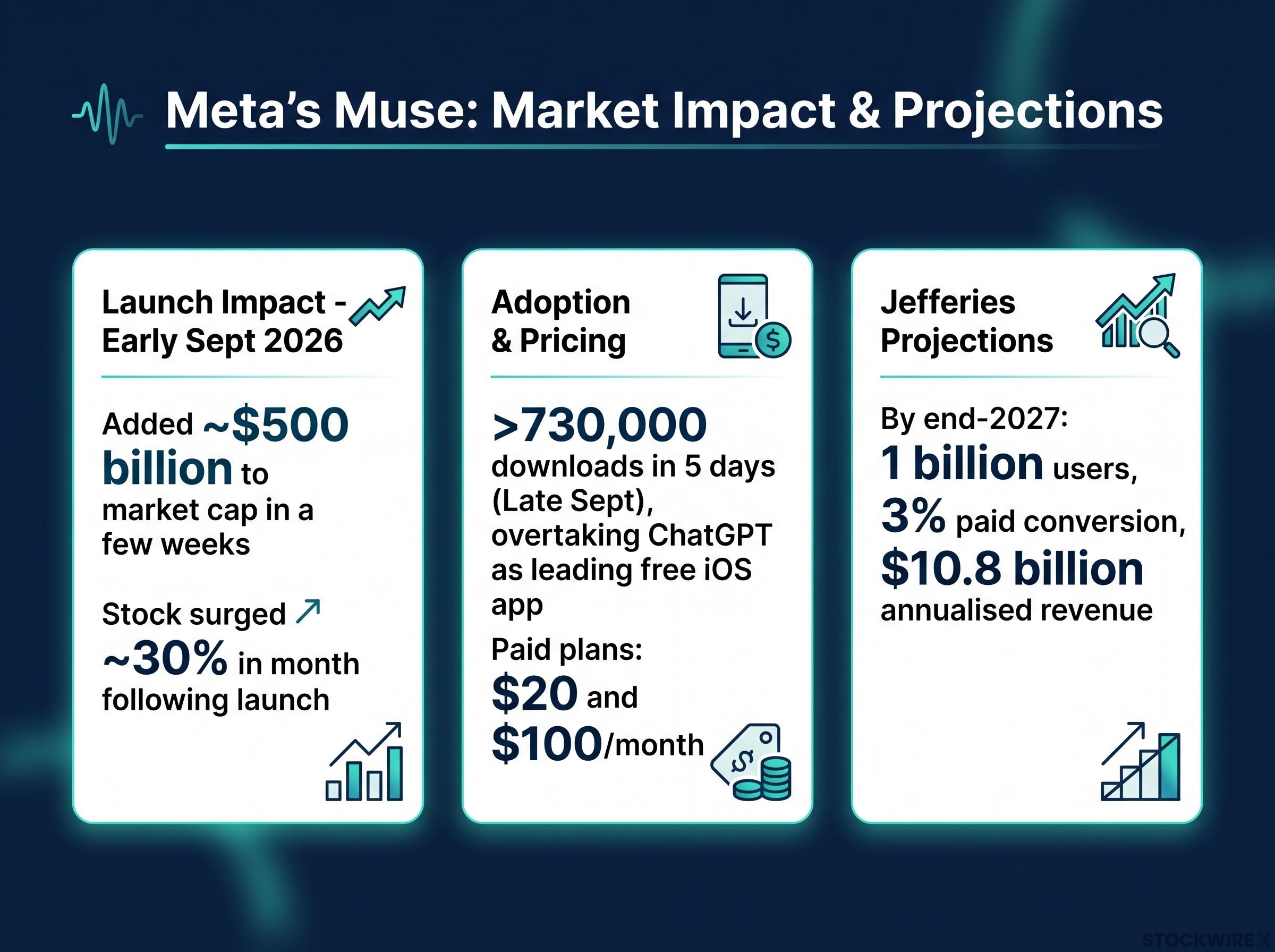
Meta launched Muse in early September 2026, functionally similar to Instinct but reportedly faster, a difference attributed to Meta’s enormous compute resources. To feed its wider superintelligence ambitions, Meta had already taken an approximately $14.3 billion stake in Scale AI for a 49% interest, bringing founder Alex Wang into the fold.
The AI capital cycle that produced Meta’s compute advantage over Instinct is the same cycle consuming roughly 94% of hyperscaler operating cash flow in 2026, a compression that reframes how quickly capital-light text-interface startups can realistically be outspent into irrelevance.
What makes Muse commercially significant is the pricing. Alongside a free tier, Meta introduced paid plans at $20 and $100 per month, establishing its first direct consumer revenue line tied to its AI build-out. Until now, Meta monetised attention through advertising. Muse attaches a recurring subscription directly to AI infrastructure.
The market response was emphatic. Meta’s stock reportedly surged roughly 30% in the month following the launch, outpacing the broader “Magnificent 7” tech cohort and coming within striking distance of its prior all-time high. Early adoption metrics were equally strong: Muse reportedly overtook ChatGPT as the leading free iOS app, with over 730,000 downloads in a five-day span in late September.
The market divergence playing out across large-cap tech is being driven by AI agent catalysts more than by any broad macro movement, with infrastructure and edge-compute providers collecting the gains that platform incumbents are beginning to lose.
Analysts have moved quickly to price the upside.
Jefferies modelling suggests that if Muse reaches 1 billion users by end-2027 and at least 3% convert to a paid plan, it could generate around $10.8 billion in annualised revenue. JPMorgan has described Muse’s potential total addressable market as being “in the tens of trillions of dollars.” Both figures are analyst projections and remain unverified.
Here is the read for you. Meta’s surge this month demonstrates that markets are aggressively rewarding companies that can bolt a recurring consumer revenue line onto their existing AI spend. It also complicates the pure disruption narrative. Incumbents are not just potential victims of the agent layer; the giants with capital and compute can build the dominant agent themselves and capture the shift rather than suffer it.
Disintermediation risk and the new rules of platform survival
That sets up the real question for your holdings: which platforms get hollowed out, and which adapt.
The most exposed businesses share a profile. They are transaction-heavy consumer platforms with largely commoditised offerings, the kind of inventory an agent treats as an interchangeable back-end. Travel booking platforms such as Booking.com and Expedia sit squarely in the firing line, given that agent-directed travel already makes up 40% to 50% of Instinct’s volume. Where an agent optimises purely on price and availability, a travel platform’s brand recognition stops paying rent.
Platform moat erosion follows a pattern investors have seen before: the metrics that once defined competitive advantage, seat counts, daily active users, renewal rates, remain stable long after the structural shift has already begun redirecting high-value transactions to the new interface layer.
The advertising economics shift in parallel. If an agent intercepts intent and routes the purchase directly, traditional display and feed advertising loses prominence, because there is no browsing session to interrupt. Spend is expected to migrate toward sponsored placement within agent recommendation lists and toward transaction-linked routing fees. Merchants end up competing inside agent-controlled auctions rather than buying eyeballs.
The pricing power this hands the agent is considerable. Analysts compare it to the Apple App Store’s control over software access, and to the way food delivery platforms such as DoorDash charge fees to both the consumer and the restaurant. An agent sitting between user and merchant could eventually extract fees from both sides of the same transaction.
The clearest way to see the stakes is to compare the two models directly.
| Dimension | Traditional platforms | Agent interfaces |
|---|---|---|
| User loyalty source | Brand habit and repeat visits to the app | Relationship with the assistant, not the supplier |
| Advertising model | Display and feed ads sold against browsing sessions | Sponsored ranking and transaction-linked routing fees |
| Competitive advantage | Network effects and consumer lock-in | Default routing rights and preferential API access |
The practical takeaway is a screening lens. Look at your consumer discretionary holdings through the question of agent-readiness. Platforms that secure preferential API access to the major agents can stay central to the transaction stack. Those that do not risk becoming invisible commodity providers, generating volume with no ability to charge a premium for it.
Not every incumbent is destined to be hollowed out. Large marketplaces can expose agent-friendly APIs or offer integrated assistants preferential economics, defending their position rather than surrendering it. Muse itself is proof that a giant can become the agent instead of being disintermediated by one.
Navigating the regulatory and behavioural speed bumps
The transition also faces friction that could slow its pace. As agents intermediate transactions across multiple sectors, regulators may start treating them as a new kind of gatekeeper. Preferential routing, opaque ranking algorithms, and the bundling of agents with incumbent ad ecosystems are all likely to attract antitrust scrutiny.
Consumer trust will set the ceiling on speed. Handing an agent your emails, payment credentials, and identity documents expands the attack surface for fraud and raises unresolved liability questions if an agent orders the wrong thing or is deceived. Users may delegate low-stakes chores happily while holding back on high-value financial decisions, which suggests the shift arrives in phases rather than all at once.
For investors wanting to model the specific valuation scenarios, our dedicated guide to AI regulatory capture risk examines how successful self-regulation builds compliance moats around incumbents while failed self-regulation invites direct government intervention that compresses sector valuations.
Pricing the transition from destination platforms to agent infrastructure
The through-line across all of this is a single structural fact: the interface layer is decoupling from the transaction layer. Consumers are attaching their loyalty to the assistant, while the marketplaces underneath become swappable inventory.
That decoupling is where value migrates, and the next 12 months will be defined by a quiet contest over API access and default routing rights. The businesses that win preferential integration stay in the transaction stack. The ones that resist or get locked out risk pricing power evaporating even as their volumes hold.
For monitoring your own holdings, the earnings call is the place to listen. Pay attention to whether consumer platform management is talking about defensive API strategies, agent partnership announcements, or new routing-fee revenue lines. Silence on the agent question, or outright hostility to agent access, is itself a data point about how a platform is positioning for this shift.
The disruption narrative and the incumbent-adaptation narrative are both live, and the evidence points to a market that rewards whoever captures the routing layer, whether that is a text-only startup or a trillion-dollar giant.
This article is for informational purposes only and should not be considered financial advice. Investors should conduct their own research and consult with financial professionals before making investment decisions. Past performance does not guarantee future results, and financial projections are subject to market conditions and various risk factors. Several figures in this article are drawn from unverified reporting and analyst projections, which are speculative and subject to change based on market developments.