
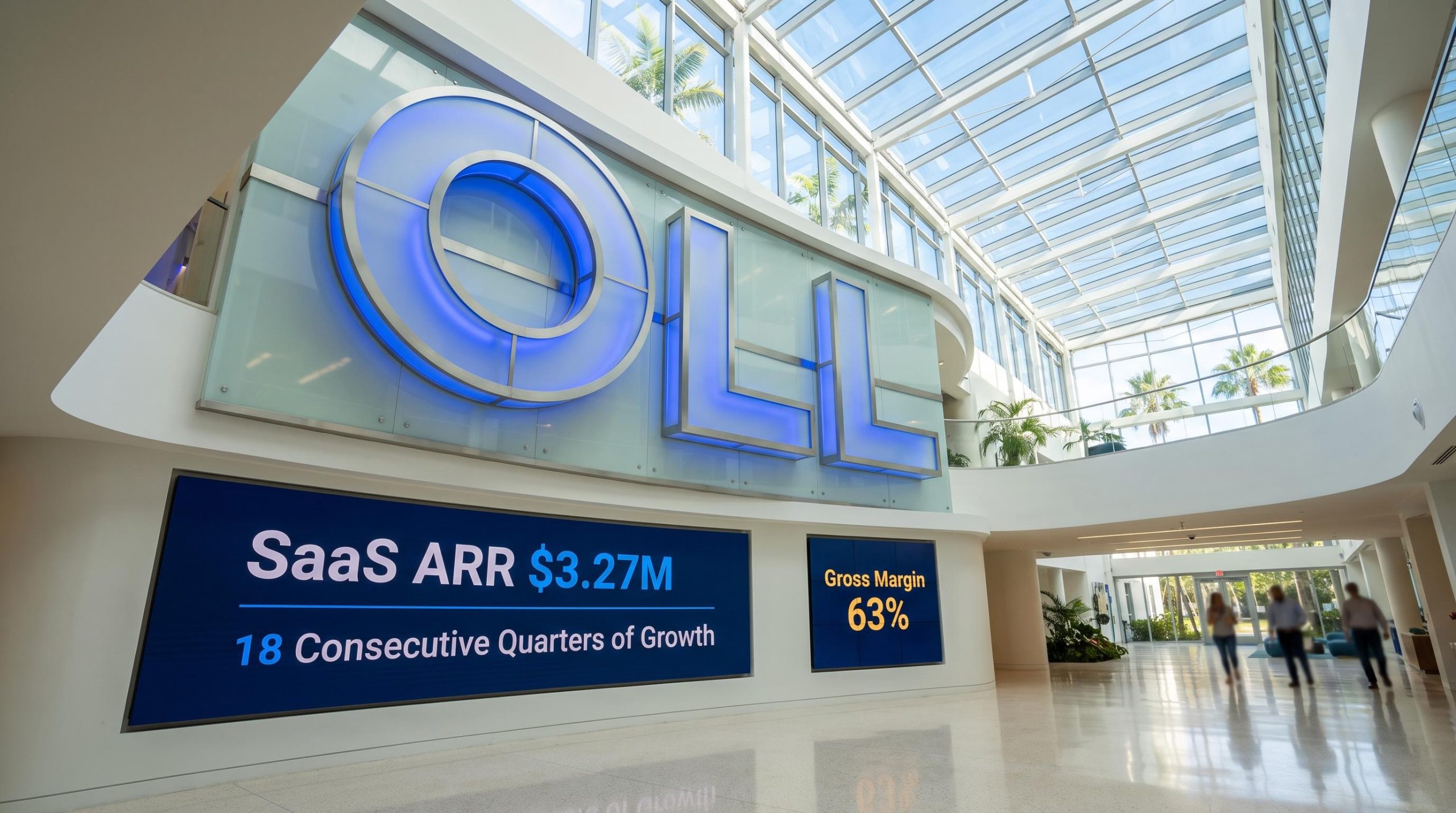
OpenLearning lifts gross profit 64% as SaaS ARR hits record $3.27 million
In its Half-Year Results and Appendix 4D for the six months ended 30 June 2026 (HY2026), OpenLearning Limited (ASX: OLL) delivered record SaaS annual recurring revenue and its highest ever gross margin, as a multi-year shift towards larger institutional contracts became visible in the numbers.
The AI-powered learning management system reported gross profit up 64% to $1.25 million, while revenue rose 42.8% to $1.99 million, from $1.39 million in HY2025.
Platform SaaS annual recurring revenue (ARR) reached a record $3.27 million, up 23.4% year-on-year, marking the Company’s 18th consecutive quarter of SaaS revenue growth. Gross margin expanded 8.4 percentage points to a record 63%, up from 15.3% three years ago.
The results reflect a deliberate strategy of moving from short courses and micro-credentials towards larger, multi-year institutional learning management system (LMS) contracts, a transition now clearly reflected in the financial outcomes for the period.
When big ASX news breaks, our subscribers know first
Record revenue and expanding margins
The top-line growth was underpinned by expanding recurring revenue and improving operating leverage across the platform business. Gross sales rose 22.2% to $2.62 million, supported by higher-value institutional agreements.
Key financial movements for the half-year included:
-
Platform SaaS fees up 30.6% to $1.58 million
-
SaaS gross margin of 65.6%, up from 54.4% in the prior corresponding period
-
Net revenue up 89.0% since the first half of 2023
-
Cost of sales (excluding marketplace) down 17.4%, from $0.89 million to $0.74 million
The combination of rising net revenue and falling cost of sales demonstrates the operating leverage inherent in a recurring-revenue model, where additional revenue can be added without a proportional increase in cost.
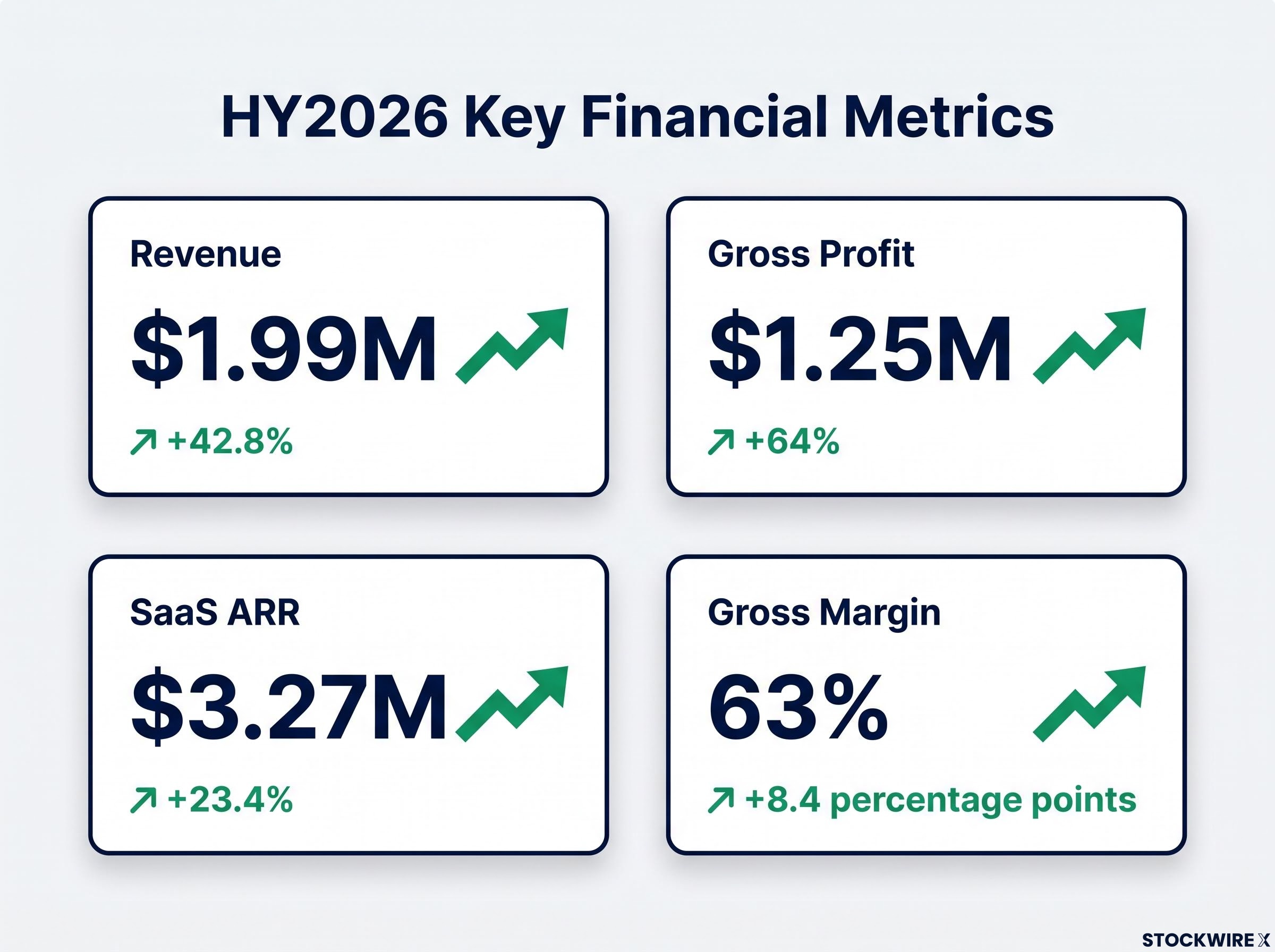
| Metric | HY2026 | HY2025 | Change |
|---|---|---|---|
| Revenue | $1.99M | $1.39M | +42.8% |
| Gross profit | $1.25M | – | +64% |
| Gross margin | 63% | – | +8.4pp |
| Platform SaaS fees | $1.58M | – | +30.6% |
| SaaS ARR | $3.27M | – | +23.4% |
| EBITDA loss | $1.22M | – | -27.1% |
| Loss after tax | $1.63M | – | -20.5% |
A growing customer base built on higher-value contracts
The half-year results reflected a deliberate move towards larger, higher-value institutional customers rather than simply increasing customer numbers.
-
Average SaaS ARR per B2B customer up 24.5% to $12,369
-
263 active B2B SaaS customers across 16 countries at period end
-
Australia, Malaysia and the Philippines account for approximately 88.6% of ARR
-
51.9% of ARR now generated from customers outside Australia
-
Over three years, ARR has grown 77.2% while customer numbers increased 16.4%
The disparity between ARR growth and customer growth signals a stickier, more scalable revenue base, with each customer contributing a larger and more predictable annual value.
Understanding SaaS ARR — why recurring revenue matters
Software-as-a-Service (SaaS) refers to software provided to customers on a subscription basis rather than as a one-off purchase. Annual recurring revenue (ARR) measures the value of those subscriptions on an annualised basis, providing a forward view of predictable income.
For OpenLearning, 18 consecutive quarters of SaaS growth indicate a revenue base that renews period after period, reducing reliance on winning entirely new business each half. Recurring revenue of this kind is generally valued for its predictability.
Gross margin measures how much of each revenue dollar remains after the direct cost of delivering the service. As margins expand while costs stay flat or fall, additional revenue increasingly flows through to the bottom line, a dynamic often described as operating leverage.
Pathway to break-even
The Company’s cash and loss position continued to improve across the period. The EBITDA loss improved 27.1% to $1.22 million, the smallest loss of the past seven half-year periods, while the loss after tax narrowed 20.5% to $1.63 million.
Cash generation strengthened notably:
-
Total cash receipts from customers up 20.8% to $2.91 million
-
Record quarterly cash receipts of $1.653 million in Q2 FY26, the highest in the Company’s history
-
Net operating cash outflow improved 21% quarter-on-quarter to $0.533 million in Q2 FY26
-
The core operating business used just $0.19 million of cash in the half-year
Sales and marketing, the two new divisions, and listed-company costs together accounted for approximately 84.3% of the Group’s half-yearly cash outflow. Excluding these items, the underlying platform business is approaching break-even. The Group ended the half-year with cash and cash equivalents of $0.87 million.
Philippines and Malaysia drive expansion
New institutional customers across the Philippines and Malaysia were the primary growth engines during the half.
In the Philippines, Philippine Normal University, the country’s National Center for Teacher Education, became the first university customer secured under the CE-Logic reseller agreement, covering 5,000 students initially and expandable to approximately 12,000 students. The direct sales team also signed LMS SaaS agreements with Thames International School, Notre Dame Jolo College, Baliuag University and Manila Central University.
The CE-Logic reseller channel opened access to a network of more than 1,000 Philippine education institutions, with Philippine Normal University becoming the first university converted through the partnership in May 2026 before the pipeline accelerated further through the half.
Subsequent to the half-year end, Holy Cross of Davao College signed a 4-year SaaS agreement covering a minimum of 11,000 learners per year, with a minimum value of approximately A$300,000 over the term, the largest agreement secured through the CE-Logic partnership to date.
In Malaysia, where OpenLearning holds SaaS agreements with more than 40% of the country’s major higher education institutions, expansions included:
-
Universiti Poly-Tech Malaysia expanded from 1,500 to 8,000 learners, now covering all on-campus students
-
Sunway University expanded its agreement to cover newly developed elective courses
-
A 5–10x total contract value uplift available within the existing Malaysian customer base
The Company also progressed low-cost market entries in India, signing a five-year usage-based SaaS agreement with Guru Jambheshwar University of Science and Technology, and in Indonesia, signing a new agreement with Universitas Muhammadiyah Lamongan.
AI at the core and two new products across the student journey
Artificial intelligence played a dual role during the period, serving as both a product differentiator and an internal efficiency driver.
Within the platform, the AI Course Builder and AI Assistant remained key selling points in competitive procurement processes against incumbents such as Canvas, Blackboard and Moodle, with AI outcome-based rubric generation and support for agentic AI in development. Internally, AI-enabled software development increased the velocity of feature releases without a corresponding increase in headcount, contributing directly to the margin expansion achieved in the half.
Two new products extended the platform across the student journey:
-
The Uni Guide, launched in May 2026, an international student recruitment marketplace with 15 university and college partners and close to 100 recruitment partners onboarded
-
Employability Advantage, relaunched in May 2026 as a fully branded employability portal with AI resume building, AI skills assessment, career planning tools and job boards, integrated with the LMS
Together, these launches complete an important step in positioning OpenLearning as “the AI-powered LMS for the entire student journey”.
CEO commentary
Adam Brimo, Group CEO & Managing Director
“The first half of 2026 demonstrates that our strategy is working. Gross profit rose 64%, revenue grew 43%, and our gross margin reached 63%, up from just 15% three years ago, while SaaS ARR hit a record $3.27 million in our 18th consecutive quarter of SaaS revenue growth.
Cash outflows from the core platform business declined, and we have continued to invest in new product development, including embedding generative AI across our platform while launching The Uni Guide and Employability Advantage. OpenLearning now supports institutions across the entire student journey. With a growing pipeline in the Philippines, continued expansion in Malaysia and early traction in India and Indonesia, we are well positioned for the second half of 2026.”
Outlook for the second half of 2026
With record ARR, expanding margins and a narrowing loss, the Company stated its focus for the second half of 2026 is to convert its growing pipeline into larger, multi-year contracts while maintaining cost discipline.
Management pointed to continued momentum in the Philippines and Malaysia, alongside early traction in India and Indonesia, as the basis for the second-half strategy. No specific financial targets were disclosed for the remainder of the calendar year.
Don’t Miss the Next ASX Tech Winner
Big News Blast delivers FREE breaking ASX tech news directly to your inbox within minutes of release, complete with in-depth analysis. Join 20,000+ subscribers already getting the edge on market-moving announcements the moment they drop. Click the “Free Alerts” button at StockWire X to start receiving alerts today.