
OpenLearning’s H1 2026 results show margins expanding to 63% as SaaS revenue compounds
In its H1 2026 results presentation, released on 28 August 2026 for the period ending 30 June 2026, OpenLearning Limited reported gross profit up 64% to $1.25m and gross margin expanding to 63%, a substantial lift from 15.3% three years earlier.
The ASX-listed AI-powered Learning Management System (LMS) business, which serves universities across the Asia-Pacific, also recorded SaaS Annual Recurring Revenue (ARR) at a record $3.27m. Management noted the result marks the company’s 18th consecutive quarter of SaaS ARR growth.
When big ASX news breaks, our subscribers know first
Profitability trajectory: gross profit up 64%, losses narrowing
The H1 2026 results reflected a consistent operating leverage narrative: revenue rising, cost of sales falling, and losses shrinking. As the platform scaled, margins expanded while the core business consumed less cash.
| Metric | Value | Change (pcp) | Detail |
|---|---|---|---|
| Gross Profit | $1.25m | +64% | Half year to 30 Jun 2026 |
| Gross Margin | 63% | +8.4 pts | Up from 15.3% in H1 2023 |
| SaaS Revenue | $1.58m | +30.6% | Platform subscription |
| Adjusted EBITDA | ($1.22m) | 27% smaller loss | Smallest in three years |
Supporting detail from the presentation included:
-
Net revenue grew 89% from H1 2023 to H1 2026, and was up 42.8% on the prior corresponding half.
-
Cost of sales excluding marketplace fell 17% (from $0.89m to $0.74m) even as revenue nearly doubled.
-
SaaS gross margin reached a series-high 66% in H1 2026, up from 54.4% in H1 2025.
The adjusted EBITDA loss of $1.22m represented the smallest loss in the three years for which data is available. The company remains loss-making, though the trajectory points to narrowing losses, with the company targeting cash-flow break-even in 2027.
What an end-to-end LMS means for investors
OpenLearning positions itself as an end-to-end platform, meaning it supports students across their full lifecycle rather than one stage in isolation.
The presentation framed this as a five-stage student journey:
-
Attract — global marketplace and branded portal.
-
Learn — AI-powered LMS and AI Course Builder.
-
Credential — outcome-based assessment and digital badges.
-
Showcase — auto-generated lifelong ePortfolios.
-
Employ — employability suite and AI Talent Search.
For universities, the value proposition is that the LMS becomes a profit centre rather than a cost, unlocking new revenue through marketplace sales, micro-credentials and online degrees, while lifting engagement, retention and graduate employability.
SaaS ARR hits record $3.27m as customer quality improves
The Q2 FY26 SaaS metrics reflected a deliberate shift towards larger, multi-year, higher-value and lower-churn customer relationships. Customer growth has reaccelerated on the back of this strategy.
Key figures from the quarter included:
-
Platform SaaS ARR: $3.27m (+23% YoY)
-
B2B SaaS ARPC: $12,369 (+24.5% YoY)
-
B2B SaaS customers: 263 active (+8 vs Q1)
-
Total cash receipts up 31% on Q1, driven by contract expansion in Australia and Malaysia plus new implementations in the Philippines and Indonesia.
Adam Brimo, Group CEO & Managing Director
“The first half of 2026 demonstrates that our strategy is working. Gross profit rose 64%, revenue grew 43%, and our gross margin reached 63%, up from just 15% three years ago, while SaaS ARR hit a record $3.27 million in our 18th consecutive quarter of SaaS revenue growth.
Cash outflows from the core platform business declined, and we have continued to invest in new product development, including embedding generative AI across our platform while launching The Uni Guide and Employability Advantage.
With a growing pipeline in the Philippines, continued expansion in Malaysia and early traction in India and Indonesia, we are well positioned for the second half of 2026.”
A pan-Asian platform: 52% of ARR now offshore
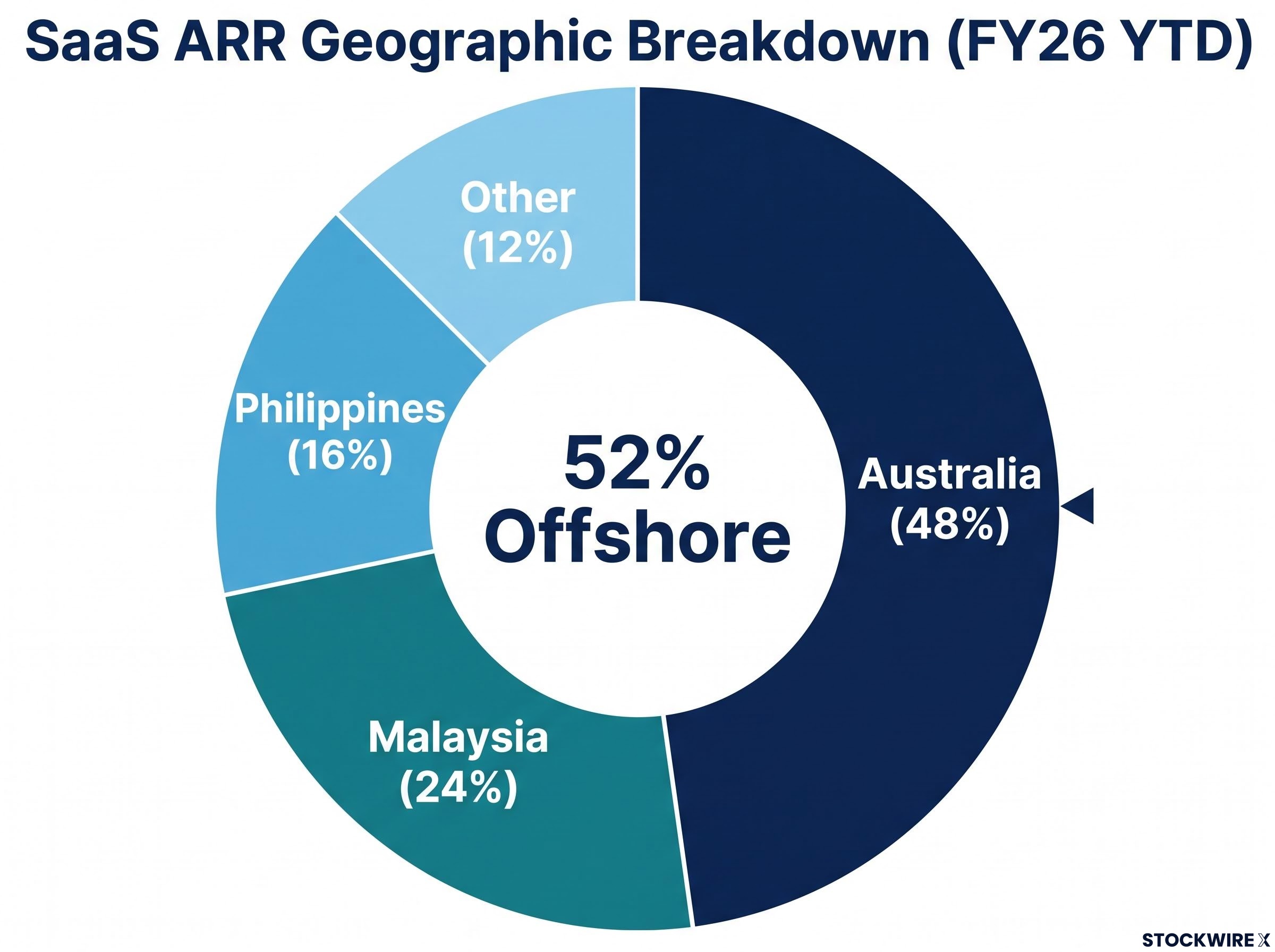
Geographic diversification formed a central part of the investment thesis outlined in the presentation, reflecting shrinking concentration risk. Management stated that 52% of SaaS ARR now comes from customers outside Australia.
| Country | Share of SaaS ARR (FY26 YTD) |
|---|---|
| Australia | 48% |
| Malaysia | 24% |
| Philippines | 16% |
| Other | 12% |
Supporting detail included:
-
Australia, Malaysia and the Philippines together contribute approximately 88% of SaaS ARR.
-
Malaysia: national partnerships established across public, private and government-linked universities, plus corporates.
-
Philippines: selected as the LMS of choice by Philippine Normal University and National University.
The Philippine Normal University agreement, signed in May 2026, was the first conversion through the CE-Logic reseller channel and established the institutional reference customer that underpinned the Philippines’ subsequent pipeline acceleration into H2 2026.
- An early-stage sales pipeline established in Indonesia and India, supporting future regional expansion.
Core cash burn falls 86.9% as operating leverage builds
The presentation detailed a marked improvement in cash flow, which management linked to the path towards break-even. Core operating outflow, with capitalised development added back on a like-for-like basis, fell from $1.45m in H1 2023 to $0.19m in H1 2026, a reduction of 86.9%.
Management noted that approximately 84.3% of half-yearly cash outflow relates to sales and marketing, the two new divisions (Employability Advantage and The Uni Guide) and listed-company costs, positioning this as growth investment rather than core burn.
The H1 2026 breakdown was outlined as follows:
-
Core: $0.19m
-
Sales and marketing: $0.55m
-
EA and Uni Guide: $0.22m
-
Listed-company costs: $0.25m
-
Statutory operating outflow: $1.21m
Management flagged that listed-company costs remain a substantial portion of cash outflows, and that steps were taken during H1 2026 to reduce them.
Outlook: targeting cash-flow break-even in 2027
Management stated the company continues to target cash-flow break-even in 2027 as recurring revenue and operating leverage build.
New product development highlighted in the presentation included embedding generative AI across the platform and the launch of The Uni Guide and Employability Advantage. The growth pipeline features continued expansion in Malaysia, a growing pipeline in the Philippines, and early traction in India and Indonesia.
Investors exploring the commercial mechanics behind these new divisions can find our detailed coverage of The Uni Guide marketplace launch, which explains the 15-university partner structure, the 98 recruitment agents onboarded at go-live, and the commission model targeting revenue from the September 2026 UK intake cycle.
The investment thesis presented centres on compounding recurring revenue, expanding margins, falling core cash burn and increasing geographic diversification.
Don’t Miss the Next ASX Tech Winner
Big News Blast delivers FREE breaking ASX tech news and in-depth analysis directly to your inbox within minutes of release. Join 20,000+ investors already staying ahead of the market. Click the “Free Alerts” button to start receiving real-time alerts the moment ASX announcements drop.