

dorsaVi targets humanoid robotics with decade of movement data, neuromorphic IP and RRAM
dorsaVi Limited (ASX: DVL) has begun engaging robotics companies to explore applications for its established human movement data library, bespoke motion-capture capabilities, exclusively licensed Reflex Engine neuromorphic IP, and RRAM hardware development program. The initial focus is humanoid balance, coordination and recovery, with discussions intended to identify application requirements and potential technical evaluations.
Over more than a decade, dorsaVi has accumulated an extensive library of real-world movement data collected across clinical, workplace and elite sporting settings via its FDA-cleared wearable sensor devices. That data already provides a baseline for occupational health and safety studies and is now being presented to robotics developers for potential additional applications.
When big ASX news breaks, our subscribers know first
The unsolved balance problem — and why dorsaVi’s data is relevant
Humanoid robots can now walk reliably on flat, predictable ground. What they continue to struggle with is everything that happens when conditions change: an uneven surface, an unexpected load, a slip, a push, or a missed step.
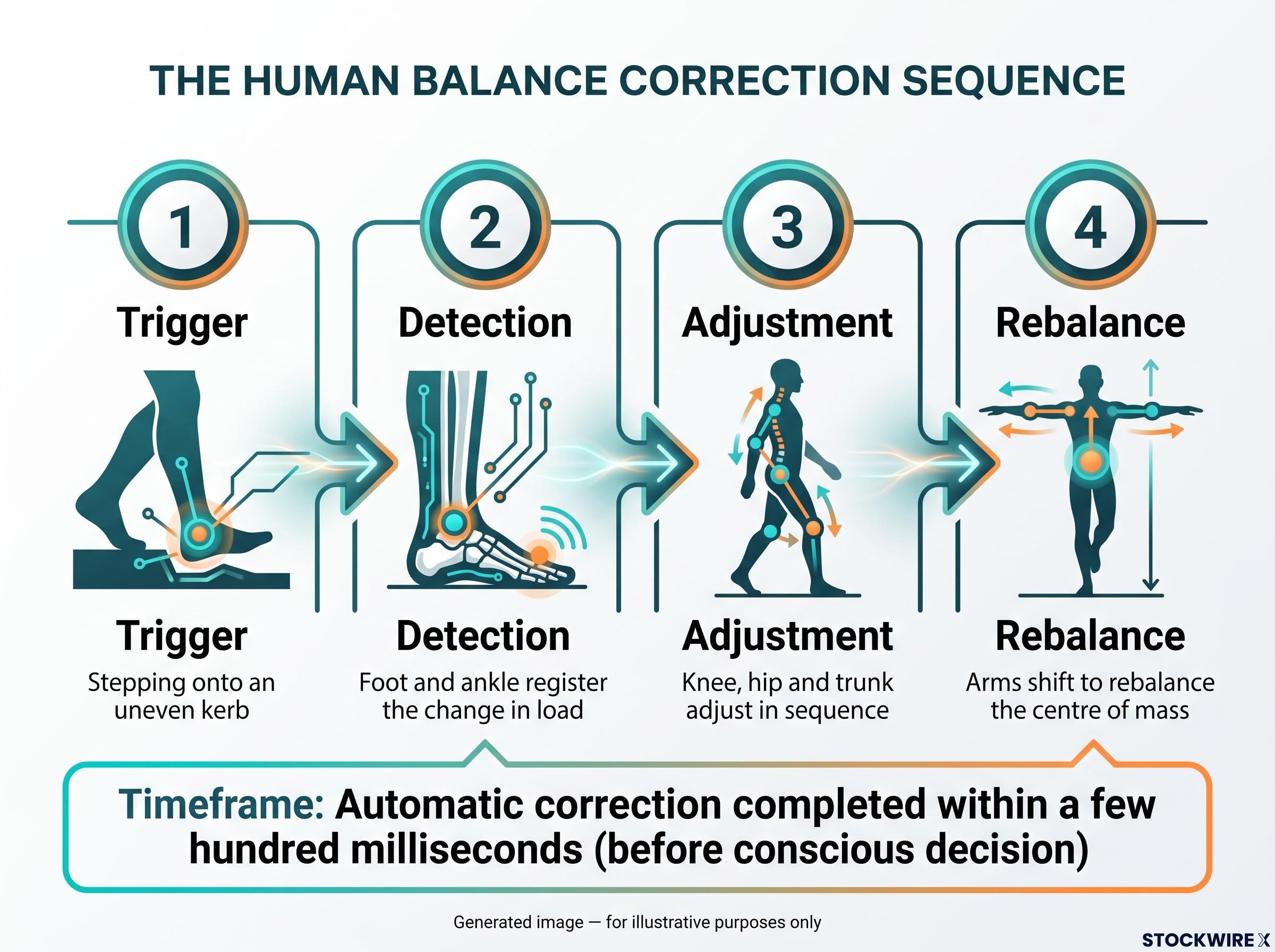
When a person steps onto an uneven kerb, the correction unfolds automatically. The foot and ankle register the change in load; the knee, hip and trunk adjust in sequence; the arms shift to rebalance the centre of mass. The entire sequence is completed within a few hundred milliseconds, well before any conscious decision is made.
What balance correction actually requires
For a machine to replicate this, three things are needed:
- Real-world movement data showing how a stable body detects and corrects instability
- Local processing that can respond across multiple joints without sending data to a central processor and waiting for an instruction
- Low power use, so the system can run continuously within the battery limits of a standalone robot
Most humanoid developers are approaching this problem from simulation and first principles. dorsaVi has spent more than a decade measuring how the human body already solves it.
What dorsaVi has already measured
Table 1 sets out the movement categories in dorsaVi’s sensing library and their relevance to humanoid robotics.
| Movement Category | What dorsaVi’s platforms have measured | Relevance to machine balance |
|---|---|---|
| Gait and locomotion | Stride, cadence, symmetry and loading across walking and running | Baseline locomotion, and how it changes under load and fatigue |
| Change of direction | Trunk and lower-limb mechanics through turning, cutting and deceleration | The transitions at which balance is most frequently lost |
| Postural control | Trunk position, sway and weight distribution under static and dynamic conditions | How a stable state is defined and maintained |
| Perturbation and recovery | Responses to slips, uneven loading and instability in real environments | The correction sequence itself — what moves, in what order, and how quickly |
| Loading and impact | Forces absorbed through landing, lifting and repetitive task work | Tolerance limits, and how a system protects itself |
| Impairment and compensation | Movement in populations with injury, pain or restricted range of motion | How a system continues to function when a component underperforms |
Coverage and fidelity across each category are the subject of dorsaVi’s current internal review.
Three capabilities, one Physical AI strategy
dorsaVi’s approach to Physical AI connects three distinct assets into a single development pathway:
- Movement data and bespoke capture — an established library of real-world recordings across clinical, workplace and sporting applications, complemented by wearable-sensor and Video AI capture designed to generate additional datasets tailored to defined tasks and conditions
- Reflex Engine — dorsaVi’s exclusively licensed neuromorphic IP, designed to support rapid local responses to sensor inputs; the company intends to assess its application to selected balance and coordination tasks identified through robotics engagement
- RRAM hardware — memory technology under development with NTU and ITRI, with 180-nm validation progressing toward a future 22-nm platform; the analogue characteristics of the material are being investigated for selected Compute-in-Memory functions, including neuromorphic processing and physical artificial neural networks
The energy-characterisation work on RRAM memory state updates was announced 14 September 2026; this announcement adds the movement data and balance application layer.
RRAM energy efficiency benchmarking work, commenced in September 2026, is establishing the first device-level performance baseline for state-update operations, with results designed to feed directly into array-level evaluation on the RRAM Validation Chip developed with NTU and ITRI.
CEO outlines next steps and strategic rationale
dorsaVi Group Chief Executive Officer Mathew Regan connected all three strategic pillars in his commentary on the announcement:
Mathew Regan, Group Chief Executive Officer, dorsaVi
“This opportunity connects the three parts of our strategy. We have an established sensing and data business, exclusively licensed neuromorphic IP designed for rapid local responses, and an RRAM hardware program progressing with NTU and ITRI. Our objective is to bring these capabilities together for selected Physical AI applications.”
The company’s next steps, as disclosed in the announcement, are expected to include:
- An internal data review to establish which movement categories are represented, their fidelity, and the preparation requirements for each
- Definition of the Reflex Engine workload for a balance application
- Identification of specific opportunities with robotics developers
- Potential joint evaluation, subject to engagement outcomes
dorsaVi is not a pure-play robotics company. It holds a rare combination of real-world human movement training data collected over more than a decade using FDA-cleared sensors, exclusively licensed neuromorphic compute IP, and a developing semiconductor program. Together, these form what the company describes as a credible Physical AI foundation. Investors should note that this remains early-stage engagement, not a commercial agreement, but the strategic logic connecting all three assets is now clearly articulated in a single announcement.
The Sensor v6.5 Physical AI wearable, commercially launched in July 2026 on the same FDA-cleared, TGA-certified hardware already deployed by BHP, Boeing and Toyota, runs the full measure-analyse-decide-act loop entirely on the device with no cloud connection, demonstrating that the on-sensor processing architecture the robotics engagement relies on is already in commercial deployment.
Don’t Miss the Next Tech Breakout in Your Inbox
Big News Blast delivers FREE breaking ASX tech and healthcare news directly to your inbox within minutes of release, complete with in-depth analysis already done for you. Join 20,000+ subscribers who stay ahead of the market the moment news breaks. Click the “Free Alerts” button at StockWire X to get started today.