

Qualitas caps FY26 with record deployment and 20% profit lift
In its FY26 Full Year Results Presentation, released on 20 August 2026, Qualitas Limited reported a normalised net profit before tax (NPBT) of $63.4m, up 20% on FY25, alongside record deployment of $6.5bn, a 42% increase.
The alternative real estate investment manager outlined a year of scalable growth, with Fee Earning FUM (FEF) reaching $11.9bn (up 36%) and margins expanding across the platform. Management issued FY27 NPBT guidance of $74m–$80m, representing growth of 17% to 26%.
Qualitas ended the year with approximately $11.6bn of committed FUM as at 30 June 2026. A market briefing was scheduled for 9:30am (AEST) on Friday, 21 August 2026.
When big ASX news breaks, our subscribers know first
FY26 headline results at a glance
The company delivered growth across its core funds management metrics, with the funds management (FM) gross operating margin reaching a record 45% and FM EBITDA margin achieving 54%.
| Metric | FY26 | Change vs FY25 | Note |
|---|---|---|---|
| Fee Earning FUM (FEF) | $11.9bn | +36% | Excludes ~$243m Qualitas Europe FUM |
| Deployment | $6.5bn | +42% | Record year |
| Funds Management Revenue | $85m | +27% | Recurring FM revenue |
| Normalised NPBT | $63.4m | +20% | Adjusted for abnormal items |
| Statutory NPAT | $42m | +25% | |
| FY26 Dividend | 11.25cps | +13% |
Secondary highlights from the presentation included:
-
Record deployment driven by larger investments, with average new investment size rising to approximately $130m
-
Qualitas Europe office established, contributing roughly $243m in FUM (excluded from FEF)
-
Arch Finance loan book up 36%, with the portfolio returning above $300m
-
Build-to-rent (BTR) equity earnings contribution more than doubling to $1.0m
What drove the earnings growth
The earnings uplift was underpinned by broad-based growth across the funds management engine. Base management fees rose 27% to $62m, while transaction fees increased 28% to $23m.
Net performance fee revenue jumped 70% to $13.7m, driven by strong credit fund performance. Management noted these fees are converting to cash, with approximately $19m in performance fees received post balance date, following around $12m in the first half of FY26.
Fee income scaling with deployment
Base management fee and transaction fee growth was tied directly to the record deployment year. The company reported that 72% of deployment came from repeat borrowers and 29% from follow-on investments, reflecting the stickiness of its institutional relationships.
Margin expansion and the AI angle
The FM gross operating margin lifted to 45.4% from 40.7%, while the FM EBITDA margin reached 54.3%. Core employee cost growth of 17% ran well below revenue growth of 27%, reflecting economies of scale from larger investments.
Management highlighted that AI investment is expected to decouple headcount from FUM growth. Since FY22, FEF has grown 3.6x while full-time equivalent (FTE) staff numbers grew only 1.9x.
The company’s long-term margin target was upgraded from above 50% to above 60% at a June 2026 strategy briefing, where management detailed a proprietary AI credit execution platform running 33 analytical agents and more than 370 automated verification checks per loan.
Understanding alternative real estate credit
An alternative real estate investment manager raises capital from institutional, wholesale and retail investors and deploys it into real estate private credit (lending) and real estate private equity. Qualitas operates across both, with a focus on residential and commercial real estate.
A central concept is Fee Earning FUM (FEF), which represents the amount earning base management fees across various calculation metrics.
The gap between Invested FUM and FEF matters because much of the difference sits in undrawn construction credit.
As construction projects draw down over time, that undrawn capital progressively begins earning fees, building embedded future income the company can see coming.
Base management fees are attractive to investors because they are recurring and predictable, unlike one-off transaction fees. This means already-committed capital creates visibility into future earnings, a key feature of the Qualitas model.
The market backdrop working in Qualitas’s favour
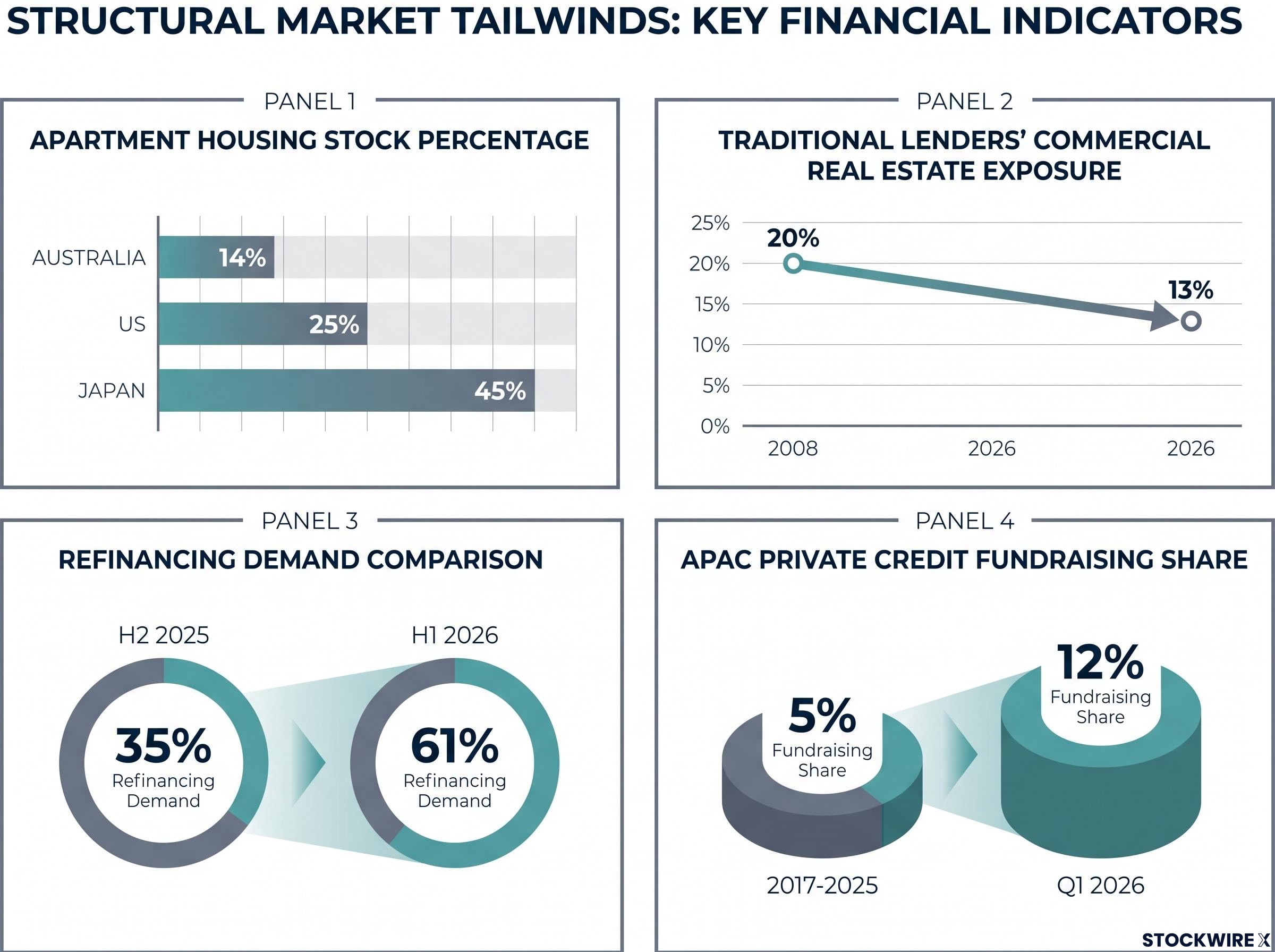
Management outlined several structural tailwinds supporting the business, attributing these views to company analysis and cited industry sources.
-
A persistent structural housing shortage, with apartments representing only approximately 14% of Australian housing stock compared with 25% in the US and 45% in Japan, according to OECD data.
-
Traditional lenders structurally retreating from commercial real estate (CRE), with authorised deposit-taking institution CRE exposure falling from 20% in 2008 to 13% in 2026, leaving a $423bn CRE exposure and a related refinancing opportunity.
-
Surging refinancing demand, with 61% of expected financing demand in H1 2026 tied to refinancing versus 35% in H2 2025, according to the CBRE Australia Lender Sentiment Survey.
-
Private credit capital shifting toward Europe and APAC, with the APAC share of fundraising rising from 5% (2017–2025) to 12% in Q1 2026.
-
Capital concentrating with larger managers, with funds targeting $1bn or more capturing 71% of capital targeted.
Financial position and cash flow
Qualitas reported net assets of $398.5m, up from $380.4m in FY25. The company’s cash position stood at $46.2m, down from $148.8m.
This decline reflected strategic redeployment rather than any deterioration. Balance sheet investments rose to $242.3m from $166.0m, alongside the Starz acquisition and increased underwriting and co-investment positions. The company noted it retains capacity to support new co-investments through recycling of short-term investments.
The Starz acquisition, completed in June 2026 for A$36.5 million funded entirely from existing cash reserves, gave Qualitas immediate access to a £376 million CRE credit portfolio and a local team of 10 staff with established sovereign wealth and pension fund relationships.
Management commentary
The presentation noted that balance sheet investment growth reflected consistent deployment and the Starz acquisition, with approximately $19m in performance fees received post balance date following around $12m received in the first half of FY26.
FY27 guidance and outlook
The company issued FY27 NPBT guidance of $74m–$80m, representing growth of 17% to 26%, with an estimated EPS range of 17.2–18.6cps. Guidance excludes any mark-to-market movements on the QRI co-investment and QRI capital raising costs.
Management outlined the following growth drivers for FY27:
-
Recurring base management fees remaining the primary driver of growth, supported by a higher opening FEF balance approximately 21% above the FY26 average.
-
Employee cost growth expected to remain below base management fee growth, supporting continued margin expansion.
-
Increasing performance fee recognition as two construction credit funds enter years four and five.
-
Higher earnings contribution from Arch Finance.
-
Qualitas Europe profitability supported by expected new mandates, with active discussions underway on a pan-European private credit fund.
The company confirmed its FY27 dividend is targeted in line with a payout ratio of between 50% and 95% of operating earnings. Guidance has been made on the basis of no adverse change in current market conditions.
The investment takeaway
FY26 delivered scalable growth for Qualitas, combining record deployment, margin expansion and growing performance fees that are converting to cash. The company enters FY27 with visible momentum and approximately $2.4bn of available capital for deployment.
Total capital deployed plus available capital reached $14.3bn, up 21% on FY25, which management indicated supports approximately 20% short-term FEF growth, reinforcing the embedded nature of the group’s growth story.
Stay Ahead on ASX Finance and Real Estate News
Big News Blast delivers FREE breaking ASX announcements straight to your inbox within minutes of release, complete with in-depth analysis already done for you. Join 20,000+ investors who never miss a market-moving update. Click the “Free Alerts” button at Big News Blast to get started today.