

NRC issues final Environmental Impact Statement for Paducah Laser Enrichment Facility
Silex Systems Limited (ASX: SLX; OTCQX: SILXY) has advised that the US Nuclear Regulatory Commission (NRC) has issued the final Environmental Impact Statement (EIS) in support of a licence for the construction and operation of the Paducah Laser Enrichment Facility (PLEF). The facility is planned by Global Laser Enrichment (GLE), the exclusive licensee of the SILEX laser enrichment technology for uranium.
The EIS is the first of two reports underpinning the NRC licence, which would authorise GLE to construct and operate the PLEF using the SILEX technology to enrich uranium for the production of nuclear fuel. For investors, it marks a regulatory step on the pathway to that licence.
Michael Goldsworthy, CEO/Managing Director, Silex
“We are delighted with the finalisation of the EIS and look forward to the final SER being issued in the coming weeks…”
When big ASX news breaks, our subscribers know first
What the EIS milestone means for GLE and Silex
How the EIS fits into the licensing pathway
The EIS follows the NRC’s evaluation of GLE’s Environmental Report, submitted in December 2024, and consideration of comments received during the public review process.
An Environmental Impact Statement is a document that assesses the environmental effects of a proposed project. The second report, the final Safety Evaluation Report (SER), is the NRC’s other report underpinning the licence. Together, the two reports underpin the NRC licence.
Commercialisation progress behind the milestone
The announcement says the milestone builds on GLE’s continued commercialisation progress, which includes:
- Advancement of the SILEX technology maturation and readiness program
- Preparations for commercial-scale deployment
- Execution of a long-term offtake agreement with Cameco for future nuclear fuel production
Together, these achievements strengthen the foundation for development of a new domestic source of uranium enrichment capacity to support the growing needs of the US nuclear energy sector.
The Cameco offtake agreement covers the full planned PLEF product range, including natural UF6, LEU, LEU+ and HALEU, with pricing tied to Cameco’s average realised price net of selling costs across its long-term contract portfolio.
What the PLEF licence would authorise
Goldsworthy said the PLEF would become the world’s first laser-based enrichment facility for the production of natural grade uranium (from depleted uranium tails) and low-enriched uranium (LEU) with uranium-235 assays up to 5%.
He added that the NRC licence would also authorise GLE to produce LEU+ with assays up to 8%, which he described as a new fuel grade being sought by nuclear utilities to improve power plant economics.
| Product | Assay | Source of material or use |
|---|---|---|
| Natural grade uranium | n/a | From depleted uranium tails |
| LEU | Up to **5%** | Uranium-235 assay |
| LEU+ | Up to **8%** | New fuel grade sought by nuclear utilities to improve power plant economics |
Longer term, subject to various factors including industry and government support, and a feasibility assessment for the PLEF leading to a positive Final Investment Decision (FID), the SILEX technology could become a major contributor to nuclear fuel production for the world’s current and future nuclear reactor fleets.
That could include natural grade uranium as UF6, LEU and LEU+, and high-assay LEU (HALEU) for next-generation advanced reactors, including small modular reactors.
What happens next for Silex and the PLEF licence
The announcement sets out the following upcoming steps:
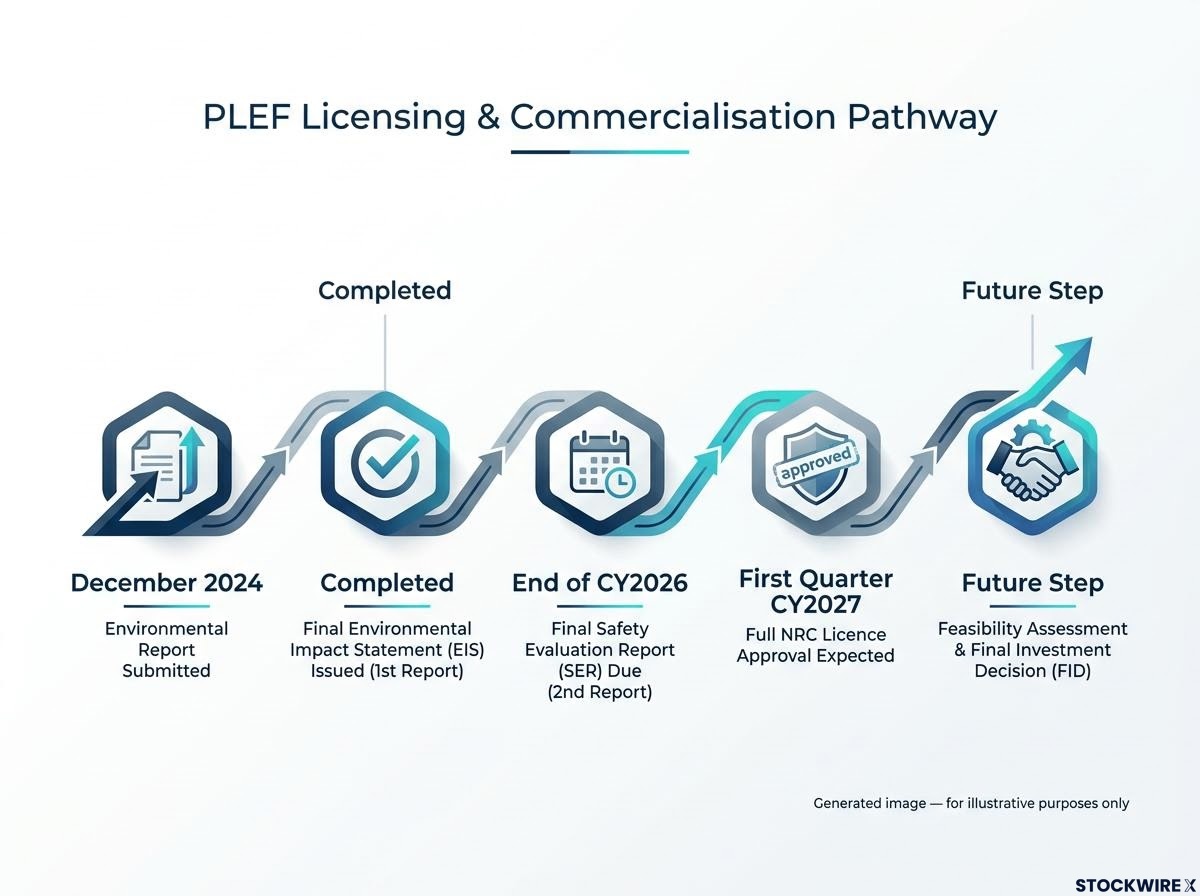
- Final Safety Evaluation Report (SER): due to be released before the end of CY2026, as the second report underpinning the NRC licence.
- Full NRC licence approval: expected to be issued in the first quarter of CY2027, which would authorise GLE to construct and operate the PLEF.
- Feasibility assessment and FID: a feasibility assessment for the PLEF leading to a positive FID, subject to industry and government support.
Licensing progress, the Cameco offtake agreement and the SILEX technology maturation program together shape the picture for Silex, which has a 51% interest in GLE. Silex notes that success of the proposed Paducah commercial project remains subject to a number of factors, including the satisfactory completion of the technology maturation program, nuclear fuel market conditions, industry and government support, project feasibility and commercial plant licensing.
For readers wanting to see how the PLEF is being funded alongside its licensing progress, our detailed coverage of the Kentucky incentives package sets out the US$98.9 million state and local support, the recent US$28.5 million DOE award and the roughly US$600 million of private investment behind the project.
Don’t Miss the Next Industrials Breakout
Join 20,000+ investors getting FREE breaking ASX news in their inbox within minutes of release, complete with in-depth analysis. Click the “Free Alerts” button at Big News Blast to get market-moving announcements the moment they break and stay ahead of the market.