
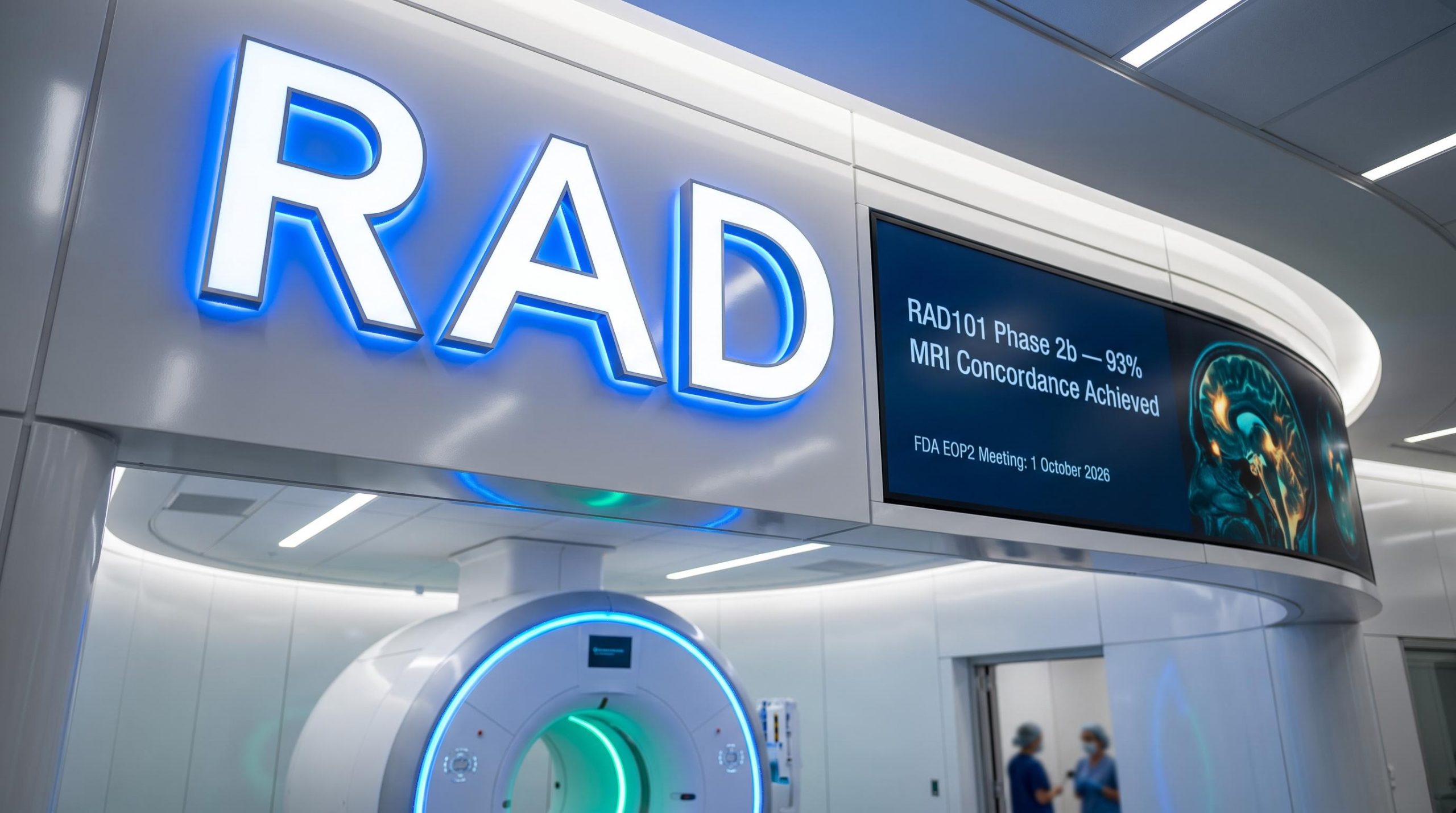
Radiopharm secures FDA End-of-Phase 2 meeting for RAD101 brain metastases imaging agent
Radiopharm Theranostics (ASX:RAD, Nasdaq:RADX) has scheduled an End-of-Phase 2 (EOP2) meeting with the U.S. Food and Drug Administration (FDA) for 1 October 2026 to align on the design of a pivotal Phase 3 trial for RAD101.
RAD101 is the company’s novel Fluorine-18-labeled small-molecule imaging agent that targets fatty acid synthase (FASN). It is being developed to diagnose suspected recurrent brain metastases arising from solid tumors following radiotherapy.
The standout data point supporting the discussion is a 93% concordance between PET and MRI imaging across all evaluable lesions in the Phase 2b trial, meeting the study’s primary endpoint. Radiopharm remains on track to be Phase 3-ready by year-end 2026.
When big ASX news breaks, our subscribers know first
What the FDA meeting means for the Phase 3 pathway
The purpose of the EOP2 meeting is to align on the pivotal Phase 3 clinical trial design criteria. This includes the number of patients to be enrolled, along with the primary and secondary endpoints.
The FDA will also review the Phase 2b data at this meeting. Alignment at this stage allows the company to finalise plans for the registrational study.
RAD101’s existing regulatory tailwinds
RAD101 has received FDA Fast Track Designation to distinguish between recurrent disease and treatment effect of brain metastases originating from solid tumors of different origin, including leptomeningeal disease.
The company recently announced a partnership with Siemens Healthineers, who will manufacture and distribute doses of 18F-labeled RAD101 to support Radiopharm’s upcoming Phase 3 registrational trial in the U.S.
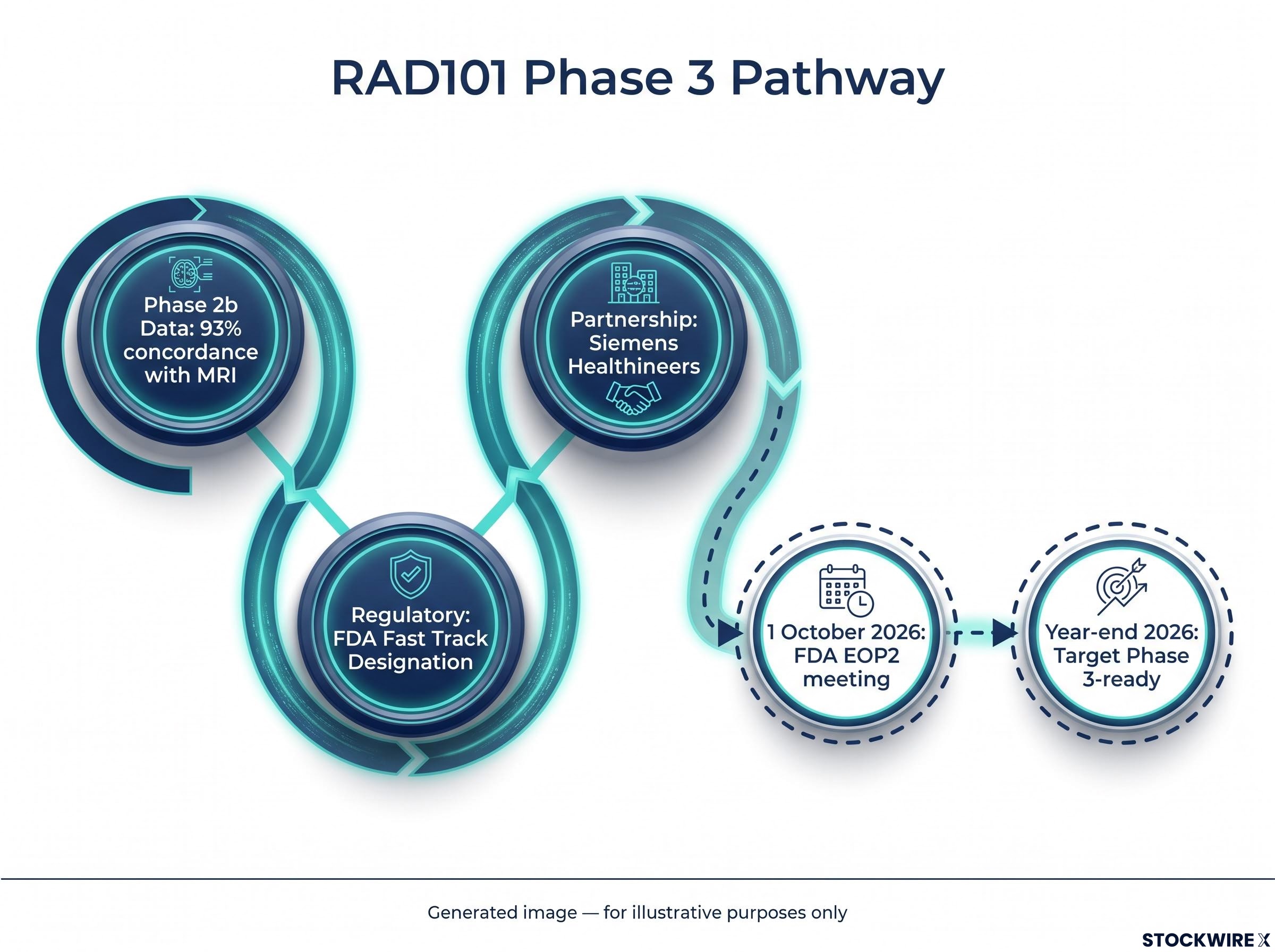
The Siemens supply agreement, signed to cover manufacture and distribution of Fluorine-18-labelled RAD101 across the U.S. radiopharmacy network, was structured specifically to support the logistics demands of a large registrational trial.
CEO Commentary
“We are pleased to have secured an End-of-Phase 2 meeting with the FDA for RAD101, an important milestone that brings us closer to advancing this promising imaging agent into a pivotal Phase 3 program,” said Riccardo Canevari, CEO and Managing Director of Radiopharm Theranostics. “Supported by the strong Phase 2b data demonstrating 93% concordance with MRI, we believe RAD101 has the potential to address a meaningful unmet need in the diagnosis of recurrent brain metastases and create significant value for patients, clinicians, and shareholders.”
Why brain metastases diagnosis is a large unmet need
Diagnosing whether disease has returned after treatment remains a clinical challenge.
Contrast-enhanced Magnetic Resonance Imaging (CE-MRI) is currently the preferred method for imaging Intracranial Metastatic Disease (IMD). It has limitations, however, particularly in follow-up surveillance scans, where distinguishing recurrent disease from treatment effect can be difficult.
RAD101 works by selectively binding to FASN, a multi-enzyme protein that is overexpressed in cerebral metastasis from solid tumors. Targeting FASN activity may allow for more accurate detection of cancer cells in the central nervous system.
A key differentiator emerged in the Phase 2a data, where tumor uptake was shown to be independent of the tumor of origin, indicating the agent may work across cancer types.
The scale of the opportunity is reflected in the following clinical context:
-
300,000+ patients diagnosed annually with cerebral metastases in the U.S. alone
-
Incidence of IMD continues to increase, driven in part by improvements in systemic therapy resulting in more durable control of the primary tumor
-
CE-MRI limitations in surveillance scans create the diagnostic gap RAD101 targets
The result is a large and growing addressable patient population with a genuine clinical gap.
The Phase 2b data behind the momentum
The Phase 2b trial demonstrated 93% concordance between MRI and PET imaging of brain metastases in patients with suspected recurrence, meeting the study’s primary endpoint. The results showed substantial and selective tumor uptake of RAD101, with images confirming metabolic activity in PET compared to equivocal MRI findings.
Supporting these results, the Imperial College of London’s Phase 2a imaging trial showed significant tumor uptake that was independent of the tumor of origin. The study further indicated that PET-MRI may potentially represent a non-invasive prediction of overall survival, a signal the company notes warrants larger studies.
| Milestone | Detail | Status | Investor Significance |
|---|---|---|---|
| Phase 2b primary endpoint | 93% concordance with MRI across evaluable lesions | Met | Validates clinical performance ahead of FDA review |
| FDA EOP2 meeting | Align on pivotal Phase 3 trial design | Scheduled for 1 October 2026 | Aims to de-risk the registrational pathway |
| Fast Track Designation | Distinguishing recurrent disease from treatment effect | Granted | Supports a potentially expedited regulatory path |
| Siemens Healthineers partnership | Manufacture and distribute 18F-labeled RAD101 | Secured for Phase 3 | Addresses supply for the upcoming trial |
What’s next for Radiopharm
The near-term roadmap centres on the EOP2 meeting on 1 October 2026, after which the company aims to finalise its registrational study plans and reach Phase 3-ready status by year-end 2026.
Within the broader pipeline, Radiopharm’s clinical program includes one Phase 2 and five Phase 1 trials across a range of solid tumor cancers, including lung, breast, and brain metastases.
RAD202 dose escalation through the HEAT trial’s first three cohorts has proceeded without any DSMC-imposed holds, with Phase 1 completion targeted by end of 2026 and potential Phase 2 progression in 2027, illustrating the parallel momentum building across Radiopharm’s broader clinical portfolio.
Upcoming catalysts for investors to track include:
-
FDA EOP2 meeting — 1 October 2026
-
Alignment on Phase 3 patient numbers and endpoints
-
Phase 3-ready status targeted by year-end 2026
These clear, dated catalysts over the coming months give investors defined milestones against which to measure the program’s progress.
Don’t Miss the Next Healthcare Breakthrough on ASX
Big News Blast delivers FREE breaking ASX healthcare news directly to your inbox within minutes of release, complete with in-depth analysis already done for you. Join 20,000+ subscribers staying ahead of market-moving announcements. Click the “Free Alerts” button at StockWire X to start receiving alerts the moment news breaks.