

Radiopharm reports confirmed durable Partial Response in RAD204 Phase 1 cancer trial
Radiopharm Theranostics (ASX:RAD, Nasdaq:RADX) has reported a RECIST-confirmed durable Partial Response in the first patient dosed in Cohort 3 of its ongoing Phase 1 trial of RAD204, the Company’s investigational PD-L1-targeted lutetium-177 nanobody radiotherapeutic.
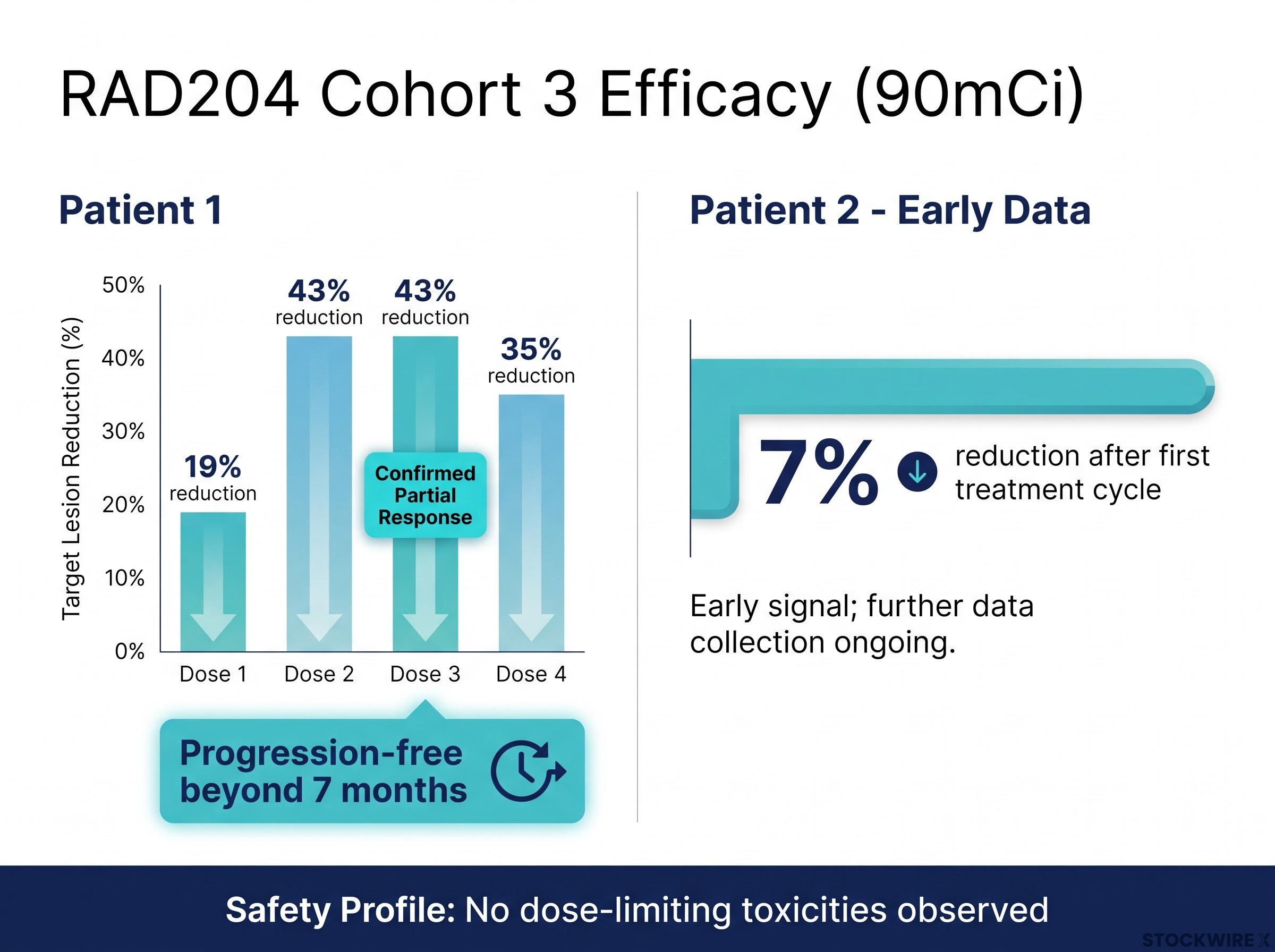
The result marks the first RECIST-confirmed durable Partial Response at the current highest dose level #3 (90mCi), with the patient remaining progression-free beyond seven months. A second patient dosed remains progression-free on treatment, showing early tumour shrinkage after the first treatment cycle.
RAD204 has been generally well-tolerated, with no dose-limiting toxicities observed across any dosing cohort to date. According to the Company, the positive efficacy signal at the highest dose evaluated supports continued dose escalation and is expected to inform the recommended dose for a planned Phase 2 clinical trial.
When big ASX news breaks, our subscribers know first
Inside the Cohort 3 clinical results
Two patients have been dosed with RAD204 in the third cohort of the Phase 1 treatment study, with a third patient under screening evaluation. Both dosed patients remain on treatment, and the Company noted that initial observations support the potential of repeated administration.
Patient 1 achieved a RECIST-confirmed Partial Response after the second treatment cycle, which was maintained through continued therapy. The tumour reduction trajectory across dosing cycles is detailed below.
| Treatment Cycle | Target Lesion Reduction | RECIST Status |
|---|---|---|
| Dose 1 | 19% reduction from baseline | — |
| Dose 2 | 43% reduction | Meets Partial Response criteria |
| Dose 3 | 43% reduction maintained | Confirmed Partial Response |
| Dose 4 | 35% reduction | Continues to meet PR criteria |
Patient 1 remains progression-free beyond seven months with continued follow-up.
Patient 2’s early data showed:
-
An early 7% reduction in target lesions following the first treatment cycle
-
Remains on treatment and progression-free, with continued follow-up for additional efficacy and safety assessments
A clean safety profile at the highest dose
Across all patients dosed to date at dose levels 1 to 3, RAD204 has continued to demonstrate a favourable safety and tolerability profile. There have been no dose-limiting toxicities observed in any cohort thus far.
Kidney uptake has been limited, with a cumulative 8.1 Gy recorded across the four cycles in Patient 1. The Company states this does not represent a potential obstacle for escalation to the next higher dose level (Dose level #4). A clean safety readout at the top dose evaluated helps de-risk the path toward further escalation.
What RAD204 is and why PD-L1 targeting matters
RAD204 is a single-domain monoclonal antibody (sdAb) that targets PD-L1, a protein that regulates the immune system’s response to malignant tumours and is overexpressed in many cancers. This overexpression makes PD-L1 an attractive therapeutic target across multiple tumour types.
The Company has identified several cancers where RAD204 may have application:
-
Non-small cell lung cancer (NSCLC)
-
Small cell lung cancer (SCLC)
-
Triple-negative breast cancer (TNBC)
-
Cutaneous Melanoma
-
Head and neck squamous cell carcinoma (HNSCC)
-
Endometrial Cancer
RAD204 is a radiotherapeutic that uses lutetium-177 (177Lu) to deliver radiation directly to PD-L1-positive tumour cells. This differs from standard immunotherapy and, according to the Company, has the potential to address resistance mechanisms to current standard-of-care treatment options.
The clean safety profile observed in RAD204 mirrors results seen elsewhere in Radiopharm’s pipeline: the 177Lu-RAD202 HEAT trial reported no dose-limiting toxicities at its first-in-human dose level, with the Data Safety Monitoring Committee subsequently clearing advancement to the 130 mCi cohort.
Supporting this approach, previously published Phase 1 imaging data in 16 NSCLC patients using 99Tc-RAD204 demonstrated positive tumour targeting and favourable biodistribution correlating with PD-L1 immunohistochemistry results. The platform is designed to provide hidden epitope access, exceptional stability, rapid tumour penetration, favourable pharmacokinetics and the potential for repeat dosing.
Targeting patients who have progressed following prior immunotherapy addresses an area of high unmet medical need.
The investment case and what comes next
For investors, the combination of an efficacy signal and a clean safety profile at the highest dose evaluated strengthens confidence in the RAD204 programme and supports progression toward Phase 2. It is important to note these remain early-stage results drawn from two patients in an ongoing trial.
The Company stated that the totality of data across its multiple dose cohorts is expected to inform the recommended dose for its planned Phase 2 clinical trial. Radiopharm also anticipates releasing additional data supporting RAD204’s therapeutic potential in PD-L1-associated malignancies.
Riccardo Canevari, CEO and Managing Director
“Importantly, the first patient has achieved a durable confirmed RECIST Partial Response lasting through four treatment cycles and has remained progression-free beyond seven months. The combined preliminary results indicate the broad therapeutic potential of RAD204 in PD-L1-associated malignancies.”
Mr Canevari added that the totality of data across the multiple dose cohorts “supports our confidence in this program and are expected to inform the recommended dose for our planned Phase 2 clinical trial.”
Radiopharm’s wider clinical programme includes one Phase 2 and five Phase 1 trials across a range of solid tumour cancers, including lung, breast and brain metastases. The company is dual-listed on the ASX (RAD) and Nasdaq (RADX).
Radiopharm’s broader clinical programme now spans multiple radiotherapeutic programmes in parallel: the BetaBart Phase 1/2a trial, targeting B7-H3-expressing solid tumours across 10 cancer types, dosed its first patient in February 2026 through a collaboration with MD Anderson Cancer Center.
Don’t Miss the Next ASX Healthcare Breakthrough
Big News Blast delivers FREE breaking ASX healthcare news directly to your inbox within minutes of release, complete with in-depth analysis. Join 20,000+ subscribers already staying ahead of the market. Click the “Free Alerts” button at StockWire X to get the next major clinical update the moment it drops.