
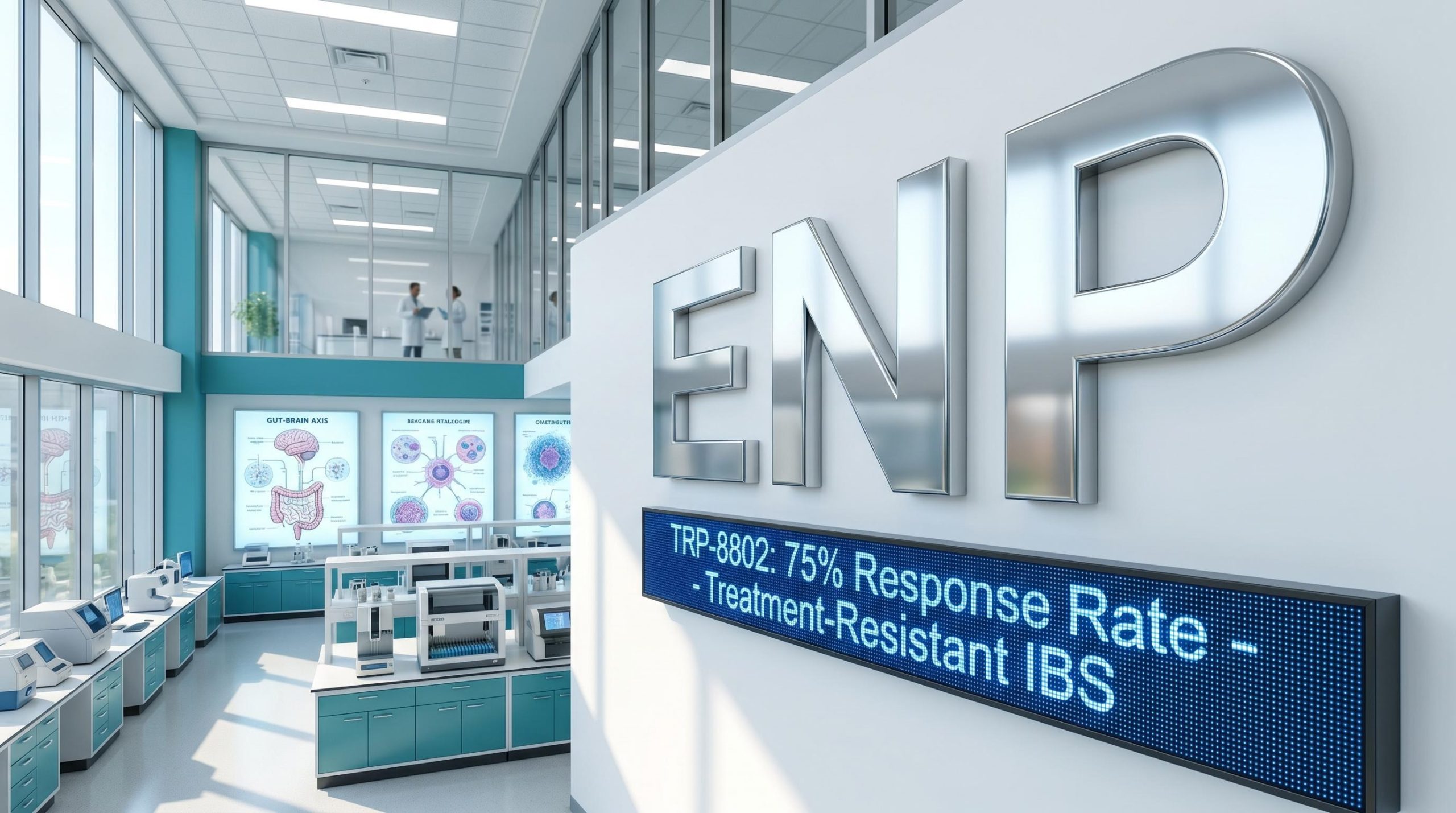
Entropy Neurodynamics achieves 75% response rate in treatment-resistant IBS trial
Entropy Neurodynamics (ASX: ENP) has reported breakthrough Phase 2a results for TRP-8802 (oral psilocybin), delivering a 75% response rate in treatment-resistant irritable bowel syndrome (IBS) patients. Existing approved IBS therapies achieve only 17-44% response rates in easier-to-treat, non-refractory populations.
The results were presented at Digestive Disease Week 2026 by researchers from Massachusetts General Hospital and Columbia University. The study evaluated two 25mg oral psilocybin doses administered with structured psychotherapy in 12 treatment-resistant patients who had previously failed multiple standard treatments.
Jason Carroll, CEO
“These results represent a breakthrough moment for Entropy and for the treatment of IBS. To deliver a 75% response rate in a treatment-resistant population, where existing therapies typically achieve only modest outcomes, is clinically unprecedented.”
Response was defined as a clinically meaningful improvement of ≥50 points on the IBS Symptom Severity Score (IBS-SSS). Symptom improvement was significantly associated with improvements in psychological insight (Spearman ρ = -0.69, p = 0.014) and psychological flexibility (ρ = 0.695, p = 0.026), validating the gut-brain axis mechanism of action hypothesis.
This is the strongest clinical signal ever reported in IBS drug development, achieved in the hardest-to-treat patient population where current therapies consistently fail.
When big ASX news breaks, our subscribers know first
What is irritable bowel syndrome and why is it difficult to treat
Irritable bowel syndrome is a chronic gut-brain disorder characterised by persistent abdominal pain, bloating, constipation, diarrhoea and urgency. Symptoms often occur daily and significantly impair quality of life, sleep and social functioning.
IBS is classified into three subtypes: IBS-C (constipation-predominant), IBS-D (diarrhoea-predominant), and IBS-M (mixed, where patients alternate between both). All three subtypes share the same core features of chronic abdominal pain, bloating, and symptoms linked to bowel movements, with no structural disease on testing.
Treatment-resistant IBS patients commonly cycle through up to 10 therapies and incur substantial out-of-pocket costs of US$6,000-$11,000 annually. Existing drugs fail to deliver consistent benefit, with response rates plateauing between 17% and 44% and relapse remaining common.
IBS is increasingly understood as a brain-driven disorder involving dysregulated pain processing, stress responses and autonomic imbalance. Unlike psychiatric conditions, IBS carries no stigma barrier to treatment adoption, supporting rapid uptake of effective therapies when they emerge.

Subtype response rates and mechanistic validation
Response by IBS subtype
TRP-8802 delivered differentiated response rates across the three IBS subtypes in the Phase 2a trial:
- IBS-C: 100% (3/3 patients)
- IBS-M: 80% (4/5 patients)
- IBS-D: 50% (2/4 patients)
IBS-C showed the strongest response, consistent with a possible direct 5-HT2A prokinetic effect. IBS-D showed the greatest heterogeneity, warranting subtype-stratified investigation in future trials. Response was pre-defined as a ≥50-point reduction on the IBS-SSS, a validated clinical scale measuring pain, distension, bowel habit dissatisfaction and quality of life.
Gut-brain axis mechanism confirmed
Symptom improvement was significantly associated with improvements in psychological insight (Spearman ρ = -0.69, p = 0.014) and psychological flexibility (ρ = 0.695, p = 0.026). This confirms TRP-8802 is targeting central brain pathways and the gut-brain axis, not merely masking symptoms.
Gut-specific anxiety (Visceral Sensitivity Index) showed minimal change at end of treatment (mean change = -0.4), suggesting the therapy acts through acceptance-based central mechanisms rather than direct extinction of gut-specific anxiety. This dissociation validates Entropy’s mechanism-based development strategy.
Mechanistic coherence significantly de-risks the program. The therapy is demonstrably engaging root-cause neurobiology rather than providing symptomatic relief.
How TRP-8802 compares to existing IBS treatments
| Therapy | Mechanism | Population | Response rate | Notes |
|---|---|---|---|---|
| TRP-8802 | 5-HT2A agonist | Treatment-refractory IBS | 75% | Strongest ever signal reported in refractory IBS |
| Linzess (linaclotide) | GC-C agonist | IBS-C | 33-34% | Approved, non-refractory population |
| Trulance (plecanatide) | GC-C agonist | IBS-C | 30-33% | Approved, non-refractory population |
| Amitiza (lubiprostone) | Chloride channel activator | IBS-C | 17-18% | Approved, modest efficacy |
| Xifaxan (rifaximin) | Non-absorbed antibiotic | IBS-D | 40-44% | Relapse common |
| Viberzi (eluxadoline) | Mixed opioid modulator | IBS-D | 29-33% | Safety limitations, pancreatitis risk |
The 75% response rate in treatment-resistant patients far exceeds any approved therapy’s performance in easier-to-treat populations. No approved IBS therapy has ever approached this level of efficacy, especially in refractory patients.
Strategic implications for TRP-8803 development
TRP-8803 is Entropy’s proprietary IV-infused psilocin formulation, the company’s lead program. The Phase 2a TRP-8802 results provide direct mechanistic validation for advancing TRP-8803 in IBS.
TRP-8803 offers several advantages over oral psilocybin:
- Faster onset of action
- Precise control over dose, depth and duration of therapeutic effect
- Avoids first-pass liver metabolism, removing dose variability seen with oral psilocybin
- More commercially scalable treatment model
Because IV psilocin avoids first-pass liver metabolism, it removes the dose and efficacy variability observed with oral psilocybin. TRP-8803 is delivered via a patented two-phase psilocin infusion, expected to provide a precise, consistent and controlled therapeutic dose compared to TRP-8802.
TRP-8802 validates the IBS indication, the gut-brain axis mechanism and the therapeutic approach, directly supporting TRP-8803’s development. Entropy will commence planning for new clinical trials and pursue non-dilutive grant funding for US-based TRP-8803 trials in IBS.
Market opportunity and commercial positioning
IBS represents a significant market opportunity with 10.4 million patients in the US, where annual spend exceeds US$60 billion. Between 3.1-4.2 million patients in the US are classified as treatment-resistant, representing one of the most urgent and commercially valuable patient groups in chronic disease.
In Australia, over 1 million patients have IBS with high unmet need in treatment-resistant populations. Patients cycle through up to 10 therapies, spend US$6,000-$11,000 annually out-of-pocket, and demonstrate strong willingness to adopt new treatments. IBS patients seek treatment more frequently than many other chronic conditions.
Unlike psychiatric conditions, IBS is free from stigma associated with mental health disorders, supporting rapid adoption of effective therapies. The treatment-resistant IBS population is already actively seeking new treatment options and demonstrates high willingness to pay out-of-pocket for medicines.
Jason Carroll, CEO
“TRP-8802 has now de-risked both the indication and the mechanism, while TRP-8803 is designed to unlock the full commercial potential of this opportunity. We see a clear pathway to building a leading, differentiated franchise in gut-brain disorders.”
The IBS addressable market in the US is larger than the market for depression. IBS represents a multi-billion dollar market with no psychiatric stigma barrier to treatment adoption.
Safety profile and next steps
The safety profile was consistent with expectations for psychedelic-assisted therapy. One serious adverse event was recorded (transient suicidal ideation), which resolved with appropriate clinical support. This underscores the importance of standard psychological screening and integration procedures in future trials.
Transient elevations in blood pressure and heart rate during dosing were observed but resolved without intervention. The acceptable safety profile supports progression to larger controlled studies with subtype stratification.
Results leave Entropy well positioned for partnering discussions, larger trials and potential grant funding opportunities. The company will continue to review its IBS dataset and pursue non-dilutive grant funding to advance further US-based clinical trials using TRP-8803 in IBS.
An investor webinar will be held on Wednesday, 6 May at 10:30am AEST, hosted by CEO Jason Carroll.
Could TRP-8803 Redefine Treatment for the 3-4 Million Americans with Treatment-Resistant IBS?
Entropy’s Phase 2a results have validated both the gut-brain axis mechanism and the IBS indication, with a 75% response rate in patients who had failed multiple standard therapies. The company’s lead programme, TRP-8803, is designed to deliver even more precise therapeutic control through IV-infused psilocin.
To explore Entropy’s commercial strategy and clinical development pathway in this multi-billion dollar market, visit the Entropy Neurodynamics investor centre. The company will host an investor webinar on 6 May at 10:30am AEST to discuss these breakthrough results and next steps.