

PYC-003 data heads to ASN Denver on 22 October 2026
PYC Therapeutics (ASX:PYC) will present exploratory efficacy data from its Phase 1a/1b studies of PYC-003 in polycystic kidney disease (PKD) at the American Society of Nephrology (ASN) conference in Denver, Colorado on 22 October 2026. The company announced the plan on 7 October 2026.
The presentation covers two datasets from patients who received a single dose of PYC-003:
- Urinary PC1 (uPC1) protein levels, described as a marker of target engagement for PYC-003 in the kidney
- Total Kidney Volume (TKV) at 3 months after treatment, compared to baseline
The headline figure is a 46% increase in uPC1 protein levels compared to baseline. For investors, the conference gives a dated event for the first public look at exploratory efficacy data from the company’s PKD drug candidate.
When big ASX news breaks, our subscribers know first
Urinary PC1 rises 46% after a single dose
What the uPC1 data showed
The data show a geometric mean fold-change from baseline of 1.46 (95% CI: 1.11–1.92; p<0.05) at Day 14, normalised to CD133 protein. The analysis covers patients with both baseline and Day 14 samples that passed quality control.
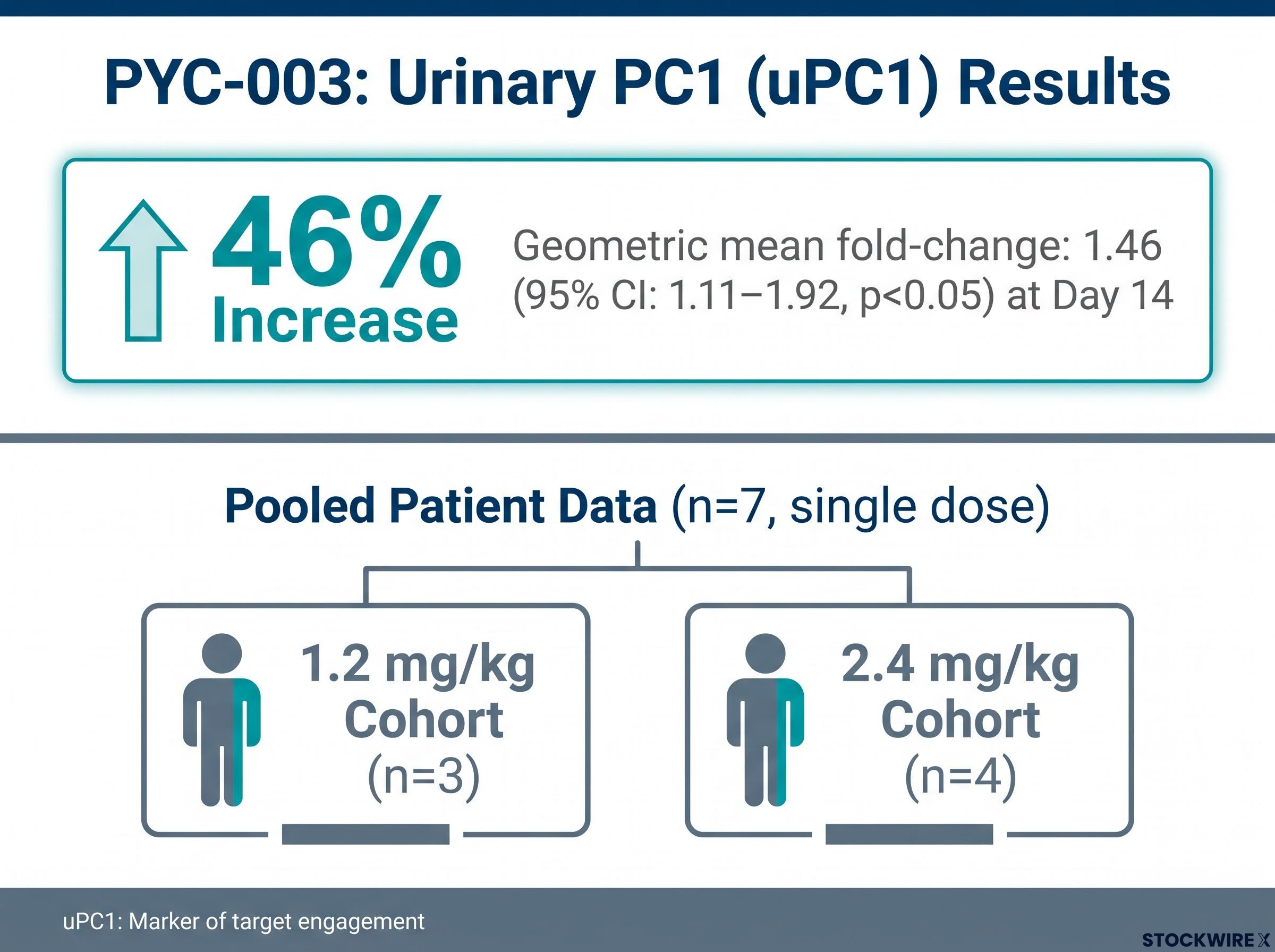
Two dose cohorts were included: 1.2 mg/kg (n=3) and 2.4 mg/kg (n=4), a total of 7 patients. Both cohorts showed a similar increase, but the small cohort sizes do not permit meaningful assessment of dose-dependent effects, so the data were pooled for statistical analysis.
PYC states the observed increase in urinary PC1 is consistent with the proposed mechanism of action of PYC-003, which is designed to increase PC1 protein levels and address the disease process at its root cause.
PYC-003 safety data from the completed single ascending dose cohorts showed zero treatment-related serious adverse events, and plasma modelling supports a 6-weekly dosing interval that now informs the repeat-dose study design.
Why PC1 matters
PKD is caused by insufficient levels of PC1 protein in the kidneys. According to the company, this applies in the majority of patients who have a loss of function mutation in one copy of the PKD1 gene.
Urinary PC1 is a pharmacodynamic biomarker of PC1 protein production. In simple terms, it is a measurable signal of whether the drug is prompting the body to make more of the protein.
PYC-003 is being evaluated for patients with PKD caused by a mutation in the PKD1 gene only.
Total Kidney Volume is the second marker. The company describes it as the anatomical surrogate of PKD disease progression, designated as the registrational endpoint for an accelerated approval in PKD.
Total Kidney Volume at 3 months versus untreated PKD
The second dataset shows TKV change from baseline at 3 months following a single dose of PYC-003. It includes all PKD patients enrolled in the Single Ascending Dose (SAD) study with 3-month follow-up TKV data (n=18).
For context, the presentation shows an illustrative natural progression of untreated PKD. That comparator is a mean of +6.2% annually in patients with Mayo Imaging Class C/D/E (n=925), combining the TEMPO 3:4, CRISP and HALT-PKD A trials. The announcement body text does not state the specific TKV change values for PYC-003.
| Dataset | Timepoint | Patients | Result | Role |
|---|---|---|---|---|
| Urinary PC1 (uPC1) | Day 14, single dose | n=7 (pooled) | 1.46 geometric mean fold-change (95% CI: 1.11–1.92) | Marker of target engagement |
| Total Kidney Volume (TKV) | 3 months, single dose | n=18 (SAD study) | Shown in Figure 2 of the announcement | Anatomical surrogate of disease progression |
A caveat on the comparator
The historical trials were open to patients with PKD due to mutations in any gene, whereas PYC’s trials enrol only patients with a PKD1 mutation. The company notes that patients with a PKD1 mutation progress faster toward end-stage kidney disease, and are consequently expected to have accelerated rates of TKV growth over time.
Company caution
“This encouraging exploratory efficacy data has been generated in a small number of patients over a short period of time and on endpoints that are variable by nature – it needs to be reproduced in repeat dose studies of PYC-003 in a larger number of PKD patients treated over a longer period of time before any conclusions regarding the likely impact of the drug candidate on the disease process can be drawn…”
What comes next for PYC-003
PYC is progressing PYC-003 through a Phase 1b Multiple Ascending Dose (MAD) and Open Label Extension (OLE) study. Data from these repeat-dose studies are expected to be presented in CY27.
The Phase 1b MAD study is designed to enrol 24-48 patients across up to four dose cohorts, with urinary PC1, total kidney volume and eGFR as efficacy endpoints, which makes it the first test of whether the single-dose signals hold up.
Further progression is expected to be accompanied by alignment with relevant regulatory authorities on the initiation of a registrational combined Phase 2/3 trial aimed at supporting a New Drug Application for PYC-003 in PKD. This timeline is subject to the risks and uncertainties outlined in the company’s ASX disclosures of 2 February 2026.
Upcoming milestones:
- ASN conference presentation of single-dose data, 22 October 2026
- Phase 1b MAD and OLE data, expected CY27
- Expected alignment with regulatory authorities on a registrational combined Phase 2/3 trial
The sequence gives investors a defined path from the conference presentation to the repeat-dose readout. The single-dose results remain exploratory, and neither efficacy nor approval has been established.
PYC is a clinical-stage biotechnology company with three clinical-stage drug development programs and a proprietary drug delivery platform for RNA therapies.
Get Biotech News Before the Market Moves
Join 20,000+ investors receiving FREE breaking ASX news within minutes of release, complete with in-depth analysis and the full announcement. Click the “Free Alerts” button at Big News Blast to get healthcare and biotech updates in your inbox the moment market-moving news breaks.