

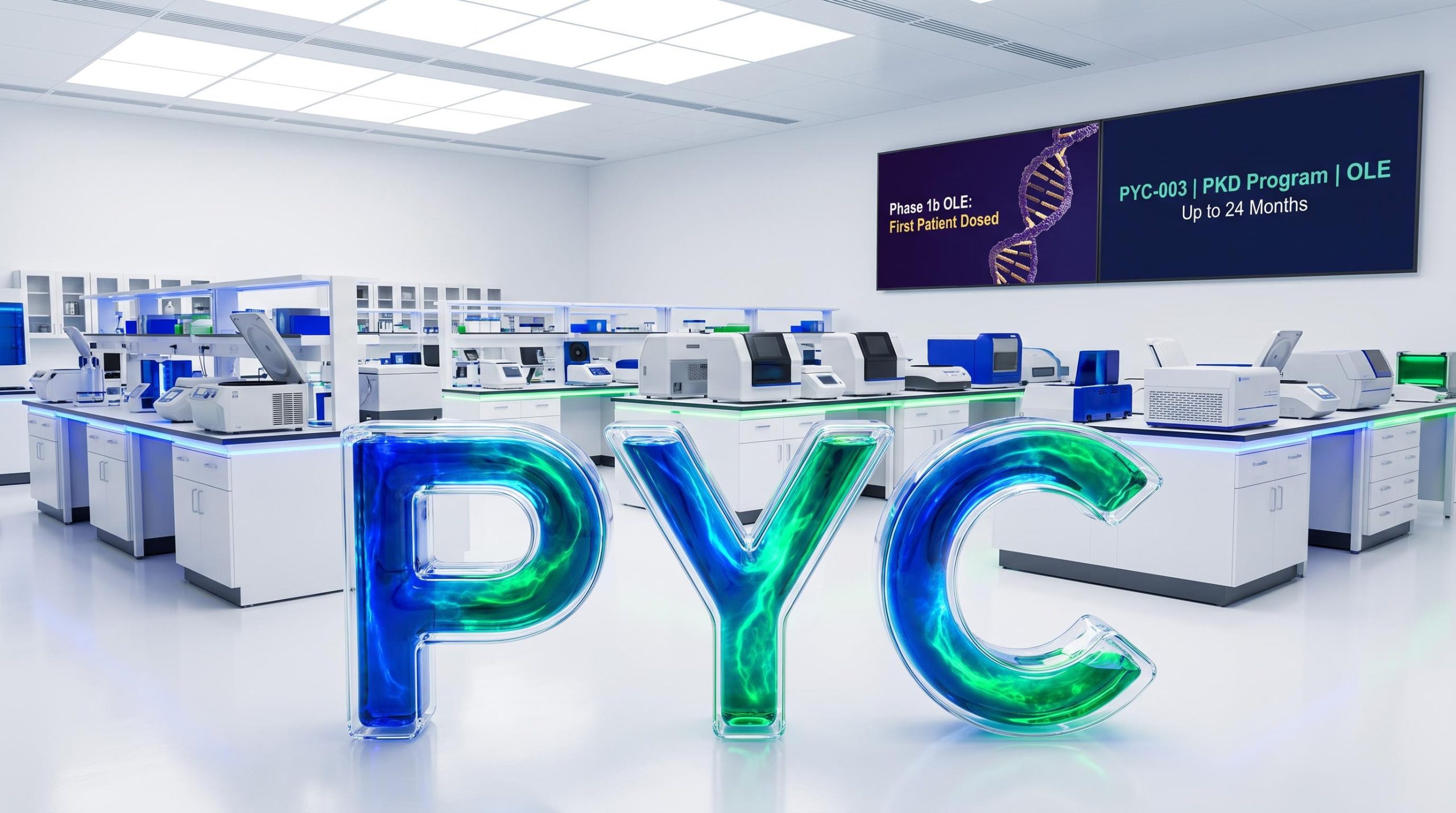
PYC-003 clears a key milestone as first patient enters open-label extension
PYC Therapeutics announced on 11 September 2026 that the first patient has been dosed in the Part D Open-Label Extension (OLE) of the ongoing Phase 1b Multiple-Ascending Dose (MAD) study of PYC-003 in Polycystic Kidney Disease (PKD) patients. The patient had already been receiving the investigational drug candidate for 4 months through the MAD study and will now continue dosing every 6 weeks for up to 24 months in the OLE.

The significance of this milestone lies in what it signals about program momentum. Patients are remaining on PYC-003, and the OLE’s duration of up to 24 months deliberately mirrors that of the proposed registrational trial set to follow completion of the Phase 1b study, subject to receiving regulatory approval in relation to the proposed registrational requirements.
The OLE was approved by the Human Research Ethics Committee and relevant regulatory bodies, as disclosed in PYC’s ASX announcement of 22 July 2026. The OLE continues to enrol eligible patients as they complete Part C of the MAD study.
The OLE approval and dose escalation to 2.4 mg/kg were granted following a Safety Review Committee assessment of data from both the Phase 1a SAD study and the first three Phase 1b patients, with the committee determining the safety profile was acceptable to proceed at the highest dose evaluated to date.
When big ASX news breaks, our subscribers know first
Understanding polycystic kidney disease and what PYC-003 targets
PKD is a serious genetic disease in which cysts form on the kidneys, progressively impairing their function. PYC-003 is specifically designed for patients whose PKD is caused by a mutation in the PKD1 gene, a defined patient population for whom no current treatment options are available.
PYC-003 belongs to the RNA therapy class of precision medicines. Rather than managing symptoms, RNA therapies are designed to address the underlying genetic cause of disease. This approach is particularly relevant in monogenic diseases, those caused by a mutation in a single gene, which PYC notes carry the highest likelihood of success in clinical development.
The absence of approved treatments for this patient population is central to PYC’s mission and to the investment thesis. Unmet medical need of this magnitude makes regulatory bodies receptive to novel therapies and can support expedited development pathways.
From Phase 1b to registrational trial — the clinical roadmap ahead
PYC’s proposed clinical development pathway for PYC-003 moves through two broad phases: a combined Phase 1a/1b study currently in progress, followed by a proposed Phase 2/3 registrational study, subject to confirmation with the relevant regulatory authorities and alignment with regulators following Phase 1b completion.
The Phase 1b MAD study, now including the OLE, is focused on determining the safety and tolerability profile and optimal dosing regimen of PYC-003 in a repeat-dose setting. The study design covers 24 to 48 patients, with two optional cohorts (0.4 mg/kg Q6W, n=12 and 4.0 mg/kg Q8W, n=12) whose inclusion will be based on safety and exploratory efficacy results from cohorts C1 and C2.
The table below maps the key elements of the proposed development pathway, as outlined in Figure 2 of the announcement:
| Study Phase | Key Endpoints | Status | Expected Data |
|---|---|---|---|
| Combined Phase 1a/1b Study (SAD + MAD + OLE) | Safety & tolerability; efficacy; biomarker (urinary PC1 protein); Total Kidney Volume (TKV); estimated Glomerular Filtration Rate (eGFR) | In progress | H2 CY26 (Phase 1a SAD data); CY27 (Phase 1b MAD + OLE data) |
| Phase 2/3 Registrational Study (proposed) | Safety & tolerability; efficacy; biomarker (urinary PC1 protein); TKV; eGFR | Planned | To be confirmed |
Successful completion of the Phase 1b MAD study, followed by alignment with relevant regulatory authorities, is proposed to lead to initiation of a combined Phase 2/3 registrational trial. That trial is aimed at supporting a New Drug Application (NDA) for PYC-003 in PKD, subject to the risks and uncertainties outlined in the company’s ASX disclosures of 2 February 2026.
The OLE’s 24-month duration is not incidental. It mirrors the proposed registrational trial design, indicating that regulatory considerations are already embedded in the study architecture from the outset.
What’s next for PYC and its PKD program
PYC currently has three clinical-stage drug development programs in total, with PYC-003 representing one of those. Near-term catalysts for the PKD program include:
- H2 CY26: Phase 1a SAD study data presentation, the next major data catalyst for PYC-003
- CY27: Phase 1b MAD study and OLE data presentation
- Ongoing: OLE continues to enrol eligible patients as they complete Part C of the MAD study
All timelines are subject to the risks and uncertainties outlined in the company’s ASX disclosures of 2 February 2026.
Investors exploring PYC’s broader pipeline beyond the PKD program can find our detailed coverage of PYC-001 ADOA trial results, which includes the NHP data supporting an extended dosing interval and vision improvement data from the MYRTLE Phase 1/2 study current to 30 June 2026.
For investors tracking the program, the H2 CY26 Phase 1a data readout represents the clearest near-term milestone, with the CY27 Phase 1b and OLE data serving as the next significant value inflection point on the clinical pathway toward a proposed registrational trial.
Don’t Miss the Next Healthcare Breakthrough on ASX
Big News Blast delivers FREE breaking ASX healthcare news directly to your inbox within minutes of release, with in-depth analysis already done. Join 20,000+ investors staying ahead of market-moving announcements the moment they drop. Click the “Free Alerts” button at StockWire X to start receiving alerts today.