
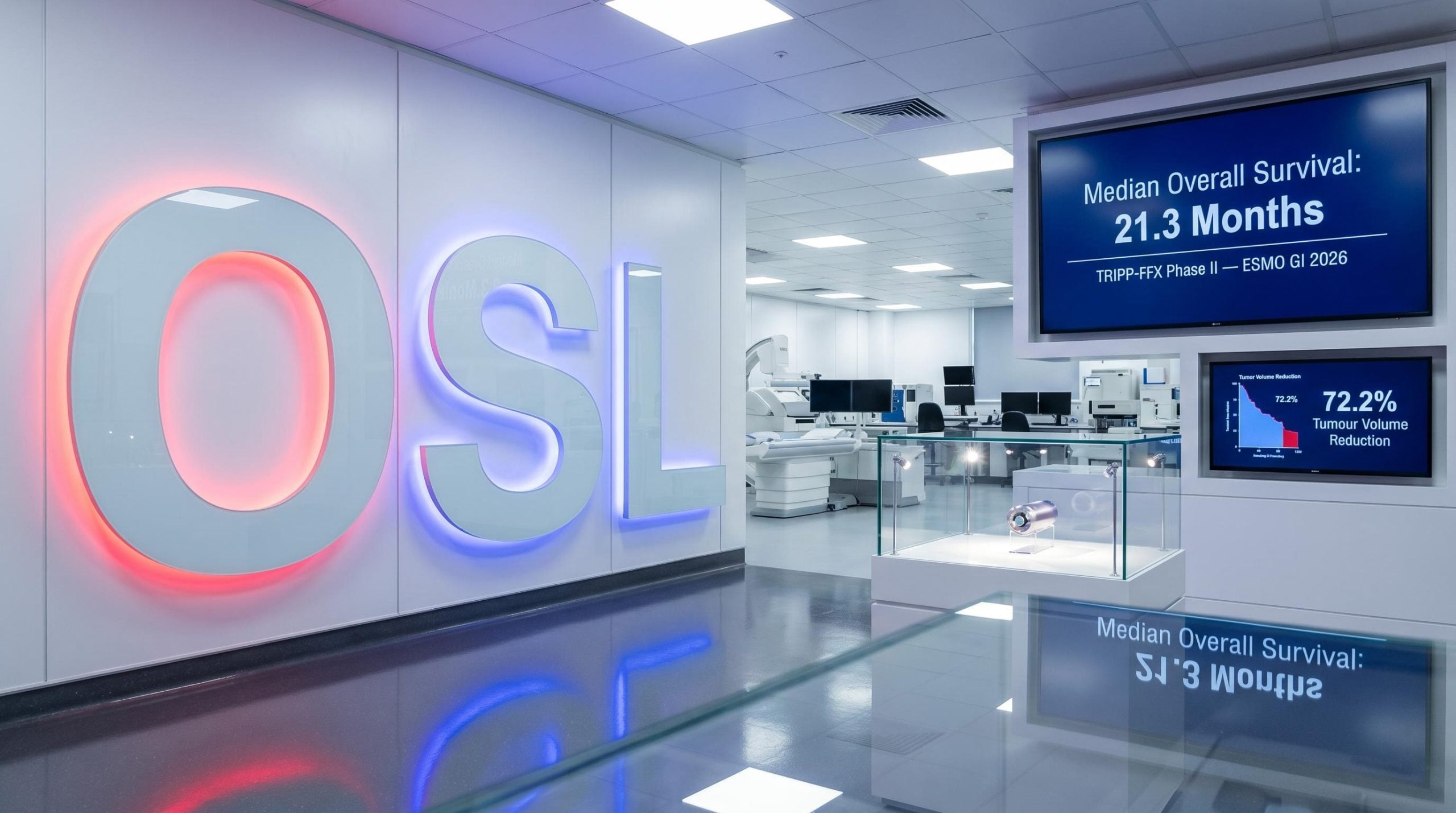
OncoSil’s TRIPP-FFX data at ESMO GI 2026 shows 21.3-month median survival in pancreatic cancer trial
OncoSil Medical (ASX: OSL) has presented updated results from its Phase II TRIPP-FFX study, including a new Per Protocol (PP) analysis, as a Rapid Oral Presentation at the ESMO GI 2026 congress in Munich, Germany. The presentation was delivered by Michele Milella, Professor of Medical Oncology at the University of Verona and co-principal investigator of the study.
The standout figure was a median overall survival of 21.3 months for patients treated with the OncoSil™ device plus FOLFIRINOX chemotherapy under the PP analysis, compared with 15.6 months for FOLFIRINOX alone. The study met both co-primary endpoints of safety/tolerability and local disease control rate (LDCR) at 16 weeks, reinforcing the clinical case ahead of a planned regulatory Change Notification.
When big ASX news breaks, our subscribers know first
What the ESMO GI 2026 presentation revealed
The presentation featured an updated analysis of the Phase II TRIPP-FFX study, which evaluated the addition of the OncoSil™ device to standard-of-care FOLFIRINOX chemotherapy in patients with unresectable locally advanced pancreatic cancer (LAPC).
Two sets of results were included. The previously announced Intent-to-Treat (ITT) findings were confirmed, alongside a new Per Protocol analysis reported for the first time. The PP analysis evaluates outcomes in patients who completed treatment according to the study protocol, covering the 40 patients in the device arm who actually received the OncoSil™ device to target tumour.
Encouraging survival and resection outcomes (PP analysis)
The Per Protocol analysis delivered several notable results across the device arm compared with FOLFIRINOX alone:
-
Median overall survival: 21.3 months (device + FOLFIRINOX) vs 15.6 months (FOLFIRINOX alone)
-
Surgical resection rate: 12.5%, with 60% achieving complete surgical removal (R0 margin), vs 7.3% with 33% R0 for the FOLFIRINOX only group
-
Median tumour volume reduction: 72.2% vs 55.9%
-
Best overall response (Partial Response): 60.0% vs 36.6%
Secondary endpoints numerically favoured the device arm across objective response rate, local progression-free survival, progression-free survival and overall survival.
Safety remained manageable
The safety profile remained consistent with previously announced results, with no new safety signals identified. The study continued to meet its co-primary safety endpoint, confirming that adverse events following the addition of the OncoSil™ device to FOLFIRINOX were limited and manageable.

The full data picture — ITT vs PP
The table below sets out the key endpoints across both the Intent-to-Treat and Per Protocol analyses for each treatment arm.
| Endpoint | FOLFIRINOX (ITT) | FOLFIRINOX (PP) | Device + FOLFIRINOX (ITT) | Device + FOLFIRINOX (PP) |
|---|---|---|---|---|
| LDCR at 16 weeks | 86.0% | 85.4% | 82.2% | 85.0% |
| Overall Survival (median months) | 15.8 | 15.6 | 18.2 | 21.3 |
| Local PFS (median months) | 11.8 | 9.9 | 12.8 | 12.8 |
| PFS (median months) | 9.9 | 9.9 | 12.1 | 12.1 |
| Surgical Resection | 11.6% | 7.3% | 11.1% | 12.5% |
| R0 margins | 16.7% | 33% | 60% | 60% |
| Tumour Volume (median change) | -57.0% | -55.9% | -72.1% | -72.2% |
Results by blinded independent central review (RECIST 1.1); CI = confidence intervals; nc = non-calculable.
CEO Commentary
“Presenting the TRIPP-FFX results at ESMO GI 2026 represents an important milestone for OncoSil Medical and provides the opportunity to share our data with one of the world’s leading audiences of gastrointestinal oncology specialists. Importantly, the presentation included new, Per Protocol analysis, which demonstrated a median overall survival of 21.3 months together with encouraging efficacy outcomes across multiple clinically meaningful secondary endpoints. This new analysis further strengthens the clinical evidence supporting the use of the OncoSil™ device alongside FOLFIRINOX in patients with unresectable LAPC,” said Nigel Lange, CEO & Managing Director of OncoSil Medical.
Understanding OncoSil and why this matters for pancreatic cancer
The OncoSil™ device delivers targeted intratumoural placement of Phosphorus-32 (³²P) Microparticles, directing radiation into the tumour while sparing surrounding critical organs. It is used in addition to chemotherapy, enabling a greater radiation dose directly into the tumour compared with external beam radiotherapy.
Unresectable LAPC represents a serious unmet medical need. Pancreatic cancer is generally diagnosed at a later stage and carries a poor prognosis for long-term survival, with around 500,000 new cases detected globally each year.
The significance of R0 resection lies in what it represents. An R0 margin refers to the complete surgical removal of a cancer, which offers the best chance of long-term survival. Improved resection rates, such as those observed in the device arm, are therefore clinically meaningful.
OSPREY Registry data from 64 patients in routine clinical practice has shown median overall survival of up to 22.0 months in first-line LAPC patients, with five of seven patients who proceeded to surgical resection achieving R0 margins, providing real-world corroboration of the TRIPP-FFX findings.
For investors, stronger survival and resection data help build the clinical evidence base that supports both broader adoption of the device and the company’s regulatory pathway.
What’s next — regulatory label expansion on track
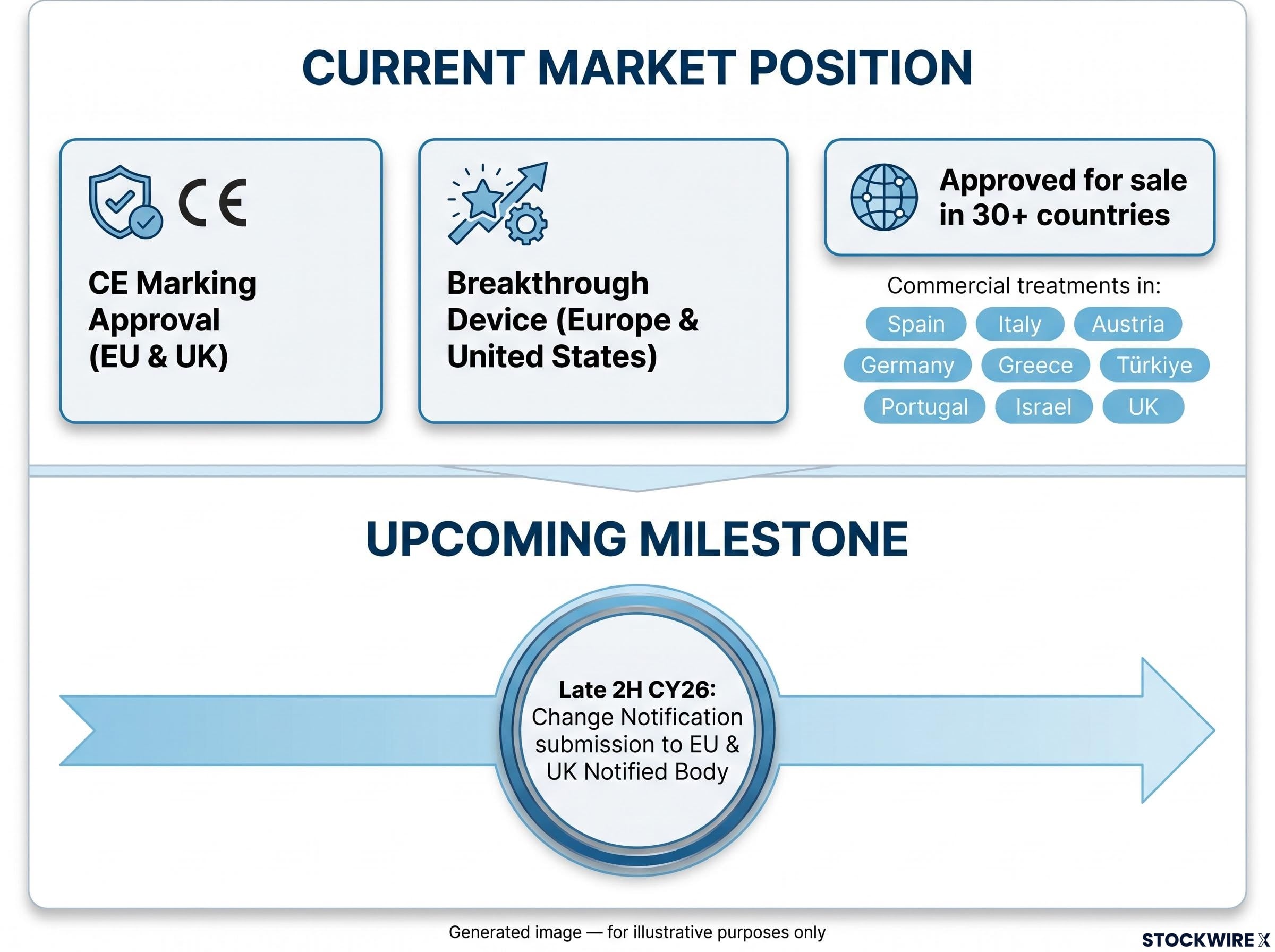
Following the presentation of the TRIPP-FFX results at ESMO GI, OncoSil Medical remains on track to submit a Change Notification to its EU & UK Notified Body in late 2H CY26 to expand the OncoSil™ device label to include use alongside FOLFIRINOX, subject to regulatory approval.
The company’s current market position provides context for that pathway:
-
OncoSil™ holds CE Marking approval, providing marketing authorisation in both the EU and the UK.
-
It is designated a breakthrough device in both Europe and the United States.
-
It is approved for sale in 30+ countries, with commercial treatments already undertaken across Spain, Italy, Austria, Germany, Greece, Türkiye, Portugal, Israel and the UK.
A successful label expansion would broaden the addressable use case for the OncoSil™ device alongside a widely used standard-of-care chemotherapy regimen, subject to regulatory approval.
For investors exploring the full scope of OncoSil Medical’s regulatory pipeline, our detailed coverage of the FDA Humanitarian Device Exemption application outlines the submission timeline, the distal cholangiocarcinoma indication, and what a US approval decision would mean for a device already commercially deployed across 30+ countries.
Don’t Miss the Next Healthcare Breakthrough on ASX
Big News Blast delivers FREE breaking ASX healthcare news directly to your inbox within minutes of release, complete with in-depth analysis already done. Join 20,000+ investors who stay ahead of the market the moment announcements drop. Click the “Free Alerts” button at Big News Blast to start receiving real-time alerts today.