


Independent study backs higher-concentration OncoSil formulations
An independent formulation study by the Institut Galien Paris-Saclay (Université Paris-Saclay) has confirmed that the OncoSil™ device microparticles can be suspended and delivered at concentrations materially higher than those currently in commercial use, without increasing the resistance to flow that governs injectability. OncoSil Medical Limited (ASX:OSL), a medical device company focused on localised treatments for unresectable locally advanced pancreatic cancer (LAPC), reported the findings on 24 July 2026.
The work, conducted by the Physical Pharmacy Team at the Institut Galien Paris-Saclay, marks an early but meaningful step in the Company’s formulation development programme. Management has stressed that the results remain subject to further validation.
When big ASX news breaks, our subscribers know first
What the study measured and found
The study assessed the rheology, or flow behaviour and viscosity, of the OncoSil™ device suspensions. Viscosity describes how easily a fluid moves, a property that directly affects whether a clinician can inject the product smoothly during a procedure.
Key details of the testing include:
-
Non-radioactive (“cold”) microparticles identical in composition and particle size to the clinical product were used
-
Viscosity was measured across eight concentrations, from 0 mg/mL (diluent alone) up to 150 mg/mL
-
All suspensions displayed the expected shear-thinning behaviour
-
Counter to conventional expectation for a particle suspension, viscosity did not rise as particle concentration increased
-
At the high shear rates encountered during injection, viscosity was essentially the same at every concentration tested
-
Particle volume fractions remained low throughout, at approximately 6% even at the highest 150 mg/mL loading
The central takeaway is that higher concentrations are unlikely to compromise injectability, providing a technical basis for exploring richer formulations.
Why formulation flexibility matters
The OncoSil™ device delivers a therapeutic dose of phosphorus-32 (³²P) microparticles suspended in the Company’s proprietary diluent. Phosphorus-32 is a radioactive isotope used to deliver targeted radiation directly into a tumour.
Because ³²P has a half-life of 14.27 days, the radioactive dose decays over time. Treatments performed later in a batch’s life therefore require a greater number of microparticles to deliver the same target activity.
Reliable higher-concentration formulation could give treating centres greater flexibility in scheduling and allow each manufactured batch to be used across a longer window. Over time, a longer usable batch life combined with fewer units handled points to potential for lower cost of goods and a simpler handling profile at the point of care, subject to further validation.
The manufacturing validation milestone completed at Cyclotek’s Macquarie Park facility provides complementary context here: OncoSil produced more than 50 validation doses across three cycles, with commercial production targeted for 2H CY2026, meaning the formulation flexibility this rheology study unlocks would feed directly into a supply chain already approaching commercial readiness.
Fact vs investor impact
| Finding | Detail | Why it matters |
|---|---|---|
| Concentration range tested | 0–150 mg/mL across 8 concentrations | Confirms broad formulation headroom |
| Viscosity vs concentration | No rise with increased loading | Injectability unlikely to be compromised |
| Volume fraction | ~6% at max loading | Physically feasible high-concentration suspensions |
| Potential outcome | Wider dosing/scheduling window per batch | Greater production flexibility, lower cost potential (subject to validation) |
Management commentary
Nigel Lange, Managing Director and CEO
“These independent findings represent an important step in our formulation development program. The rheology data support continued investigation of higher-concentration formulations and provide a strong rationale for the next phase of testing, which will evaluate injectability. We’re encouraged by these results and look forward to building on them as the program advances.”
What comes next and the investment case
OncoSil Medical considers the findings supportive of its formulation development, though the Company has framed forward-looking outcomes as conditional on further validation through planned studies and regulatory processes.
The anticipated next steps and their significance include:
-
The next phase of testing will evaluate injectability directly.
-
If validated, higher-concentration formulations could extend the usable dosing window from each manufactured batch.
-
Such formulations could potentially reduce manufacturing frequency and handling complexity, supporting production efficiency and lower costs, subject to development and regulatory processes.
For investors, the update sits against a device that already holds commercial approvals. OncoSil™ has received CE Marking approval, providing marketing authorisation in both the EU and the UK, and is designated as a breakthrough device in both Europe and the United States.
The TRIPP-FFX trial results, released in June 2026, showed an 82.2% local disease control rate and 18.3-month median overall survival in the OncoSil plus FOLFIRINOX arm, with a regulatory submission targeting label expansion to include FOLFIRINOX combination therapy planned for late 2H CY2026.
The device is currently approved for sale in 30+ countries, with commercial treatments already undertaken in Spain, Italy, Austria, Germany, Greece, Türkiye, Portugal, Israel and the UK.
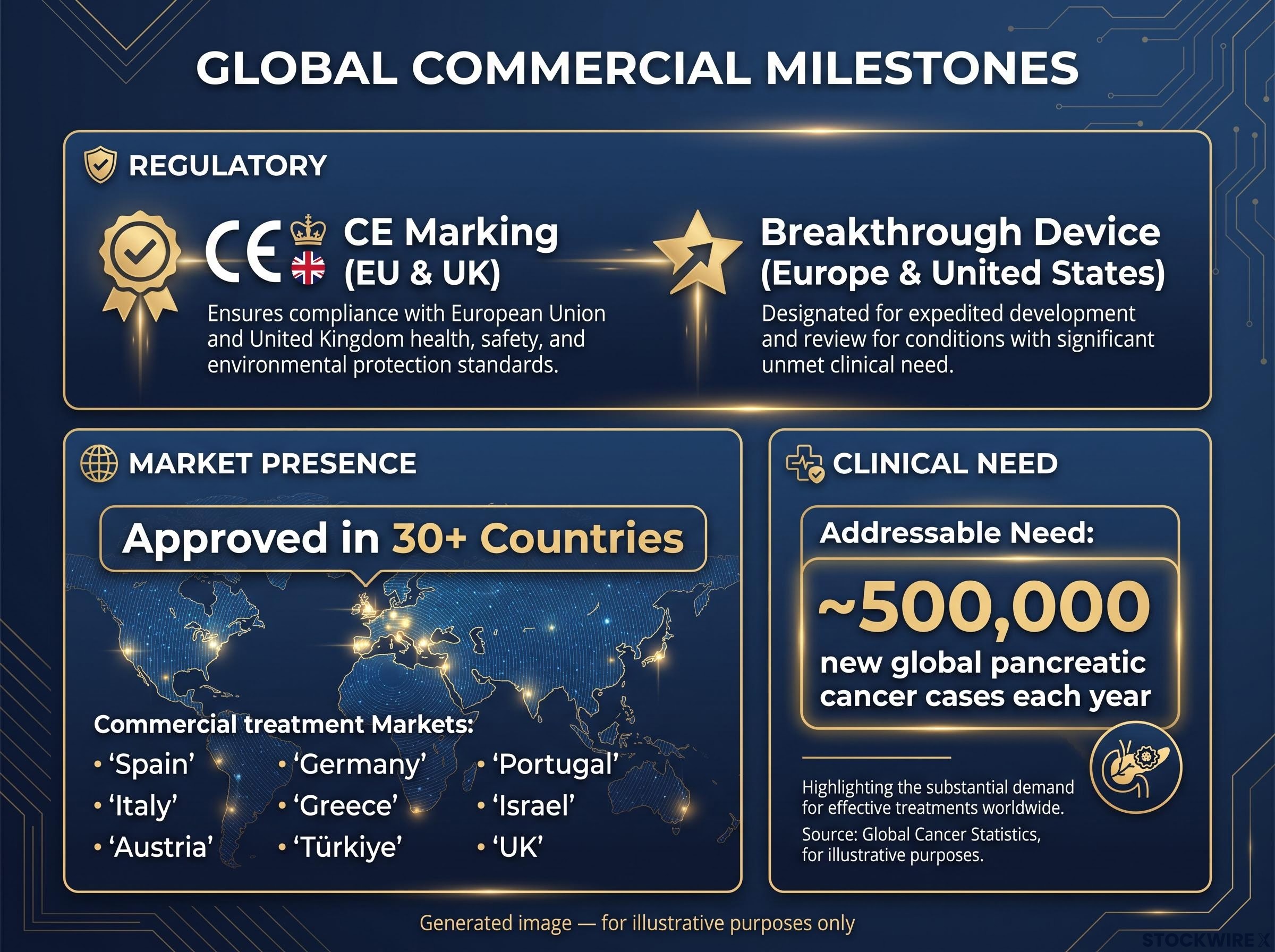
The addressable clinical need is substantial. Pancreatic cancer accounts for approximately 500,000 new cases globally each year, and because it is generally diagnosed at a later stage, it carries a poor prognosis for long-term survival.
Taken together, the study represents a development milestone rather than a finished result. It reflects a commercially approved device now working to improve its manufacturing economics and treatment flexibility, with the direct evaluation of injectability set to determine whether higher-concentration formulations can progress further.
Don’t Miss the Next Healthcare Breakthrough
Big News Blast delivers FREE breaking ASX healthcare news directly to your inbox within minutes of release, complete with in-depth analysis. Join 20,000+ investors already staying ahead of the market. Click the “Free Alerts” button at StockWire X to get the next market-moving announcement the moment it drops.