
OncoSil Medical joins EU-funded PALACROS consortium in pancreatic cancer push
OncoSil Medical (ASX: OSL) has been selected to participate in PALACROS, a major European academic research and innovation consortium focused on improving outcomes for patients with unresectable locally advanced pancreatic cancer (LAPC). Participation is through its wholly owned European subsidiary, OncoSil Medical Europe GmbH, consistent with the consortium’s eligibility requirements for European organisations.
The Company will contribute via a dedicated Phase II study, the PULSE Trial, which runs alongside but separate from the consortium’s flagship randomised trial. Two headline points anchor the announcement for investors: an estimated ~$9M cost saving versus a company-sponsored study, and access to the resulting clinical data for both regulatory and commercial purposes.
When big ASX news breaks, our subscribers know first
Why selection matters — independent validation, not company-funded
PALACROS is an academically led initiative funded by the European Union under the Horizon Europe research and innovation programme. OncoSil did not commission the consortium, which reinforces the independent clinical interest behind its inclusion. This external endorsement carries weight with clinicians, payers and regulators.
The consortium brings together leading academic institutions, clinicians, researchers, patient organisations, imaging and artificial intelligence experts, and selected industry partners from across Europe. Its stated aim is to establish a new European standard for multimodal, surgery-centred care. Notably, PALACROS explicitly identifies innovative local therapies, including the OncoSil™ device, as a key component of its strategy to improve outcomes for patients who remain unresectable after chemotherapy.
Nigel Lange, CEO & Managing Director
“Being selected to participate in PALACROS is an important validation for OncoSil. What makes this opportunity particularly significant is that PALACROS, which is funded via a grant from the European Union, is an academically driven European consortium bringing together a select group of the world’s leading pancreatic cancer centres. The inclusion of OncoSil™ in this initiative e reflects growing independent clinical interest in our technology and its potential role within future multimodal treatment strategies for locally advanced pancreatic cancer. The dedicated PULSE study provides an important opportunity to evaluate the potential of repeat OncoSil™ treatment in a robust multicentre academic setting, while contributing to one of Europe’s most ambitious collaborative pancreatic cancer research programs.”

Inside the PULSE Trial
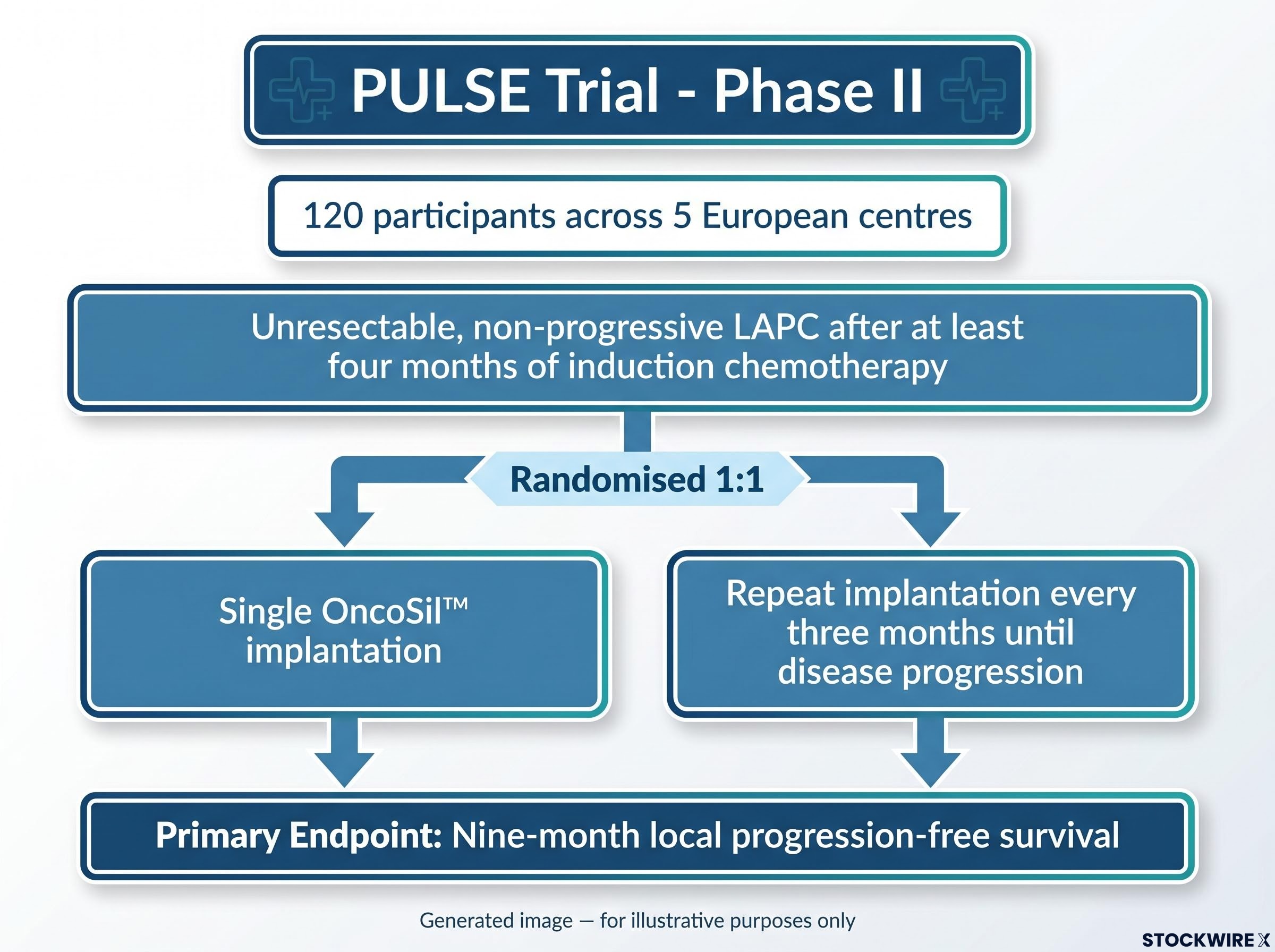
The PULSE Trial is the vehicle for OncoSil’s participation. It is a prospective, multi-centre, Phase II randomised study designed to evaluate whether repeat intratumoural brachytherapy using the OncoSil™ device can improve outcomes in patients with unresectable, non-progressive LAPC following induction chemotherapy.
| Parameter | Detail |
|---|---|
| Design | Phase II, multi-centre, randomised (1:1) |
| Patients | 120 participants across five European centres |
| Population | Unresectable, non-progressive LAPC after at least four months of induction chemotherapy |
| Treatment arms | Single OncoSil™ implantation vs. repeat implantation every three months until disease progression |
| Primary endpoint | Nine-month local progression-free survival |
The study also tracks a broad set of secondary endpoints:
-
Overall progression-free survival
-
Overall survival
-
Safety and tolerability
-
Quality of life, pain and opioid use
-
Conversion to surgical resection
-
Biomarker assessment
-
Health economic assessment of repeat versus single implantation
The PULSE Trial builds on earlier prospective clinical studies, including TRIPP-FFX, PANCOSIL and PANCO, positioning it as the next multicentre evidence step in assessing repeat OncoSil™ treatment for improving local tumour control.
The TRIPP-FFX trial results reported an 82.2% local disease control rate and 18.3-month median overall survival in the OncoSil plus FOLFIRINOX arm, with a 60% R0 margin rate among patients who proceeded to surgical resection.
The commercial logic — cost savings now, revenue multiplier later
Under the contract for the study, OncoSil™ devices will be provided in-kind, with no other study-related costs applicable to the Company. The trial sponsor, rather than OncoSil, meets the site, monitoring, regulatory, data-management and other operating costs that a company-sponsored trial of comparable size and duration would ordinarily require.
On that basis, the arrangement is expected to deliver a cost saving of approximately $9 million relative to an equivalent OncoSil Medical-sponsored study. The in-kind model therefore represents a capital-efficient means of expanding the clinical evidence base supporting the device in LAPC.
The benefit extends beyond near-term efficiency. Positive data has the potential to strengthen the evidence supporting the OncoSil™ device across relevant markets and to support engagement with clinicians, payers and regulators as the Company progresses its commercialisation strategy. If the trial outcomes are successful and support adoption of the device as a standard treatment for LAPC, the Company would expect a corresponding uplift in device utilisation, with a revenue multiplier effect on a per-patient basis as treated patient volumes increase over time.
The key investor takeaways can be summarised as follows:
-
Capital-efficient evidence generation without the full sponsorship burden
-
Data usable for both regulatory and commercial purposes
-
Support for engagement with clinicians, payers and regulators as part of the commercialisation strategy
-
Potential per-patient revenue multiplier if adoption follows successful outcomes
Understanding LAPC and the OncoSil™ device
Locally advanced pancreatic cancer refers to a tumour that has grown into surrounding tissue or blood vessels but has not spread to distant organs, making it unresectable, meaning it cannot be removed surgically. Because pancreatic cancer is generally diagnosed at a later stage, it carries a poor prognosis for long-term survival.
To provide context on scale, pancreatic cancer is the 12th most common cancer in men and the 11th most common in women globally, with around 500,000 new cases detected every year, according to the company citing the International Agency for Research on Cancer.
The OncoSil™ device uses the targeted, intratumoural placement of Phosphorus-32 (³²P) microparticles in addition to chemotherapy. This approach enables healthcare professionals to deliver a greater radiation dose directly into the tumour compared with external beam radiotherapy, while sparing surrounding critical organs.
A peer-reviewed localisation study published in Pathology International confirmed that Phosphorus-32 microparticles showed zero migration beyond tumour tissue across all evaluated surgical specimens, providing histopathological validation of the device’s targeted mechanism and a median overall survival of 24 months in patients who proceeded to resection.
On the regulatory front, OncoSil™ has received CE Marking approval, providing marketing authorisation in both the EU and the UK, and is designated as a breakthrough device in both Europe and the United States. It is currently approved for sale in 30+ countries, with commercial treatments already undertaken across multiple European markets, Türkiye and Israel. For investors, existing approvals combined with growing independent clinical evidence together underpin the commercial adoption pathway.
What comes next
The PULSE Trial is planned to run across five European centres within the PALACROS framework. Its health economic analysis is designed to evaluate the cost-effectiveness and budget impact of repeat versus single implantation, providing a direct input into future adoption and reimbursement decisions.
Should the resulting data prove successful, it could support adoption of the OncoSil™ device as a standard treatment for LAPC and potentially increase the number of patients eligible for curative surgery. Through this structure, OncoSil gains exposure to both near-term savings and a potential longer-term commercial return, without assuming the full financial burden of a sponsored trial.
Don’t Miss the Next Healthcare Breakthrough on the ASX
Big News Blast delivers FREE breaking ASX healthcare news directly to your inbox within minutes of release, complete with in-depth analysis. Join 20,000+ subscribers already staying ahead of the market. Click the “Free Alerts” button at Big News Blast to ensure the next market-moving announcement lands in your inbox the moment it breaks.