

Q1 FY27 highlights: fourth consecutive quarter of positive operating cash flow
In its Q1 FY27 business update presentation, dated 26 October 2026 and covering the quarter ended 30 September 2026, Mach7 Technologies (ASX: M7T) outlined four consecutive quarters of positive operating cash flow. The company stated this is a first in its history.
Management framed the update around one line: the reset is producing results, and commercial conversion is catching up. The presentation was led by Chief Executive Officer Teri Thomas and Chief Financial Officer Shawni Hadfield.
| Metric | Q1 FY27 | Comparison |
|---|---|---|
| Operating cash flow | A$0.3M | Q1 FY26: -A$3.7M |
| Receipts | A$7.3M | +58% on Q1 FY26 |
| Operating activity payments | (A$7.0M) | -17% on Q1 FY26 |
| Closing cash | A$19.3M, no debt | 30 Sep 2025: A$18.9M |
| ARR run rate | A$23.5M | +8.5% on 30 Sep 2025, constant currency |
| CARR | A$25.3M | -7.4% on 30 Sep 2025, constant currency |
Management attributed the 58% rise in receipts to customer growth and continued focus on disciplined cash collection. Payments were 17% lower than the prior corresponding period, which the company said demonstrates the sustainability of the lower cost base following the FY26 restructuring.
The FY26 restructuring cut operating expenses by 16% to A$26.7M and absorbed A$1.9M of one-off costs, which is why the lower payment base is now showing up in quarterly cash flow.
ARR (Annual Recurring Revenue) run rate is subscription and maintenance and support fees at the end of September, annualised. The company attributed the 8.5% increase to growth in the installed base and new customers going live.
CARR (Contracted Annual Recurring Revenue) was down 7.4% on the prior corresponding period on a constant currency basis, sitting beside the ARR growth.
When big ASX news breaks, our subscribers know first
How the reset is turning into a growth engine
The presentation grouped results into three themes: lower costs and faster customer service, growth from existing customers, and a new customer that went live in record time alongside a growing pipeline. Management said existing customers are expanding their volumes, and that new customer sales are a focus.
The AMRADNET contract illustrates the faster deployment theme, with a five-year, A$1.7M eUnity subscription slated to go live within 45 days against a typical 12-month timeline.
Mach7 set out four growth steps, in order of speed to revenue:
- Protect and expand the installed base
- Win new customers
- Flamingo is easier to adopt
- EMR (Electronic Medical Record) integration and advisory work, described as early development paths
The company described existing customer volume growth and cross-selling as the fastest revenue available to it.
Development pace also lifted on a lower cost base. Q1 FY27 capitalised development was 2.5x the prior corresponding period, and the company cited a 4.4x AI-enabled productivity gain.
Flamingo explained: the modular imaging architecture
A VNA (Vendor Neutral Archive) stores medical images from different systems in one place. An imaging data architecture organises how those images are stored, moved and accessed. Mach7 said Flamingo modernises the VNA holding customers’ images and adds more.
Flamingo uses containerised deployment, a modern database and one unified experience, with new capabilities sold as modules on top of one core. The modules are:
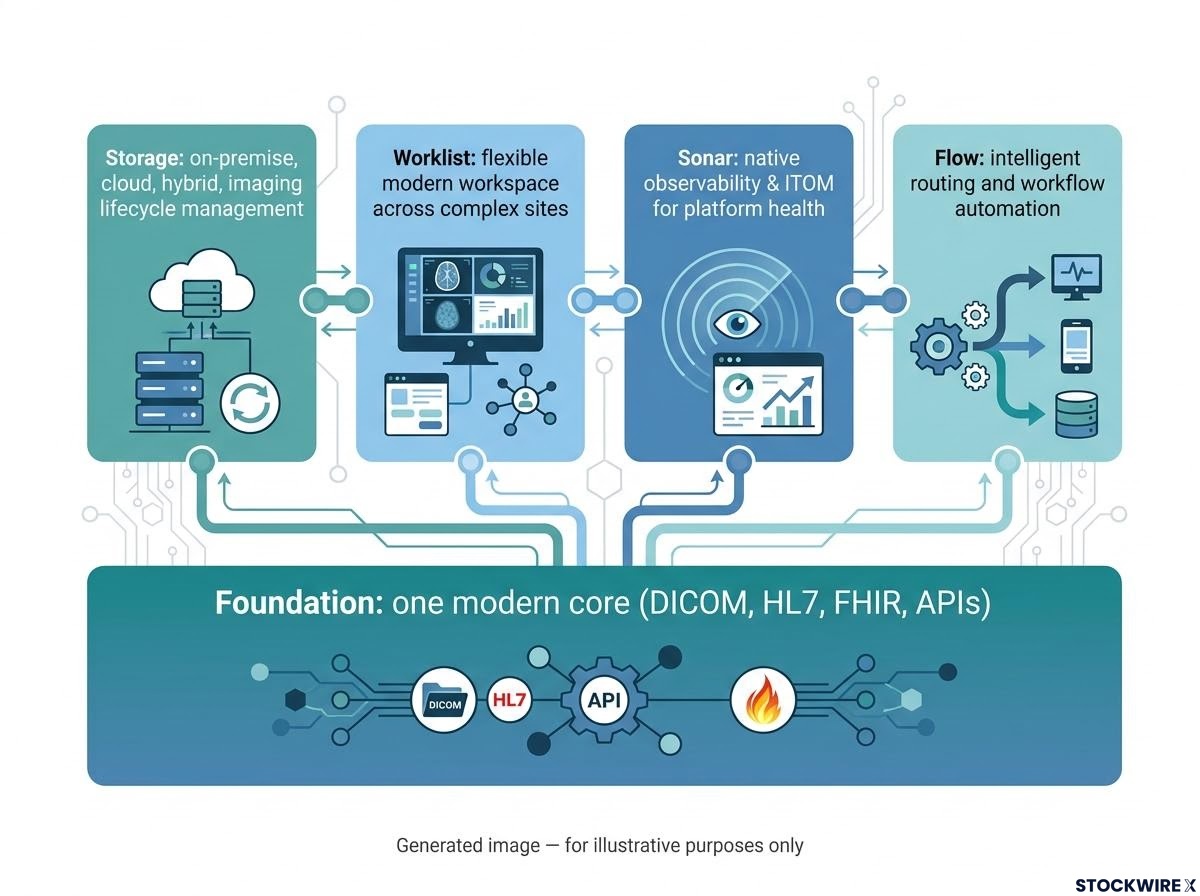
- Foundation: one modern core, included with the first module a customer buys, including DICOM, HL7, FHIR and other APIs
- Storage: on-premise, cloud and hybrid, with imaging lifecycle management
- Worklist: a flexible and modern workspace used across complex sites
- Sonar: native observability and IT Operations Management (ITOM) for the imaging platform’s health
- Flow: intelligent routing and workflow automation
The company framed customer benefits as saving money, time and risk. Customers can start with one module and add more later, and can buy orchestration without the full VNA, which is how the first new customer started last year.
Other benefits cited include one worklist across every site, Sonar replacing third-party monitoring tools customers pay for today, and Flow routing images automatically using each customer’s rules to reduce manual work.
Mach7 said the architecture was shaped with customers: worklist feedback sessions have been held, and Sonar has an early adopter and a development partner. The company said easier purchasing and deployment due to modularity reduces sales friction, and that each module a customer adds makes the next easier to buy.
The horizon: from reset to owning the imaging data layer
Management outlined four phases:
- Reset and stabilise: largely complete
- Prove the growth engine: now
- Compound and lead: next
- Own the imaging data layer: ambition
The “now” phase involves growing and winning customers with today’s products, releasing new Flamingo products to early adopters, and maintaining discipline to keep revenue growing faster than costs.
The ambition phase is the company’s stated intent rather than a result. Mach7 cited Towbin, A. (2026) in saying imaging is about 90% of healthcare data, with most of its growth outside radiology. The company said it intends to be the single organised, governed source as AI uses more of that data.
What happens next for Mach7
- Flamingo is to be shown at RSNA 2026 (Radiological Society of North America), which the company described as the industry’s largest imaging meeting, held from 29 Nov to 3 Dec.
Don’t Miss the Next Healthcare Technology Winner
Join 20,000+ investors getting FREE breaking ASX news in their inbox within minutes of release, complete with in-depth analysis. Click the “Free Alerts” button at Big News Blast to get the moment-it-breaks coverage of healthcare, tech and other non-resource sectors before the wider market catches up.